““We’re going through!” The Commander’s voice was crisp, even in the din.”
— Walter Mitty's first daydream, imagining himself as a Navy Commander.


James Thurber (1968)
Genre
Fantasy
Reading Time
30 min
Key Themes
See below
Sign in to track this book
A mild-mannered man escapes his ordinary life by imagining himself as a daring pilot, a life-saving surgeon, and a debonair assassin.
Walter Mitty drives his wife, Mrs. Mitty, to Waterbury. As she reminds him to buy puppy biscuits and overshoes, Walter drifts into a vivid daydream. He is Commander Mitty, a calm pilot of a Navy hydroplane, navigating a hurricane. His crew looks to him for leadership as the 'old man' calmly gives orders, his voice steady amidst the storm's fury and the plane's violent shaking. He expertly manages the 'eight-engined Navy hydroplane' through 'the worst storm in twenty years of flying,' showing his skill and courage, a clear contrast to his meek reality.
After Mrs. Mitty criticizes him for driving too fast and nearly hitting a car, Walter's imagination takes flight again. He is Dr. Mitty, a famous surgeon, entering a crowded operating room where specialists are confused by a complex surgical case. The patient, a millionaire banker, needs a new, innovative procedure that only Dr. Mitty, with his 'new anaesthetizer' and 'left-handed reverse-curve incision,' can perform. He commands the room, dismissing other doctors' outdated methods and preparing to execute a life-saving operation with his brilliant, unconventional technique, demonstrating his genius under pressure.
Mrs. Mitty leaves Walter to park the car and run errands, reminding him to get his overshoes. While waiting, Walter flips through a magazine and is inspired by a headline about a murder trial. He becomes Walter Mitty, a calm defendant on trial for murder. Despite the district attorney's aggressive questioning and a 'haughty, overbearing' prosecutor, Mitty remains steady. He delivers a witty, defiant retort, hinting at a secret weapon or motive, captivating the courtroom with his enigmatic charm and intelligence, proving himself innocent with a single, clever line that silences his accusers.
As Walter waits for his wife outside the hotel, he lights a cigarette. This action triggers his final, most dramatic daydream. He is Walter Mitty, standing before a firing squad, condemned to death. He refuses a blindfold and takes a final, defiant drag on his cigarette, his face 'pale and resolute.' He stands alone against his executioners, accepting his fate with stoic courage and dignity, a solitary hero facing impossible odds. This final fantasy embodies his desire for ultimate self-possession and heroic sacrifice, a powerful end to his imagined adventures.
The Protagonist
Mitty's character remains largely static in reality, but his internal world provides a rich arc of self-realization and heroic fantasy, culminating in a defiant, imagined death.
The Antagonist/Supporting
She remains a static character, serving as the primary external force that triggers Walter's escapism.
The main theme explores the clear difference between Walter Mitty's dull, controlled reality and his heroic fantasy life. His daydreams are a coping mechanism, allowing him to escape the mundane and the feeling of being henpecked by his wife. Each fantasy starts with a real-world event, like driving past a hospital or hearing a news report, but quickly becomes an elaborate scenario where Mitty is the brave, competent hero. This highlights a universal human desire to escape daily frustrations through imagination, even if only for a short time. The story suggests that while reality may be unfulfilling, the mind's power can create a rich, alternative existence.
“Walter Mitty the Undefeated, inscrutable to the last.”
The story subtly critiques the stifling nature of typical domesticity and societal expectations. Walter Mitty's real-life interactions are marked by his wife's nagging, errands, and general subservience. He is a man stripped of his individuality and control by the routines and demands of his marriage. The mundane tasks—buying puppy biscuits, remembering overshoes, driving carefully—are presented as oppressive forces that push him into his imaginative world. This theme suggests that for some, the ordinary demands of life can be so overwhelming that the only freedom lies within one's own mind.
“"We're going to allow you to take the case," said the first anaesthetist. "I've got to take a look at the hydroplane first," said Mitty.”
Walter Mitty's elaborate fantasies provide the structure and action of the story.
The entire narrative is framed by Walter Mitty's daydreams. Each fantasy sequence, triggered by a seemingly trivial real-world event (like a reminder from his wife or an observation), transports the reader into a new, exciting scenario. These daydreams serve as the primary 'plot' of the story, showcasing Mitty's inner heroism and providing the conflict and resolution he desires, even if only in his mind. The transitions between fantasy and reality are abrupt, often marked by his wife's voice or a sudden real-world interruption, emphasizing the stark contrast between his inner and outer worlds.
The sharp contrast between Mitty's heroic fantasies and his meek reality.
Thurber masterfully uses juxtaposition to highlight the comedic and tragic aspects of Walter Mitty's life. The dramatic, action-packed scenarios of his daydreams (piloting through a hurricane, performing complex surgery) are constantly contrasted with the mundane, often humiliating realities (being scolded by his wife, forgetting errands). This sharp contrast emphasizes Mitty's desire for a more exciting life and the extent of his real-world powerlessness. It creates both humor, in the absurdity of the shifts, and a sense of pathos for Mitty's unfulfilled aspirations.
““We’re going through!” The Commander’s voice was crisp, even in the din.”
— Walter Mitty's first daydream, imagining himself as a Navy Commander.
““I’m driving, aren’t I?” Walter Mitty said. “You don’t have to tell me when to stop.””
— Walter's internal frustration with his wife's constant nagging.
““I was thinking,” said Walter Mitty. “Does it ever occur to you that I am sometimes thinking?””
— Mitty attempts to assert his intellectual capacity to his wife.
““To see what’s what,” said the Commander. “You can’t go around with your eyes shut.””
— From Mitty's daydream as a Navy Commander, highlighting a need for vigilance.
““I could have licked that young cur with one hand tied behind me,” said Walter Mitty.”
— After being ridiculed by parking attendants, Mitty fantasizes about a fight.
““Things are not what they used to be,” said Walter Mitty.”
— A general lament reflecting his perception of a changing world or his own life.
““Man is a creature of habit,” said Walter Mitty.”
— Part of an internal monologue reflecting on routine and predictability.
““You’re not a young man any longer,” his wife said.”
— Mrs. Mitty's blunt reminder of his age, contrasting with his youthful fantasies.
““The Old Man’ll get us through,” said the Commander. “He always does.””
— Another quote from a daydream, showing Mitty's longing to be a capable leader.
““He was not a man to be trifled with.””
— A description of Walter Mitty from one of his daydreams, highlighting his desired persona.
““I’ve got to get some overshoes,” said Mrs. Mitty.”
— A mundane demand from Mrs. Mitty, interrupting one of Walter's thoughts.
““It’s the right thing to do,” said Walter Mitty.”
— From a daydream where Mitty is a brave figure making a moral decision.
““He looked at the distant trees and he was thinking of the life that lay before him.””
— A moment of reflection, hinting at Mitty's unfulfilled desires.
““He was thinking about the time he had almost run over a small boy.””
— A brief moment of real-world memory, contrasting with his elaborate fantasies.
Ready to see how well you understood this book? Take our interactive quiz with 10 questions.
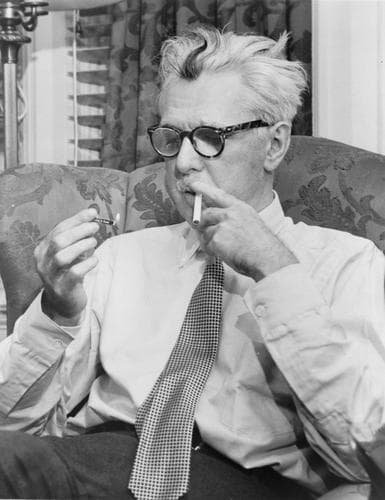
James Grover Thurber was an American cartoonist, writer, humorist, journalist and playwright. He was best known for his cartoons and short stories, published mainly in The New Yorker and collected in his numerous books.







