“Oh, that was just what a lady did when she was feeling particularly unladylike. She went out and bought a new hat.”
— Eloise reflects on purchasing a hat after a frustrating encounter.

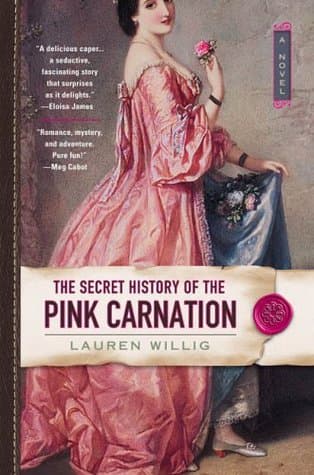
Lauren Willig (2004)
Genre
Historical Fiction / Mystery / Romance
Reading Time
8-9 hours
Key Themes
See below
Sign in to track this book
An American graduate student in Jimmy Choo boots unearths a scandalous 19th-century spy romance, discovering the true identity of England's most elusive savior, the Pink Carnation, and perhaps a hero of her own.
Eloise Kelly, an American graduate student, arrives in England to research her dissertation on the Regency-era spies the Scarlet Pimpernel and the Purple Gentian. She aims to uncover new information about these legendary figures. She is interested in the Pimpernel's network and its lesser-known operatives. During her research, Eloise finds unread letters and documents, hinting at an even more elusive spy known only as the 'Pink Carnation.' This discovery captivates her, suggesting a deeper web of espionage than historians previously understood. She reads these documents, which form the 'secret history' she hopes to unravel, believing they hold the key to identifying the Pink Carnation and understanding their role in saving England from Napoleon's invasion.
The story shifts to the early 19th century, introducing Lady Henrietta Selwick, known as Amy Balmaine, a young woman living in London. Amy, recently returned from finishing school in Paris, is secretly a sharp observer, often underestimated due to her charming, socialite facade. She frequently encounters Lord Richard Selwick, the dashing 'Purple Gentian,' a spy working against Napoleon's agents. Richard, while publicly charming, is often dismissive of Amy, viewing her as a typical society debutante. Their initial interactions are marked by witty banter, with Amy subtly trying to decipher Richard's true activities while he tries to keep her away from the dangerous world of espionage.
Amy notices suspicious activities and individuals in London's social circles, particularly a group of French émigrés she suspects are not what they seem. Her intellect and observational skills lead her to believe they are agents working for Napoleon. Despite Richard's attempts to keep her uninvolved, Amy's curiosity drives her to investigate further. She starts to gather information, often using her social events as cover. This leads to her accidentally overhearing conversations and finding clues that confirm her suspicions. Richard, annoyed by her meddling, slowly recognizes her intelligence and resourcefulness, realizing she might not be as helpless as he first assumed.
Facing danger from French agents, Richard realizes he needs a more effective cover for his espionage activities, particularly for gaining access to social gatherings and information. He plans to propose marriage to Amy, believing her reputation as a flighty socialite will provide the perfect distraction. Amy, surprised by the pragmatic nature of his proposal, agrees, intrigued by the possibility of being closer to the action. Their engagement provides them with a plausible reason to be seen together frequently and to attend events where they can gather intelligence without arousing suspicion from their enemies.
As their 'engagement' progresses, Amy and Richard work more closely to identify a high-ranking French spy, the 'Black Tulip,' operating within English aristocratic circles. Their investigation involves attending balls, deciphering coded messages, and navigating social dynamics. Amy's wit and ability to blend into society prove valuable in gathering gossip and clues, while Richard's experience in espionage provides strategic direction. They develop a reluctant respect for each other's abilities, though their personal feelings remain complicated, masked by their professional partnership and the pretense of their engagement. The stakes rise as they realize the Black Tulip's plan could compromise English defenses.
Through Amy's observations and Richard's strategic planning, they narrow down the suspects for the Black Tulip. The unmasking occurs during a tense social event, where they set a trap for the spy. The reveal is shocking, as the Black Tulip is a trusted member of society. This betrayal highlights the pervasive nature of French espionage and the difficulty of discerning friend from foe. The successful exposure of the Black Tulip is a victory, preventing a major intelligence leak and safeguarding critical information about English military movements. This event solidifies Amy's reputation within the spy network, proving her capabilities.
Following the success with the Black Tulip, Amy is recognized for her intelligence and courage, and she adopts the codename 'The Pink Carnation.' Her first solo mission involves infiltrating a network of French sympathizers in a provincial town, where she must gather intelligence about a planned invasion route. This mission tests her resourcefulness and independence, forcing her to rely on her own wits. She navigates dangerous encounters, uses her charm to extract information, and proves her capability as a standalone agent. This mission marks a moment in her development as a spy, establishing her as a formidable member of the English intelligence network, separate from the Purple Gentian.
As Amy, the Pink Carnation, gains confidence and proves her abilities, Richard finds himself increasingly torn. While proud of her successes, he struggles with jealousy and protectiveness. He realizes his feelings for her have deepened beyond convenience or professional respect. He watches her navigate dangerous situations with growing admiration and fear. His initial dismissal of her has transformed into respect and, undeniably, love. He grapples with the implications of loving a woman who is now deeply involved in the perilous world of espionage, a world he had tried to shield her from.
The climax of the historical narrative revolves around the Pink Carnation's role in thwarting Napoleon's invasion plans. Amy, using her skills and network of informants, discovers a piece of intelligence regarding a hidden French naval fleet and a planned diversionary tactic. She races against time to relay this information to the English command, often putting herself in danger. Her quick thinking and bravery directly lead to the English forces being able to preempt the French strategy, effectively saving England from invasion. This mission solidifies her legacy as one of England's most effective heroes.
Back in the present, Eloise, having read the historical documents, finally identifies the Pink Carnation: Amy Balmaine. This revelation is an academic breakthrough, rewriting a significant chapter of espionage history. Simultaneously, Eloise is drawn to Colin Selwick, the archivist who has been assisting her. Their shared passion for history and the unfolding romance of Amy and Richard's story bring them closer. As Eloise's academic quest concludes, she realizes she has found her own unexpected hero and a love story that mirrors the historical romance she uncovered, bridging the gap between past and present.
The Protagonist
Eloise evolves from a cynical academic focused solely on the past to someone who finds a contemporary romance that mirrors the historical love story she uncovers.
The Historical Protagonist
Amy transforms from an underestimated society girl into the legendary Pink Carnation, earning respect and finding love in the process.
The Historical Protagonist/Love Interest
Richard learns to trust and respect Amy, ultimately realizing his love for her and accepting her as an equal partner in both life and espionage.
The Supporting Character/Love Interest
Colin develops a romantic relationship with Eloise, proving to her that modern heroes exist.
The Supporting/Mentioned
Remains a consistent, guiding force in the background, a symbol of unwavering resistance.
The Antagonist
The Black Tulip's arc culminates in their exposure and downfall at the hands of Amy and Richard.
The Mentioned
Remains a constant, external threat, symbolizing the larger conflict.
The novel explores what makes a hero, contrasting the traditional dashing male spy with the unexpected heroism of a woman often dismissed as frivolous. Amy's transformation into the Pink Carnation shows that heroism is not just physical prowess, but intelligence, wit, and courage, often hidden. Eloise's initial cynicism about modern heroes is challenged by her own romantic entanglement, suggesting heroism can be found in unexpected places. The historical narrative shows Amy's subtle yet impactful contributions to saving England, highlighting that heroism is not always recognized publicly.
“"Perhaps the greatest heroes were the ones no one ever knew about."”
This theme is central to both the historical and modern narratives. Amy Balmaine uses her facade as a flighty debutante to mask her intelligence and espionage activities. Her 'trivial' pursuits like gossip become tools for gathering intelligence. Similarly, Richard, as the Purple Gentian, maintains a public persona of a charming nobleman to deflect suspicion from his dangerous work. In the modern storyline, Eloise initially judges Colin based on first impressions, only to discover his depth and connection to the historical narrative. The 'secret history' itself shows how public perception can differ from the truth.
“"No one ever looks for a spy in a pink gown, do they?"”
The novel weaves the conflict between personal desires and patriotic duty. Richard and Amy's relationship begins as a strategic alliance for espionage. However, their professional partnership grows into genuine affection, forcing them to reconcile their dangerous work with their feelings. They must constantly weigh the risks their love poses to their missions and to each other. Eloise's modern romance with Colin parallels this, showing how love can intertwine with one's professional passions, making her question her initial belief that love and academic pursuits were separate.
“"He had sought a wife for cover, but found a partner for his heart."”
The novel is based on the idea that historical events and figures can be overlooked by official records. Eloise's dissertation quest leads her to a 'secret history' that reveals the true identity and importance of the Pink Carnation, a spy absent from mainstream accounts. This theme highlights the limitations of official narratives and the potential for new discoveries to alter our understanding of the past. It champions the role of researchers in bringing hidden truths to light, emphasizing that history is often richer and more complex than initially perceived, especially regarding the contributions of individuals, like women, who might have been omitted.
“"History, she realized, was less about what was written down and more about what was hidden between the lines."”
The modern-day research of Eloise Kelly frames the historical narrative of the Pink Carnation.
The novel employs a framing device where Eloise Kelly's contemporary research into the Pink Carnation serves as the outer story, while the historical account of Amy Balmaine (the Pink Carnation) and Lord Richard Selwick (the Purple Gentian) forms the inner story. Eloise's discoveries and interpretations of the historical documents drive the reader through the past events. This device allows for a dual narrative, juxtaposing modern academic investigation with Regency-era espionage and romance, creating suspense as Eloise uncovers the truth, and providing context for the historical events through a modern lens.
Characters use false appearances and hidden identities to achieve their goals.
Misdirection and disguise are crucial plot devices, particularly in the historical narrative. Amy Balmaine's entire persona as a flighty debutante is a carefully constructed disguise to allow her to operate as a spy without suspicion. Richard, the Purple Gentian, also employs various disguises and maintains a public facade to deflect attention from his dangerous activities. This device generates tension and intrigue, as characters must constantly discern friend from foe, and readers are kept guessing about the true intentions and identities of individuals. It reinforces the theme of appearance vs. reality, demonstrating how calculated deception is vital in the world of espionage.
Historical letters and documents serve as the primary source for Eloise's research and the unfolding of the past.
The narrative hinges on Eloise's discovery and interpretation of a collection of old letters, diaries, and other documents. These artifacts are not just props; they are the literal 'secret history' that Eloise reads and analyzes, which in turn becomes the historical story presented to the reader. These documents serve as a means of revealing past events, character motivations, and plot twists. Their fragmented nature and the need for careful interpretation add an element of mystery and academic puzzle-solving to Eloise's journey, directly connecting the past to the present.
The initial historical accounts are incomplete or misleading, requiring Eloise to uncover the 'true' story.
While not a traditional unreliable narrator in terms of a character's direct voice, the plot device of the 'unreliable historical record' is central. The established history of the Scarlet Pimpernel and Purple Gentian is presented as incomplete, omitting the crucial role of the Pink Carnation. Eloise's quest is precisely to correct this 'unreliable' or incomplete historical narrative. This device creates the central mystery and driving force of the plot, as the reader, along with Eloise, strives to piece together the full and accurate version of events, challenging commonly accepted truths and highlighting the biases inherent in historical documentation.
“Oh, that was just what a lady did when she was feeling particularly unladylike. She went out and bought a new hat.”
— Eloise reflects on purchasing a hat after a frustrating encounter.
“The thing about secrets, she had learned, was that they were like tiny, invisible threads. They might seem harmless alone, but woven together, they could form a very strong net indeed.”
— Eloise ponders the nature of secrets and their interconnectedness.
“He was a duke, of course. They were all dukes, or earls, or marquesses. It was a veritable dictionary of the peerage.”
— Eloise observes the aristocratic company she finds herself in.
“Perhaps all heroes were a little mad. Or perhaps all madmen were a little heroic.”
— Eloise considers the unconventional nature of the historical figures she studies.
“There was a fine line between bravery and foolhardiness, and Miss Gwen seemed to be straddling it with remarkable agility.”
— Eloise describes Miss Gwen's adventurous spirit.
“One could not simply *decide* to be a spy. One had to be born to it, or marry into it, or perhaps stumble into it quite by accident.”
— Eloise contemplates the accidental nature of some historical spies.
“History, she had discovered, was rarely neat. It was a messy, sprawling thing, full of contradictions and unanswered questions.”
— Eloise reflects on the complexities of historical research.
“A gentleman never truly knew a lady until he had seen her in a state of advanced dishevelment.”
— A humorous observation about understanding someone's true self.
“The greatest weapon in a woman's arsenal was not her beauty, but her wit.”
— Eloise considers the strengths of historical female spies.
“Sometimes, the most shocking revelations lay hidden in plain sight, disguised as the utterly mundane.”
— Eloise makes a discovery during her research.
“It wasn't about being fearless. It was about doing what needed to be done, even when you were terrified.”
— A character defines true courage.
“Love, like espionage, often required a certain amount of deception.”
— Eloise draws a parallel between romance and spycraft.
“There was a certain exhilaration in uncovering a truth that had been buried for two hundred years.”
— Eloise experiences the thrill of historical discovery.
Ready to see how well you understood this book? Take our interactive quiz with 10 questions.

Biography coming soon.







