“Scent is the most powerful of all our senses. It can transport you instantly across great distances and years, and even, I believe, across the boundaries of life and death.”
— Emmeline's father explains the profound nature of scent to her.

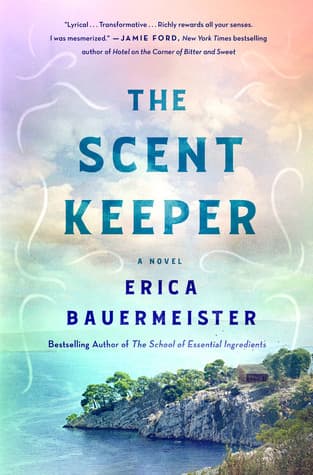
Erica Bauermeister (2019)
Genre
Fantasy / Historical Fiction
Reading Time
600 min
Key Themes
See below
Sign in to track this book
On a secluded island, a young woman raised on the magic of scent must unravel her father's fragrant secrets and her own identity when she's thrust into a world more complex and dangerous than she imagined.
Emmeline lives an isolated, idyllic childhood on a remote island off the coast of Maine with her father, who teaches her to interpret the world through her senses, especially scent. He assigns names like 'Fear' or 'Joy' to various natural smells. Their cabin is lined with drawers, each containing a stoppered bottle of a unique, strong scent that her father meticulously creates using a complex machine. He tells her these are 'stories' and warns her never to open them. Emmeline's father teaches her to read and write, but their world is limited to the island. She often wonders about her mother, whom her father vaguely describes as 'gone' and associated with a particular, heartbreaking scent. This mystery fuels her early curiosity.
A woman named Rose arrives on the island, a rare visitor who seems to know Emmeline's father. Rose's presence disrupts Emmeline's routine, and she senses a change in her father's demeanor. One day, Emmeline opens one of the forbidden scent bottles. The scent is overwhelmingly powerful, evoking a flood of unfamiliar emotions and images—a bustling city, a feeling of being lost. This act of disobedience fills her with both wonder and fear, confirming that the scents hold unsettling secrets about the world beyond her island home and her own hidden past. She quickly re-seals the bottle, fearing her father's reaction.
Emmeline's father falls gravely ill. In his final days, he reveals that Emmeline is not his biological daughter. He explains that he rescued her from a dangerous situation when she was a baby and brought her to the island to protect her. He entrusts her with a small wooden box containing a few personal items and a cryptic message about her true identity. After his death, Rose returns to the island and takes Emmeline to the mainland. This abrupt departure from her isolated home ends her childhood innocence and begins her journey into the unknown 'real world' her father had shielded her from.
Rose takes Emmeline to live with her in a small town, where Rose owns a struggling perfumery. Emmeline struggles to adapt to this new, busy environment after her solitary upbringing. Rose, a skilled perfumer, begins to teach Emmeline the technical aspects of scent creation, blending, and the commercial business of fragrances. Emmeline discovers she has an innate talent for identifying and combining scents, a gift honed by her father's unique teachings. However, Rose's motivations are complex; she sees Emmeline's talent as a way to save her failing business, subtly using Emmeline's abilities while withholding truths about her past.
As Emmeline works in the perfumery, she encounters various scents that trigger flashes of memory or strong, unidentifiable emotions. She realizes that the 'stories' her father created were not just abstract concepts but actual scent markers from her past. Using the few clues her father left her, along with her heightened sense of smell, Emmeline starts a quiet investigation into her origins. She learns about a perfumer named Jean-Pierre, a rival of her father's, and suspects a connection to her birth. Her quest becomes a subtle game of discovery, piecing together fragments of a life she can't remember but can smell.
Through diligent research and following scent trails, Emmeline discovers that her biological mother was a perfumer named Marguerite, and her father was a renowned, ambitious perfumer, Jean-Pierre. She learns that her father, the man who raised her, was Marguerite's brother, and he took Emmeline to protect her after a tragic incident. Her biological parents were rivals in the world of high-end perfumery, and their relationship was tumultuous, marked by both passion and professional jealousy. The 'stories' in the drawers on the island were scents Marguerite had created, preserved by Emmeline's uncle.
Emmeline confronts Rose, asking why she withheld information about her past. Rose confesses that she knew Emmeline's biological parents and her uncle. She admits she saw an opportunity to use Emmeline's talent for scent to revive her own failing perfumery, hoping to capitalize on Emmeline's genetic legacy. Rose's confession reveals a web of past relationships, rivalries, and unfulfilled ambitions that shaped Emmeline's early life. Feeling betrayed and used, Emmeline decides she must leave Rose and forge her own path, seeking to understand her heritage on her own terms.
Emmeline travels to Paris, the center of the perfumery world and the city where her biological parents had their careers. She seeks out places associated with Marguerite, learning more about her mother's innovative spirit and unique approach to fragrance creation. Emmeline discovers that Marguerite was not just a competitor but an artist who saw scent as a form of storytelling, much like Emmeline's uncle taught her. She finds remnants of her mother's work and begins to understand the connection she shares with Marguerite through their shared gift and philosophy of scent.
Emmeline eventually meets Jean-Pierre, her biological father, who is now an aging, somewhat bitter perfumer. He is initially distant but slowly opens up, revealing his version of events surrounding Marguerite's death and Emmeline's infancy. He explains the intense professional rivalry and personal drama that led to a tragic accident, which her uncle interpreted as a need to protect Emmeline from the volatile environment. Jean-Pierre expresses regret and a sense of loss for the family he never knew. This meeting gives Emmeline a more complete, albeit painful, picture of her origins, allowing her to reconcile with her complex heritage.
With a fuller understanding of her past, Emmeline resolves to honor both her uncle's protective love and her biological parents' creative legacy. She decides to use her talent not for commercial gain in the way Rose envisioned, but to create scents that tell true stories, like her uncle's 'stories' and her mother's artistic vision. She finds a balance between the natural world of her childhood and the art of perfumery. Emmeline ultimately establishes her own perfumery, creating fragrances that evoke emotions and memories, finally finding her true place in the world, rooted in her past but looking towards her own future.
The Protagonist
Emmeline transforms from an innocent, isolated girl into a self-aware woman who reconciles her past and forges her own path in the world of scent.
The Supporting
From a protective, reclusive guardian, he ultimately sacrifices his life to preserve Emmeline's innocence, leaving her clues for her future.
The Supporting
Initially a seemingly benevolent guardian, Rose's true, self-serving motivations are exposed, leading to a betrayal of Emmeline's trust.
The Mentioned
Her life story, pieced together by Emmeline, reveals a tragic genius whose artistic legacy lives on through her daughter.
The Supporting
From an ambitious, embittered man, he slowly finds a measure of redemption and peace through connecting with his estranged daughter.
The Mentioned
Provides a brief, supportive presence in Emmeline's life, representing connection outside of her family's legacy.
The novel explores Emmeline's quest to understand who she is, both in terms of her origins and her unique talents. Her journey from an isolated childhood to uncovering her biological heritage in the world of perfumery is central to the narrative. The 'scent stories' her father creates become literal clues to her past, forcing her to confront the complex legacies of both her adoptive and biological families to forge her own identity. This theme is in her pursuit of truth, even when it means confronting painful revelations about betrayal and tragedy.
“Every scent was a story, he'd told her. And she was finally ready to read her own.”
Scent is not merely a sensory detail but a narrative device and thematic core of the book. It is a direct link to memory, emotion, and truth. Emmeline's ability to interpret scents allows her to access forgotten memories, understand complex relationships, piece together her fragmented past. The 'scent stories' her father creates are literal encapsulations of moments and emotions, showing how powerfully scent can evoke the past and shape perception. This theme highlights how our olfactory sense can be a gateway to our deepest selves and hidden histories.
“Scent was the language of memory, of emotion. It was the whisper of what had been, and what could be.”
The book explores various forms of familial love—the protective, secretive love of Emmeline's adoptive father; the complex, ambitious love between her biological parents; and the manipulative 'love' of Rose. It looks at the sacrifices made for family, the secrets kept, and the betrayals that can arise from ambition and fear. Emmeline's understanding of love evolves as she learns about the motivations behind her uncle's protection and Rose's exploitation, ultimately leading her to define what true, unconditional love means for her. The narrative shows how love, in its many forms, can both nurture and complicate lives.
“Love, like scent, could be a comfort, a warning, or a poison.”
Emmeline's upbringing on a remote, natural island with her father's teachings about the elemental scents of the earth contrasts with the commercial, artificial world of perfumery in cities. This theme explores the tension between an intuitive, sensory understanding of the world and a more structured, profit-driven approach. Emmeline must reconcile these two worlds, integrating her connection to natural scents with the art of synthetic fragrance creation. Her ultimate goal is to bridge these two realms, creating authentic 'scent stories' that honor both her wild origins and her artistic heritage.
“The island had taught her the language of earth and sky. The city was teaching her the language of ambition and artifice.”
Bottled fragrances that encapsulate memories, emotions, and hidden truths.
The 'scent stories' are a central plot device. These are unique, potent fragrances created by Emmeline's adoptive father and later discovered to be creations of her biological mother. Each bottle holds a specific, powerful emotion or memory, acting as a direct link to Emmeline's past and the mysteries surrounding her birth. They function as both symbolic representations of her fragmented heritage and literal clues, guiding her investigation into her identity. Their forbidden nature in her childhood adds to their allure and significance, driving her initial curiosity and later her quest for truth.
The extensive use of scent descriptions to drive narrative and character understanding.
The novel heavily relies on rich, evocative sensory descriptions, particularly focusing on the sense of smell. Bauermeister uses olfactory imagery not just to set the scene but to reveal character emotions, foreshadow events, and advance the plot. Emmeline's heightened sense of smell allows her to perceive the world in a unique way, making scent a narrative lens. This device immerses the reader in Emmeline's perspective and emphasizes the central theme of scent as a language of memory and emotion, making the abstract concrete through detailed aroma descriptions.
An isolated environment that fosters innocence and mystery, then contrasts with the 'real world'.
The remote island serves as both a literal and metaphorical setting. It represents Emmeline's sheltered, innocent childhood, protected from the complexities and dangers of the 'real world.' Its isolation allows for her unique sensory education and the preservation of her father's secrets. When Emmeline leaves the island, the stark contrast with the bustling mainland and the sophisticated world of perfumery highlights her transition from innocence to experience. The island remains a symbol of her origins and the pure, unadulterated connection to scent that defines her.
A physical object containing cryptic clues about Emmeline's true parentage.
The small wooden box entrusted to Emmeline by her dying adoptive father is a classic plot device for revealing hidden information. It contains a few personal items and cryptic notes that serve as the initial tangible clues to her true identity. This box acts as a catalyst for Emmeline's journey, providing her with the starting points for her investigation into her biological parents. It symbolizes the legacy of her past and the secrets she must unravel, a physical manifestation of the mystery surrounding her birth.
“Scent is the most powerful of all our senses. It can transport you instantly across great distances and years, and even, I believe, across the boundaries of life and death.”
— Emmeline's father explains the profound nature of scent to her.
“The world was a symphony of scents, and most people, I realized, were deaf.”
— Emmeline reflects on her unique ability to perceive scents compared to others.
“Every scent has a story, a history, a memory tied to it. You just have to learn how to listen.”
— Her father teaches Emmeline how to interpret the deeper meanings of scents.
“To truly know a person, you must know their scent. It is the truest part of them, the part they cannot hide.”
— Emmeline's father emphasizes the revealing nature of a person's unique scent.
“Sometimes the most beautiful things are the ones that are hardest to hold onto.”
— A reflection on the fleeting nature of certain scents and experiences.
“The world outside the island was a cacophony of smells, overwhelming and confusing, yet also exhilarating.”
— Emmeline's first experience of the mainland after growing up in isolation.
“Love, I learned, had its own scent. It was subtle, changing, but always there, a constant undertone.”
— Emmeline's evolving understanding of human emotions through scent.
“We are all scent keepers, in our own way, collecting the invisible threads of our lives.”
— A broader philosophical reflection on how everyone unconsciously preserves memories and experiences.
“The past is never truly gone; it just lingers in the air, waiting for the right breeze to stir it.”
— Emmeline's perspective on how past events continue to influence the present.
“To forget a scent is to forget a part of yourself, a piece of your own story.”
— Highlighting the integral role of scent in personal identity and memory.
“There are some things that even scent cannot explain, only hint at, like the deepest secrets of the human heart.”
— Emmeline acknowledges the limits of even her extraordinary sensory abilities.
“Fear had a sharp, metallic edge, like a forgotten coin left in the rain.”
— Emmeline describes the distinct scent of fear.
“The stories we tell ourselves about scents are just as important as the scents themselves.”
— A reflection on the interplay between sensory input and personal narrative.
“Every person carries a library of scents within them, a silent history waiting to be read.”
— Emmeline's understanding of the rich, unspoken information contained in each individual's scent.
Ready to see how well you understood this book? Take our interactive quiz with 10 questions.







