“I am a Scarecrow! I have a brain, and I can think! And if I can think, I can do anything!”
— Scarecrow's declaration of self-awareness and potential.

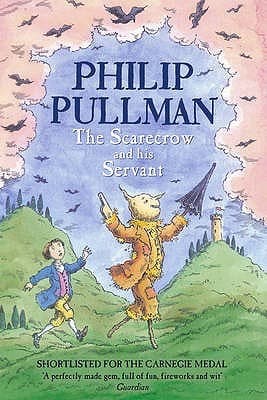
Philip Pullman (2004)
Genre
Fantasy / Children's / Young Adult
Reading Time
150 min
Key Themes
See below
Sign in to track this book
Struck by lightning, a chivalrous but dim-witted scarecrow embarks on a whimsical journey to Spring Valley with his resourceful young servant, encountering shipwrecks, brigands, and endless misadventures that only his quick-thinking companion can resolve.
One stormy night, a scarecrow in a farmer's field is struck by lightning. This brings him to life, giving him consciousness and a pompous, optimistic personality. Believing himself a noble general and the heir to Spring Valley, he immediately sets out. He soon meets Jack, a young, resourceful boy, who is initially drawn to the scarecrow out of curiosity and pity. The scarecrow, in his new grandiosity, 'hires' Jack as his servant, promising him riches and adventure, though Jack quickly realizes he will do most of the work.
Their journey is quickly interrupted when the Scarecrow and Jack are ambushed and captured by a band of brigands led by the cunning but foolish Mrs. Gamp. The brigands are amused by the Scarecrow's peculiar nature and his grand declarations, while Jack assesses their situation. The Scarecrow, oblivious to the true danger, treats his captivity as a minor inconvenience, believing his nobility will prevail. Jack, however, understands the need for an escape plan, showing his early resourcefulness.
While the Scarecrow talks about his impending rescue, Jack secretly watches the brigands and plans an escape. He uses his sharp wit and practical skills, exploiting the brigands' greed and simple-mindedness. He creates a distraction, perhaps by feigning illness or leading them on a wild goose chase for imagined treasure, allowing him and the Scarecrow to slip away. This incident shows Jack as the brains of their duo, constantly helping the naive Scarecrow out of trouble, a pattern that repeats throughout their journey.
Continuing their journey, the Scarecrow and Jack find themselves on a rickety boat, trying to travel down a river. True to form, the Scarecrow's poor judgment or bad luck leads to a shipwreck. They are cast into the turbulent waters, and Jack must again navigate the immediate danger. He ensures his own survival and rescues the waterlogged, confused Scarecrow, who, despite the ordeal, maintains his optimistic and detached demeanor, convinced these 'adventures' are tests of his noble spirit on the path to Spring Valley. This event highlights the physical dangers and Jack's constant vigilance.
After the shipwreck, the two travelers stumble upon a grand estate where a seemingly benevolent but self-serving rich man offers them hospitality. The Scarecrow, with his trust in others, is easily charmed by the man's generosity. Jack, however, remains wary, sensing an ulterior motive. He observes the rich man's actions and words carefully, understanding that their situation is likely a trap or that they are being used. This encounter tests their judgment and Jack's ability to discern true intentions.
Jack's suspicions prove correct as he uncovers the rich man's plan to exploit the Scarecrow, possibly for his unique nature, his perceived 'fortune' in Spring Valley, or simply for amusement. The rich man might try to separate them, or manipulate the Scarecrow into signing away rights. Jack, using his observational skills and quick thinking, exposes the deception, perhaps by overhearing a conversation or finding evidence. He then devises a strategy to escape the rich man's clutches, protecting the naive Scarecrow and showing his growing confidence and resourcefulness.
Their journey takes them through a dense, eerie forest, a place with shadows, strange noises, and potential dangers. The Scarecrow finds a poetic beauty in the forest, often lost in his thoughts, while Jack focuses on survival and navigation. They might encounter wild animals, get lost, or face other natural challenges. This section emphasizes the isolation and arduous nature of their quest, highlighting the contrast between the Scarecrow's idealism and Jack's realism.
Deep in the forest, or perhaps near its edge, they stumble upon a community of other scarecrows, perhaps animated in a similar way, or figures the Scarecrow sees as his 'family.' This encounter offers a moment of reflection on the Scarecrow's unique existence and his connection to inanimate objects brought to life. He might feel a sense of belonging, or a renewed understanding of his purpose. Jack observes these other scarecrows, trying to understand the implications of their existence and what it means for his future with the Scarecrow.
After many trials, the Scarecrow and Jack finally arrive at the borders of Spring Valley. The Scarecrow is filled with anticipation and a sense of destiny fulfilled, believing his inheritance awaits. However, they discover that Spring Valley is not merely a place, but perhaps a guarded secret, or ruled by someone who challenges the Scarecrow's claim. A final obstacle, perhaps a gatekeeper, a rival, or a misunderstanding about his inheritance, stands between the Scarecrow and his perceived destiny. This sets up the climax of their long journey.
Upon entering Spring Valley, the Scarecrow's grand illusions meet reality. Spring Valley is not a kingdom or a treasure trove as he imagined. Instead, his 'inheritance' might be symbolic, a responsibility, or a humble truth that challenges his pompous self-image. Jack, always practical, helps the Scarecrow come to terms with this revelation, guiding him through the disappointment and helping him understand the true value of their journey and companionship, rather than the material wealth the Scarecrow had envisioned. This marks a turning point for the Scarecrow's character.
Despite the initial disillusionment, the Scarecrow, with Jack's quiet guidance, finds a new and unexpected purpose in Spring Valley. Perhaps he becomes a protector, a storyteller, or a symbol of hope for the community. His good nature, though often misguided, finds a genuine outlet. He might use his unique perspective or his 'general' skills in a way that truly benefits others. This resolution offers fulfillment for the Scarecrow, moving beyond his initial, naive quest for material inheritance towards something more meaningful and contributing, thanks to Jack's influence.
With the Scarecrow settled in his new role, Jack, the loyal servant, reflects on his own future. He has grown significantly throughout their adventures, showing courage, intelligence, and loyalty. He might be offered a place in Spring Valley, or he might choose to embark on his own path, armed with the wisdom and experience gained from his time with the Scarecrow. The ending suggests that while their adventure is over, their bond remains strong, and Jack's future is open with possibilities, having forged his own identity beyond simply being the Scarecrow's servant.
The Protagonist
He begins as a deluded figure seeking a material inheritance and evolves to find a more meaningful, service-oriented purpose.
The Protagonist / Supporting
Jack grows from a curious boy into a confident, indispensable leader, finding his own identity and purpose.
The Antagonist
She remains largely static, representing a recurring type of external threat.
The Antagonist
He is a static character, embodying the theme of hidden dangers and false appearances.
The Mentioned
N/A
The book explores the dynamic between the Scarecrow, who believes himself a leader, and Jack, who is officially his servant but acts as the real leader. The Scarecrow's pompous declarations and lack of practical skills contrast with Jack's ingenuity and problem-solving. This dynamic shows that true leadership comes from capability, wisdom, and selfless action, not from title or self-proclaimed authority. Scenes like Jack outwitting the brigands or navigating the shipwreck exemplify how Jack consistently takes charge despite his 'servant' status.
“''I am a general, you know, and a man of great importance. You shall be my faithful servant!' said the Scarecrow, puffing out his chest, while Jack quietly considered how they would escape.”
This theme is central to the Scarecrow's character and the challenges they face. The Scarecrow's grand self-image and belief in his noble heritage contrast with his actual vulnerability and dependence. Similarly, characters like the Rich Man appear benevolent but have deceptive intentions. Spring Valley itself represents a final confrontation with this theme, as its reality likely differs from the Scarecrow's idealized vision. Jack's ability to discern true intentions and practical solutions, rather than being swayed by appearances, is crucial to their survival.
“'He looks like a grand gentleman, but his eyes are too close together,' Jack whispered to himself, watching the rich man carefully.”
Jack embodies this theme, consistently showing his ability to think quickly and use what is at hand to overcome obstacles. Whether escaping brigands, surviving a shipwreck, or seeing through deception, Jack's practical intelligence drives their progress. The Scarecrow, by contrast, lacks this quality, making Jack's resourcefulness even more prominent. The book celebrates the power of wit and practical skills over brute force or naive optimism, showing how a young boy can outsmart more powerful adversaries through cleverness.
“''We're in a fix, but a fix is just a puzzle waiting for a solution,' Jack muttered, already scanning their surroundings for an escape route.”
While the Scarecrow's initial quest is for an external inheritance, the true journey for both characters is one of self-discovery. The Scarecrow, through his trials and interactions with Jack, gradually moves from deluded self-importance to a more grounded understanding of his nature and capabilities, eventually finding a meaningful purpose beyond his initial aspirations. Jack, too, discovers his own strength, courage, and leadership potential through the responsibility of caring for the Scarecrow. Their adventures shape who they become, proving that the journey itself is more valuable than the destination.
“'Perhaps Spring Valley isn't a place, but a feeling you carry inside, General,' Jack mused, looking at the contented Scarecrow.”
The object of the Scarecrow's quest, driving the plot forward.
Spring Valley serves as the primary MacGuffin in the story. It is the destination the Scarecrow believes is his rightful inheritance, and his desire to reach it propels the entire narrative. Its true nature is less important than its function in motivating the characters and providing a goal around which the various adventures and obstacles can be structured. The ultimate revelation about Spring Valley likely subverts the Scarecrow's expectations, highlighting that the journey itself was more significant than the literal destination.
The Scarecrow's inherent innocence and lack of understanding.
The Scarecrow's naivety is a central plot device. It constantly places him and Jack in precarious situations, requiring Jack's intervention. His inability to perceive danger, his blind trust, and his inflated self-importance create both comedic moments and serious threats. This device allows for the exploration of themes like appearance vs. reality and highlights Jack's resourcefulness. Without the Scarecrow's naivety, many of the plot's conflicts would not arise, making him an essential catalyst for the story's events.
Jack's intelligence and practicality in overcoming challenges.
Jack functions as the resourceful sidekick, an indispensable plot device. His intelligence, quick thinking, and practical skills are the primary means by which the duo overcomes every obstacle. He is the problem-solver, the protector, and the voice of reason. This device not only provides solutions to the plot's conflicts but also allows for the Scarecrow's naivety to be fully explored without the story becoming too bleak. Jack's actions drive the plot forward through active problem-solving rather than passive reaction.
The Scarecrow's absurd pronouncements and situations.
The Scarecrow himself, particularly his grandiloquent speeches and his detached reactions to perilous situations, serves as a significant source of comic relief. His 'pea-brained' nature and his unwavering belief in his own importance, despite overwhelming evidence to the contrary, lighten the tone of potentially dangerous encounters. This device helps to make the story accessible and enjoyable for younger audiences, balancing moments of tension with humor and highlighting the absurdity of the Scarecrow's character.
“I am a Scarecrow! I have a brain, and I can think! And if I can think, I can do anything!”
— Scarecrow's declaration of self-awareness and potential.
“The wind blows, and the world turns, and the sun shines, and the rain falls. And that is all there is to it.”
— Scarecrow's simple, almost philosophical, view of the natural world.
“Every journey has a thousand steps, and the first is always the hardest.”
— Scarecrow's reflection on the beginning of any significant undertaking.
“A servant is not a slave. A servant is a companion, a helper, a friend.”
— Jack's understanding of his role and relationship with the Scarecrow.
“It's not what you are made of, but what you make of yourself.”
— A theme often reinforced through the Scarecrow's development.
“Sometimes the most important things are the ones you can't see.”
— Referring to abstract concepts like courage, love, or thought.
“The world is full of things to learn, if only you keep your eyes and ears open.”
— Scarecrow's constant curiosity and openness to new experiences.
“Even a small light can show the way in the darkest night.”
— A metaphor for hope or guidance in difficult times.
“To be truly free, you must first know who you are.”
— Scarecrow's journey of self-discovery leading to his ultimate freedom.
“There are many kinds of riches, and not all of them are gold.”
— A lesson learned about the value of experiences, friendship, and knowledge.
“A true leader knows when to listen to his servant.”
— Scarecrow's evolving understanding of leadership and collaboration.
“The greatest adventures often begin with the most ordinary steps.”
— Reflecting on how their epic journey started from a simple field.
“It is better to be a thinking Scarecrow than a thoughtless King.”
— A clear statement about the superiority of intellect and character over mere title.
“The world is not always what it seems, and people are not always who they appear to be.”
— Lessons learned through various encounters and deceptions on their journey.
Ready to see how well you understood this book? Take our interactive quiz with 10 questions.

Sir Philip Nicholas Outram Pullman is an English writer. His books include the fantasy trilogy His Dark Materials and The Good Man Jesus and the Scoundrel Christ, a fictionalised biography of Jesus. In 2008, The Times named Pullman one of the "50 greatest British writers since 1945". In a 2004 BBC poll, he was named the eleventh most influential person in British culture. He was knighted in the 2019 New Year Honours for services to literature.







