““I'm afraid Prickwillow Place is going to be the death of me,””
— Mrs. Plume, the headmistress, often expressed her exasperation with the girls and the house.

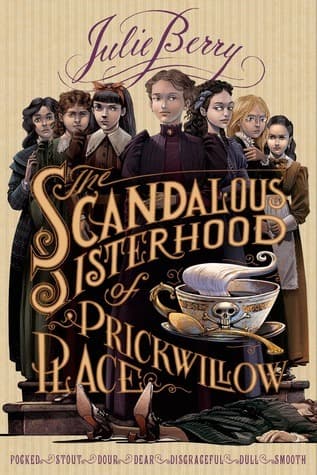
Julie Berry (2014)
Genre
Children's / Historical Fiction / Mystery / Young Adult
Reading Time
240 min
Key Themes
See below
Sign in to track this book
Seven Victorian schoolgirls, fearing their academy's closure after their headmistress and her brother are poisoned, conspire to hide the murders amidst a farcical web of mistaken identities and outrageous antics.
On a quiet Sunday evening at St. Etheldreda's School for Girls, the seven students—Disgrace, Smudge, Pippi, Dandy, Dearlove, Clovis, and Emmeline—have dinner with the headmistress, Mrs. Plackett, and her brother, Mr. Godding. During the meal, both adults suddenly fall ill and die, seemingly poisoned. The girls realize the problem: if the deaths are discovered, the school will close, and they will be sent back to their often-unpleasant homes. Led by Disgrace and Smudge, they decide to hide the deaths and pretend Mrs. Plackett and Mr. Godding are just sick, keeping their home at Prickwillow Place.
With Mrs. Plackett and Mr. Godding's bodies hidden, the girls begin a series of deceptions. They say Mrs. Plackett has a contagious fever and Mr. Godding is away on business. To keep up the lie, they forge letters, imitating the adults' handwriting, and create reasons for their continued absence. Disgrace manages the household finances, while Smudge tells believable stories to nosy villagers and tradespeople. The girls also take on the duties of running the school and household, trying to appear normal and avoid suspicion.
While maintaining the deception, the girls secretly investigate who poisoned Mrs. Plackett and Mr. Godding. They make a list of suspects, including former servants, local tradesmen, and Mrs. Plackett's estranged family. Their investigation shows that both victims had many enemies and were involved in shady dealings. They discover Mrs. Plackett's gambling debts and Mr. Godding's questionable business practices, suggesting several motives for murder. The girls realize solving the mystery is important for justice and to keep their unusual arrangement at Prickwillow Place.
Their world is threatened by Mr. Cromwell, a solicitor for Mrs. Plackett's estranged husband, who wants a divorce. Mr. Cromwell is suspicious of the girls' vague explanations for Mrs. Plackett's absence and asks questions. The girls, especially Smudge and Disgrace, use all their cunning to avoid his inquiries, inventing complicated reasons for the headmistress's unavailability. They fear Mr. Cromwell's persistence will uncover their secret, leading to the discovery of the bodies and their removal from the school, so they must work harder to keep him from the truth.
During their secret investigations, the girls find a hidden room and passages within Prickwillow Place, revealing more about the house's secrets. They find a hidden compartment with Mrs. Plackett's diary, which gives insights into her life, her relationship with her brother, and her financial problems. This discovery deepens the mystery and makes Mrs. Plackett seem more complex than the tyrant they knew. The hidden passages also help the girls move around the house undetected for their plans.
As days pass, the girls face many challenges keeping their charade going. The local baker, Mr. Pimm, becomes suspicious, and a visit from a nosy neighbor, Mrs. Treacle, almost exposes them. They constantly improvise, leading to comedic and tense near-misses. For example, they use an old wig and Mrs. Plackett's clothes to make a dummy in a window, only for it to fall over. They also struggle with household chores and money, often taking desperate measures to keep up appearances and prevent anyone from entering parts of the house where the bodies or secrets are hidden.
The girls eventually suspect Mr. Pimm, the baker, who has been unusually persistent. Through observation and eavesdropping, they discover Mr. Pimm was secretly in love with Mrs. Plackett and gave her 'medicinal' concoctions, which turn out to be poison. He intended to kill Mr. Godding, whom he blamed for Mrs. Plackett's unhappiness, but Mrs. Plackett accidentally ate the poisoned food too. This discovery adds tragedy and misunderstanding to the murders, showing the complex lives of the people around them.
When confronted, Mr. Pimm confesses, explaining his misguided love for Mrs. Plackett and his wish to 'free' her from her brother's influence. The girls, understanding the tragic circumstances and Mr. Pimm's regret, face a moral choice. They could expose him, but that would expose their deception and close the school. They decide to keep Mr. Pimm's secret, becoming accomplices. In return, Mr. Pimm agrees to keep providing them with supplies and support, securing their alliance and the continuation of their independent life at St. Etheldreda's.
With the mystery solved and Mr. Pimm's help secured, the girls bury Mrs. Plackett and Mr. Godding's bodies. They plan and execute the burial, using the hidden passages and the cover of night. They choose a remote spot on the school grounds, ensuring the bodies will never be found. This act solidifies their shared secret and their commitment to their new, self-governed life. It is a dark but necessary step that binds them together even more tightly, marking their transition from bewildered students to self-reliant young women.
With immediate threats gone and the bodies handled, the girls establish a new order at St. Etheldreda's. They create their own rules, dividing responsibilities, and ensuring a more equal and enjoyable environment than Mrs. Plackett provided. The school, now run by the students, becomes a place of independence and friendship. While occasional visitors require them to maintain parts of their deception, they have formed a unique sisterhood, showing their resourcefulness and resilience. They continue their studies, but on their own terms, embracing their newfound freedom.
The Protagonist
Disgrace learns to trust and delegate, recognizing the value of her friends' diverse talents beyond her own logical framework.
The Protagonist
Smudge hones her imaginative talents for practical, life-sustaining purposes, finding purpose in her theatrical flair.
The Supporting
Pippi grows in confidence, realizing her keen observational skills are a valuable asset to the group.
The Supporting
Dandy sheds her initial vanity, learning resilience and contributing her unique social skills to the group's survival.
The Supporting
Dearlove's artistic talents become invaluable to the group, boosting her self-worth and confidence.
The Supporting
Clovis embraces her practical strengths, becoming an indispensable and reliable member of the sisterhood.
The Supporting
Emmeline overcomes her shyness, finding courage and a sense of belonging within the group.
The Antagonist/Victim
Dies at the beginning, her past secrets slowly uncovered by the girls.
The Antagonist/Victim
Dies at the beginning, his past actions fueling the girls' investigation.
The Supporting
Revealed as the killer, he transitions from a suspicious figure to a reluctant accomplice and helper.
The Supporting
Serves as an external antagonist, challenging the girls' deception without ever fully uncovering the truth.
The main theme is the girls taking control of their lives and environment without adult authority. Without their headmistress and facing uncertain futures, they work together, using their strengths and wit to survive. They manage the household, finances, and even solve a murder, defying Victorian expectations for young women. This is seen in Disgrace's leadership, Smudge's deceptions, and the group's decision to run the school themselves, dividing responsibilities and creating new rules.
““We are seven, and we are capable. We shall manage.””
The plot relies on the girls' deception to hide the murders. The story shows how truth can be manipulated, hidden, and reimagined, and how lies, consistently told, can create a new reality. The girls become masters of hiding things, forging letters, crafting elaborate backstories, and performing ruses to convince the outside world that all is well. This theme is highlighted in Smudge's talent for storytelling and the constant improvisation needed to maintain their facade, especially during Mr. Cromwell's visits.
““A lie, if told often enough, becomes a kind of truth, doesn’t it?””
Forced into an unusual situation, the seven girls, initially different, form a strong bond. They learn to rely on each other's talents, support one another through fear and stress, and work together towards a common goal: preserving their home. The 'scandalous sisterhood' starts out of necessity but becomes a genuine, loving community. This is seen in their shared decision-making, their efforts to hide the bodies, and their choice to protect Mr. Pimm to safeguard their independence, solidifying their loyalty.
““We were no longer just girls; we were a unit, a compact, dangerous, and utterly devoted sisterhood.””
The novel deals with questions of justice and morality. While the girls are first motivated by self-preservation, they also seek the truth behind the murders. However, their decision to protect the killer, Mr. Pimm, and hide the crime challenges typical ideas of justice. They prioritize their own safety and the continuation of their community over reporting a crime, suggesting that morality can be flexible and situational, especially when facing serious consequences. Their choice to bury the bodies and keep Mr. Pimm's secret shows their practical, rather than strictly legal, approach to justice.
““Sometimes, justice isn’t about what’s right, but about what allows us to survive.””
The story subtly criticizes the rules and hypocrisies of Victorian society, especially for young women. The girls are seen as helpless, yet they prove resourceful. The adults in their lives—Mrs. Plackett, Mr. Godding, and Mr. Pimm—are shown to have hidden vices, secrets, and moral failings that contradict the era's appearance of respectability. The girls' ability to outwit the supposedly 'proper' adults exposes the superficiality of societal expectations, showing the gap between outward appearances and inner realities. The scandal they create directly defies these societal norms.
““Respectability was a cloak, and beneath it, all manner of mischief could hide.””
Misleading clues or suspects designed to distract the reader and characters.
Throughout the girls' investigation, several characters are introduced or situations arise that make them seem like plausible murderers. For instance, Mrs. Plackett's estranged husband, various disgruntled former servants, and even local tradesmen are considered by the girls as potential culprits. These red herrings serve to complicate the mystery, provide comedic opportunities for the girls' deductive reasoning (or lack thereof), and heighten the suspense before the true culprit, Mr. Pimm, is revealed, making his confession more surprising.
The audience knows more than the characters, creating tension and humor.
Dramatic irony is a pervasive element, as the reader is aware from the very beginning that Mrs. Plackett and Mr. Godding are dead and that the girls are actively concealing their deaths. This creates constant tension and humor whenever an unsuspecting outsider, like Mr. Cromwell or Mrs. Treacle, interacts with the girls. The humor arises from the girls' increasingly elaborate lies and the outsiders' cluelessness, while the tension stems from the constant threat of discovery, as the reader anticipates the moment the truth might be revealed.
Architectural elements that facilitate the plot and reveal secrets.
The discovery of secret passages and a hidden room within St. Etheldreda's serves multiple crucial functions. Practically, it allows the girls to move bodies, hide evidence, and eavesdrop undetected, aiding their deception. Symbolically, these hidden spaces represent the secrets and hidden lives of the house's inhabitants, particularly Mrs. Plackett, whose diary is found in one such compartment. It reinforces the theme that appearances can be deceiving and that there's always more beneath the surface, both in the house and its occupants.
Hints or clues about future events or revelations.
While the initial poisoning is sudden, there are subtle hints throughout the narrative that build towards the eventual revelation of Mr. Pimm as the killer. His unusual persistence in visiting the school, his seemingly innocent 'medicinal' deliveries to Mrs. Plackett, and the girls' growing unease about his behavior all serve as foreshadowing. These clues, often overlooked by the girls initially, become clear in retrospect, adding to the satisfaction of the mystery's resolution and demonstrating the author's careful plotting.
““I'm afraid Prickwillow Place is going to be the death of me,””
— Mrs. Plume, the headmistress, often expressed her exasperation with the girls and the house.
““One must always maintain appearances, no matter how dire the circumstances.””
— A recurring theme among the girls, particularly when trying to hide the 'death' of Mrs. Plume.
““A proper young lady never screams, even when faced with a dead body.””
— Stated by one of the more 'sensible' girls as they tried to manage the situation.
““We are all in this together, for better or worse, and mostly for worse.””
— One of the sisters acknowledging their shared predicament and growing camaraderie.
““The truth, like a stubborn stain, will always find a way to reveal itself.””
— A reflection on the difficulty of keeping secrets, especially a large one.
““Sometimes, the most scandalous acts are born of the most respectable intentions.””
— A philosophical observation on the girls' desperate attempts to avoid scandal.
““A good lie, like a good corset, must be well-constructed and able to withstand scrutiny.””
— One of the girls offering practical advice on their elaborate deception.
““The world is not always as it appears, especially not at Prickwillow Place.””
— A general statement about the deceptive nature of their situation and the house itself.
““One must never underestimate the resourcefulness of a young lady determined to avoid scandal.””
— A nod to the girls' inventive solutions to their problems.
““There is a certain freedom in absolute despair.””
— A surprisingly profound thought from one of the girls when they believe all is lost.
““Even the most dreadful events can have their amusing moments, if one is willing to look for them.””
— A testament to the book's dark humor and the girls' resilience.
““Secrets, like mice, multiply quickly in the dark.””
— A vivid metaphor describing how their initial secret led to many more.
““A lady's reputation is a fragile thing, easily shattered by the slightest breath of suspicion.””
— A clear reflection of Victorian societal pressures and the girls' fears.
““Who knew that being good could be so very, very complicated?””
— A frustrated exclamation from one of the girls as their attempts to do 'right' lead to more chaos.
Ready to see how well you understood this book? Take our interactive quiz with 10 questions.

Biography coming soon.

Dan Gemeinhart
4.5
Kate O'Hearn
4.4

Jeanne Birdsall
4.4

Jen Wang
4.4

Wendelin Van Draanen
4.3

John Marsden
4.3

Chris Van Allsburg
4.3
Jennifer A. Nielsen
4.2