“There are some things in this world that money can't buy. But for everything else, there's a lawyer.”
— A cynical observation about the legal system and the power of money.

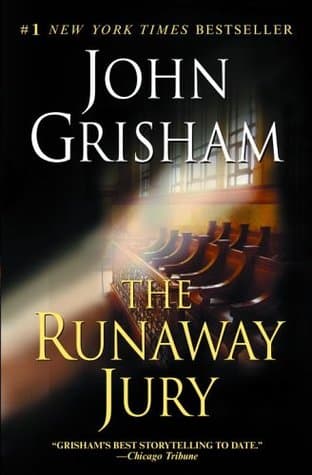
John Grisham (1996)
Genre
Thriller / Mystery
Reading Time
358 min
Key Themes
See below
Sign in to track this book
In a tobacco trial, a mysterious young woman and an odd jury lead a lawyer to suspect a plot to manipulate justice from inside the jury room.
The story begins in Biloxi, Mississippi, where a lawsuit, *Jacob Wood v. Pynex Tobacco*, is about to start. Celeste Wood is suing on behalf of her deceased husband, Jacob Wood, claiming his lung cancer was caused by Pynex cigarettes. The stakes are enormous. Wendell Rohr, a seasoned plaintiffs' lawyer, represents Celeste. Rankin Fitch, a cynical jury consultant, and Durwood Cable, a brilliant defense attorney, lead the defense for Pynex. Jury selection is a tense battle, with both sides carefully vetting potential jurors, each seeking an advantage in what promises to be a long legal fight.
As jury selection continues, Nicholas Easter (real name Jeff Kerr) and Marlee (Amanda Monroe) begin to exert influence. Nicholas, an ordinary young man, manages to become Juror Number 2, despite unusual behaviors that should have disqualified him. Marlee, working in secret, contacts Rankin Fitch's team. She claims to have inside information about the jury and demands a large sum for her ability to predict and influence jurors' decisions. Her early predictions are accurate, immediately catching Fitch's attention and making him suspect a deeper conspiracy.
Once the jury is sequestered, their behavior becomes erratic. Jurors who seemed to favor the defense begin to waver, and those who seemed pro-plaintiff become more vocal. Nicholas Easter, from within the jury, subtly guides discussions and influences the group, often seeming reasonable while pushing his own agenda. This shift in the jury's mood confuses both Wendell Rohr and Rankin Fitch. Fitch, relying on his research and profiles, is frustrated as the jury's actions contradict his expectations, leading him to suspect jury tampering from the inside.
Marlee continues negotiating with Rankin Fitch, her demands for money growing. She shows detailed knowledge of the jurors' thoughts and interactions, giving Fitch accurate predictions about their deliberations and personal lives. She makes it clear that she and Nicholas Easter, her accomplice, are orchestrating the process. Marlee's goal is a specific verdict, not just money. Fitch, desperate to protect Pynex from financial ruin, feels pressured to consider paying a large bribe to influence the trial's outcome, even as he tries to uncover the extent of their scheme and their identities.
Alarmed by Marlee's control and the jury's unpredictable nature, Rankin Fitch uses his resources to investigate her and Nicholas Easter. His private investigators look into their backgrounds, trying to find their true identities, motives, and connections to the plaintiff. They discover Nicholas Easter is Jeff Kerr, and Marlee is Amanda Monroe. They also uncover a tragic backstory involving a family member who died from tobacco-related illness, suggesting a personal vendetta. Fitch realizes he is dealing with a planned, personal operation to punish the tobacco industry.
As the trial ends, the jury begins deliberations. Nicholas Easter, using his alias Jeff Kerr, plays an important role. He guides discussions, planting doubt and influencing opinions without dominating. He uses his charm, intelligence, and understanding of human psychology to sway the undecided and strengthen those leaning toward the plaintiff. He dismantles the defense's arguments and highlights the plaintiff's case, all while appearing to be an impartial juror. The defense team, watching the jury's behavior, sees the verdict slipping away.
The jury reaches a verdict, finding for the plaintiff, Celeste Wood, and awarding a large sum in damages — over 100 million dollars in compensatory damages and an additional 200 million in punitive damages. The courtroom reacts, with the plaintiff's side celebrating and the defense in shock. Immediately after the verdict, Marlee contacts Rankin Fitch with her final demand: a huge sum of money, hundreds of millions, for her and Nicholas/Jeff, in exchange for not revealing their jury manipulation. She threatens to expose everything, leading to a mistrial and further financial ruin for Pynex, if her demands are not met.
In a confrontation, Marlee and Nicholas/Jeff reveal their true identities and the personal motivation behind their scheme. They are Amanda Monroe and Jeff Kerr, driven by a desire for justice for Amanda's sister, who died from lung cancer caused by Pynex cigarettes. They planned this operation for years, infiltrating the legal system to hold a tobacco company accountable. Their goal was not just money, but to make a statement and inflict a financial blow on the industry they blamed for their family's tragedy. They explain their detailed planning, from jury selection to deliberations.
Rankin Fitch is in a difficult position. If he exposes Marlee and Nicholas, he risks a mistrial, another costly trial, and public humiliation for Pynex. The public relations damage alone would be severe. If he pays them, Pynex takes a financial hit, but the scandal is contained. After intense debate and pressure from Pynex executives, Fitch reluctantly agrees to pay the demanded sum. The money is transferred to offshore accounts, securing Marlee and Nicholas's silence. The corporation effectively avoids a deeper scandal, at an enormous cost, showing the power of the duo's plan.
With payment secured, Marlee and Nicholas disappear. They use the money to start a new life, having achieved both financial gain and justice for Amanda's sister. The tobacco industry is affected by the verdict and financial blow. While the jury manipulation remains secret, the incident sends a message to powerful corporations: even careful legal defenses can be circumvented. The story ends with the implication that Marlee and Nicholas successfully executed their plan, leaving a lasting impact on the legal system and the tobacco industry.
The Protagonist
Jeff transforms from a grieving individual into a master manipulator of the legal system, achieving both financial gain and justice.
The Protagonist
Amanda evolves from a grieving sister to a powerful and effective avenger, successfully orchestrating a complex scheme for justice and profit.
The Antagonist
Fitch, initially confident and in control, is systematically outmaneuvered and ultimately defeated by Marlee and Nicholas, forcing him to compromise his principles even further.
The Supporting
Rohr, initially facing an uphill battle, experiences an unexpected victory due to the jury manipulation, fulfilling his goal of justice for his client.
The Supporting
Celeste, initially overwhelmed by grief and the legal process, finds a measure of justice and closure through the jury's verdict.
The Supporting
Cable, confident in his legal prowess, is ultimately blindsided by the manipulated verdict, demonstrating the limits of traditional legal strategy against covert operations.
The Supporting
Loreen evolves from an indecisive juror to a vocal proponent of the plaintiff's case, swayed by Nicholas's influence.
The Supporting
Herman moves from a skeptical, defense-leaning juror to one convinced by the plaintiff's arguments, thanks to Nicholas's influence.
The novel explores the tension between achieving legal victory through conventional means and through manipulation, even if the outcome is seen as 'just.' Marlee and Nicholas believe the tobacco industry has avoided justice, and they are willing to subvert the legal process to force accountability. Their actions raise questions about whether the ends justify the means, especially when the legal system can be influenced by powerful corporations, as shown by Rankin Fitch's methods. The manipulated verdict, while legally questionable, delivers a form of justice the plaintiffs might not have achieved otherwise.
“We're not trying to win a lawsuit, Mr. Fitch. We're trying to win justice.”
Grisham shows how money and power can corrupt and manipulate the legal system. Rankin Fitch's business relies on selecting and influencing juries to favor his wealthy corporate clients, using surveillance and psychological profiles. Marlee and Nicholas use these vulnerabilities, turning Fitch's tactics against him. The fact that Pynex pays a large bribe to avoid further scandal highlights the idea that justice can be bought, sold, and circumvented, rather than purely decided on merit. The jury's sequestration and manipulation show the system's fragility.
“A jury is a terrible thing to waste, Mr. Fitch. So much money, so much time, so much effort.”
The story is driven by Marlee and Nicholas's personal quest for revenge against the tobacco industry for Amanda Monroe's sister's death. Their elaborate, years-long scheme is fueled by grief and a desire to punish those responsible. This personal motivation elevates their actions beyond mere greed, giving their manipulation a moral, though ethically ambiguous, dimension. The narrative suggests that when the established system fails to provide justice for personal tragedies, individuals may take extraordinary measures to achieve their own retribution. Their careful planning shows the depth of their commitment.
“It was never about the money, not really. It was about making them pay.”
The novel shows the art of manipulation and persuasion, both ethical and unethical. Rankin Fitch's career is built on influencing juries through selection and research. Nicholas Easter, from within the jury, shows skill in reading people, understanding group dynamics, and guiding conversations without appearing dominant. Marlee's ability to negotiate and control Fitch, despite being unknown, shows her persuasive power. The story highlights how easily human perception and decision-making can be swayed by strategic influence.
“The trick is not to make them think what you want, but to make them think they want what you want.”
A key manipulator (Nicholas Easter) is embedded within the jury itself.
This device is central to the plot, as Nicholas Easter (Jeff Kerr) deliberately gets himself selected onto the jury. His presence inside the sequestered group allows for direct, subtle manipulation of the other jurors, circumventing traditional courtroom procedures and the watchful eyes of the legal teams. He acts as an internal agent, guiding discussions, influencing opinions, and ensuring the desired verdict from within. This 'Trojan Horse' strategy is what makes the scheme so difficult to detect and counter, as the manipulation comes from a seemingly legitimate source.
An outside figure (Marlee) controls the inside player and negotiates with the opposition.
Marlee (Amanda Monroe) functions as the unseen mastermind, operating from outside the direct purview of the court. She communicates with Rankin Fitch, revealing her knowledge of the jury's inner workings and making demands, while orchestrating Nicholas's actions from afar. This creates a two-pronged attack: one visible (Nicholas on the jury) and one shadowy (Marlee's negotiations). Her external position allows her to maintain leverage and control, while also providing a crucial narrative hook as Fitch tries to uncover her identity and motives.
The manipulators demand a large sum of money to prevent exposure of their scheme.
After securing the desired verdict, Marlee and Nicholas pivot to a blackmail scheme, demanding a massive payment from Pynex Tobacco to keep their jury manipulation a secret. This device raises the stakes significantly, forcing the corporation and Rankin Fitch into a moral and financial dilemma. It highlights the corruptibility of the system, as a corporation chooses to pay a bribe to avoid a greater scandal and financial ruin, rather than expose the manipulation and face another trial. It serves as the ultimate payoff for the protagonists' elaborate plan.
The plot is driven by a deeply personal motive for revenge.
Unlike a simple criminal conspiracy, the entire jury manipulation scheme is rooted in Marlee and Nicholas's personal tragedy – the death of Marlee's sister due to tobacco-related illness. This personal vendetta provides a strong emotional core and a moral justification (from their perspective) for their illegal actions. It transforms them from mere criminals into complex anti-heroes seeking justice outside conventional means, making their actions more understandable, if not entirely defensible. This device adds depth and motivation to the otherwise audacious plot.
“There are some things in this world that money can't buy. But for everything else, there's a lawyer.”
— A cynical observation about the legal system and the power of money.
“A jury is a terrible thing to waste.”
— Thoughts on the manipulation and importance of jury selection.
“The truth is a powerful weapon, but it's not always enough.”
— Reflecting on the limitations of truth in a rigged legal battle.
“You can't buy justice, but you can rent it.”
— A character's jaded view on the influence of money in trials.
“Every man has his price, or so they say. But some prices are higher than others.”
— Considering the various motivations and vulnerabilities of the jurors.
“The law is a game, and like any game, it has its rules. But the best players know how to bend them.”
— Discussing legal tactics and the art of winning a case.
“Fear is a great motivator, especially when it's your own neck on the line.”
— Explaining why people might cooperate under pressure.
“The beauty of a jury is its unpredictability. The horror of a jury is its unpredictability.”
— An observation on the double-edged nature of jury trials.
“Sometimes the best defense is a good offense, especially when the other side is playing dirty.”
— A tactical discussion about how to counter an opponent's illicit methods.
“It's not about what you know, it's about what you can prove.”
— Highlighting the evidentiary challenges in a courtroom.
“There are no innocent bystanders in a war like this.”
— Referring to the high-stakes legal battle and its impact on everyone involved.
“Money talks, and in a courtroom, it screams.”
— Emphasizing the overwhelming influence of financial resources in legal proceedings.
“Revenge is a dish best served cold, and sometimes, it's served by a jury.”
— A character's reflection on the ultimate goal of their actions within the trial.
“The system is flawed, but it's the only one we have. And sometimes, it needs a little push.”
— Justifying the extraordinary measures taken to influence the trial.
Ready to see how well you understood this book? Take our interactive quiz with 10 questions.
Biography coming soon.







