“It was a good morning, and even the smell of the city seemed to have been washed away by the rain.”
— Early morning in San Juan, after a night of rain.

Hunter S. Thompson (1998)
Genre
Thriller / Lifestyle
Reading Time
240 min
Key Themes
See below
Sign in to track this book
In 1950s San Juan, a drunken journalist pursuing an elusive woman gets caught in a dangerous mix of lust, jealousy, and quick-money schemes, where every drink could be his last.
Paul Kemp, a disillusioned American journalist, arrives in San Juan, Puerto Rico, in 1958, to work at The San Juan Daily News. He notices the intense heat, the island's lively but chaotic energy, and the constant presence of alcohol. After checking into a cheap hotel, he meets Sala, another American and a veteran journalist at the paper, who quickly introduces him to the local drinking culture and the harsh realities of their job. Kemp feels both fascinated and uneasy, dealing with culture shock and the heavy drinking that defines his new life.
Kemp meets Yeamon, another American expat at the newspaper, a man prone to violent outbursts. More importantly, Kemp meets Chenault, Yeamon's beautiful and mysterious girlfriend. There is an immediate, unspoken attraction between Kemp and Chenault, a dangerous undercurrent that suggests future problems. Yeamon's possessiveness and Chenault's appeal create a tense dynamic, forming a love triangle that will drive much of the story's conflict, all set against San Juan's indulgent lifestyle and the ever-present flow of rum.
Paul Kemp soon realizes that The San Juan Daily News is a failing, low-quality publication, staffed by cynical and often drunk American expats. He sees firsthand the ethical compromises and general lack of interest in the newsroom, as journalists write sensationalized stories or simply fill space. The paper's owner, Mr. Zimburger, is a distant and seemingly indifferent figure, while the editor, Lotterman, is a stressed man trying to maintain some order amid the chaos. Kemp's initial journalistic ideals begin to fade as he becomes part of this environment of professional despair and personal excess.
The growing tension between Kemp, Chenault, and Yeamon turns into open conflict. Yeamon's jealousy and paranoia increase, leading to several violent fights. One notable event involves Yeamon brutally beating Chenault, leaving her bruised. Kemp, witnessing this abuse, feels a growing desire to protect Chenault and a deepening dislike for Yeamon. These clashes show Yeamon's destructive nature and Chenault's vulnerable position, while strengthening the forbidden connection between Kemp and Chenault amidst the rising drama.
Kemp, Sala, Yeamon, and Chenault go on a doomed yacht trip that quickly falls apart. Fueled by large amounts of alcohol, the journey becomes a symbol of their shared recklessness. Yeamon's erratic behavior reaches its peak, and the boat itself becomes a source of tension and near-disaster. The yacht eventually runs aground, leaving the group stranded and forcing them to face the results of their irresponsible actions. This incident illustrates the self-destructive path many characters are on and the dangers of their unrestrained lifestyle.
Kemp meets Sanderson, a smooth, wealthy American businessman involved in questionable real estate development schemes in Puerto Rico. Sanderson sees potential in Kemp, not as a journalist, but as a public relations operative who can help promote his dubious ventures. He offers Kemp a well-paying opportunity to write promotional material, tempting him with the promise of wealth and a more comfortable life away from the failing newspaper. This meeting marks a turning point, as Kemp is drawn further into the island's corrupt underworld and the appeal of easy money, blurring his journalistic ethics.
After a particularly brutal beating from Yeamon, Chenault disappears, leaving Kemp and Sala worried. Her absence casts a shadow over the story, increasing Kemp's concern and feelings for her. However, she eventually reappears, seemingly unaffected by her ordeal but with a tougher edge. Her return reignites the complex dynamics between her, Kemp, and Yeamon, adding another layer of unpredictability to their volatile relationships. Her resilience, or perhaps her detachment, in the face of such violence highlights her mysterious nature.
Kemp and Sala find themselves caught in a violent carnival riot in the streets of San Juan. The festive atmosphere quickly becomes chaotic, with clashes between revelers and police. This incident vividly depicts the underlying social unrest and instability of Puerto Rico, a sharp contrast to the idyllic image often presented. Kemp and Sala's frantic escape through the chaos emphasizes the unpredictable and often dangerous nature of their adopted home, further solidifying Kemp's growing disillusionment with the island's superficial charm.
Paul Kemp faces a choice, torn between his fading journalistic ideals and Sanderson's tempting offer to join his corrupt real estate business. He struggles with the moral implications of leaving his profession for a life of easy money and involvement in schemes he knows are unethical. This internal conflict shows his disillusionment with traditional journalism and his growing cynicism about the possibility of honest work in San Juan. The decision he faces tests his character and his ability to resist the pervasive corruption around him.
The struggling San Juan Daily News finally closes, a victim of its financial problems and its owners' general indifference. The closure leaves Kemp, Sala, and their fellow journalists jobless and uncertain. This event marks the end of an era for the expat journalists and forces them to confront their unknown futures. For Kemp, it means the complete collapse of his original reason for being in Puerto Rico and pushes him toward making a definite decision about his next steps, whether to accept Sanderson's world or find another path.
With the newspaper gone and his options limited, Kemp finally decides his future. He rejects Sanderson's offer, refusing to completely give in to the corruption he has seen. He realizes that while he may be disillusioned, he cannot abandon his core principles entirely. He chooses to leave San Juan, though with a lingering attachment and a deep impact from his experiences. This decision marks a maturation for Kemp, as he acknowledges the destructive path he was on and seeks a different direction, carrying the scars and lessons learned from his time in Puerto Rico.
The Protagonist
Kemp arrives seeking escape, becomes deeply immersed in the island's hedonism and corruption, but ultimately rejects it to reclaim a semblance of his moral compass.
The Supporting
Sala remains largely static, a symbol of the expat journalist's fate, but his loyalty provides a constant for Kemp.
The Supporting
Chenault endures significant abuse but remains resilient and somewhat opaque, her fate mirroring the instability of the island.
The Antagonist
Yeamon's character remains consistently volatile and destructive, serving as a catalyst for conflict.
The Supporting
Sanderson remains a static representation of corruption and temptation, offering Kemp a path he ultimately rejects.
The Supporting
Lotterman's arc is one of sustained struggle leading to the inevitable demise of his newspaper.
The Supporting
Mobley remains a relatively minor character, providing a glimpse of a less corrupted individual amidst the chaos.
The Mentioned
Mr. Zimburger's arc is one of passive ownership leading to the newspaper's inevitable failure.
The novel explores the widespread disillusionment felt by its protagonist, Paul Kemp, and his fellow expat journalists. They come to Puerto Rico, often escaping past failures or seeking new beginnings, only to find their professional ideals shattered by a failing newspaper and a corrupt society. Kemp's initial hope for meaningful journalism quickly turns to cynicism as he sees the ethical compromises and trivial nature of the stories he must write. This theme appears clearly in the newsroom scenes, where the journalists' apathy and heavy drinking show their lost aspirations, ending with the newspaper's eventual collapse.
“I was looking for some kind of truth, and it seemed to me that a journalist's job was to find it, no matter what.”
Alcohol acts as both a coping mechanism and a destructive force throughout the story. Almost every character, especially the American expats, is deeply involved in a culture of heavy drinking. Rum fuels their days and nights, blurring reality and often leading to violence and self-sabotage. Sala and Yeamon show this theme, their lives spiraling out of control due to their addiction. For Kemp, alcohol is a constant companion, but he also struggles with its destructive power, making it a strong symbol of the characters' attempts to escape their grim realities and their simultaneous descent into chaos.
“You can drink rum for a hundred years and never get used to it. It's like a woman. The more you drink, the more you want to drink.”
The novel criticizes the widespread corruption and the negative side of unregulated capitalism in 1950s Puerto Rico. The island, presented as a paradise, is actually a hub of shady real estate deals and get-rich-quick schemes, often harming local communities. Sanderson embodies this theme, tempting Kemp with opportunities that require moral compromise. The failing newspaper itself is a symptom of this environment, unable to hold power accountable. This theme highlights the exploitation of the island and the moral decay that comes with rapid, unregulated development, forcing Kemp to confront his own ethical boundaries.
“The whole damn island is for sale. Just like everything else.”
The book clearly shows the lives of American expats in San Juan, a group of individuals often running from something or looking for a fresh start. They form a closed, indulgent society, defined by heavy drinking, casual sex, and a cynical outlook. Characters like Sala, Yeamon, and Kemp are all seeking something – escape, wealth, meaning – but often find only more disillusionment and self-destruction. This theme explores the challenges of adapting to a foreign culture, forming new social groups, and how individuals can become trapped in a transient, morally ambiguous lifestyle, far from the norms of home.
“We were all strangers there, in one way or another, and we clung to each other like shipwreck survivors.”
The story is told entirely from Paul Kemp's subjective perspective.
The entire novel is narrated through Paul Kemp's first-person perspective, offering an intimate and unfiltered view of his experiences, thoughts, and feelings. This device allows readers to directly access his cynicism, his moral dilemmas, and his often-hallucinatory observations, particularly under the influence of alcohol. It creates a strong sense of immediacy and authenticity, characteristic of Thompson's writing style, immersing the reader in Kemp's chaotic world and psychological state without external judgment.
San Juan, Puerto Rico, acts as a dynamic and influential force in the story.
The city of San Juan, Puerto Rico, is more than just a backdrop; it functions almost as a character itself. Its oppressive heat, vibrant but chaotic streets, pervasive rum culture, and underlying corruption significantly influence the characters' actions and fates. The setting embodies both allure and decay, mirroring the characters' internal struggles and the novel's themes of hedonism and disillusionment. The island's dual nature – a tropical paradise and a moral wasteland – shapes the narrative and the psychological states of its inhabitants.
Rum represents both escape and destruction for the characters.
Rum is a powerful symbol throughout the novel, embodying both the promise of escape and the reality of destruction. It is the lifeblood of the expatriate community, a constant companion that facilitates camaraderie, numbs pain, and fuels reckless behavior. However, it also leads to violence, poor decisions, and a deeper descent into self-destruction. The pervasive presence of rum highlights the characters' attempts to cope with their disillusionment and the inherent dangers of their uninhibited lifestyle, blurring the lines between pleasure and peril.
The romantic tension between Kemp, Chenault, and Yeamon drives much of the interpersonal conflict.
The complex and dangerous love triangle involving Paul Kemp, Chenault, and Yeamon serves as a central plot device, fueling much of the novel's interpersonal drama and violence. Kemp's forbidden attraction to Chenault, combined with Yeamon's possessiveness and abusive nature, creates constant tension and leads to several explosive confrontations. This device not only explores themes of desire, jealousy, and loyalty but also highlights the destructive potential of relationships within the hedonistic and morally ambiguous environment of San Juan.
“It was a good morning, and even the smell of the city seemed to have been washed away by the rain.”
— Early morning in San Juan, after a night of rain.
“I felt like a fly caught in a web, and the web was this goddamn city.”
— Paul Kemp reflecting on his situation and dislike for San Juan.
“The only way to make sense out of change is to plunge into it, move with it, and join the dance.”
— Paul Kemp's philosophical musings on adapting to new circumstances.
“Every now and then when your life gets complicated and the weasels start closing in, the only cure is to load up on super-pure booze and slide into the nearest fantasy.”
— Kemp's coping mechanism for stress and difficult situations.
“San Juan was an ugly city, and I was just another ugly thing in it.”
— Paul Kemp's self-deprecating view of himself and his surroundings.
“We are all alone, born alone, die alone, and—despite what they tell you—we shall all go to hell alone.”
— Kemp's bleak view on human existence and isolation.
“There are some things you can't learn from a book. You have to feel them.”
— Kemp considering the nature of experience versus theoretical knowledge.
“The only thing I ever learned from a woman was how to hate her.”
— Kemp's cynical view on relationships and the opposite sex.
“I would get up in the mornings and write a column about the news, and then I would get drunk and write another column about the news.”
— Kemp's daily routine as a journalist in San Juan.
“It was a mistake to come here. A terrible mistake. But what the hell, I'm here now.”
— Kemp's resignation to his current predicament in Puerto Rico.
“We were not looking for anything, and we were finding everything.”
— Kemp reflecting on the serendipitous nature of their adventures.
“The feeling of a good story, even a bad one, is a powerful drug.”
— Kemp's fascination with narrative and its intoxicating effect.
“There was a faint, lingering smell of rum and desperation.”
— Describing the pervasive atmosphere of the city and its inhabitants.
“The world was a terrible place, but it was all we had.”
— Kemp's acceptance of the world's flaws while acknowledging its singularity.
“It was a fine line between pleasure and pain, and sometimes it was impossible to tell which was which.”
— Kemp's observation on the blurred boundaries of human experience.
Ready to see how well you understood this book? Take our interactive quiz with 10 questions.
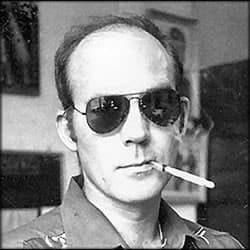
Hunter Stockton Thompson was an American journalist and author who founded the gonzo journalism movement. He rose to prominence with the publication of Hell's Angels (1967), a book for which he spent a year living and riding with the Hells Angels motorcycle club to write a first-hand account of their lives and experiences.







