“There are some things in this world that are not for us to know.”
— Early in the book, a character reflects on the limits of human understanding.

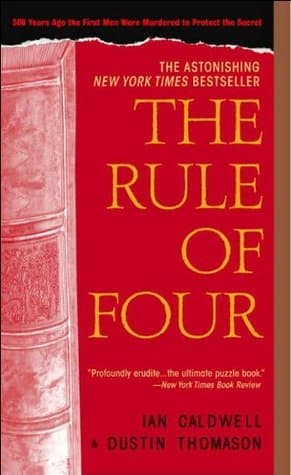
Ian Caldwell (2004)
Genre
Thriller / Historical Fiction / Mystery / Romance
Reading Time
900 min
Key Themes
See below
Sign in to track this book
At Princeton, two seniors race to decipher a 500-year-old coded manuscript, uncovering a Renaissance-era murder and placing their own lives in mortal danger as they unravel its deadly secrets.
It is Easter 1999 at Princeton University. Senior Tom Sullivan struggles to complete his thesis on the Hypnerotomachia Poliphili, a mysterious 15th-century book. His research partner, Paul Harris, is obsessed with the same enigma. Tom’s family has a long history with the book, which complicates his personal life, especially his relationship with his girlfriend, Katie Marsh. Their friend and fellow researcher, Bill Stein, is also involved. The deadline for their senior theses nears, and the complex, coded text of the Hypnerotomachia continues to hide deeper secrets.
While going through his family's belongings, Tom discovers a lost diary belonging to his ancestor, Marco. This diary, filled with notes, appears to contain clues directly related to the Hypnerotomachia Poliphili. The discovery gives new hope and urgency to Tom and Paul's research, as Marco's writings seem to explain the obscure symbols and Latin phrases that have puzzled scholars for centuries. The diary suggests a personal connection between Marco and the book's creation or early interpretation, making its insights potentially revolutionary for their thesis.
Hours after Tom's discovery of Marco's diary, a shocking event occurs: Bill Stein, their friend and fellow Hypnerotomachia researcher, is murdered. Bill is found dead in his apartment, the scene suggesting a violent struggle. This murder immediately raises the stakes for Tom and Paul, changing their academic pursuit into a dangerous real-world mystery. They realize that the secrets of the Hypnerotomachia are not just intellectual curiosities but hold a dangerous power, and someone is willing to kill to protect or acquire them. The murder casts a dark shadow over Princeton and their thesis work.
Detective Kessler of the Princeton police begins an investigation into Bill Stein's murder. Tom and Paul, as Bill's closest collaborators, are questioned. The murder forces them to re-evaluate everyone involved in their research, including Professor Richard Curtius, their advisor, and even each other. They realize the killer is likely someone connected to the book and its secrets. The academic community, initially shocked, begins to suspect, and the pressure on Tom and Paul grows as they realize they might be the next targets.
With Marco's diary as a guide, Tom and Paul look deeper into the Hypnerotomachia. They begin to uncover a mathematical and linguistic code within the text, which they call the 'Rule of Four.' This code arranges certain words, phrases, and even illustrations, revealing hidden meanings beyond the surface narrative of love and architecture. The 'Rule of Four' suggests that the book is not just a philosophical treatise or a romantic allegory, but a puzzle designed to hide a secret, possibly related to wealth or power.
As Tom and Paul apply the 'Rule of Four,' the hidden messages within the Hypnerotomachia begin to point towards the Sforza family of Renaissance Milan. The book, seemingly fiction, appears to be a coded chronicle of their history, including secrets, betrayals, and possibly hidden treasures or political actions. This revelation connects the academic puzzle directly to historical events and figures, suggesting the book's true purpose was to preserve or reveal information the Sforzas wished to keep secret, making its decipherment dangerous for those who seek the truth.
Growing suspicious, Tom and Paul confront Professor Richard Curtius, their thesis advisor, about his knowledge of the Hypnerotomachia's secrets and his potential involvement in Bill's murder. Curtius, a renowned but enigmatic scholar, has always seemed to understand the book deeply. Their confrontation is tense, as Curtius's responses are evasive, and his past research on the book comes under scrutiny. They realize he has been guiding them, perhaps even manipulating them, towards discoveries he already understood.
Tom discovers that Katie Marsh, his girlfriend, has her own connections to the Hypnerotomachia and its researchers. Her family also has a history with the book, and she has been keeping secrets from Tom about her own investigations and motivations. This revelation creates a rift in their relationship, as Tom feels betrayed by her dishonesty. Katie's involvement suggests that the network of people interested in the book's secrets is wider and more intricate than he imagined, adding danger and personal conflict to his quest.
Following the clues from the 'Rule of Four' and Marco's diary, Tom and Paul finally decipher the ultimate secret of the Hypnerotomachia Poliphili. The book is not just a historical record but a map, leading to a hidden Sforza treasure—a collection of wealth and priceless artifacts hidden centuries ago. This revelation also exposes the identity of Bill Stein's killer, who has been manipulating events to gain exclusive access to the treasure. The race to claim the treasure and expose the murderer becomes a struggle for survival.
The story ends in a confrontation within the Princeton library. Tom and Paul, with their new knowledge, face the killer, whose identity is revealed to be a figure in their academic world, driven by greed and a desire to control the Sforza legacy. The confrontation is a tense battle of wits and physical struggle, as the killer tries to eliminate Tom and Paul to secure the treasure and prevent the truth from coming out. The fate of the Hypnerotomachia's secrets and their own lives is uncertain.
After the confrontation, the killer is apprehended, and the Sforza treasure's existence is confirmed, though its disposition remains a complex issue. Tom and Paul, shaken but alive, deal with their discoveries. Tom reflects on the impact of the Hypnerotomachia on his life, his family's legacy, and his relationships. He begins to mend his relationship with Katie, understanding the pressures and motivations that led to her secrecy. The experience has changed him, forcing him to balance academic pursuit with real-world danger and personal growth.
The Protagonist
Tom evolves from a somewhat reluctant scholar burdened by legacy into a courageous truth-seeker who confronts danger and redefines his relationships.
The Protagonist/Supporting
Paul's arc shows him moving from pure academic obsession to a realization of the real-world dangers and human cost of their pursuit, though his core drive remains.
The Supporting
Katie's arc involves revealing her hidden agenda and confronting the consequences of her secrecy, ultimately seeking reconciliation and honesty.
The Antagonist/Supporting
Curtius's arc reveals him as a manipulative figure, guiding his students towards discoveries he already knows, ultimately exposed as a key player in the larger conspiracy.
The Supporting/Victim
Bill's arc is tragically cut short, serving as a warning and a turning point for the protagonists, solidifying the danger they face.
The Mentioned/Historical
Marco's influence extends across centuries, guiding Tom to the truth even after his death, serving as a posthumous mentor.
The Supporting
Kessler's arc involves him slowly unraveling the complex mystery from a law enforcement perspective, eventually accepting the extraordinary nature of the crime.
The novel explores the power of hidden knowledge and the lengths people will go to acquire or protect it. The Hypnerotomachia Poliphili is a trove of secrets, drawing scholars into its orbit. However, this pursuit of knowledge is dangerous, as seen in Bill Stein's murder and the constant threat to Tom and Paul. The book suggests that some truths are too dangerous to be known, capable of shattering lives and friendships, and causing violence.
““Some secrets are best left buried, not because they are evil, but because they are too potent for the world.””
The theme of legacy is central, especially through Tom Sullivan's family history with the Hypnerotomachia. His ancestor, Marco, left a diary crucial to solving the puzzle, connecting Tom to a centuries-old quest. This legacy is both a burden and a gift, linking Tom to an intellectual lineage but also putting him in danger. The novel also touches on the Sforza family's legacy, whose hidden wealth and history are the ultimate secret within the book, showing how historical power influences the present.
““The past is never dead. It’s not even past.””
The different approaches of Paul Harris and Tom Sullivan highlight the line between passionate academic pursuit and destructive obsession. Paul embodies obsession, letting the Hypnerotomachia consume him, often at the expense of his well-being and relationships. Tom, while dedicated, initially seeks a balanced approach, but the escalating danger forces him into similar intensity. The novel questions the cost of singular focus and whether the pursuit of knowledge justifies personal sacrifice and moral compromise, especially when others are involved.
““There is a difference between devotion and madness, though the line blurs quickly when one is truly consumed.””
The Hypnerotomachia Poliphili itself shows how truth is elusive, offering multiple layers of meaning and requiring interpretation. The book challenges characters to differentiate between surface narratives, allegories, and hidden codes. The novel demonstrates how different individuals, driven by varying motives (academic curiosity, greed, power), interpret the same text differently. The 'Rule of Four' reveals that truth can be hidden and requires a specific key to unlock, suggesting that objective truth is often buried beneath subjective interpretation.
““The book did not merely tell a story; it was a story about how stories are told, and how they can be hidden.””
A real 15th-century book serving as the central MacGuffin and puzzle.
The Hypnerotomachia Poliphili is a real, exquisitely printed 1499 incunabulum written in a unique Latinized Italian, filled with woodcut illustrations and obscure allusions. In the novel, it functions as the ultimate MacGuffin and a complex, multi-layered puzzle. It is not merely a book but a coded message, a historical record, and a map to a hidden treasure. Its historical mystery and coded nature drive the entire plot, motivating characters to obsession and violence. The book's very existence and enigmatic reputation lend credibility and intrigue to the fictional narrative.
A long-lost family artifact containing crucial insights into the Hypnerotomachia's codes.
Marco's diary is a pivotal plot device, representing a direct link to the past and providing the breakthrough needed to decipher the Hypnerotomachia. It functions as a form of posthumous exposition, revealing the 'Rule of Four' and guiding Tom and Paul through the book's complexities. The diary's discovery is a classic 'found object' trope, propelling the narrative forward and raising the stakes. It also highlights the theme of legacy and the idea that answers often lie within one's own history.
A mathematical and linguistic code embedded within the Hypnerotomachia.
The 'Rule of Four' is the key decryption method uncovered by Tom and Paul, a fictional construct within the novel that allows them to unlock the Hypnerotomachia's deepest secrets. It serves as a central puzzle mechanic, providing a tangible goal for the protagonists. This device gives the abstract academic pursuit a concrete framework, demonstrating how the book's seemingly disparate elements are actually part of an intricate design. It transforms the book from a literary curiosity into a coded blueprint for historical revelation and treasure hunting.
A classic mystery trope used to introduce immediate danger and suspicion.
Bill Stein's murder, occurring in what appears to be a secured environment, immediately introduces the 'locked room' element (or a close variant) to the narrative. This device heightens suspense and narrows the pool of suspects, forcing the protagonists to look inward at their academic circle. It transforms the intellectual puzzle into a life-or-death thriller, demonstrating that the secrets of the Hypnerotomachia are worth killing for. The murder serves as the inciting incident, pushing Tom and Paul beyond mere academic curiosity into active investigation.
“There are some things in this world that are not for us to know.”
— Early in the book, a character reflects on the limits of human understanding.
“Every page of the Hypnerotomachia, like every step of a pilgrimage, is meant to be savored, not rushed.”
— Tom discussing the intricate nature of the Hypnerotomachia Poliphili.
“The past is never dead. It's not even past.”
— A character's reflection on how historical events continue to influence the present.
“The greatest treasure is not gold or jewels, but the truth hidden in plain sight.”
— A thematic statement about the nature of the quest for knowledge.
“Love, like a riddle, often reveals its true meaning only after painstaking deciphering.”
— Paul considering the complexities of his romantic relationships.
“To truly understand a text, you must first understand the mind of its author.”
— A key principle in their approach to interpreting the ancient manuscript.
“Some secrets are meant to be kept, not for malice, but for protection.”
— Reflecting on the motivations behind certain characters' actions.
“The greatest dangers often lie not in the unknown, but in what we refuse to see.”
— A character's realization about the hidden threats around them.
“Every answer only leads to more questions, a labyrinth without end.”
— Paul's frustration and fascination with the ongoing mystery.
“Friendship, like scholarship, requires dedication, patience, and an unwavering belief in its value.”
— The bond between the four friends is tested throughout the story.
“The beauty of a puzzle is not just in solving it, but in the journey of discovery.”
— Contemplating the allure of the Hypnerotomachia's enigmatic nature.
“Sometimes the most profound truths are whispered, not shouted.”
— Referring to the subtle clues and hidden messages within the book.
“The greatest fear is not of death, but of a life unexamined, a truth undiscovered.”
— A character's deep motivation for pursuing the mystery.
“History does not repeat itself, but it rhymes.”
— A character's observation about patterns in historical events.
Ready to see how well you understood this book? Take our interactive quiz with 10 questions.







