“My mind tells me that if the Nazarene was what they said He was, then the robe is not a thing to be gambled for.”
— Marcellus's initial thoughts after winning the robe, reflecting a growing unease.

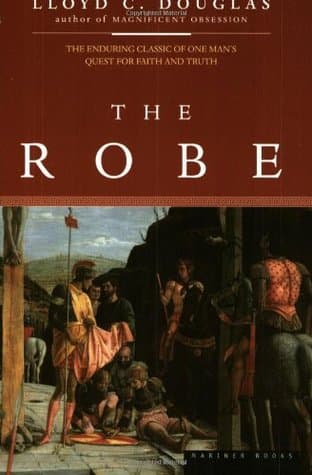
Lloyd C. Douglas (1942)
Genre
Historical Fiction / Spirituality
Reading Time
10-12 hours
Key Themes
See below
Sign in to track this book
A Roman tribune's life changes with spiritual fervor after he wins the robe of the crucified Nazarene, sending him on a quest for truth that challenges the Roman Empire.
Marcellus Gallio, a young Roman tribune, is assigned to oversee the crucifixion of three men in Jerusalem, one of whom is Jesus of Nazareth. Disgusted by the task and the crowd, Marcellus orders the execution. Afterward, he and his soldiers gamble for the condemned men's belongings. Marcellus wins a simple, seamless crimson robe belonging to Jesus. When he touches the garment, a deep, unsettling chill runs through him, shaking his cynical view. He feels an inexplicable dread and guilt, attributing it to the robe, and tries to discard it, but cannot. This marks the start of his inner conflict.
Haunted by Golgotha and the robe's presence, Marcellus suffers from terrifying nightmares and sadness. He often cries out 'The Robe!' in his sleep, disturbing his family and his betrothed, Diana. His father, Senator Gallio, worried about his son's sanity and reputation, blames his distress on battle fatigue and a superstitious fear of the robe. To stop rumors and provide a change of scene, Senator Gallio arranges for Marcellus to be transferred to Minoa in Judea, a punishment disguised as an assignment. Demetrius, Marcellus's loyal Greek slave, goes with him.
In Minoa's isolation, Marcellus's mental pain deepens. He is plagued by visions and a strong urge to understand the man who owned the robe. He tells Demetrius to find those who knew Jesus. Demetrius, initially doubtful, gathers information from local villagers, fishermen, and former followers of Jesus, including Peter. Through these meetings, Marcellus hears stories of Jesus's miracles, teachings, and compassion, slowly forming a different image of the Nazarene than the criminal he saw on the cross. The robe, which he still keeps, becomes a trigger for his growing curiosity and a symbol of an unknown power.
Demetrius's inquiries lead him and Marcellus to Galilee, where they meet Peter, the apostle, and other early disciples like John. Initially wary of the Roman tribune, Peter and the others cautiously share their experiences with Jesus, describing his love, healing, and impact on their lives. Marcellus, still struggling with his Roman upbringing and the shame of his role in the crucifixion, is deeply moved by their accounts. He begins to feel peace near believers, and his nightmares start to lessen. He even sees Demetrius's growing faith, as his slave finds comfort and purpose among the Nazarenes.
As Marcellus continues his search, listening to more accounts and seeing the early Christians' firm faith, the psychological torment that has bothered him since Golgotha begins to lift. The chilling feeling with the robe turns into warmth and peace. He starts to understand that the robe is not cursed, but holds the spirit of the man who wore it. This realization marks a turning point, as he decides to accept Jesus's teachings, not just out of curiosity, but from a growing conviction. He sheds his Roman pride and accepts humility, finding healing in the new faith.
Recalled to Rome by his father, Marcellus returns a changed man. His former cynicism and arrogance are replaced by quiet thought and new compassion. His betrothed, Diana, initially concerned by his change, gradually understands his spiritual journey. Despite social pressures and the dangers of associating with the Christian sect, Diana stays loyal to Marcellus, supporting his search for truth. Their love deepens as she sees his integrity and the deep peace he has found, even as his beliefs clash with the Roman establishment and her family's expectations.
Back in Rome, Marcellus finds himself in a city under Emperor Caligula's tyrannical and erratic rule. Caligula's cruelty grows, causing widespread fear. The small, secretive Christian community, viewed with suspicion by Roman authorities, becomes a scapegoat for Caligula's madness and public discontent. Christian persecution begins, forcing them further underground. Marcellus, now a secret follower of Christ, faces a dangerous choice: hide his faith or stand by his convictions, knowing the severe results.
Marcellus's changed demeanor and his association with known Christians are noticed. He is accused of treason against the Emperor and of being a follower of Christ. He is brought before a tribunal, where he must defend himself against charges that carry the death penalty. Despite the danger, Marcellus refuses to deny his faith or the truth he has found. His powerful testimony, telling of his journey from a cynical Roman soldier to a believer, captivates some in the court but angers others loyal to Caligula and the Roman gods. Diana stands by him.
During Marcellus's trial, Diana, seeing his firm resolve and moved by his faith, publicly declares her own belief in Christ. This act seals her fate with Marcellus. Emperor Caligula, angered by their refusal to recant and their open embrace of a forbidden religion, personally intervenes. He condemns both Marcellus Gallio and Diana to death, seeing their conversion as a direct challenge to his authority and the Roman gods. The verdict shocks the Roman elite, showing the growing conflict between imperial power and the rising Christian faith.
Marcellus and Diana are led to their execution, facing death with serenity and courage. As they walk, they speak of their faith and eternal life, finding strength in each other. The robe, which started Marcellus's journey, is not mentioned in this final scene, but its power is clear in their peaceful acceptance of martyrdom. Their deaths show the early Christians' firm conviction and the deep impact of their faith, leaving a lasting impression on those who witness their final moments and cementing their place as martyrs for Christ.
The Protagonist
Marcellus transforms from a cynical Roman officer haunted by a cursed object into a devout Christian who finds peace and purpose in his faith, culminating in his martyrdom.
The Supporting
Diana evolves from a loving but conventional Roman noblewoman to a steadfast Christian, publicly declaring her faith and accepting martyrdom alongside Marcellus.
The Supporting
Demetrius transitions from a dutiful slave to a committed Christian, serving as Marcellus's guide and companion on his spiritual quest.
The Supporting
Peter remains a steadfast and compelling witness to Christ's life and teachings, guiding new seekers like Marcellus.
The Antagonist
Caligula remains a static embodiment of tyrannical power, escalating his cruelty and persecution of Christians.
The Supporting
Senator Gallio tries to preserve his son's status and sanity within the Roman system, ultimately failing to prevent his conversion and martyrdom.
The Mentioned
Jesus's influence, though posthumous, acts as the primary catalyst for the spiritual transformation of multiple characters.
The Supporting
John serves as a consistent source of spiritual insight and witness to Christ's teachings for those seeking truth.
The main theme is Marcellus Gallio's spiritual journey from a cynical Roman soldier to a Christian. His initial torment after winning the robe, marked by nightmares and pain, shows his soul's struggle. His quest to understand the man who wore the robe leads him to early Christians, slowly healing his spirit and replacing cynicism with faith. This change ends with his peaceful acceptance of martyrdom, showing his redemption and faith's triumph over worldly power, as he and Diana walk to their deaths with calm conviction.
“The Robe had been a thing of evil omen, full of dreadful power. Now it was a garment of peace, a mantle of comfort, a banner of triumphant joy.”
The novel contrasts the Roman Empire's oppressive power, shown by Emperor Caligula, with the quiet, growing power of Christian faith. Rome represents worldly authority, military might, and pagan worship, while Christianity, a small, persecuted group, offers spiritual freedom and hope. Marcellus and Diana's defiance of Caligula and their willingness to die for their beliefs illustrate that spiritual conviction can overcome even the strongest earthly power. Their martyrdom is a victory of the spirit, showing that true power is in firm faith.
“There was no force strong enough in Rome to break the spirit of a Roman who had found Christ.”
Marcellus's journey is a search for truth. Initially, he seeks to understand the robe's 'curse,' but this becomes a search for the truth about Jesus of Nazareth. Through Peter, John, and other disciples, the truth of Christ's life, teachings, and divine nature is revealed. This process is not just intellectual but personal and spiritual, leading him to a deep understanding that changes him. The story suggests that truth, when genuinely sought, leads to spiritual awakening, as Marcellus puts together the stories to form a life-altering understanding.
“He had started out to find the secret of the Robe. He had found the secret of life.”
Love is a central theme, appearing in many forms: Christ's divine love, Marcellus and Diana's romantic love, and the communal love among early Christians. Jesus's teachings, as told by his followers, stress sacrificial love. Marcellus and Diana's relationship deepens as they share their spiritual journey, ending in their mutual decision to die for their faith, a deep act of love and sacrifice. This theme highlights that true love is not just romantic but includes loyalty, shared conviction, and the willingness to sacrifice everything for a higher purpose, reflecting Christ's sacrifice.
“Love is the only thing that can explain everything. It is the only thing that can make sense of a world that is otherwise senseless.”
A physical object that acts as a catalyst for spiritual transformation.
The seamless crimson robe, won by Marcellus at Golgotha, is the central plot device. Initially, it functions as a symbol of a 'curse,' triggering Marcellus's psychological torment and driving his initial quest to understand its unsettling power. As he learns more about Jesus, the robe transforms into a symbol of peace, healing, and divine presence, becoming a tangible link to Christ. It serves as a constant reminder of the crucifixion and the man who wore it, compelling Marcellus to seek truth and ultimately embrace faith, thus initiating and guiding his entire spiritual journey.
Marcellus's physical and spiritual search for understanding.
Marcellus's journey, both geographical (from Jerusalem to Minoa, Galilee, and back to Rome) and internal, is a classic quest narrative. He travels to distant lands, not for treasure, but for knowledge and healing. This physical journey allows him to encounter various characters and gather testimonies about Jesus, while simultaneously reflecting his internal struggle and spiritual progression. The quest structure provides a clear narrative arc for his transformation, moving him from ignorance and suffering to enlightenment and peace, showcasing his gradual conversion through a series of significant encounters and revelations.
Firsthand stories from early Christians that reveal Christ's character.
The novel heavily relies on testimonial accounts from early Christians, such as Peter and John, and various common folk. These narratives are crucial for Marcellus's understanding of Jesus, as he was only present at the crucifixion. Each story, anecdote, and teaching shared by those who knew Jesus personally builds a composite picture of Christ, challenging Marcellus's preconceived notions and gradually softening his heart. This device allows the author to present Jesus's character and teachings indirectly, through the eyes of his devoted followers, making the conversion experience more authentic and impactful for Marcellus and the reader.
Characters who highlight Marcellus's transformation through contrast.
Several characters serve as foils to Marcellus, highlighting his spiritual transformation. Emperor Caligula, with his extreme cruelty and self-deification, stands in stark contrast to Marcellus's humility and burgeoning faith. Senator Gallio, Marcellus's father, represents the traditional Roman values and inability to comprehend spiritual truths, emphasizing the radical nature of Marcellus's conversion. These foils underscore the moral and spiritual chasm between the pagan Roman world and the emerging Christian ethos, making Marcellus's choice and subsequent martyrdom even more profound and impactful.
“My mind tells me that if the Nazarene was what they said He was, then the robe is not a thing to be gambled for.”
— Marcellus's initial thoughts after winning the robe, reflecting a growing unease.
“There must be something in it. I have never seen a man look at a piece of cloth with such reverence.”
— Marcellus observing Demetrius's reaction to the robe, puzzled by its effect.
“Love is not a dream; it is a reality. But it is a reality that must be created.”
— Hadassah speaking about the nature of love, contrasting it with fleeting emotions.
“It is not what we possess, but what possesses us, that makes us rich or poor.”
— A philosophical reflection on true wealth, often attributed to Demetrius or a similar character.
“There is no sin but ignorance, and no virtue but knowledge.”
— A statement reflecting a certain philosophical viewpoint within the story, often challenged by Christian perspectives.
“The Nazarene had a way of getting into people's hearts and staying there.”
— Marcellus observing the lasting impact of Jesus on those who encountered him.
“We are all seeking something. Some of us know what it is; some do not.”
— A general observation on the human condition and the search for meaning.
“The greatest freedom is to be free from fear.”
— A theme explored through the transformations of characters like Marcellus and Hadassah.
“He did not preach of power, but of love. He did not preach of riches, but of giving.”
— Description of Jesus's teachings, contrasting them with worldly values.
“There is no peace for the wicked, saith my God.”
— A biblical quote used by a character, reflecting on the consequences of unrighteousness.
“The world is full of people who are afraid to love, and so they hate instead.”
— A poignant observation on the root of hatred and its connection to fear.
“It is a strange thing, this power of a simple garment.”
— Marcellus reflecting on the unexpected and profound influence of the robe.
“To believe is to commit, to commit is to act, to act is to live.”
— A character's philosophy on the active nature of faith and conviction.
“The Nazarene died for truth, and truth cannot be killed.”
— A declaration of the enduring power of truth, even in the face of persecution.
Ready to see how well you understood this book? Take our interactive quiz with 10 questions.







