“The river was the key. It always had been. The river would take him where he needed to go.”
— Ben's realization about the importance of the river for his survival and journey.

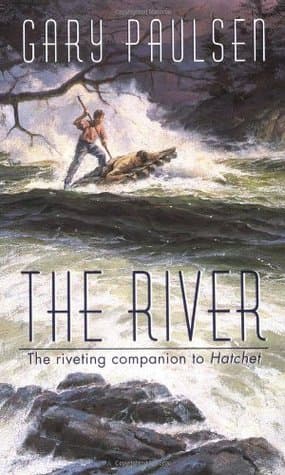
Gary Paulsen (1990)
Genre
Children's / Young Adult
Reading Time
150 min
Key Themes
See below
Sign in to track this book
Tasked by the government to relive his harrowing survival, Brian Robeson must once again brave the wilderness, this time rafting an unconscious psychologist down a treacherous river after a lightning strike disables their only communication.
Two years after his fifty-four days of survival in the Canadian wilderness, Brian Robeson, now sixteen, is living a somewhat normal life. The government unexpectedly contacts him, specifically a man named Caleb, who explains that the military and NASA are interested in studying his survival techniques. They propose an experiment: Brian is to return to the wilderness for a week, accompanied by a government psychologist, Derek Holtzer, to document his methods. Brian is hesitant at first, having moved past the trauma, but the appeal of contributing to science and the subtle pressure from officials persuade him to agree to the unusual request.
Brian and Derek Holtzer fly deep into the Canadian wilderness by a bush plane, landing near a remote lake. They set up a basic camp, with a tent, sleeping bags, and some emergency supplies, though Brian is expected to primarily use his survival skills. Derek begins his detailed observations, recording Brian's every move as he shows how to find food, build shelter, and make fire. Brian feels a mix of familiarity and unease being back in the wild, but he focuses on the task, showing Derek the practical application of the knowledge he gained during his previous ordeal.
Several days into their experiment, a violent and unexpected thunderstorm rolls in. As Brian and Derek huddle in their tent, lightning strikes nearby. The impact is catastrophic; the lightning travels through the ground, hitting Derek directly. Brian is thrown back by the shockwave but is unharmed. He quickly realizes Derek is unconscious and severely injured, his body twitching and his breathing shallow. The lightning strike also destroys their radio transmitter, cutting them off from any hope of immediate rescue. Brian is in a familiar, yet far more serious, survival situation, now with the added responsibility of another life.
After the storm passes, Brian frantically attends to Derek. He finds Derek in a deep coma, unresponsive. Brian remembers basic first aid and tries to make Derek comfortable, but he knows Derek needs immediate medical attention that he cannot provide. Dehydration is a major concern, as is the potential for further complications from the lightning strike. Brian checks their supplies and confirms the radio is completely dead. He realizes that staying put will lead to Derek's death. His only option is to find a way to transport Derek out of the wilderness to a place where help can be found.
While searching through Derek's belongings for anything useful, Brian discovers a small, folded map. It shows their current location and, crucially, a river that flows for a long distance, eventually leading to a trading post marked approximately one hundred miles downstream. This discovery sparks a desperate plan in Brian's mind. He realizes that if he can build a raft strong enough to carry Derek and their remaining supplies, he might be able to navigate the river to the trading post. The journey will be dangerous, but it offers the only hope for Derek's survival.
Brian immediately begins the difficult task of building a raft. He uses his hatchet to cut down small trees and branches, carefully tying them together with vines and strips of bark. He works with desperate urgency, knowing that every hour counts for Derek. The raft needs to be sturdy enough to withstand the river's currents and carry the weight of both him and the unconscious Derek, along with their limited supplies. It takes him a full day of exhausting labor, fueled by adrenaline and determination, to complete a serviceable, though basic, vessel.
With the raft completed, Brian carefully moves the unconscious Derek onto it, securing him as best he can. He loads their remaining supplies, including a small amount of food and water, and pushes off into the river. The current immediately grabs the raft, and Brian, using a makeshift pole, begins to guide it. The river is unpredictable, with sections of calm water giving way to swift currents and minor rapids. Brian is constantly watchful, using all his strength and wits to keep the raft on course and prevent it from capsizing, all while regularly checking on Derek's unchanging condition.
The river journey proves to be incredibly challenging. Brian encounters several sets of rapids, narrowly avoiding disaster by skillfully maneuvering the raft. Food becomes scarce, and he has to rely on his fishing and foraging skills even while navigating the river. The constant stress of keeping Derek alive, coupled with the physical demands of the journey and the isolation, takes a heavy emotional toll. He talks to the unconscious Derek, expressing his fears and his resolve, finding a strange comfort in the one-sided conversations as he battles exhaustion and dwindling hope.
One of the most terrifying moments of the journey occurs when Brian hears the distinct roar of a waterfall ahead. Despite his best efforts to paddle to shore, the current is too strong. The raft plunges over the falls, and Brian desperately clings to it and to Derek. The impact is violent, throwing them into the churning water below. Miraculously, the raft holds together, and Brian, battered but alive, manages to pull himself and the still unconscious Derek back onto it. He is shaken but more determined than ever to reach their destination.
As days turn into a week, Brian starts to notice subtle changes in the landscape – less dense forest, clearer signs of game trails, and even an old, partially submerged log that looks like it might have been cut by a saw. These small indications of human activity reinvigorate his fading hope. He pushes harder, his senses acutely tuned to any further signs. His food supply is almost gone, and his body is weary, but the thought of reaching civilization and saving Derek's life keeps him going. He knows he is getting closer.
Finally, after what feels like an eternity, Brian spots a crude wooden dock and a small cabin through the trees – the trading post. With a surge of renewed strength, he guides the raft to the shore. He is utterly exhausted but overcome with relief. He yells for help, and an elderly man, the proprietor of the trading post, emerges from the cabin. The man is shocked to see Brian and the unconscious Derek. Brian quickly explains their predicament, and the man immediately begins to help, offering what aid he can and preparing to contact authorities for a medical evacuation.
Within hours of their arrival at the trading post, a bush plane arrives, carrying medical personnel. Derek is carefully loaded onto the plane and airlifted to a hospital. Brian is also given medical attention and food, and he contacts Caleb to inform him of what happened. He learns that Derek eventually recovers from his coma, though the recovery is slow and difficult. Brian returns home, once again a survivor, but this time with a deeper understanding of responsibility and human connection, carrying the heavy weight of his unique and harrowing experience.
The Protagonist
Brian transforms from a reluctant participant in a scientific experiment to a determined rescuer, reaffirming his deep connection to the wilderness and his capacity for selfless action.
The Supporting
Derek begins as an active observer but quickly becomes a passive, comatose burden, serving as the central motivation for Brian's heroic efforts.
The Supporting
Caleb's role is largely static, initiating the plot and serving as a point of contact for Brian at the story's conclusion.
The Mentioned
This character provides crucial assistance at the climax of Brian's journey, marking the transition from wilderness survival to human aid.
The main theme is Brian's immense responsibility for Derek's life. Unlike his first survival experience where he was only responsible for himself, here he carries the physical and emotional burden of another human being. This shows in his tireless efforts to build the raft, his constant vigilance during the river journey, and his internal monologues with the unconscious Derek. The weight of this responsibility pushes him beyond his limits, changing a personal survival quest into a selfless act of rescue. For example, his dedication to keeping Derek hydrated and secured on the raft, even while facing his own starvation and exhaustion, highlights this theme.
“He had to get Derek out. He had to. There was no other way. This was not about him, not anymore. This was about Derek.”
Nature is both a source of life and a harsh force, capable of sudden, devastating change. The lightning strike that incapacitates Derek is an example of nature's indifference and unpredictability, derailing a carefully planned scientific experiment. The river itself shows this theme, offering both a path to salvation and a challenge of rapids, waterfalls, and unknown dangers. Brian, despite his experience, is constantly at the mercy of the elements, showing humanity's vulnerability when confronted with the raw power of the wild. The suddenness of the storm and its catastrophic consequences for Derek highlight this theme.
“Nature didn't care about plans, or experiments, or human schedules. Nature just was.”
Brian's ability to adapt and persevere when faced with overwhelming adversity is a core theme. Having survived once, he uses his previous experiences, but this time he must innovate further to solve new, complex problems, such as building a raft capable of transporting a comatose person. His mental strength, his ability to overcome fear, exhaustion, and despair, is repeatedly tested. His resourcefulness in finding food, navigating the river, and protecting Derek shows an extraordinary capacity for resilience, showing the human spirit's ability to endure and overcome seemingly impossible obstacles.
“He was tired. So tired he could barely lift his arms. But he had to. For Derek. For them both.”
While Brian is physically alone for much of the journey, the presence of the unconscious Derek fundamentally changes the nature of his survival. Brian's actions are driven by his connection to another human life, emphasizing that even in the most isolated circumstances, human beings are often connected and dependent on one another. His internal monologues with Derek, despite the lack of response, highlight this bond. The story ultimately argues that true survival sometimes means sacrificing for others, and that the value of human life extends beyond individual existence, creating a shared destiny.
“He talked to Derek, quietly, constantly. Not just to keep himself sane, but because Derek was there. A silent presence, a reason.”
Derek Holtzer's unconscious state drives the plot and elevates the stakes.
Derek's coma serves as the primary plot driver. His incapacitation transforms Brian's intended scientific observation mission into a desperate rescue mission. This device significantly raises the stakes from Brian's previous survival story, as he is now responsible for another life. The fact that Derek is unconscious means Brian cannot rely on him for help, conversation, or decision-making, emphasizing Brian's isolation and the immense burden he carries. It forces Brian to act quickly and decisively, pushing him to find a way out of the wilderness rather than simply enduring.
The lightning strike renders their only communication device useless, isolating them.
The destruction of the radio transmitter by the lightning strike is a critical plot device. It immediately severs their connection to the outside world and eliminates any hope of a quick rescue. This forces Brian to rely entirely on his own skills and ingenuity to find a way out. Without the radio, the option of waiting for help is removed, making the arduous river journey the only viable, albeit perilous, solution. It heightens the sense of isolation and urgency, amplifying the dangerous nature of their predicament.
A hidden map provides Brian with a crucial path to civilization.
The discovery of the map among Derek's belongings is a pivotal plot device. It provides Brian with the crucial information he needs to formulate a plan for escape. Without the map, Brian would be aimlessly wandering or waiting for a rescue that might never come. The map offers a tangible goal – the trading post – and a feasible route – the river. It transforms a seemingly hopeless situation into one with a desperate, but clear, objective, giving Brian direction and renewed purpose in his rescue efforts.
“The river was the key. It always had been. The river would take him where he needed to go.”
— Ben's realization about the importance of the river for his survival and journey.
“He was no longer the same Ben. The wilderness had changed him. It had made him stronger, more aware.”
— Ben reflecting on his personal growth and transformation since his time in the wilderness.
“There was a rhythm to the river, a pulse that matched his own heartbeat.”
— Ben feeling a deep connection and harmony with the natural environment of the river.
“Every stroke of the paddle was a decision, every ripple in the water a potential lesson.”
— Ben's focused and observant approach to navigating the river, learning from every detail.
“The hunger was a constant companion, a dull ache that reminded him of his vulnerability.”
— Ben's ongoing struggle with food scarcity and the physical challenges of survival.
“He had to think like the animals, move like the water, become part of the land.”
— Ben's strategy for adapting to and surviving in the wilderness by mimicking nature.
“The silence of the wild was not empty; it was full of sounds, full of life.”
— Ben's appreciation and understanding of the subtle complexities of the wilderness sounds.
“Fear was a good thing, sometimes. It kept him sharp, kept him alive.”
— Ben acknowledging the role of fear as a survival mechanism, not just a weakness.
“He knew the sun by its arc, the wind by its whisper, the river by its song.”
— Ben's deep intuitive knowledge and connection to the natural elements around him.
“There was beauty in the struggle, a raw, wild beauty that he had never seen before.”
— Ben finding aesthetic value and profound meaning in the challenges of his journey.
“He was alone, but not lonely. The river was his companion, the forest his home.”
— Ben's feeling of contentment and belonging despite his physical isolation.
“The fire was more than warmth; it was a friend, a protector against the dark.”
— Ben's reliance on fire for comfort and safety in the wilderness.
“Every day was a gift, every breath a victory.”
— Ben's profound appreciation for life and his continued existence in the face of adversity.
“He had come to understand that true strength wasn't about fighting, but about enduring.”
— Ben's evolving definition of strength through his experiences in the wild.
“The river had taught him that even when things seemed lost, there was always a way forward.”
— Ben reflecting on the ultimate lesson learned from his journey down the river.
Ready to see how well you understood this book? Take our interactive quiz with 10 questions.

Biography coming soon.

Dan Gemeinhart
4.5

Kate O'Hearn
4.4

Jeanne Birdsall
4.4

Jen Wang
4.4

Wendelin Van Draanen
4.3

John Marsden
4.3

Chris Van Allsburg
4.3
Jennifer A. Nielsen
4.2