“The air shimmered, not with heat, but with something else, something ancient and hungry.”
— Describing the initial feeling upon arriving at the resort.

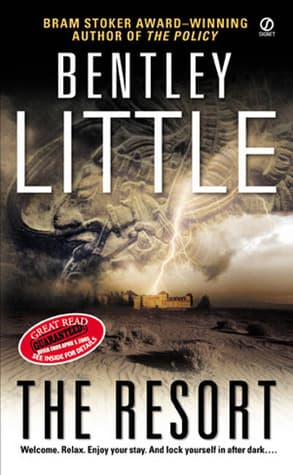
Bentley Little (2004)
Genre
Thriller / Fantasy / Mystery
Reading Time
10-12 hours
Key Themes
See below
Sign in to track this book
A luxurious desert spa becomes a nightmarish trap where disappearing guests and monstrous entities in the pool are just part of the 'relaxation' package.
Frank Favaletta, a struggling writer, arrives at The Reata, a remote and exclusive Arizona desert resort, with his wife, Anne, and their two children, Jason and Debbie. They are immediately struck by the resort's opulent yet strangely deserted atmosphere. The staff, including the enigmatic manager Mr. Thorne, are overly attentive but possess an unnerving uniformity and blankness. Frank observes peculiar details: the resort seems to have no other guests, the staff communicate in an odd, almost telepathic way, and the desert landscape surrounding them feels increasingly hostile. Despite the initial discomfort, the family tries to settle into their luxurious suite, unaware of the sinister forces at play within The Reata's pristine walls.
As the Favalettas explore The Reata, the oddities escalate. Frank witnesses staff members engaged in strange, ritualistic behaviors, and the other 'guests' they occasionally encounter seem dazed and unresponsive. Anne finds herself drawn to the spa's unusual treatments, experiencing vivid, unsettling visions and a growing sense of detachment. Jason and Debbie report seeing shadowy figures and hearing whispers. Frank tries to voice his concerns to Mr. Thorne, who dismisses them with an unsettling calm. The resort's seemingly perfect facade begins to crack, revealing deep dread and a sense of being constantly watched. The family feels increasingly isolated and trapped, with no easy way to leave the remote location.
Frank notices that some of the other guests, who had seemed equally dazed, start to disappear. When he inquires about them, the staff provides vague or contradictory explanations, further fueling his paranoia. He overhears hushed conversations among the remaining guests about strange noises at night and an overwhelming sense of dread. One guest, a woman named Mrs. Henderson, confides in Frank about her fears before she too vanishes. The resort's isolation, coupled with the staff's unsettling demeanor, makes it impossible for Frank to get outside help or confirm his suspicions. The Favalettas realize they are in grave danger, and the resort's tranquil facade is a deadly trap.
Anne becomes increasingly distant and apathetic, spending more time at the spa and with the resort staff. Her personality shifts, becoming colder and less empathetic, particularly towards Frank's growing alarm. She begins to defend The Reata and its practices, dismissing Frank's fears as irrational. Frank observes physical changes in her as well: her eyes seem to hold a vacant stare, and she moves with a strange, almost robotic grace. He suspects she is being subtly brainwashed or influenced by the resort's sinister power, losing her sense of self and becoming another one of its compliant inhabitants. This transformation creates a deep rift between Frank and Anne, isolating him further in his fight against the resort.
Jason, more sensitive and perceptive than Debbie, begins to experience disturbing visions and nightmares. He sees shadowy figures lurking in the corridors and senses a malevolent presence specifically targeting him. The staff show an unusual interest in Jason, often trying to engage him in strange activities or lure him away from his parents. Frank becomes fiercely protective of his son, understanding that the resort's power is trying to corrupt or claim him. He struggles to keep Jason safe while also dealing with Anne's growing detachment and the constant surveillance of the staff. The pressure mounts as Frank realizes his children are in immediate danger.
Driven by desperation, Frank begins to investigate the resort on his own. He discovers a series of hidden tunnels and secret passages beneath The Reata, revealing a vast, dark network. Within these tunnels, he uncovers evidence of bizarre rituals and the fate of the missing guests. He also stumbles upon the source of the resort's power: a monstrous, shapeless entity in the depths of a hidden pool. This creature, a being of immense evil, is responsible for the staff's control and the guests' transformations and disappearances. Frank realizes the resort is not just a place of luxury, but a living, breathing entity that feeds on human fear and essence, and the staff are its devoted servants.
Frank learns that the staff members are not normal humans but a cult dedicated to the entity beneath the resort. They have been serving it for generations, luring unsuspecting guests to The Reata to be sacrificed or transformed. Mr. Thorne is the high priest of this cult, orchestrating the elaborate deception. The resort itself is designed to disorient and control, subtly draining the guests' will and preparing them for their ultimate fate. The 'luxury' and 'relaxation' are merely tools to make victims compliant. Frank understands that The Reata is an ancient evil, a place of profound darkness masquerading as paradise, and his family has become its latest offering.
Frank confronts Mr. Thorne, demanding answers and the release of his family. Thorne, shedding his calm facade, reveals more about the entity's power and its desire to absorb and control. He explains that Anne has been fully integrated into the resort's collective consciousness and that Jason is being prepared for a special role within the cult. Thorne offers Frank a choice: join them and live in eternal 'peace' as part of the resort's consciousness, or be consumed. Frank refuses, reaffirming his humanity and his commitment to his family. The confrontation solidifies Frank's resolve to fight, even against seemingly insurmountable odds.
Desperate to save his children, Frank attempts to gather Jason and Debbie and flee The Reata. However, Anne, now fully under the resort's influence, actively obstructs his efforts. She tries to convince the children to stay, acting as an agent of the resort. Frank is forced to physically restrain Anne or bypass her, adding immense emotional pain to his struggle. The staff, alerted to his escape attempt, pursue him relentlessly through the resort's labyrinthine corridors. Frank realizes that his wife is lost to him, and his priority must be the survival of his children. The resort's power is absolute, and escape seems almost impossible.
Cornered and with his children in tow, Frank makes a desperate final stand. He discovers a way to potentially harm the entity, perhaps by disrupting its connection to the resort or exposing it to something it fears. This involves a dangerous journey back into the hidden tunnels and a direct confrontation with the monstrous thing in the pool. He fights off the possessed staff and the now-hostile Anne, using his wits and sheer will to protect Jason and Debbie. The climax is a chaotic battle against an ancient evil, where Frank's humanity and love for his children are pitted against the overwhelming, insidious power of The Reata.
Frank, battered and traumatized, manages to escape The Reata with Jason and Debbie. The resort, or at least its immediate malevolent influence, seems to be neutralized or significantly weakened, though its ultimate fate is ambiguous. They drive away from the desolate Arizona desert, leaving behind the nightmare. However, the experience leaves deep psychological scars. Anne's fate is left uncertain, possibly still trapped within the resort's consciousness or having perished. Frank and his children must now grapple with the trauma of what they endured, the loss of Anne, and the knowledge of the unspeakable evil that exists in the world. The 'resort' experience forever changes them.
The Protagonist
Frank transforms from a passive observer to a determined, resourceful fighter, sacrificing his own well-being to protect his children.
The Supporting/Antagonist
Anne tragically devolves from a loving wife into a puppet of the resort's entity, losing her humanity.
The Supporting
Jason endures terrifying experiences, but ultimately survives, scarred but unbroken, thanks to his father's protection.
The Supporting
Debbie goes from innocent enjoyment to terrified witness, relying on her family for survival.
The Antagonist
Thorne maintains his sinister composure throughout, serving as the unwavering agent of the resort's ancient evil.
The Antagonist
The entity remains a constant, malevolent force, its power revealed and challenged but never truly destroyed.
The Supporting/Antagonist
The staff remain unwavering in their devotion to the entity, acting as its collective will.
The Reata promises ultimate relaxation and escape from the mundane, but this promise becomes its most insidious trap. Guests, like Anne, are drawn to the idea of shedding their worries, which makes them vulnerable to the resort's mind-altering influences. The 'perfect' environment, free from external problems, becomes a prison where their identities are stripped away. The theme explores how the desire to escape reality can lead to a far more terrifying reality, where one loses their self in the pursuit of an idealized, artificial peace, as seen in Anne's transformation.
““Relax. Let go. That’s what we’re here for.””
A central horror of The Resort is the gradual erosion of individual identity. The guests, particularly Anne, slowly lose their personalities, memories, and free will, becoming blank, compliant shells. The staff members themselves embody this loss, acting as a collective consciousness with no discernible individual traits. Frank constantly fights to retain his own identity and protect his children's. This theme highlights the terror of being consumed, not just physically, but mentally and spiritually, by an external force, turning people into mere vessels for a greater, malevolent will, evident in the dazed 'guests' and the transformed Anne.
““You become part of something greater. You become whole.””
The Reata is presented as a flawless, luxurious oasis, a paradise in the desert. Its pristine aesthetics, attentive staff, and opulent amenities hide a grotesque, ancient evil. This theme explores how superficial perfection can mask profound corruption and horror. The resort's beauty is a lie, a seductive facade designed to disarm and entrap. Frank's initial discomfort with the 'too perfect' atmosphere proves prescient, as the unnatural flawlessness itself becomes a sign of the deeper wrongness. The resort shows that true horror often lurks beneath the most beautiful surfaces.
““Nothing is ever quite this perfect. Not without a price.””
Despite the overwhelming odds and the psychological torment, Frank's unwavering love and devotion to his children, Jason and Debbie, drive his every action. Even as his wife Anne is lost to him, his commitment to his children never falters. This theme highlights the resilience of family bonds as a source of strength against insurmountable evil. It underscores the primal instinct to protect one's offspring and the emotional toll of having to make impossible choices for their survival, particularly when a loved one (Anne) becomes an obstacle. It is Frank's humanity and love that ultimately allow him to resist and escape.
““I won’t let them touch my children. Not ever.””
The remote Arizona desert resort creates a sense of entrapment and helplessness.
The Reata's location deep in the Arizona desert, far from civilization, is a crucial plot device. It immediately establishes a sense of isolation and cuts off any easy means of escape or communication with the outside world. This geographical isolation mirrors the psychological isolation of the characters, intensifying their helplessness and making their plight more terrifying. It prevents Frank from easily seeking help or verifying his suspicions, forcing him to confront the horror within the resort's walls alone. The vast, empty desert surrounding them becomes another silent, indifferent antagonist.
The resort itself becomes an active, deceptive, and malevolent antagonist.
The Reata is more than just a setting; it's a living, breathing, and actively deceptive entity. Its luxury is a trap, its staff are agents, and its very architecture hides secrets. This device makes the environment unreliable and hostile, blurring the lines between safety and danger. The resort's ability to subtly influence minds, make people disappear, and create a false sense of security constantly disorients the characters and the reader. It's a character in itself, constantly working against the protagonists, making escape incredibly difficult.
The resort uses gradual, insidious methods to control and transform its guests.
Instead of overt violence, The Reata employs subtle psychological manipulation. This includes the unnerving politeness of the staff, the constant emphasis on 'relaxation,' the strange spa treatments, and the gradual erosion of personal boundaries. This slow, insidious process makes the horror more effective, as characters (and the reader) question what is real and what is influence. It's a slow burn that builds dread, exemplified by Anne's gradual transformation, where her free will is gently, almost imperceptibly, stripped away before she becomes an antagonist.
The primary antagonist is a cosmic, shapeless entity, fueling existential dread.
The core evil of The Reata is not a tangible monster but a formless, ancient entity lurking beneath the resort. Its indescribable nature amplifies the horror, tapping into primal fears of the unknown and the cosmic. By keeping its true form vague and its motives alien, the story creates a pervasive sense of existential dread. This device ensures that the threat is not easily understood or defeated, making Frank's struggle against it feel desperate and almost futile, as he is fighting against something beyond human comprehension.
“The air shimmered, not with heat, but with something else, something ancient and hungry.”
— Describing the initial feeling upon arriving at the resort.
“It wasn't just a place; it was a living, breathing entity, with its own dark will.”
— Reflecting on the malevolent nature of the resort.
“Every amenity, every smiling face, felt like a carefully constructed trap.”
— The protagonist's growing unease with the resort's perfection.
“The past wasn't dead here; it was merely waiting for the right moment to reassert itself.”
— Hinting at the historical horrors embedded within the resort.
“There are some places that don't just hold secrets, they devour them, along with anyone who gets too close.”
— A character's warning about the resort's dangerous nature.
“The laughter from the pool wasn't joyous; it was the sound of souls being slowly, irrevocably lost.”
— Observing the unsettling merriment of other guests.
“He saw himself in their eyes, a mirror reflecting his own slow descent into madness.”
— The protagonist recognizing his own unraveling in others.
“The brochure had promised paradise. It had delivered a very personalized hell.”
— A bitter realization about the discrepancy between advertising and reality.
“Fear wasn't an emotion here; it was a constant, tangible pressure, like the air itself.”
— Describing the pervasive sense of dread.
“The boundaries between what was real and what was merely perceived blurred into a terrifying, seamless whole.”
— The protagonist's struggle with reality at the resort.
“You can check out anytime you like, but you can never truly leave.”
— A chilling thought about the resort's inescapable grasp.
“The sun felt cold on his skin, a cruel mockery of warmth.”
— Sensory detail reflecting the unnatural state of the resort.
“Every perfectly manicured bush, every pristine fountain, hummed with an unspoken malevolence.”
— Noticing the sinister undertones in the resort's beauty.
“The greatest trick the resort pulled wasn't its illusions, but making you doubt your own sanity.”
— Reflecting on the psychological manipulation employed by the resort.
Ready to see how well you understood this book? Take our interactive quiz with 10 questions.







