“Fate is like a strange, unpopular restaurant filled with odd little waiters who bring you things you never asked for and don't always like.”
— Narrator reflecting on the unpredictable nature of life.

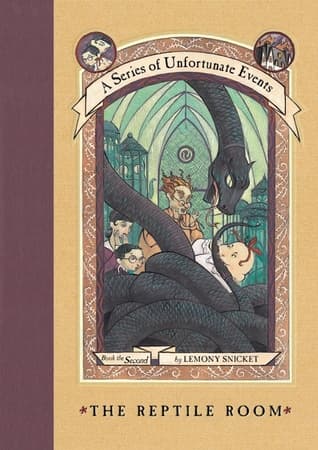
Lemony Snicket (1999)
Genre
Fantasy / Children's / Mystery / Young Adult
Reading Time
120 min
Key Themes
See below
Sign in to track this book
In a house with many snakes and a kind herpetologist, the Baudelaire orphans soon discover their new guardian's happiness hides a plot involving a deadly viper and their worst enemy.
After a fire destroyed their home and killed their parents, the Baudelaire orphans — Violet, Klaus, and Sunny — are taken by Mr. Poe to live with their closest relative, Dr. Montgomery Montgomery, known as Uncle Monty. They travel in Mr. Poe's unreliable car to Uncle Monty's large, isolated house. They notice the smell of cake and a garden. Uncle Monty, a kind and eager herpetologist, welcomes them. He shows them his many reptiles in the 'Reptile Room,' a large conservatory full of snakes, lizards, and other scaled creatures. This includes the Incredibly Deadly Viper, a venomous but gentle snake he says is harmless if treated well. The children feel hopeful and comfortable for the first time since their parents died, believing they have found a safe place.
Uncle Monty plans to take the children on a trip to Peru to study a new snake species. However, his previous assistant, Gustav, suddenly resigned, so he needs to hire someone new. As the children look forward to the trip, a man named Stephano arrives, saying he is the new assistant. The Baudelaires immediately recognize Stephano's single eyebrow, shiny eyes, and an eye tattoo on his ankle. These are signs of Count Olaf, their evil guardian who tried to steal their fortune. Stephano has a detailed disguise, including shaved eyebrows and a new accent. The children are scared and try to warn Uncle Monty, but he dismisses their worries, thinking Stephano is just a strange but harmless man.
The Baudelaire children watch Stephano and gather proof to show Uncle Monty his real identity. Violet sees Stephano sharpening a long knife. Klaus finds a hidden trunk with stage makeup and a disguise kit. Sunny bites Stephano, leaving a clear mark. They show their findings to Uncle Monty, explaining that Stephano is Count Olaf and wants their inheritance. But Uncle Monty, who understands reptile behavior better than villains, thinks Stephano's actions are innocent. He believes the knife is for cutting food, the trunk belongs to a theater group, and Sunny's bite is just a toddler's play. He even suggests Stephano might be a spy from another herpetological group but never sees him as a threat to the children.
The night before their Peru trip, a loud noise wakes the children. They run to Uncle Monty's room and find him dead on the floor with two small marks on his face. Stephano immediately points to a Mamba du Mal cage, one of Uncle Monty's most venomous snakes, saying it must have bitten him. He insists the snake bit Uncle Monty in his sleep and that the children should not touch anything. The children are suspicious. Klaus notes that the Mamba du Mal is a night snake and usually does not bite unless provoked. Its venom also causes different discoloration than what they see on Uncle Monty's face. They realize Stephano, as Count Olaf, killed their kind guardian.
Mr. Poe arrives at the house, followed by the police and an ambulance, to investigate Uncle Monty's death. Stephano, still in disguise, sticks to his story that the Mamba du Mal bit Uncle Monty. The Baudelaires try to tell Mr. Poe that Stephano is Count Olaf and killed their uncle. Klaus points out the Mamba du Mal's behavior and the wounds' nature are inconsistent with Stephano's story. Violet tries to show Mr. Poe the hidden trunk of disguises, but Stephano has already removed the evidence. Mr. Poe, always unaware and focused on rules, dismisses the children's claims as fantasies caused by grief. He believes Stephano's calm manner and logical explanation. He even scolds the children for their 'imagination.'
During the autopsy, done by a local doctor who also believes Stephano, the children get a closer look at Uncle Monty's body. Klaus sees a purple discoloration around the marks on Uncle Monty's face, which is not consistent with Mamba du Mal venom. He remembers seeing similar discoloration on his own ankle after Sunny bit Stephano. This makes him realize that Stephano injected Uncle Monty with a strong, fast-acting venom, then used the Mamba du Mal's fangs to make the two marks, making it look like the snake was responsible. The purple discoloration is a side effect of the injected venom, not the snake's bite. The children now have clear proof of Olaf's crime.
With new resolve, Violet plans to expose Stephano. Knowing the children's words alone are not enough, she decides to use a scientific demonstration. She asks for a strong light and a magnifying glass, which she uses to examine Stephano's ankle. Under the bright light, she shows the eye tattoo, partly hidden by makeup but still visible. She also points out the single, bushy eyebrow Stephano tried to shave but was now growing back. Faced with this clear physical evidence, Mr. Poe finally has to admit that Stephano is Count Olaf. The deception is over, and Olaf's murder plot is revealed.
Exposed, Count Olaf drops his disguise and tries to run away. As he rushes out, he tries to grab the cage with the Incredibly Deadly Viper, a rare and valuable snake, likely to sell it. The children stop him. In the struggle, the snake's cage opens, and the Incredibly Deadly Viper slithers out. Despite its name, the snake is, as Uncle Monty always said, completely harmless. It playfully wraps itself around Sunny's arm, showing it is gentle. Count Olaf, seeing his plan ruined, escapes into the night in his car. The Baudelaires are again without a guardian and face an uncertain future.
With Count Olaf gone, the Baudelaires process losing Uncle Monty, who gave them the closest thing to a loving home since their parents died. Mr. Poe, feeling bad for his earlier doubt, apologizes to the children. The police start looking for Count Olaf, but the children know he is clever and hard to catch. The Reptile Room, once a place of wonder, now feels sad. The children pack their few things, understanding that their time with Uncle Monty, though short and tragic, gave them a brief break from their sadness. They prepare to move to another guardian, their future as unsure and dangerous as ever, knowing Count Olaf is still free.
The Protagonist
Violet's resourcefulness and determination are tested, hardening her resolve to protect her siblings and expose injustice, even when adults fail them.
The Protagonist
Klaus learns to trust his intellectual instincts and apply his vast knowledge to real-world dangers, growing more confident in challenging adult authority when it is misguided.
The Protagonist
Sunny develops her communication and physical abilities, demonstrating her essential role in the Baudelaire team and her surprising bravery in the face of danger.
The Supporting
Uncle Monty represents a fleeting hope for the Baudelaires, his tragic death reinforcing the series' overarching theme of relentless misfortune.
The Antagonist
Olaf's relentless pursuit of the Baudelaire fortune solidifies his role as an unyielding and dangerous adversary, showcasing his cunning and murderous intent.
The Supporting
Mr. Poe's consistent failure to recognize danger and protect the Baudelaires solidifies his role as a symbol of adult ineptitude and the children's isolation.
The Mentioned
The Viper's true nature serves as a symbol of misunderstanding and the contrast between appearance and reality.
The Mentioned
The Mamba du Mal serves as a key plot device, initially a red herring and ultimately a vital clue in unraveling Olaf's crime.
A main theme is that adults consistently fail to protect or believe the Baudelaire orphans. Mr. Poe, despite his good intentions, often does not see Count Olaf's disguises and plans. He dismisses the children's smart observations as childish. Uncle Monty, while kind, is too trusting to see the danger in Stephano. This theme shows the children's isolation and how they must rely on their own intelligence in a world where adults are either bad or unable to help.
““There are many, many reasons to be afraid of a snake. If it is a venomous snake, for instance, it could bite you and inject poison into your bloodstream. If it is a constrictor snake, it could squeeze you until all the bones in your body are broken. If it is a giant snake, it could simply swallow you whole. But if you are a Baudelaire orphan, you are afraid of a snake for a much simpler reason: it means that Count Olaf is nearby.””
This theme is clear through Count Olaf's disguises and the reptiles. Stephano's shaved eyebrows, changed voice, and made-up story are meant to hide his identity as Olaf. Likewise, the Incredibly Deadly Viper, despite its name, is harmless, while the Mamba du Mal is blamed for a murder it did not commit. The children struggle to convince adults of these hidden truths. This shows that appearances can be very misleading, and real danger often hides behind something that looks normal or misleads.
““It is a curious thing, the death of a loved one. It's like walking into a house and turning on all the lights. Only to find that no one is home.””
The Baudelaire children use their skills to find the truth. Klaus's knowledge of reptiles helps him see problems in Stephano's story about the Mamba du Mal. Violet's creative mind helps her find a way to show Stephano's tattoo. Sunny's sharp teeth leave an important mark. Their ability to notice details, connect information, and use their specific talents is their main defense against Count Olaf's plans and the adults' ignorance. This proves that knowledge and careful thinking are strong tools against lies.
““Knowledge is like a library, with countless books of facts, some of which are true and some of which are false.””
The children are still dealing with the loss of their parents, and their short time of hope with Uncle Monty ends badly. This repeated experience of loss and betrayal forces them to become very strong. Despite their fear and sadness, they keep fighting for their safety and for justice, never giving up on exposing Count Olaf. Their ability to handle many sad events, while still grieving, shows their inner strength and their commitment to each other, even as their world falls apart.
““It is a sad truth in life that when one is in a new place, one can often feel very lonely.””
The audience (and children) know Count Olaf's identity, but most adults do not.
Dramatic irony is a pervasive device in 'The Reptile Room.' The reader, along with the Baudelaire children, immediately recognizes Stephano as Count Olaf, but Uncle Monty and Mr. Poe remain oblivious throughout much of the story. This creates tension and frustration, as the audience is privy to information that the characters desperately need, highlighting the incompetence of the adults and the children's isolation in their struggle against evil. This device also builds suspense as the audience anticipates when and how Olaf's true identity will finally be revealed to the ignorant adults.
Count Olaf's primary method of manipulation.
Count Olaf's disguise as Stephano is central to the plot. His shaved head, single eyebrow, and fabricated backstory are designed to deceive, and they successfully fool the adults. The children, however, see through the facade, recognizing his distinctive eye tattoo and cruel demeanor. This device underscores the theme of appearance versus reality and highlights the children's superior observational skills compared to the adults. Olaf's reliance on disguise demonstrates his cunning and his theatrical nature, while also serving as a recurring challenge for the Baudelaires to overcome.
A symbolic setting and source of critical plot elements.
Uncle Monty's Reptile Room is more than just a setting; it's a symbolic space. It initially represents a haven of wonder and knowledge for the children, filled with fascinating creatures. However, it quickly becomes the scene of Uncle Monty's murder and the site of Olaf's attempted frame-up using the Mamba du Mal. The reptiles themselves, from the harmless Incredibly Deadly Viper to the truly venomous Mamba du Mal, are not only plot devices for Olaf's scheme but also serve to illustrate the theme of appearance versus reality and the importance of scientific knowledge (Klaus's expertise) in discerning truth.
The Mamba du Mal is initially presented as the cause of death.
The Mamba du Mal serves as a classic red herring in the murder mystery. Count Olaf deliberately places the highly venomous snake near Uncle Monty's body and claims it was the cause of death. This misdirection is intended to mislead Mr. Poe and the authorities. However, Klaus's knowledge of the snake's behavior and the specific characteristics of its venom allows the children to see through the deception, demonstrating that the obvious explanation is not always the correct one, and forcing them to look deeper for the truth behind the staged accident.
“Fate is like a strange, unpopular restaurant filled with odd little waiters who bring you things you never asked for and don't always like.”
— Narrator reflecting on the unpredictable nature of life.
“It is very useful, when one is young, to learn the difference between 'literally' and 'figuratively.' If something happens literally, it actually happens; if something happens figuratively, it feels like it's happening.”
— Narrator explaining language nuances to the Baudelaire children.
“A good library will never be too neat, or too dusty, because somebody will always be in it, taking books off the shelves and staying up late reading them.”
— Describing Uncle Monty's library, which the children enjoy.
“Sometimes words are not enough.”
— Narrator commenting on a moment of emotional distress for the Baudelaires.
“It is a curious thing, the death of a loved one. We all know that our time in this world is limited, and that eventually all of us will end up underneath some sheet, never to wake up. And yet it is always a surprise when it happens to someone we know.”
— Reflecting on the death of Uncle Monty.
“Wicked people never have time for reading. It's one of the reasons for their wickedness.”
— Narrator musing on the character of Count Olaf.
“The way sadness works is one of the strangest riddles of the world.”
— Narrator describing the children's feelings after a tragic event.
“If you are allergic to a thing, it is best not to put that thing in your mouth, particularly if the thing is cats.”
— Narrator giving humorous advice about allergies.
“It is always sad when someone leaves home, unless they are simply going around the corner and will return in a few minutes with ice-cream sandwiches.”
— Narrator commenting on the children's departure from Uncle Monty's house.
“A library is like an island in the middle of a vast sea of ignorance, particularly if the library is very tall and the surrounding area has been flooded.”
— Describing the importance of Uncle Monty's library.
“There are some things in this world that are too terrible to think about, and so we don't.”
— Narrator reflecting on the children's avoidance of painful thoughts.
“It is a well-known fact that reality is much more frightening than fiction.”
— Narrator comparing the children's real troubles to made-up stories.
“The only thing worse than a lie is a lie that is believed to be the truth.”
— Narrator commenting on Count Olaf's deceptions.
“Miracles are like meatballs, because nobody can exactly agree on what they are made of, where they come from, or how often they should appear.”
— Narrator using a humorous analogy to discuss unlikely events.
Ready to see how well you understood this book? Take our interactive quiz with 10 questions.
Biography coming soon.







