“I was just trying to be normal. But normal is overrated.”
— Nora reflects on her decision to hide her intelligence.

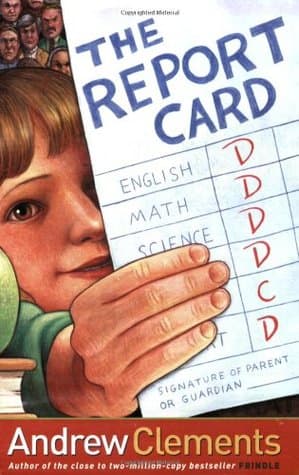
Andrew Clements (2004)
Genre
Children's / Young Adult
Reading Time
180 min
Key Themes
See below
Sign in to track this book
A hidden fifth-grade genius orchestrates a failing report card to expose the absurdity of grades, inadvertently thrusting herself into the spotlight she desperately tried to avoid.
Nora Rose Rowley is an intelligent fifth-grader who has successfully kept her genius a secret from everyone. From a very young age, Nora realized she learned faster and thought differently than other children. She observed how some smart kids were treated as outcasts. She made a conscious decision to act like an average student, deliberately underperforming on tests and assignments. She enjoys learning for its own sake, often reading advanced books and watching educational programs in secret. Her best friend, Stephen, is the only person she truly connects with on a deeper level, though even he is unaware of her full intellectual capabilities. Nora likes her 'normal' life and fears that revealing her true intelligence would isolate her.
As Nora progresses through fifth grade, she notices the increasing pressure placed on students to achieve high grades. Her teachers, Miss Hackney and Mr. Sweeny, frequently discuss grades, and her classmates often compare their scores. Nora observes that many students, including her friend Stephen, become anxious and stressed about their academic performance. They equate their self-worth with their report card. She sees how this system creates unnecessary competition and discourages genuine learning. This widespread obsession with grades deeply bothers Nora. She believes that true intelligence and understanding cannot be accurately measured by a simple letter or number. She feels the grading system is flawed and unfair, leading to a desire to challenge it.
Nora is frustrated with the grading system. She devises a radical plan: she will intentionally earn terrible grades on her first report card. Her goal is to show that grades are not the sole measure of a person's intelligence or worth. She believes that if a seemingly 'average' student like herself can suddenly get all F's, it will force people to question the validity and importance of the grading system. She plans her 'failure' carefully, ensuring she doesn't do anything too obvious, like turning in blank papers. Instead, she submits work that is just poor enough to warrant low marks. She spends weeks executing this plan, carefully managing her performance to avoid suspicion while still achieving her desired outcome: a disastrous report card.
When Nora's report card arrives, it is, as planned, filled with F's. Her parents, Mr. and Mrs. Rowley, are shocked and devastated. They cannot comprehend how their seemingly average daughter could suddenly be failing every subject. They immediately schedule a meeting with Nora's teachers, Miss Hackney and Mr. Sweeny, and the school principal, Mrs. Davis. During this meeting, the teachers express their surprise, noting that Nora has always been a quiet, compliant student, though never exceptional. Mrs. Davis suggests that Nora might be having personal problems or struggling with a learning disability. Nora observes these discussions, feeling a mix of guilt for upsetting her parents and satisfaction that her plan is unfolding, though the attention is already becoming uncomfortable.
Nora is overwhelmed by the escalating situation and the pressure from her parents and school. She decides she needs to confide in someone. She chooses her best friend, Stephen. One afternoon, she takes Stephen to the library and, showing him an advanced book she's reading, reveals her genius and her plan to intentionally fail. Stephen is initially stunned and disbelieving. As Nora explains her reasoning about the unfairness of grades, he begins to understand and even sympathize with her motives. He agrees to help her, becoming her confidant and co-conspirator. This shared secret deepens their friendship, and Stephen, who has always been a good student, starts to view his own grades and the school system with a more critical eye.
Following the disastrous report card, the school intervenes. Mrs. Davis, concerned about Nora's sudden decline, arranges for her to receive extra tutoring and special attention. Nora is in a difficult position: she needs to continue acting 'dumb' enough to maintain her cover, but the increased scrutiny makes it harder. She also sees how her actions genuinely upset her parents and cause concern for her teachers. The attention she had sought to ignite a conversation about grades is now focused entirely on her perceived academic problems. Nora begins to question whether her plan is worth the emotional toll it is taking on those around her, especially Stephen, who is now actively helping her navigate the situation.
As Stephen helps Nora maintain her charade, he finds himself becoming less focused on his own schoolwork. He starts to question the importance of his own good grades. He feels the pressure to perform while also understanding Nora's critique of the system. His grades begin to slip slightly, which concerns his parents. Nora witnesses Stephen's struggle and the unintended negative consequences of her initial plan. She realizes that simply failing is not enough. It is causing distress without clearly conveying her message. She decides they need a new strategy, one that will highlight the absurdity of the grading system more directly and involve more students. This will shift the focus from her individual 'failure' to a broader discussion.
Nora, with Stephen's help, develops a new plan. Instead of failing, she proposes that a group of students aim for 'average' grades – C's and B's – to show that grades don't define intelligence and to lessen the pressure on everyone. They start by talking to their classmates, explaining Nora's perspective on grades and how they create unnecessary stress. They articulate that students should learn for the sake of learning, not just for a letter grade. Gradually, they convince a small but growing group of students to join their 'no grades' movement, agreeing to aim for consistent average scores rather than striving for perfection, hoping to make a collective statement to the school administration.
The 'no grades' movement gains traction among Nora and Stephen's classmates. Students who were once competitive or anxious about grades begin to relax, aiming for solid average scores. This collective shift in academic performance puzzles Miss Hackney and Mr. Sweeny, who notice a uniformity in their students' work. Parents, too, start to question why their children, who were once striving for A's, are now content with B's and C's. The teachers and principal, Mrs. Davis, hold more meetings, trying to understand this new phenomenon. Nora and Stephen subtly guide the conversations, planting seeds of doubt about the effectiveness and fairness of the grading system, hoping to spark a school-wide dialogue.
During a meeting involving parents, teachers, and the principal, Nora decides it's time to reveal her true intelligence and the full scope of her plan. She articulates her arguments against the current grading system with clarity and maturity. She explains how it promotes anxiety, competition, and a superficial approach to learning. Her revelation shocks everyone, especially her parents and teachers, who had misjudged her abilities. Her classmates, particularly Stephen, support her, explaining their participation in the 'no grades' movement. Nora's act and well-reasoned arguments ignite a debate among the adults and students about the purpose and impact of grades, forcing the school community to re-evaluate its beliefs.
Nora's revelation and the ensuing debate lead to changes at Philbrook Elementary. While grades are not abolished entirely, the school implements a new policy that emphasizes effort, participation, and individual growth alongside academic performance. Teachers provide more qualitative feedback, and the focus shifts from letter grades to a holistic understanding of student progress. Nora, no longer hiding her genius, finds a new sense of liberation and acceptance. She continues to excel academically, now openly and without fear of isolation. Her friendship with Stephen remains strong, and both are proud of the positive impact they had on their school community, proving that a single voice, or a collective one, can challenge the status quo.
The Protagonist
Nora transforms from a secretive genius afraid of exposure to a courageous advocate for educational reform, ultimately finding acceptance for her true self.
The Supporting
Stephen evolves from an ordinary good student to a critical thinker who actively supports a cause, deepening his understanding of education and friendship.
The Supporting
They move from confusion and concern over Nora's 'failure' to pride and understanding of her genius and her principled stand.
The Supporting
She shifts from adhering strictly to traditional grading to being open to new perspectives on student assessment.
The Supporting
He moves from a conventional view of grading to a more nuanced understanding of student motivation and assessment.
The Supporting
She evolves from trying to fix a 'problem student' to leading a school-wide re-evaluation of educational practices.
The Mentioned
She shifts from grade-focused learning to a more relaxed, intrinsic motivation for education.
The central theme is that traditional letter grades are an inadequate and potentially harmful measure of intelligence, effort, and true learning. Nora's plan exposes how grades create anxiety, promote unhealthy competition, and distract students from the intrinsic joy of learning. The book shows how students become obsessed with the 'score' rather than the knowledge itself, leading to stress and a superficial understanding of subjects. The collective 'no grades' movement further emphasizes that a uniform grading system fails to account for individual learning styles, passions, and growth.
“''Grades are like a game, and the points don't really matter. It's the playing that counts.'”
Nora's journey relates to her struggle with her identity as a genius. For years, she hides her true self, fearing that being different will lead to isolation. Her initial plan to fail is a way to maintain her 'average' identity while challenging a system she dislikes. However, as the plot unfolds, she realizes the emotional cost of hiding her true abilities and the importance of being authentic. Her decision to reveal her genius, despite her fears, is a step towards self-acceptance and finding her voice. It shows that true belonging comes from being oneself.
“'Sometimes it felt as if the real Nora was a secret, locked away in a box, and only she had the key.'”
The novel highlights the theme of challenging established systems and speaking truth to power, even for a child. Nora, with Stephen's help, questions a fundamental aspect of the educational system that adults have long accepted. Her initial act of defiance with the F's, and then the more organized 'no grades' movement, shows the power of individual and collective action. The book encourages readers to critically examine norms and to advocate for change when they believe something is unjust or ineffective, showing that age does not diminish the capacity for impactful social commentary.
“'Nora knew that sometimes, to make people really think, you had to do something drastic.'”
Running parallel to the critique of grades is the exploration of what genuine education means. Nora, despite her 'failure,' is a learner, driven by curiosity and a love for knowledge. The book contrasts this intrinsic motivation with the extrinsic motivation of grades, suggesting that the latter often stifles the former. The 'no grades' movement aims to redirect focus from competitive scores back to the joy of discovery, critical thinking, and personal growth. The story promotes an educational environment where students feel safe to explore, make mistakes, and learn at their own pace, rather than constantly performing for a grade.
“'Learning wasn't about getting a good grade. It was about finding out new things, solving problems, and thinking.'”
A character with extraordinary hidden abilities drives the central conflict.
Nora's concealed genius is the fundamental premise of the story. This device allows the author to explore themes of identity, societal expectations, and the pressure to conform. By having a highly intelligent protagonist deliberately underperform, the narrative creates a unique perspective from which to critique the education system. It also builds suspense as readers wonder when and how Nora's secret will be revealed and what the consequences will be, making her eventual confession a powerful turning point in the plot.
A protagonist deliberately underperforms to make a statement.
Nora's decision to intentionally receive all F's on her report card serves as the inciting incident and a major plot driver. This act of calculated rebellion is a direct challenge to the grading system she despises. It creates immediate conflict with her parents and the school and forces the adults to pay attention. This device is crucial for setting up the subsequent investigations, meetings, and ultimately, the school-wide debate. It's a non-violent, intellectual form of protest that puts her principles into action.
A group of students unite to challenge an established norm.
Initially, Nora's plan is individual, but it evolves into a collective 'no grades' movement involving Stephen and other classmates. This plot device amplifies the impact of Nora's message, transforming it from a personal problem into a broader social issue within the school. It demonstrates the power of peer influence and collective action, showing that a shared belief can lead to significant change. The collective nature of the movement makes the critique of grades more compelling and harder for the adults to dismiss as an isolated incident.
“I was just trying to be normal. But normal is overrated.”
— Nora reflects on her decision to hide her intelligence.
“Grades don't measure what you know. They measure what you do on a test.”
— Nora explains her view on the school grading system.
“Sometimes the smartest thing you can do is act dumb.”
— Nora discusses her strategy of underperforming in school.
“A test score doesn't tell you who a person is.”
— Nora argues against judging people by academic performance.
“I wanted to see what would happen if I stopped trying.”
— Nora describes her experiment with getting bad grades.
“Learning isn't about grades. It's about understanding.”
— Nora shares her philosophy on true education.
“People treat you differently when they think you're smart.”
— Nora observes how perceptions of intelligence affect relationships.
“Why should one test decide how smart you are?”
— Nora questions the validity of standardized testing.
“I didn't want to be the smart kid. I just wanted to be a kid.”
— Nora expresses her desire for a normal childhood.
“Sometimes you have to break the rules to make a point.”
— Nora justifies her actions in challenging the system.
“It's not about being the best. It's about being yourself.”
— Nora advises a friend on authenticity.
“A report card is just a piece of paper. It doesn't define you.”
— Nora reassures a classmate worried about grades.
“Smart isn't something you are. It's something you do.”
— Nora explains her view on intelligence as action.
“The system is broken, but we don't have to be.”
— Nora encourages her peers to rise above flawed educational norms.
Ready to see how well you understood this book? Take our interactive quiz with 10 questions.

Andrew Clements was a prolific author of children's literature, celebrated for his engaging and relatable stories. His notable works include the beloved "Frindle," "A Week in the Woods," and the "Jake Drake" series, which often explored themes of school, friendship, and growing up. Clements' accessible writing style and keen understanding of young readers earned him widespread critical acclaim and a dedicated fanbase.

Dan Gemeinhart
4.5

Kate O'Hearn
4.4

Jeanne Birdsall
4.4

Jen Wang
4.4

Wendelin Van Draanen
4.3

John Marsden
4.3

Chris Van Allsburg
4.3

Jennifer A. Nielsen
4.2