“Go to the end of the world, if you must, but bring back wisdom.”
— Prince Jen's father, the Emperor, sends him on a quest.

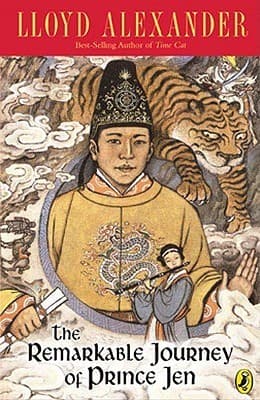
Lloyd Alexander (1991)
Genre
Fantasy / Children's / Historical Fiction / Young Adult / Romance
Reading Time
300 min
Key Themes
See below
Sign in to track this book
Prince Jen, on a quest to a legendary court, travels a dangerous land with mysterious gifts and loyal friends, learning about leadership and himself.
Prince Jen, heir to Tungho, is a spirited but naive young man who wants adventure. When an old prophecy mentions the legendary court of T'ien-kuo, a place of wisdom and peace, Jen volunteers to find it. His father, the Emperor, consults an old man named Master Hu, who gives Jen six ordinary gifts: a saddle, a sword, a paint box, a bowl, a kite, and a flute. Master Hu warns Jen that the gifts are not what they seem and their true purpose will only be revealed during his journey. Jen, with his loyal but anxious servant Mafoo, leaves Tungho, full of youthful confidence and a sense of destiny, though confused by the simple gifts.
Soon after leaving Tungho, Jen and Mafoo face problems. Their best horse, meant for Jen, is stolen, and Jen must ride a small, stubborn donkey. This humbling experience, along with the difficult journey, starts to chip away at Jen's pride. He first thinks the saddle Master Hu gave him is useless without a grand horse. However, when the donkey throws him, Jen realizes the saddle, though plain, gives stability and comfort, no matter the animal. This incident suggests that the gifts have deeper, metaphorical meanings beyond their literal looks, making Jen question his ideas about status and value.
Jen and Mafoo are attacked by bandits led by General Tsei-wei. Jen, using the sword from Master Hu, tries to fight them with force but is easily beaten. Mafoo, despite his fear, distracts the bandits, letting Jen escape, though they lose most of their belongings. Jen is discouraged by his failure. Later, they find a village being robbed by the same bandits. Jen realizes the sword's purpose is not just for personal fighting, but for defending the innocent and upholding justice, even when outnumbered. He uses it to disarm and outsmart the bandits, instead of fighting directly, securing the villagers' safety.
Continuing their journey, Jen and Mafoo find a reclusive artist named Master Wu, who lives in poverty but creates beautiful art. Jen, still focused on the practicalities of their journey, first sees the paint box as useless. Master Wu, however, shows how the paint box, with simple colors, can change perception and create beauty from ordinary things. He teaches Jen that true art is not just about skill, but about seeing the world with an open heart and mind, and capturing the essence of things. This meeting broadens Jen's understanding of value beyond material wealth and physical power.
Jen and Mafoo find themselves in a barren area, suffering from hunger and thirst. They meet a wise, elderly hermit who owns little but shares what he has. Jen, still focused on his own needs, is confused by the empty bowl Master Hu gave him, seeing no practical use for it. The hermit shows that the bowl is meant to be filled not just with food for oneself, but with generosity for others. He explains that true nourishment comes from sharing and receiving, and that an empty bowl can symbolize a readiness to give and accept help. This lesson deeply affects Jen, teaching him compassion and interdependence.
Jen and Mafoo arrive in a town where they meet Voyaging Moon, a spirited and independent girl who plays the flute well. Voyaging Moon is trying to help her poor community. Jen, at first interested in her, is still somewhat self-absorbed. The kite, one of Master Hu's gifts, seems the most frivolous. However, Voyaging Moon, through her determination and her dreams for her people, inspires Jen. Together, they use the kite not just for play, but as a symbol of hope and a way to send messages of encouragement. Jen realizes the kite means aspiration, the ability to reach for higher goals, and to lift spirits even in hard times, a lesson he learns alongside Voyaging Moon's own resilience.
As Jen and Voyaging Moon become closer, she teaches him to play the flute. At first, Jen struggles, making only harsh sounds. Voyaging Moon patiently guides him, explaining that true music comes from within, from a harmonious spirit. The flute, the final gift, becomes a symbol for self-expression, communication, and finding inner peace. By learning to play, Jen starts to understand himself better, to listen more carefully, and to express his emotions and thoughts in a new way. The music they create together symbolizes their growing bond and Jen's developing maturity, as he learns to blend his own voice with others.
During their travels, Mafoo, overcome by fear and hardship, briefly betrays Jen by trying to leave him and return to Tungho. This act deeply hurts Jen, shaking his trust. However, after thinking and talking with Voyaging Moon, Jen realizes Mafoo's actions came from fear, not malice. He chooses to forgive Mafoo, understanding that true leadership involves compassion and inspiring loyalty rather than demanding it. This incident strengthens Jen's growth, showing his capacity for empathy and his changing understanding of human nature, making him a more effective and understanding leader.
Jen, Voyaging Moon, and Mafoo eventually confront General Tsei-wei and his bandits again, who are now threatening a larger area. This time, Jen is not the naive prince who first met them. He uses the lessons from the gifts: the sword for strategic defense, the saddle for steady leadership, the paint box for creative problem-solving, the empty bowl for inspiring generosity among the villagers, the kite for communication and morale, and the flute for unity and courage. With Voyaging Moon's bravery and Mafoo's renewed loyalty, they gather the local people and, through cleverness and cooperation, defeat General Tsei-wei, bringing peace to the region.
After their victory over General Tsei-wei, Jen, Voyaging Moon, and Mafoo continue their journey, feeling a sense of purpose. They eventually arrive at a simple, unadorned place that is T'ien-kuo. It is not a grand court as Jen had imagined, but a peaceful community of wise individuals. Jen realizes that the true 'court' was never a physical place of splendor, but the wisdom, compassion, and leadership he developed through his trials. The journey itself, and the lessons from the six gifts, changed him into a wise and just ruler worthy of understanding T'ien-kuo's true meaning. He has found the legendary court within himself.
Prince Jen, now a mature and enlightened young man, returns to Tungho with Voyaging Moon and Mafoo. He is no longer the proud and naive boy who left. His experiences have given him humility, wisdom, and a deep understanding of his people and the world. He brings back not material treasures, but the valuable lessons learned from Master Hu's gifts. His father, the Emperor, and the people of Tungho see the profound change in him. Jen is now truly prepared to rule, not just by birthright, but by character, ready to apply the wisdom of T'ien-kuo to his own kingdom, promising a reign of justice, compassion, and peace.
The Protagonist
Jen transforms from a naive, prideful prince into a wise, compassionate, and effective leader, understanding that true power lies in humility, empathy, and integrity.
The Supporting
Mafoo overcomes his overwhelming fear to become a truly courageous and steadfast companion, finding his own strength through hardship.
The Supporting
Voyaging Moon remains true to her compassionate nature, guiding Jen and finding love and partnership along the way.
The Supporting
Master Hu's role is primarily to initiate Jen's journey, his arc is complete upon bestowing the gifts.
The Antagonist
Tsei-wei remains a force of chaos, ultimately defeated by Jen's growth and the application of his learned wisdom.
The Supporting
Master Wu's role is to impart a specific lesson to Jen regarding art and perception.
The Supporting
The Hermit's role is to impart a specific lesson to Jen regarding generosity and community.
The main theme is Prince Jen's change from a naive, proud youth to a wise and compassionate leader. His physical quest for T'ien-kuo symbolizes his internal journey of self-discovery. Each challenge he faces, and each lesson from the six gifts, removes a layer of his initial arrogance and ignorance, showing his true potential. This theme is clear from his confident departure to his return as a mature ruler, understanding that the true 'court' was the wisdom he gained within himself, not a physical place. The journey's difficulties are key to his growth.
“The greatest treasure is not what you find, but what you become.”
The book explores the idea that true wisdom and power are not found in wealth, status, or brute force, but in humility, compassion, and understanding. Jen first seeks glory and power through traditional means (a grand horse, a sharp sword), but he learns that real strength comes from empathy (the empty bowl), creativity (the paint box), spiritual aspiration (the kite), effective communication (the flute), and steady leadership (the saddle). His defeat of General Tsei-wei is not through greater force, but by using these nuanced forms of wisdom. T'ien-kuo itself shows this theme, being a place of quiet wisdom rather than showy grandeur.
“A king rules not by the strength of his arm, but by the wisdom of his heart.”
Each of Master Hu's six gifts is a powerful symbol, representing a different part of Jen's character development and the virtues he must learn. The saddle teaches humility and steady purpose, regardless of outside circumstances. The sword means justice and strategic defense, not just aggression. The paint box represents perception, creativity, and finding beauty. The empty bowl symbolizes generosity and human connection. The kite stands for aspiration, hope, and rising above challenges. The flute embodies inner harmony, self-expression, and communication. Together, they form a complete course for Jen's moral and spiritual education, showing that the most valuable tools often have the deepest symbolic meaning.
“The gifts are not what they seem, Prince Jen. Their true purpose will unfold as you do.”
Jen's journey is not alone; his relationships with Mafoo and Voyaging Moon deeply shape it. Mafoo's constant, though fearful, loyalty provides a steady anchor and shows Jen his own growth. Voyaging Moon offers not only love but also important lessons in compassion, music, and resilience. Mafoo's brief betrayal highlights the fragility of trust and the importance of forgiveness and understanding in keeping relationships strong. Their combined efforts are essential in overcoming obstacles, showing that even a prince needs the support and wisdom of others to succeed. The theme emphasizes that true leadership involves building loyalty and working with others.
“No journey is truly taken alone, for our companions shape the path as much as we do.”
A set of seemingly ordinary objects that serve as symbolic tools for Prince Jen's education.
The six gifts—a saddle, a sword, a paint box, a bowl, a kite, and a flute—are the central plot device. They function as both literal objects that Jen carries and metaphorical lessons he must learn. Each gift is introduced at the beginning as an enigma, and its true meaning is revealed through Jen's experiences and interactions with various characters. They provide a clear structure for Jen's character arc, with each gift corresponding to a specific virtue or understanding he must acquire. They act as a test, a guide, and ultimately, a symbol of his transformation.
Prince Jen's journey to find the legendary court of T'ien-kuo, following a classic narrative structure.
The entire narrative is framed as a classic Hero's Journey. Prince Jen receives a call to adventure (the quest for T'ien-kuo), crosses the threshold from his familiar world, faces trials and tribulations, gains allies (Mafoo, Voyaging Moon), encounters mentors (Master Hu, Master Wu, the Hermit), experiences a symbolic death and rebirth (his transformation), and ultimately returns to his world as a changed individual. This structure provides a universal framework for understanding Jen's growth and the archetypal nature of his journey.
Characters who highlight the protagonist's traits or flaws through contrast.
Mafoo serves as a significant foil to Prince Jen. Mafoo's constant fear and practicality contrast sharply with Jen's initial arrogance and idealism, making Jen's growth in humility and courage more apparent. General Tsei-wei acts as a villainous foil, representing the destructive power Jen must overcome, highlighting the difference between brute force and wise leadership. These characters emphasize Jen's development by providing points of comparison and conflict that force him to evolve.
The use of objects, characters, and places to represent deeper ideas or qualities.
Beyond the explicit symbolism of the six gifts, the novel employs broader symbolism. T'ien-kuo itself symbolizes inner peace, wisdom, and enlightenment rather than a physical kingdom. The journey through diverse landscapes symbolizes the varied experiences and challenges of life. The music played on the flute symbolizes harmony, connection, and the expression of the soul. This rich symbolism elevates the narrative beyond a simple adventure story, inviting readers to consider deeper philosophical and moral lessons.
“Go to the end of the world, if you must, but bring back wisdom.”
— Prince Jen's father, the Emperor, sends him on a quest.
“A journey of a thousand miles begins with a single step, but it is the steps after that truly test the traveler.”
— A variation of an old proverb, often pondered by Jen.
“One does not choose wisdom; wisdom chooses the one who seeks it.”
— Spoken by the philosopher, Master Hu.
“The greatest treasure is not what you find, but what you become in the finding.”
— A recurring theme as Jen undergoes transformations.
“Sometimes the shortest path to a goal is the one that seems longest.”
— A lesson learned by Jen through various detours and struggles.
“True strength is not in never falling, but in rising every time you fall.”
— A piece of advice given to Jen after a setback.
“Fear is a fog that blinds the eyes and chills the heart, but it can be swept away by a single ray of courage.”
— Jen confronts his own fears and doubts.
“A good deed, however small, can ripple outward to touch many lives.”
— Jen witnesses the impact of kindness throughout his journey.
“The world is full of wonders, if only you open your eyes to see them.”
— Jen's growing appreciation for the world beyond his palace.
“Love is a bridge that can span the widest chasms.”
— Jen's growing affection for other characters and his people.
“Even the mightiest emperor is but a man, and wisdom is his truest crown.”
— A reflection on the nature of leadership and power.
“To truly know oneself, one must first lose oneself.”
— Jen's experiences often lead him away from his royal identity.
“The greatest battles are not fought with swords, but within the heart.”
— Jen faces internal struggles more challenging than external threats.
“Sometimes, the answers you seek are not found in distant lands, but in the heart of your own home.”
— Jen's eventual realization about the nature of his quest's end.
Ready to see how well you understood this book? Take our interactive quiz with 10 questions.

Biography coming soon.







