“Most things, most times, are not what they seem.”
— Early on, as the strange events begin to unfold in Wentworth, Ohio.

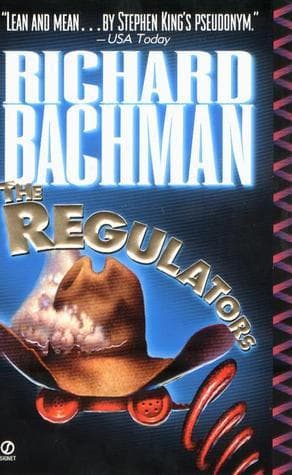
Richard Bachman (1996)
Genre
Thriller / Fantasy / Science Fiction
Reading Time
10-12 hours
Key Themes
See below
Sign in to track this book
On a quiet Poplar Street, an idling red van unleashes a surreal, cartoonish nightmare as evil forces transform the suburban neighborhood into a battleground.
A peaceful afternoon on Poplar Street in Wentworth, Ohio, ends when a red van, seemingly an ice cream truck, drives onto the street. From it emerge bizarre, cartoonish figures resembling cowboys, armed with anachronistic and deadly weapons. These 'Regulators' immediately begin a brutal assault on residents and their homes, turning the familiar street into a nightmarish battlefield. The attack is sudden, unprovoked, and violent, leaving inhabitants bewildered as their reality begins to unravel. The first victims are innocent bystanders, caught off guard by the absurdity and lethality of the invasion.
The Regulators' initial assault kills many adult residents of Poplar Street. The violence is graphic and relentless, with no apparent logic. Amidst the chaos, it becomes clear that the strange phenomena—the cartoonish villains, the transforming landscape, the bizarre weaponry—connect to the minds of the children on the street, particularly Seth Garin. Seth, a young autistic boy, and his recently deceased cousin, Collie Entragian, shared an intense imaginative world, fueled by old Westerns and children's cartoons. This shared fantasy, now twisted by a malevolent entity, manifests physically, turning their innocent games into a deadly reality.
Mary Jackson, a writer living with her sister Ellen and nephew Seth, quickly realizes the supernatural nature of the attack. She is one of the few adults who does not immediately panic, instead trying to protect Seth and understand the unfolding horror. She observes Seth's unusual reactions and how his attention seems to influence the manifestations. Mary's maternal instincts take over, but she also needs to understand the 'story' behind the madness. Her efforts to shield Seth become central, as she suspects his unique mind is both the source and the potential key to stopping the onslaught.
As the situation worsens, the true nature of the threat emerges. The Regulators and the increasingly surreal environment are controlled by the malevolent spirit of Collie Entragian, a serial killer who recently died in a shootout with police. Collie's spirit, possessing Seth Garin, uses Seth's powerful imagination and autistic mind to project his twisted fantasies and dark desires onto Poplar Street. Collie's personality, a mix of childish cruelty and adult depravity, shapes the Regulators and their actions, turning the street into a living nightmare of his own design. He feeds off the fear and chaos he creates.
Audrey Wyler, an elderly resident of Poplar Street, has some psychic sensitivity. She experiences vivid visions and premonitions, which give her a terrifying, fragmented understanding of the forces at play. She sees the ghost of Collie Entragian and understands his connection to Seth. Her insights, though often cryptic and disbelieved by others, provide crucial pieces of the puzzle for Mary and other survivors. Audrey's struggle to communicate her visions and her eventual confrontation with the source of the evil highlight the supernatural elements of the narrative and her role as an unwitting oracle.
Under Collie Entragian's influence, Poplar Street undergoes grotesque and impossible transformations. Houses become animated, roads turn into deserts, and objects warp into monstrous versions of themselves. Reality itself stretches and tears, reflecting Collie's chaotic and childishly malevolent imagination as channeled through Seth. These transformations are not just cosmetic; they pose real dangers, trapping residents, creating new obstacles, and further disorienting the survivors. The street becomes a dynamic, unpredictable prison, a literal playground for the entity's dark fantasies.
As deaths rise, a small group of survivors—including Mary Jackson, her sister Ellen, Seth, Audrey Wyler, and others like John Marinville and Steve Ames—form an uneasy alliance. They are united by shared terror and the desperate need to survive. They attempt to make plans, share information, and protect each other from the constant threat of the Regulators and the mutating environment. Despite personal differences and initial skepticism, the extreme circumstances force them to rely on one another, showing community and resilience in the face of overwhelming horror. Their fight is not just against the Regulators, but against despair itself.
Mary Jackson, guided by Audrey's fragmented visions and her own observations, realizes that Seth is not just a victim but the critical conduit for Collie Entragian's power. They understand that to stop the Regulators and restore reality, they must reach Seth and sever Collie's connection to him. This realization shifts their focus from mere survival to a desperate mission to save Seth, knowing that doing so might be their only chance to save themselves and Poplar Street. The confrontation becomes less about fighting the Regulators and more about confronting the entity within Seth.
In a climactic struggle, the remaining survivors, led by Mary Jackson, make a desperate push to reach Seth and break Collie Entragian's hold over him. The street is a maelstrom of surreal dangers and Regulator attacks. Mary understands that she must reach Seth not with violence, but with love and understanding, appealing to his true self beneath Collie's influence. This confrontation is emotional and psychological, as Mary tries to break through the mental barriers imposed by Collie, while simultaneously fending off physical attacks from the cartoonish villains who are manifestations of Collie's rage and fear.
Mary's desperate efforts to reach Seth succeed, and the connection between Collie Entragian's spirit and Seth's mind is severed. With Collie's influence gone, the Regulators vanish, and Poplar Street slowly reverts to its normal, peaceful state. The houses, cars, and landscape return to their original forms, leaving behind only the physical evidence of the horrific events: the bodies of the deceased and the traumatized survivors. While reality is restored, the psychological scars run deep. The few remaining residents must grapple with the unimaginable horror they witnessed and the profound loss they endured, forever changed by their encounter with the Regulators.
The Protagonist
Mary transforms from a cynical observer into a courageous protector, ultimately confronting the source of the evil to save her nephew.
The Central Figure/Victim
Seth is initially a passive victim but is ultimately freed from the control of Collie Entragian, returning to his innocent self though traumatized.
The Antagonist
Collie's arc is one of sustained malevolence, culminating in his defeat and expulsion from Seth.
The Supporting
Audrey's arc reinforces her role as a seer, culminating in her providing the final pieces of the puzzle before her fate is sealed.
The Supporting
Steve's arc is one of a common man trying to cope with an impossible situation, ultimately facing tragic loss.
The Supporting
Ellen's arc involves her struggle to accept the supernatural truth and her reliance on Mary for strength and guidance.
The Supporting
John's arc is one of reluctant involvement, applying his past experiences to a new, equally horrific situation.
The Antagonists
The Regulators exist only as manifestations of Collie's power, appearing and disappearing until his influence is broken.
The novel explores how imagination, particularly a child's, can be a force for both wonder and terror. Seth Garin's autistic mind, with its vivid inner world, becomes the conduit for Collie Entragian's malevolent spirit. What begins as innocent play with toy cowboys and cartoon characters transforms into a living nightmare, showing how creative energy, when corrupted, can warp reality itself. The Regulators, the transforming houses, and the surreal landscapes are all products of this twisted imaginative power, highlighting the terrifying potential of the mind when it falls into the wrong hands.
“It was like the world had turned inside out, and the cartoon they watched every Saturday morning had come to life, not as a friendly show, but as a bloodbath.”
A central theme is the shattering of innocence and the breakdown of reality. Poplar Street, a symbol of suburban tranquility, is violently invaded by forces that defy all logic. The children, who were once playing games, now witness unspeakable horrors, and their world is irrevocably changed. Adults struggle to comprehend and cope as their understanding of the world is dismantled. The novel suggests that once innocence is lost and reality is fractured, it can never be fully restored, leaving deep psychological scars on those who survive. The normalcy of life is tainted.
“The world was no longer sane. Poplar Street was no longer Poplar Street. It was something else, something dreamed up by a madman, or a child, or both.”
The Regulators presents a terrifying vision of evil, not as a tangible force, but as a parasitic, malevolent spirit that preys on the vulnerable. Collie Entragian's spirit, without a body, finds a new way to inflict suffering by hijacking Seth's mind. This evil is chaotic, childishly cruel, and driven by a primal urge to destroy and corrupt. It manifests through the familiar and the absurd—cartoon characters, everyday objects—making it even more unsettling. The novel suggests that evil can adapt and find new forms, particularly when it can exploit innocence and untapped potential.
“It wasn't just a ghost. It was a disease, a cancer that ate at the world through a child's mind.”
Despite the overwhelming horror, the novel also explores the human instinct to survive and the unexpected bonds that form under extreme duress. The disparate residents of Poplar Street, initially strangers, must rely on each other for protection and support. They form a fragile community, pooling resources and courage to face an incomprehensible enemy. This theme highlights resilience, the power of collective action, and the enduring human spirit even when confronted with insurmountable odds. Their shared trauma creates an unbreakable, if tragic, connection.
“We're all we've got. If we don't stick together, we're all going to die out here, one by one.”
The shifting and warping of the physical environment.
This device is central to the horror, as Poplar Street itself becomes a character, constantly transforming in response to Collie Entragian's influence through Seth. Houses change colors, roads become deserts, and familiar objects morph into menacing entities. This creates an atmosphere of pervasive dread and disorientation, as characters can't trust their own senses or the stability of their environment. It isolates the survivors by making escape impossible and heightens the psychological terror, forcing them to question what is real and what is merely a projection of a corrupted mind.
An innocent character unknowingly serves as a channel for malevolent forces.
Seth Garin, an autistic child, serves as the 'innocent conduit' for the malevolent spirit of Collie Entragian. His unique mind, with its vivid imagination and communication challenges, makes him particularly susceptible to being possessed and exploited. This device amplifies the horror by turning a vulnerable, sympathetic character into the source of terror, creating a moral and emotional dilemma for the protagonists. They cannot simply 'kill' the monster, as the monster is inextricably linked to an innocent child, making the solution far more complex and heartbreaking.
The use of absurd, cartoon-like villains and violence.
The Regulators themselves, with their over-the-top, anachronistic appearances and methods, are a key plot device. Their cartoonish nature, initially seeming ridiculous, quickly becomes deeply unsettling. This device subverts expectations of horror, making the violence more surreal and grotesque. It highlights the source of the evil—a child's twisted fantasy—and creates a jarring contrast between the mundane suburban setting and the outlandish, deadly invaders. The absurdity makes the horror more profound, as it challenges the characters' ability to process and fight against something so inherently illogical.
Audrey Wyler's ability to see fragments of the truth.
Audrey Wyler's psychic abilities serve as a crucial plot device, providing the characters and the reader with fragmented, often terrifying, insights into the true nature of the invasion. Her visions, though cryptic, help to gradually piece together the mystery of Collie Entragian's involvement and Seth's role. This device builds suspense, foreshadows future dangers, and provides a supernatural explanation for the otherwise inexplicable events. It also establishes a bridge between the physical world and the spiritual/mental dimension where the true battle is being fought.
“Most things, most times, are not what they seem.”
— Early on, as the strange events begin to unfold in Wentworth, Ohio.
“The world was suddenly a cartoon, and they were trapped inside it.”
— Describing the surreal and violent transformation of Wentworth.
“It was like a dream, but you couldn't wake up.”
— Characters grappling with the unreality and inescapable nature of their situation.
“Monsters are real. And they don't live under your bed. They live inside your head.”
— A reflection on the source of the horror, hinting at the true antagonist.
“Sometimes the only way out is through.”
— Characters facing impossible odds and deciding to fight back.
“Fear was a kind of glue, holding them together even as it threatened to tear them apart.”
— Describing the paradoxical effect of shared terror on the survivors.
“The past was a road that led straight to this moment.”
— Characters realizing the connections between past events and their current predicament.
“There were no rules anymore, only the screaming of a child's imagination.”
— Highlighting the chaos and the source of the reality distortion.
“He understood then that evil was not a thing, but a force. A force that could take root anywhere.”
— A character's realization about the nature of the malevolent entity.
“You can't fight a dream with a gun.”
— The futility of conventional weapons against a reality-bending threat.
“It was the silence that was wrong, not the noise. The silence meant it was watching.”
— A moment of heightened tension, emphasizing the unseen threat.
“Sometimes, the smallest things are the most dangerous.”
— Referring to the seemingly innocent origins of the terrifying events.
“The world had turned inside out, and the lining was made of nightmares.”
— A vivid description of the transformed, horrific landscape.
“Hope was a tiny, flickering candle in a hurricane, but it was still there.”
— Describing the enduring spirit of the survivors despite overwhelming odds.
“You never truly know what's real until it tries to kill you.”
— A grim realization about confronting an existential threat.
Ready to see how well you understood this book? Take our interactive quiz with 10 questions.

Biography coming soon.







