“The quiet is what kills you, not the end of the world.”
— Spoken by Luna, reflecting on the post-apocalyptic silence.

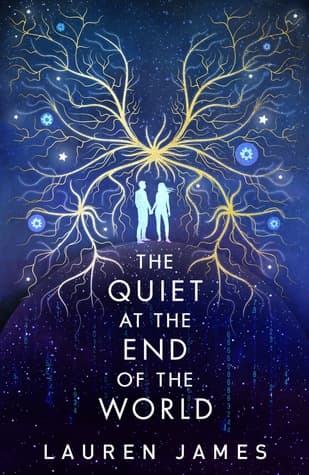
Lauren James (2019)
Genre
Fantasy / Science Fiction / Young Adult / Romance
Reading Time
450 min
Key Themes
See below
Sign in to track this book
As the last fertile teenagers in a dying world, Lowrie and Shen must uncover a secret that forces them to choose between their family and the desperate hope for humanity's future.
Lowrie and Shen are the only two people under sixty-eight left on Earth. They live in a secluded, self-sufficient community in what was once London. A global infertility virus, 'The Quiet', ended humanity's ability to reproduce generations ago. As teenagers, they live in a grand, decaying mansion with their adoptive 'Grandparents': the practical Grandma, the kind Grandpa, and the scientific Gran. They spend their days searching the Thames for old items and exploring their large home, all while being the focus of the community's dwindling hopes for humanity's future. They are aware of their unique and solitary position as the last fertile people.
While exploring the mansion, Lowrie finds a hidden room behind a bookshelf, accessed by a complex puzzle. Inside, she finds old electronics and a series of video diaries from her biological mother, Evelyn. The first video shows Evelyn talking directly to Lowrie, speaking of a 'project' and a 'lie' the Grandparents have kept. This discovery deeply troubles Lowrie, making her question everything she thought she knew about her family and the world. She feels a desperate need to find the full truth.
Lowrie confronts Shen, who admits he already knew about the hidden room and Evelyn's videos, having found them years ago. He kept it secret to protect Lowrie from painful truths. Together, they watch more of Evelyn's recordings. Evelyn's messages become more urgent and mysterious, warning Lowrie about the real nature of 'The Quiet' and suggesting the Grandparents are not who they seem. She speaks of a 'cure' and a 'mistake,' implying a deliberate act rather than a natural disaster. This sends Lowrie and Shen into doubt and fear.
As they watch more of Evelyn's recordings, Lowrie and Shen uncover the full extent of their Grandparents' deception. Evelyn explains that 'The Quiet' was not a virus but a genetically engineered sterility agent, released globally to prevent an ecological disaster and save Earth from human overpopulation. Their Grandparents, leaders of the 'Quiet Project,' were directly responsible. Lowrie and Shen were the result of a desperate, last-ditch effort to create fertile humans using modified genes from Evelyn and others, making them engineered products of the project, not natural survivors.
The most shocking revelation comes when Evelyn explains that Lowrie and Shen are not just the last fertile humans, but the last two viable subjects of the 'Quiet Project's' fertility experiments. Their Grandparents had been watching them, guiding their lives, and subtly influencing their choices, all to observe their development and, possibly, find a way to reverse 'The Quiet' or understand its full effects. Lowrie realizes her entire life has been a carefully constructed lie. This makes her question her identity and her relationship with Shen, who shares her engineered origins.
When confronted by Lowrie and Shen, the Grandparents confess, explaining their actions came from a desperate desire to save humanity, even if it meant sacrificing individual freedom and truth. They reveal a 'seed bank' with human genetic material and the potential for a future where humanity could return, but only if Lowrie and Shen agree to maintain the facade, live their lives as humanity's 'natural' last hope, and possibly reproduce. This places a huge burden on the teenagers, forcing them to choose between keeping the illusion for a slim chance of future life or exposing the truth, which could mean humanity's definite end.
Overwhelmed by the revelations and feeling trapped, Lowrie and Shen decide to escape their controlled community. They want to find evidence of Evelyn's claims and seek a life free from the Grandparents' manipulation. Their attempt is dangerous, as they navigate a desolate, decaying London that has been largely abandoned. They encounter the harsh realities of a world without humanity, confirming the scale of the 'Quiet Project's' impact and the desolation that now defines the planet outside their protected area. Their journey strengthens their bond but also highlights their extreme isolation.
During their escape, Lowrie and Shen meet small, isolated groups of elderly survivors, living in their own self-sufficient communities. These encounters are brief and often tense, as these groups are wary of outsiders. They learn that their London community is not the only one, and that the 'Quiet Project' had set up similar, monitored enclaves across the globe. This further confirms the scale of the Grandparents' operation and the extent to which humanity's final generations have been managed and observed, deepening Lowrie and Shen's understanding of their engineered existence.
Lowrie, driven by a desire for truth and independence, decides she cannot live a lie. With Shen's support, she uses old broadcasting equipment found in a hidden bunker to transmit a message to any remaining, isolated communities. In her broadcast, she reveals the true nature of 'The Quiet'—that it was a deliberate act by the Grandparents' generation to save the planet. She exposes her own engineered existence and the Grandparents' manipulation, offering humanity the stark truth rather than a comforting lie. This act is a definitive break from the past, sacrificing a potential future for present honesty.
Lowrie's broadcast sends shockwaves through the few remaining communities, including their own. The Grandparents are devastated but accept Lowrie's choice. While humanity's immediate future remains uncertain, Lowrie and Shen have taken back control of their lives. They decide to live on their own terms, free from the burden of being humanity's last hope or a scientific experiment. They choose to explore the world, understanding that the end of humanity, as they knew it, might be unavoidable, but their own lives, and the quiet beauty of a world healing from human impact, are still worth living and experiencing together.
The Protagonist
Lowrie transforms from a naive, protected girl into a strong, independent woman who chooses truth over a comfortable lie, accepting the responsibility of her unique existence.
The Supporting/Protagonist
Shen moves from a position of resigned acceptance to actively supporting Lowrie's radical choice, finding his own agency in choosing truth and a shared future with Lowrie.
The Antagonist/Supporting
Grandma is forced to confront the ethical implications of her life's work and the personal cost of her deceptions, ultimately accepting Lowrie's choice.
The Supporting
Grandpa's silent complicity is challenged by Lowrie's revelations, leading him to a quiet acceptance of the consequences.
The Supporting/Mentioned
Though deceased, Evelyn's arc is revealed posthumously as she transitions from a project participant to a truth-teller, guiding Lowrie from beyond the grave.
This theme explores the moral questions in scientific advancements, especially when they involve manipulating life for a perceived greater good. 'The Quiet Project' itself is the ultimate example, where a sterile agent was engineered and released globally to save the planet. The Grandparents believe their actions were justified to prevent ecological collapse, but Lowrie and Shen struggle with the ethical cost of their engineered existence and the deception. The story asks if the ends (saving the planet) justify the means (destroying natural human reproduction and individual autonomy).
““They didn’t save the world, Lowrie. They just saved the planet from us.””
A central theme is the impact of truth and the harm of deception. Lowrie's entire life is built on a lie, carefully created by her Grandparents. The discovery of Evelyn's videos shatters this illusion, forcing Lowrie to choose between a comfortable, false existence and a painful truth. The Grandparents maintain their deception believing it is necessary for humanity's survival, but Lowrie ultimately chooses to expose the truth, even if it means sacrificing humanity's slim hope for a future. This highlights the value of integrity and self-determination.
““Sometimes, the truth hurts more than the lie. But it's still the truth.””
The novel considers what it means for humanity to survive and what kind of legacy it leaves. With 'The Quiet' causing global infertility, the book explores the finality of human extinction and the desperate measures taken to avoid it. The Grandparents' project aims to save the planet from humanity's destructive habits, but in doing so, they essentially sacrifice humanity itself. Lowrie and Shen represent the last, artificial hope, prompting a re-evaluation of whether survival at any cost is truly desirable, or if a dignified, finite end is better. The story questions the definition of 'humanity' in the face of engineered existence.
““We are not the last. We are the first generation of a new quiet.””
Lowrie and Shen's journey is a struggle for personal freedom and free will against a meticulously controlled existence. From their engineered conception to their sheltered upbringing, their lives have been dictated by the Grandparents' plan for humanity. The discovery of the truth sparks a strong desire for self-determination. Lowrie's decision to broadcast the truth, despite the potential consequences for humanity's future, is the ultimate act of reclaiming her agency and asserting her right to make her own choices, rather than being a pawn in someone else's vision.
““Our lives are not a project. They are ours.””
Posthumous messages from Evelyn that reveal the hidden truth.
Evelyn's video diaries serve as the primary expositional device, gradually unraveling the complex backstory of 'The Quiet Project' and the Grandparents' deception. Hidden within the mansion, these recordings act as a direct line from the past to the present, providing Lowrie and Shen with crucial information that challenges their entire understanding of their world and their identities. This device allows for a slow, suspenseful reveal of information, building tension and driving the plot forward as Lowrie and Shen piece together the truth.
A secret space that acts as the gateway to the story's central mystery.
The hidden room in the mansion is a classic plot device, functioning as the physical trigger for the story's major conflict. Its discovery by Lowrie is not accidental but a predetermined event, as Evelyn intended for Lowrie to find her messages. This room symbolizes the hidden truths and secrets lurking beneath the surface of their seemingly idyllic life. It serves as a portal to the past and the catalyst for Lowrie's journey of self-discovery and rebellion against the established order.
The central environmental catastrophe and the driving force behind the plot.
'The Quiet' is presented initially as a natural disaster, a virus causing global infertility. However, it is later revealed to be a genetically engineered sterility agent, making it a pivotal plot device. It sets the stakes of the entire narrative – the impending extinction of humanity – and justifies the Grandparents' extreme actions. The ambiguity around its nature (natural vs. engineered) is a key mystery that drives Lowrie's investigation and ultimately defines the moral conflict of the story.
The act of searching for historical artifacts, symbolizing a connection to a lost past.
Mudlarking, Lowrie and Shen's daily activity of sifting through the Thames for old objects, serves as a subtle yet significant plot device. It grounds them in the history of the pre-Quiet world, offering glimpses into the lost human civilization. Each artifact is a tangible link to a past they never knew, fueling Lowrie's innate curiosity and foreshadowing her eventual discovery of the larger, hidden history of humanity's downfall. It represents their connection to the past and their role as inadvertent archivists of a dying world.
“The quiet is what kills you, not the end of the world.”
— Spoken by Luna, reflecting on the post-apocalyptic silence.
“History isn't just about what happened, it's about who tells the story.”
— Luna considers the importance of their recorded messages for future generations.
“Love isn't about finding someone perfect. It's about finding someone who makes the imperfections bearable.”
— Luna's internal reflection on her relationship with Cillian.
“We are the last two people on Earth, and we still manage to annoy each other.”
— A lighthearted moment between Luna and Cillian, highlighting their everyday dynamic.
“The stars are always there, even when you can't see them. Just like hope.”
— Luna finding solace and meaning in the night sky.
“What's the point of surviving if you forget how to live?”
— Luna questions the purpose of their isolated existence without joy or purpose.
“Every message we send is a tiny boat in a vast ocean, hoping someone, somewhere, will find it.”
— Describing their efforts to communicate with potential survivors.
“The future isn't a blank page; it's a series of choices we make right now.”
— Luna contemplating their agency and influence on what comes next.
“Sometimes the bravest thing you can do is just keep going, even when you don't know why.”
— Luna's internal monologue during moments of despair.
“We're not just living for ourselves anymore. We're living for everyone who came before us, and everyone who might come after.”
— Luna recognizing the weight of their legacy as the last humans.
“The world ended, but the little things, the everyday things, they just carried on.”
— A poignant observation about the mundane aspects of life persisting even after catastrophe.
“Fear is a powerful motivator, but so is curiosity.”
— Luna's internal debate about venturing out and exploring.
“Perhaps the end of the world isn't an ending at all, but a very strange beginning.”
— Luna's hopeful perspective on their unique situation.
“You can't save everyone, but you can save someone. Even if that someone is just yourself.”
— Luna's realization about the limits of their power and the importance of self-preservation.
Ready to see how well you understood this book? Take our interactive quiz with 10 questions.

Biography coming soon.







