“The trouble with trucks is that they are bigger than people.”
— Early in the book, explaining the central conflict between pushcart peddlers and large trucks.

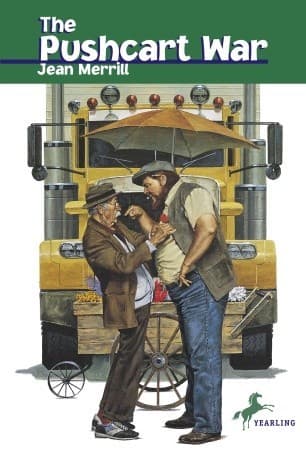
Jean Merrill (1964)
Genre
Children's / Historical Fiction / Young Adult
Reading Time
220 min
Key Themes
See below
Sign in to track this book
New York City's pushcart peddlers win a 'war' against powerful delivery trucks using pea shooters, tacks, and wit.
In the spring of 1976, New York City has a lot of traffic, especially on its main avenues. This is mainly because large delivery trucks have grown a lot in size and number. These 'mammoth' trucks, from companies like Big Midget Movers, Tiger Trucking, and Atlas Moving Company, take over the streets. This makes it almost impossible for smaller vehicles and people to get around. People are frustrated, and they ask city officials to do something. The trucks, in turn, blame the small, slow pushcarts run by independent peddlers for making traffic worse. This sets up a conflict.
The owners of the three biggest trucking companies—Big Midget, Tiger, and Atlas—meet secretly at the Hotel Commodore. Mr. W. Lee Preston, owner of Big Midget Movers, leads them. They decide the pushcarts are the main problem and must be removed. They make a plan to get rid of the pushcarts, saying it is needed for traffic flow. This secret agreement starts what will be called the Pushcart War, though the public and peddlers do not know at first that the attacks are organized.
After their secret meeting, the trucking companies start their attacks. On May 15th, the first recorded event happens when a Tiger Trucking vehicle purposely hits Frank the Flower's pushcart, crushing it and its contents. Frank, an experienced peddler, is very upset. Authorities first say this and similar events across the city are just accidents. But the pushcart peddlers start to think it is organized. The incident with Frank the Flower's cart becomes a rallying point for their community, marking the start of their fight.
Angry about Frank the Flower's cart being destroyed and the growing attacks, the pushcart peddlers meet in a restaurant basement. Morris the Florist, a respected and clear-speaking peddler, becomes an important leader. They talk about different ways to protest and defend themselves. The trucks are much bigger and stronger, so they know direct fighting will not work. Instead, they decide to use cleverness and guerrilla tactics. Maxie Hammerman, a skilled cart-builder, suggests using pea shooters to put tacks on truck tires, aiming to disable them without serious injury. This strategy becomes central to their fight.
The peddlers start Maxie Hammerman's plan. They use pea shooters and many thumbtacks to target the tires of large trucks. The campaign works well. Trucks all over the city get flat tires, causing delays and increasing repair costs for the trucking companies. The police are confused at first, unable to find proof of sabotage. The 'Pea-Shooter Campaign' causes problems for the trucking companies and makes the pushcart peddlers known to the public. Many citizens, tired of traffic, feel sympathy and support for them.
The pea-shooter attacks anger the trucking companies. Mr. W. Lee Preston leads them in planning 'Operation Broom.' This plan involves putting large magnets and heavy brushes on their trucks to sweep the streets for tacks. They also drive more aggressively against the pushcarts. But the peddlers quickly adapt. They start using wooden tacks, which magnets do not affect, and develop new ways to avoid trucks. Operation Broom does not work well, frustrating the truck executives more and showing the peddlers' creativity.
As the conflict grows, authorities and the media cannot ignore it. Newspapers start reporting on the 'Pushcart War,' often favoring the peddlers. The public, already annoyed by traffic, begins to see the giant trucks as bullies and the pushcarts as underdogs fighting for their living and the public good. The Mayor, who did not want to get involved at first, faces more pressure to fix the situation. This change in public opinion helps the peddlers a lot in their struggle.
One of the most dramatic events happens when Joey Kafflis, a peddler, puts his cart in the path of a huge Atlas truck. The truck driver, following company orders, will not stop. Joey, with great courage, will not move. A tense standoff happens, drawing a large crowd and media attention. The truck driver has to back down, not wanting to risk a public crash and more bad press. This event shows the peddlers' strong resolve and is a big moral victory. It shows that even a small, determined person can stand up to a powerful force.
The growing chaos, public outcry, and economic impact of the war force Mayor Curley to get involved. He arranges a peace conference between the trucking executives and the pushcart peddlers. After tough talks, a treaty is signed. The terms include specific routes and times for trucks, limits on truck size, and protected areas for pushcarts. The trucking companies have to accept the pushcarts' right to operate, and the peddlers get official recognition and protection. This is a win for the smaller, independent businesses.
The Pushcart War officially ends, but its effects stay in New York City. The treaty reduces traffic congestion and makes sharing city streets fairer. The giant trucks are mostly restricted, and the pushcarts do well. They become a valued part of the city. The narrator documents the war, stressing its importance as a historical event. It shows how ordinary people, using cleverness, unity, and courage, can challenge powerful, established interests. The streets, once controlled by trucks, become more accessible and pleasant for everyone, showing the peddlers' unexpected win.
The Protagonist/Supporting
From a concerned peddler, he becomes the strategic mind and public voice of the resistance, leading his community to victory.
The Antagonist
Starts as an arrogant, unchallenged business magnate and ends as a frustrated, defeated executive forced to compromise.
The Supporting
His practical genius provides the peddlers with their most effective weapon, shifting the war's momentum.
The Supporting
From an ordinary peddler, he becomes an iconic figure of resistance and courage.
The Supporting
His initial suffering serves as the emotional spark that ignites the resistance.
The Antagonist
Maintains her aggressive stance throughout the war but is ultimately forced to accept the peace treaty.
The Antagonist
Remains a staunch opponent of the peddlers until the Mayor's intervention forces him to negotiate.
The Supporting
From a hesitant politician, he becomes the necessary mediator, restoring order and fairness.
The Mentioned
Serves as the objective chronicler, ensuring the 'true' story is told.
This is the main theme of 'The Pushcart War.' The seemingly weak pushcart peddlers, using only their wits and pea shooters, successfully challenge and defeat the powerful, rich trucking industry. This is clear in Maxie Hammerman's clever tack strategy, Joey Kafflis's defiant stand against a huge truck, and Morris the Florist's leadership. The book shows how creativity, unity, and determination can overcome force and money, proving that size and resources do not always guarantee victory.
“What had begun as a traffic problem had turned into a full-scale war, with the giants of the trucking industry arrayed against the little men of the pushcarts. And the little men were winning.”
The Pushcart War looks at justice when a stronger group unfairly targets a weaker one. The trucking companies start the conflict out of greed and a desire for full control, destroying peddlers' livelihoods. The peddlers' fight is for fairness and their right to exist and do business. The public's eventual sympathy for the peddlers and the Mayor's involvement show society's need for justice. It demonstrates that unchecked power often leads to unfairness, which then causes resistance.
“It was simply a matter of who was going to own the streets. The giants, or the little men.”
The peddlers win mainly because they unite as a community and act together. They come together after Frank the Flower's cart is destroyed, holding meetings, sharing ideas, and using a coordinated plan. Leaders like Morris the Florist and Maxie Hammerman emerge from group decisions. Their unity against a common enemy, their willingness to help each other, and their shared goal are key to their victory. This shows the strength that comes from being united.
“The peddlers were not rich. They had no powerful friends. But they had something more important: they had each other.”
The book shows how media coverage and changing public opinion are important to the war's outcome. At first, the trucking companies try to control the story. But as the war grows, news reports start to show the truth about the trucks' aggression and the peddlers' cleverness. The public, tired of traffic and feeling for the underdogs, sides with the pushcarts. This public pressure makes the Mayor get involved, showing how media attention can change public feelings and influence political choices, even against powerful interests.
“The people of New York City, who had been grumbling about traffic for years, suddenly found themselves with a cause.”
The peddlers' main weapon is not force, but cleverness and strategic non-violent resistance. Maxie Hammerman's pea-shooter and tack invention is a good example, causing problems without physical harm. Joey Kafflis's peaceful but firm stand also shows this theme. The peddlers always outwit the trucks and authorities, changing their tactics to counter every move their opponents make. This theme highlights that intelligence and creative problem-solving can be more effective than aggression in solving conflicts.
“The pushcart peddlers had shown the world that you don't need bombs and guns to fight a war. All you need is a good idea and a lot of courage.”
The entire story is presented as a 'true' historical record of events from 1976.
The book employs the device of a fictionalized historical account, narrated by 'Professor Lyman,' who claims to have compiled the definitive history of the Pushcart War. This includes fabricated footnotes, newspaper clippings, interviews, and official documents. This device lends an air of authenticity and importance to the fantastical events, making the reader feel like they are learning about a genuine historical conflict. It also allows the author to comment on real-world issues like corporate greed and urban planning through a detached, academic lens, enhancing the satirical elements.
Trucks are described with human-like characteristics and intentions, especially their 'aggression'.
While the trucks aren't literally sentient, they are often described in anthropomorphic terms, particularly when detailing their 'aggressive' behavior and their 'war' against the pushcarts. They are referred to as 'giants' and are given a collective will and intent to dominate the streets. This personification helps to clearly establish them as the antagonists, making their actions feel more deliberate and menacing, and heightens the David-and-Goliath dynamic with the small, vulnerable pushcarts. It simplifies the conflict into a battle of personalities rather than just machines.
Uses humor and exaggeration to critique urban planning, corporate power, and individual rights.
The book uses satire to comment on various societal issues, particularly urban traffic congestion, the unchecked power of large corporations, and the struggle of independent businesses. The exaggerated scale of the trucks, the absurd lengths the trucking executives go to, and the ingenious, almost comical, tactics of the peddlers all serve to highlight these issues in a humorous yet thought-provoking way. The 'war' itself is a satirical take on real-world conflicts, advocating for the rights of the common person against powerful establishments and critiquing the prioritization of commercial interests over quality of life.
A classic story structure where a weaker, less powerful group triumphs over a stronger adversary.
The Pushcart War is a quintessential underdog narrative. The pushcart peddlers are portrayed as small, financially disadvantaged, and lacking political influence, while the trucking companies are large, wealthy, and powerful. The entire plot revolves around the struggle of the 'little guys' against the 'giants.' This narrative structure creates inherent sympathy for the peddlers and makes their eventual triumph all the more satisfying and inspiring, reinforcing the theme that determination and unity can overcome superior resources.
“The trouble with trucks is that they are bigger than people.”
— Early in the book, explaining the central conflict between pushcart peddlers and large trucks.
“A pushcart is a small business on wheels.”
— Describing the importance of pushcarts to the peddlers' livelihoods.
“The first shot in the Pushcart War was fired by Maxie Hammerman, the pushcart king.”
— Narrating the beginning of the conflict with Maxie's pea-shooter attack.
“It is not easy to fight an enemy who is ten times your size.”
— Reflecting on the peddlers' struggle against the powerful trucking companies.
“The secret weapon of the pushcart peddlers was the common pin.”
— Describing how peddlers used pins to flatten truck tires as a tactic.
“In war, the first casualty is the truth.”
— Commenting on the propaganda and misinformation spread during the conflict.
“A traffic jam is a beautiful thing when it is your enemy who is jammed.”
— Expressing the peddlers' satisfaction at disrupting truck operations.
“The Mayor was a man who liked to keep the peace, but peace is not always possible.”
— Describing the Mayor's initial reluctance to get involved in the conflict.
“Sometimes the smallest people can make the biggest difference.”
— Highlighting the theme of ordinary individuals effecting change.
“The pushcart peddlers had no army, but they had each other.”
— Emphasizing the solidarity and cooperation among the peddlers.
“War is not just about fighting; it is about outsmarting your opponent.”
— Explaining the peddlers' strategic approach to the conflict.
“The history books will call it the Pushcart War, but we called it survival.”
— A peddler's perspective on the conflict as a struggle for existence.
“Even a truck can be stopped by a little cooperation and a lot of pins.”
— Summarizing the effectiveness of the peddlers' coordinated efforts.
“In the end, it was not the size of the weapon but the size of the idea that won the war.”
— Reflecting on the moral victory of the pushcart peddlers' cause.
Ready to see how well you understood this book? Take our interactive quiz with 10 questions.
Biography coming soon.

Dan Gemeinhart
4.5

Kate O'Hearn
4.4

Jeanne Birdsall
4.4

Jen Wang
4.4

Wendelin Van Draanen
4.3

John Marsden
4.3

Chris Van Allsburg
4.3

Jennifer A. Nielsen
4.2