“And the world was a great house left empty, and its master gone.”
— The narrator reflecting on the desolation after the purple cloud's passage.

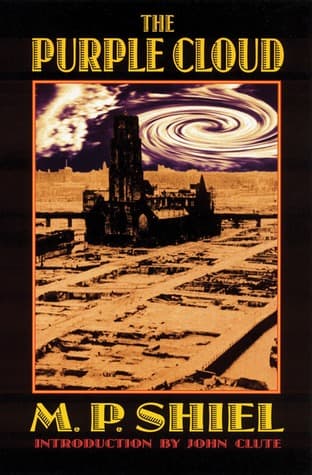
Matthew Phipps Shiel (1901)
Genre
Fantasy / Science Fiction
Reading Time
296 min
Key Themes
See below
Sign in to track this book
After a mysterious purple cloud ends humanity, the last man on Earth descends into madness, convinced his survival has a divine, terrifying purpose.
The story begins with Adam Jeffson, a young Englishman, preparing for a dangerous expedition to the North Pole. He wants to be the first to reach the Pole. Adam joins a well-equipped ship, the 'Purple Cloud,' with an experienced crew. Before leaving, Adam has a final meeting with his beloved, the beautiful but sickly Clara, who makes him promise to return. The journey is dangerous, with treacherous ice and harsh Arctic conditions. Adam's ambition is clear, but a sense of foreboding hints at the extraordinary events to come.
Adam Jeffson and his crew reach the North Pole, a triumph quickly overshadowed by a terrifying event. A strange, luminous purple cloud appears, expanding and descending upon Earth. The crew, at first confused, soon dies. Adam, by some miracle, is spared, perhaps due to his position or immunity. He watches in horror as the world below is consumed by the toxic vapor, realizing he is seeing the end of all life on Earth. The 'Purple Cloud' becomes a symbol of the disaster.
After the purple cloud disappears, Adam Jeffson descends from the Pole to a silent world. He finds the ship's crew dead, and as he travels south, he sees no living thing, hears no human sound. The cities are empty, filled with the preserved bodies of their inhabitants. He slowly realizes he is the sole survivor, which brings him deep grief and overwhelming loneliness. He questions why he survived, the enormity of his isolation weighing on his mind.
Adam Jeffson accepts his unique, though tragic, position and explores the deserted cities of Europe. He enters palaces, museums, and grand houses, taking whatever he wants. He wears royal robes, adorns himself with jewels, and enjoys the finest foods and wines, living a life of luxury without consequence. He becomes a king in a silent world, a solitary ruler over an empire of the dead. This period marks his initial descent into madness, as he tries to fill the void of human company with possessions and fantasies.
The newness of his solitary kingdom eventually fades, replaced by boredom and growing madness. Wanting a grand spectacle, or perhaps to rid the world of its silent reminders of humanity, Adam Jeffson decides to burn London. He carefully sets fire to different parts of the city, watching in a terrifying dream as landmarks and homes burn. This act is a key moment, showing his complete break from normal human morality and his embrace of destructive freedom.
Despite his destructive acts, Adam still longs for companionship. He travels the world, across continents and oceans, looking for another human. He uses ships, trains, and cars, always hoping he might not be entirely alone. His journey takes him through countless deserted cities and landscapes, each one showing his isolation. This quest, though often fruitless, shows his lasting need for connection.
Throughout his solitary travels, Adam Jeffson often sees visions and memories of his beloved Clara. Her image comforts and torments him, reminding him of the love he lost and the world that was. He also begins to think about the deeper meaning of his survival. He remembers a prophecy given to him before his expedition, suggesting he was meant for a unique, perhaps terrible, fate. These mystical elements hint at a cosmic plan behind the purple cloud and Adam's unique existence.
After years of wandering, Adam Jeffson makes a miraculous discovery in a remote part of the world. He finds a young woman, seemingly untouched by the purple cloud, alive and well. He names her Eve, recognizing the biblical importance of their meeting as the last man and woman. Her appearance brings Adam hope and purpose, but also new complexities and challenges, as he deals with their shared, yet different, experiences.
Adam's initial joy at finding Eve is soon complicated by their different views and personalities. Eve, having grown up alone, is wild, untamed, and has a primal innocence that clashes with Adam's jaded and often controlling worldview. Adam, still haunted by his past and madness, struggles to balance his desire for companionship with his ingrained habits of solitary dominance. Their interactions are tense, suspicious, and a power struggle, as both try to assert their will and define their new, fragile world.
As Adam and Eve's relationship grows, Adam starts to understand the true nature of his survival and the purple cloud. He remembers the prophecies and signs he encountered, realizing his immunity was not accidental but part of a grand, divine plan. He understands that he and Eve are not just survivors, but the chosen parents of a new humanity, tasked with repopulating Earth. This brings a deep sense of responsibility and purpose, changing his view from a cursed survivor to an instrument of cosmic will.
With his understanding of their destiny firm, Adam Jeffson sheds his past madness and accepts his role as the new Adam. He and Eve, despite their initial conflicts, begin to form a bond based on their shared future. They represent humanity's rebirth, meant to start anew on a clean Earth. The story ends with hope and solemnity, as the last man and woman stand at the start of a new era, ready to fulfill their cosmic purpose and repopulate the world, leaving the old world's ashes behind.
The Protagonist
From ambitious explorer to a mad, solitary king, then to the reluctant 'New Adam' tasked with repopulating the Earth.
The Supporting/Mentioned
Her existence is a tragic reminder of what Adam lost, serving as a catalyst for his emotional turmoil.
The Supporting
From an isolated wild child to the 'New Eve', accepting her role in humanity's rebirth.
The Mentioned
Their collective death marks the beginning of Adam's solitary journey.
The Mentioned
A static character whose prophecy guides Adam's understanding of his fate.
Adam Jeffson's deep isolation is the main psychological theme. After the purple cloud, he is completely alone, which leads to a slow descent into madness. This appears in his grandiose behavior, like crowning himself king and burning London (plot_summary section 5), as he tries to cope with humanity's absence. His thoughts and actions show the psychological cost of absolute solitude, highlighting the human need for connection and the fragility of sanity without it.
“What then, my God, shall I do?”
The novel explores the end of one human era and the possibility of a new beginning. The purple cloud represents a complete reset, clearing the way for a fresh start. Adam's survival, first seen as a curse, is eventually shown as a divine appointment to be the 'New Adam' (plot_summary section 10). His meeting with Eve confirms this theme, as they become the literal parents of a new human race, symbolizing hope and renewal after devastation. This theme looks at the cyclical nature of existence and life's resilience.
“I am the last man. I am the first man.”
A key tension is between Adam's initial belief in random survival and his growing realization that his existence is part of a grand, perhaps divine, cosmic plan. The prophecies from the mystic (characters section 5) and Adam's later insights (plot_summary section 10) suggest the purple cloud was not an accident but a purposeful event. This theme explores predestination and a higher power guiding human destiny, rather than just chaotic events, giving Adam's suffering and survival a deep, terrifying meaning.
“I was not saved by chance, but by a design.”
As the sole survivor, Adam Jeffson gains absolute power over the world's resources. This theme examines how he uses this power, at first indulging in luxury and destructive acts like burning London (plot_summary section 5). His journey forces him to face the responsibilities that come with such power, especially after finding Eve and understanding his role in repopulating Earth. The story asks if humanity, even with a fresh start, can overcome its destructive tendencies or if the cycle of power will repeat.
“I am king of the world! And there is none to dispute me!”
The cataclysmic event that wipes out humanity.
The purple cloud is the central plot device, serving as the catalyst for the entire narrative. It is a mysterious, lethal vapor that sweeps across the Earth, killing all living creatures except for Adam Jeffson. Its enigmatic nature – its origin, composition, and why it spared Adam – drives much of the story's suspense and philosophical inquiry. Beyond its function as a destructive force, it also symbolizes a divine or cosmic cleansing, paving the way for a new beginning for humanity.
Adam Jeffson as the sole survivor of a global catastrophe.
This classic science fiction trope forms the foundational premise of 'The Purple Cloud'. Adam Jeffson's status as the 'last man' immediately establishes a unique set of dramatic conflicts: profound isolation, the struggle for sanity, the burden of being the sole witness to humanity's end, and the potential for a new beginning. This device allows the author to explore themes of human nature, civilization, and the psychological impact of ultimate solitude without the complexities of societal interaction.
Mystical hints at Adam's destiny.
The novel employs prophecy and foreshadowing, particularly through the encounter with the ancient mystic before Adam's expedition. These cryptic pronouncements hint at Adam's unique fate and the extraordinary events to come, lending a sense of predetermination to the narrative. This device elevates the story beyond a simple survival tale, suggesting a cosmic design behind the apocalypse and Adam's survival, and guiding the reader towards a deeper, more spiritual interpretation of events.
Deserted cities as a new kind of wilderness.
Instead of a traditional natural wilderness, the novel presents abandoned cities and structures as a 'wilderness' for Adam to navigate. These deserted urban landscapes, filled with the preserved remnants of human life, serve as a constant, haunting reminder of what was lost. This device amplifies Adam's isolation and provides a unique setting for his psychological journey, where the ruins of civilization become both a resource for survival and a monument to his profound loneliness.
“And the world was a great house left empty, and its master gone.”
— The narrator reflecting on the desolation after the purple cloud's passage.
“For I was alone, and the last of all men, and the world was mine.”
— Adam Jeffson's realization of his unique, solitary position.
“The wind sang a song of nothingness, and the stars looked down on a world that had forgotten to breathe.”
— Describing the profound silence and emptiness of the post-apocalyptic Earth.
“But the silence was the worst, the silence of a million voices stilled.”
— Adam reflecting on the absence of humanity's sounds.
“I was a king without a kingdom, a god without worshippers, a man without a kind.”
— Adam's internal struggle with his ultimate isolation and power.
“And I saw that the earth was beautiful even in its desolation, a vast and silent monument to what had been.”
— Adam appreciating the natural world despite the absence of human life.
“There was no one to hear me, no one to see me, no one to judge me. I was free.”
— Adam's initial sense of liberation from societal constraints.
“The purple cloud had been the breath of God, sweeping clean the corruption of man.”
— Adam's interpretation of the apocalyptic event, linking it to divine judgment.
“All knowledge was mine, all treasures, all power. But what was power without a rival, treasure without an heir, knowledge without a listener?”
— Adam realizing the hollowness of his absolute control.
“For I was the last man, and the first, and the only.”
— Adam's unique and ultimate position as the sole survivor.
“And the cities were tombs, vast and splendid, where the winds whispered the names of the dead.”
— Describing the abandoned, decaying urban landscapes.
“I had become a part of the earth, and the earth a part of me.”
— Adam's deep connection to the natural world in his solitude.
“The world was a canvas, and I the only painter.”
— Adam's sense of creative freedom and responsibility in a world without others.
“Love, too, was a phantom, a memory, a cruel jest in the empty chambers of my heart.”
— Adam's longing for human connection and love in his isolated state.
Ready to see how well you understood this book? Take our interactive quiz with 10 questions.

Biography coming soon.







