“The past is a place you can visit, but you can never truly go back to.”
— A reflection on the nature of time travel and its limitations.

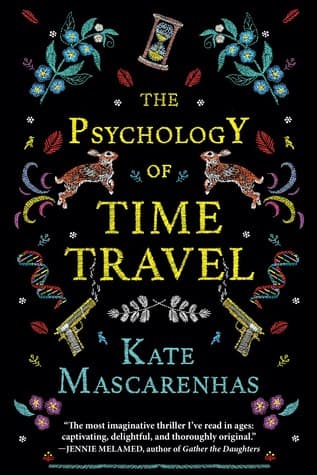
Kate Mascarenhas (2018)
Genre
Fantasy / Mystery / Science Fiction
Reading Time
9-11 hours
Key Themes
See below
Sign in to track this book
When a newspaper clipping from the future hints at her grandmother's murder, Ruby Rebello must navigate a fractured timeline and the hidden history of the world's first female time-travel pioneers to prevent a tragedy that hasn't even happened yet.
In 1967, four scientists—Margaret, Barbara, Grace, and Bee—are about to unveil the world's first time machine. Just before their public debut, Barbara has a severe mental breakdown, believing she has seen her own death. Her behavior threatens to expose their experimental work and jeopardize the project. To protect their invention and the future of time travel, the remaining three scientists decide to exile Barbara, effectively erasing her contributions from the official history of time travel. This event affects them all and sets the stage for future temporal paradoxes and personal tragedies.
Fifty years later, in 2017, time travel is a commercial enterprise. Ruby Rebello, a young woman working at a time travel agency, is devoted to her grandmother, Elspeth 'Bee' Rebello, one of the original pioneers. Ruby knows Bee was involved but understands little of the details due to the secrecy surrounding the early days. One day, Bee receives a newspaper clipping from the future, dated 2018, reporting the murder of an elderly woman. Ruby, recognizing the location and description, believes the victim is Bee, sparking her quest to uncover the truth and prevent her grandmother's death.
Ruby's initial attempts to investigate meet resistance. She approaches Kian, a chrononaut and former colleague of her grandmother, who now works for the Chronology Protection Agency (CPA). The CPA maintains the integrity of the timeline and prevents paradoxes. Kian, bound by rules and skeptical of Ruby's 'future knowledge,' dismisses her concerns, attributing the clipping to a hoax or misinterpretation. He warns her against tampering with the timeline, emphasizing the risks involved. Despite his warnings, Ruby's determination grows stronger, fueling her independent search for answers.
Concurrently, in 2018, Detective Odette is investigating a murder. An elderly woman has been found dead in a locked room at the 'Oakhaven' retirement home, with no signs of forced entry or struggle, and no identification. The circumstances are unusual, suggesting a time travel connection, though Odette, initially unaware of the full implications, struggles to make sense of the scene. The victim's identity remains a mystery, and the lack of conventional clues makes the case challenging. Odette's methodical approach slowly uncovers inconsistencies that point towards an unconventional crime.
Throughout the novel, the narrative interweaves Ruby's present-day investigation with flashbacks to the lives of Margaret, Barbara, Grace, and Bee. These sections detail their groundbreaking work, their personal sacrifices, the emotional toll of their discovery, and their complex relationships. We see their early camaraderie, the impact of Barbara's breakdown, and the subsequent guilt and secrecy that shaped their lives. These flashbacks provide context for the present-day mystery, illustrating how past decisions and temporal events ripple through the decades, influencing the future.
Barbara's story, initially shrouded in mystery, unfolds through the flashbacks. After her banishment, she struggles with her mental health and the injustice of being erased from history. She eventually finds a way to continue her work in secret, though in a more fragmented and desperate manner. Her attempts to interact with the timeline, driven by a desire to correct past wrongs or to be remembered, inadvertently create further paradoxes and complications. Her legacy becomes a central thread, showing how her actions, even in exile, continue to influence the other pioneers and the future of time travel itself.
Driven by her love for Bee and her growing suspicion that the CPA is hiding something, Ruby begins to use her limited access to time travel to conduct her own investigation. She makes small, careful jumps, observing events from different temporal vantage points, trying to identify the victim and potential motives. Her inexperience and the dangers of temporal manipulation lead to near-misses and ethical dilemmas. She learns about the rules of time travel and the severe consequences of altering the past, but her determination to save Bee outweighs her fear of paradoxes.
Ruby eventually uncovers the truth about Oakhaven, the retirement home where the murder takes place. It is not just a regular care facility, but a discreet sanctuary for chrononauts suffering from 'temporal disorientation'—a form of dementia caused by prolonged or traumatic time travel. The residents, including Bee and eventually Margaret, exhibit symptoms like memory loss, anachronistic behavior, and a fragmented sense of self. This revelation adds another layer of complexity to the mystery, suggesting that the victim might be a chrononaut, and the motive could be tied to their unique temporal ailments or past actions.
Through her own temporal jumps and by piecing together clues, Ruby eventually realizes the murdered woman is not Bee, but Margaret, another of the original four pioneers. This realization is a shock, shifting Ruby's focus from preventing Bee's death to solving Margaret's murder. Simultaneously, Detective Odette, through police work and by interviewing the residents and staff at Oakhaven, also starts to narrow down the suspects and recognizes the unique circumstances surrounding the chrononauts. Their investigations, though separate, begin to point towards a shared, complex truth.
The narrative culminates in the revelation that the lives of the four pioneers, particularly Barbara's and Margaret's, are intertwined through repeated temporal interventions. Barbara, seeking to alleviate her guilt and prevent past tragedies, made multiple unauthorized jumps, inadvertently causing more harm and creating a complex web of paradoxes. Margaret, burdened by the secret of Barbara's exile and the responsibility of the time machine, also made critical decisions that affected the timeline. The 'murder' itself is a tragic culmination of these temporal manipulations, a desperate act driven by love and regret.
It is revealed that Margaret's 'murder' was an act of mercy, committed by Grace, the fourth pioneer. Margaret, suffering from advanced temporal disorientation and haunted by her past decisions, had been making unauthorized jumps, attempting to 'fix' her past and interacting with Barbara in dangerous ways. Grace, seeing Margaret's increasing suffering and fearing the catastrophic paradoxes she might unleash, made the decision to end her life. This act was not out of malice, but a desperate measure to protect the timeline and spare her friend further agony, highlighting the ethical dilemmas of time travel.
Ruby, having uncovered the full, heartbreaking truth, comes to terms with the complexities of her grandmother's past and the ethical issues of time travel. She understands that the pioneers, despite their brilliance, were flawed individuals grappling with unprecedented power. She accepts that not all mysteries have simple answers and that some tragedies are unavoidable, even with the ability to travel through time. While her initial quest was to prevent a death, her journey ultimately leads to a deeper understanding of love, loss, and the bonds that transcend time.
The Protagonist
Ruby transforms from an innocent observer to a determined investigator, grappling with the moral ambiguities of time travel and ultimately accepting the nuanced truths of her family's past.
The Supporting
Bee's arc is largely revealed through flashbacks, showing her journey from a hopeful scientist to an elder grappling with the consequences of her past and the onset of temporal illness.
The Supporting
Margaret's arc, revealed through flashbacks and the murder investigation, shows her descent from a brilliant scientist to a victim of temporal illness and the unintended consequences of time travel.
The Supporting
Barbara's arc is one of tragic isolation and a desperate, ultimately destructive, quest for validation and to alter her fate, culminating in her becoming a catalyst for many of the story's paradoxes.
The Supporting
Grace's arc is defined by her unwavering commitment to the timeline and her friends, leading her to make a heartbreaking decision for the greater good.
The Supporting
Kian evolves from a rule-bound enforcer to a more empathetic individual, willing to bend rules for the sake of truth and justice.
The Supporting
Odette's arc shows her gradual realization and acceptance of the time travel elements in her investigation, challenging her traditional understanding of crime.
The novel explores how the knowledge of time travel, and the secrets surrounding its creation and use, weigh heavily on the characters. The pioneers are forced to make agonizing decisions, like exiling Barbara and erasing her contributions, which haunt them for decades. Ruby's pursuit of truth is initially hampered by the pervasive secrecy surrounding Bee's past. The narrative suggests that while knowledge brings power, it also brings responsibility and often leads to isolation and regret, as seen in Grace's ultimate act of mercy for Margaret.
““Knowing too much about the future was a terrible burden, worse even than knowing nothing at all.””
The concept of time itself is a central theme, not as a linear progression but as something fluid and manipulable, leading to questions about identity. Characters like Barbara and Margaret suffer from 'temporal disorientation,' where their memories and sense of self become fractured across different timelines. The novel challenges the idea of a fixed past and future, demonstrating how even small temporal interventions can irrevocably alter personal histories and create paradoxes that blur who a person truly is. Ruby's own identity is shaped by her connection to a past she didn't live but deeply impacts her.
““Time travel wasn’t just about going to another time; it was about bringing another time back with you, whether you wanted to or not.””
The book explores the ethical dilemmas inherent in groundbreaking scientific discoveries, particularly time travel. The pioneers face choices that have far-reaching, often unforeseen, consequences. The decision to exile Barbara, the creation of the CPA to control the timeline, and Grace's final act all highlight the moral tightropes walked by those wielding such power. The narrative questions whether humanity is ready for such technology and whether the pursuit of knowledge justifies the personal and temporal sacrifices made, showing how good intentions can lead to tragic outcomes.
““Every jump was a gamble, a tiny tear in the fabric of what was, and what should be.””
At its heart, the novel explores the complex dynamics of female friendship, particularly among the four pioneering scientists. Their bond is initially strong, forged through shared ambition and scientific brilliance. However, the pressure of their discovery, Barbara's breakdown, and the subsequent decision to exile her lead to deep-seated guilt, betrayal, and resentment that ripple through their lives for decades. The story examines how these relationships evolve under extreme circumstances, demonstrating both the enduring strength of their connections and the pain caused by their difficult choices, culminating in acts of both love and desperation.
““They had built a machine that could conquer time, but they couldn’t conquer the fractures within their own hearts.””
A tangible piece of future information that initiates the central mystery.
This device serves as the inciting incident for Ruby's investigation. It's a specific, physical object from the future that provides a cryptic clue (a murder report) without full context. It immediately establishes the central mystery and the stakes, demonstrating the potential for paradoxes and the dangers of foreknowledge. Its ambiguity allows for misdirection, initially leading Ruby to believe Bee is the victim, before the true identity is revealed, driving the plot's twists and turns.
A fictional neurological condition caused by time travel, akin to dementia.
This condition is a brilliant plot device that explains the fragmented memories and erratic behavior of the older chrononauts, particularly Margaret and Bee. It provides a realistic consequence of prolonged or traumatic time travel, grounding the fantastical elements in a relatable human experience of illness. It also serves as a source of misdirection and adds to the mystery, as the victims' confused statements can be misinterpreted, and their actions can be both symptom and deliberate choice, complicating the investigation.
The narrative shifts between different characters and time periods.
This structural device allows the author to gradually reveal information and build suspense. By jumping between Ruby's present-day investigation (2017/2018), Detective Odette's parallel investigation (2018), and extensive flashbacks to the pioneers' past (1967 and onwards), the reader slowly pieces together the full picture. This technique creates a rich tapestry of interconnected events and consequences, showing how past actions directly influence future outcomes and providing multiple viewpoints on the same complex events, enhancing the mystery and emotional depth.
An organization tasked with maintaining the integrity of the timeline.
The CPA acts as both a necessary regulatory body within the time travel universe and an initial obstacle for Ruby. It embodies the institutional response to the dangers of time travel, setting rules and attempting to prevent paradoxes. Kian's role within the CPA highlights the conflict between individual desire for truth and the greater good of a stable timeline. The CPA's existence underscores the inherent risks of time travel and provides a framework for the ethical and practical limitations faced by characters attempting to alter events.
“The past is a place you can visit, but you can never truly go back to.”
— A reflection on the nature of time travel and its limitations.
“Every paradox is a knot in time, and every knot can be untied, or tightened.”
— Discussing the complexities and dangers of altering timelines.
“We are all just trying to fix the mistakes we haven't made yet.”
— A character's cynical view on the motivations behind time travel.
“Memory is a fickle thing, especially when you've lived the same moment a dozen different ways.”
— Exploring the psychological toll of experiencing multiple timelines.
“The future isn't a single path; it's a garden of branching possibilities.”
— Describing the inherent unpredictability of the future, even for time travelers.
“Some secrets are best left buried, even if you have the power to dig them up from any era.”
— A warning about the dangers of uncovering past truths.
“Love, like time, finds a way to bend around obstacles, even if it has to break itself to do it.”
— A poignant observation on the enduring nature of love across different timelines.
“The greatest prison isn't made of bars, but of the moments you can't change.”
— A character's lament about being trapped by unalterable past events.
“History isn't just written by the victors; it's rewritten by the time travelers.”
— Highlighting the power and responsibility of those who can alter the past.
“Sometimes, the only way to move forward is to go back and understand why you're stuck.”
— A therapeutic perspective on using time travel for self-discovery.
“The 'butterfly effect' isn't a theory; it's a daily reality for us.”
— Emphasizing the constant awareness of small changes having large impacts.
“You can't outrun your own timeline, no matter how many jumps you make.”
— A reminder that personal destiny or consequences often catch up.
“The most dangerous thing about time travel isn't changing the past, but forgetting which past is real.”
— Addressing the psychological disorientation caused by multiple timelines.
“We build machines to escape time, but all we do is get more entangled in it.”
— A commentary on the ironic outcome of technological advancements in time travel.
Ready to see how well you understood this book? Take our interactive quiz with 10 questions.







