“Murder is the ultimate invasion of privacy.”
— Reflection on the nature of the crime central to the novel.

Genre
Thriller / Mystery
Reading Time
480 min
Key Themes
See below
Sign in to track this book
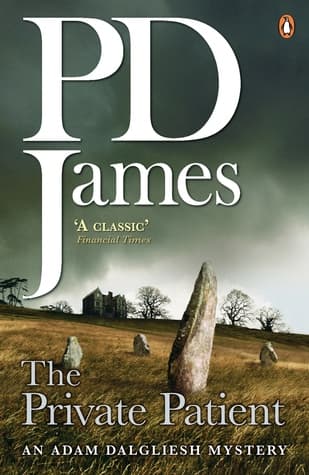
Commander Adam Dalgliesh unravels a web of secrets and surgical ambition when a journalist is found dead at an exclusive plastic surgery clinic, exposing the dark underbelly of beauty and privilege.
Rhoda Gradwyn, a well-known investigative journalist known for her sharp comments and controversial articles, checks into Cheverell Manor, a private nursing home in Dorset. She is there for a facelift by the celebrated plastic surgeon, Mr. George Chandler-Powell. Cheverell Manor, a converted Elizabethan house, is run by Chandler-Powell and his sister, Caroline. After a successful operation and what seems like a good recovery, Gradwyn is found dead in her bed the next morning, strangled. At first, people think it is suicide, but the situation quickly suggests murder, leading to a call to Scotland Yard and Commander Adam Dalgliesh.
Commander Adam Dalgliesh, with Detective Inspector Kate Miskin and Detective Sergeant Francis Benton-Smith, arrives at Cheverell Manor. They immediately notice the isolated beauty of the estate and the complex relationships among its residents and staff. Dalgliesh learns about Rhoda Gradwyn's difficult personality and her history of exposing scandals, which made her many enemies. The first interviews show unease and several possible suspects, each with a reason to want Gradwyn dead. The team sets up a temporary base at the manor to carefully examine the crime scene and interview everyone present during Gradwyn's stay.
Dalgliesh and his team begin to look into the lives of Cheverell Manor's residents and staff. Suspects appear: George Chandler-Powell, whose reputation Gradwyn might have threatened; his sister Caroline, who protects her brother and the manor; Emma Lavenham, Gradwyn's literary agent, who had a complex relationship with her client; and the other patients, including the quiet mystery writer Flavia Kinnaird, the outspoken elderly patient Miss Ulrica Friedman, and the former politician Marcus Dupayne. All of them had reasons to dislike Gradwyn or fear her revelations. The team also learns about Gradwyn's past investigations, especially one about a scandal from decades ago that ruined careers and lives.
The team discovers that Rhoda Gradwyn was researching an old scandal involving a prominent family, the De Vere's, who used to own Cheverell Manor. This scandal involved a murder and a cover-up, which Gradwyn was reportedly close to revealing. This line of inquiry leads Dalgliesh to consider suspects connected to this past event, including the manor's gardener, Dennis Tremlett, whose family was indirectly affected. While this provides a strong reason for some, the timing and details of Gradwyn's murder do not fit perfectly, suggesting this might be a distraction from the real killer.
Just as the investigation seems to be moving forward, a second murder shocks Cheverell Manor. Dr. Marcus Dupayne, a former politician and patient recovering from a stroke, is found dead in his room, also strangled. This confirms that the killer is still in the manor and is targeting those connected to Gradwyn or her investigations. Dupayne had his own reasons to fear Gradwyn's revelations, especially about his political past. The second murder increases the pressure on Dalgliesh's team, showing how urgent it is to find the killer before another person dies.
Emma Lavenham, Rhoda Gradwyn's literary agent and long-time friend, becomes a main person in the investigation. Her seemingly strong loyalty to Gradwyn is complicated by discoveries of a deeper, more resentful relationship. Emma felt exploited by Gradwyn, whose success she helped but did not share. Also, Emma knew about Gradwyn's habit of keeping detailed, often harmful, notes about people in her life, including Emma herself. This motive of resentment and self-preservation, along with her detailed knowledge of Gradwyn's habits and schedule, makes Dalgliesh scrutinize Emma closely.
Under Dalgliesh's questioning, Emma Lavenham eventually confesses to Rhoda Gradwyn's murder. She describes how, driven by years of anger and a sudden impulse, she strangled Gradwyn with a silk scarf after a late-night argument. However, Emma strongly denies any involvement in Marcus Dupayne's death. Her confession, while identifying a perpetrator for the first murder, leaves the second murder unsolved and Dupayne's killer still at large. This adds a new layer of difficulty, making Dalgliesh consider if there are two murderers or if Emma is lying about Dupayne's death.
Dalgliesh, not convinced by Emma's partial confession, continues to put together the evidence. He carefully re-examines the timeline, the physical evidence, and the psychological profiles of everyone involved. He realizes that the answer is in the small inconsistencies and the motive connecting both victims. Dalgliesh concludes that the killer is someone who had a strong, personal reason against Gradwyn, and then killed Dupayne to mislead suspicion or because Dupayne had found out the truth. He focuses on the long-standing resentments and the carefully built appearance of one of the manor's residents.
Dalgliesh confronts Caroline Chandler-Powell, George's sister and the calm manager of Cheverell Manor. He reveals that Caroline was the murderer of both Rhoda Gradwyn and Marcus Dupayne. Her reason came from a deep fear that Gradwyn was about to expose a secret from her past, specifically her part in a crime decades ago – the murder of her abusive father, which her family covered up. Gradwyn's notes and research were dangerously close to revealing this truth. Dupayne was killed because he had overheard Caroline speaking to Gradwyn shortly before the first murder, and she feared he would expose her. Caroline, trapped, confesses to both crimes, driven by a desperate need to protect her secret and her brother's reputation. Emma Lavenham's confession to Gradwyn's murder was a convenient, if temporary, distraction.
With Caroline Chandler-Powell's confession, the truth of both murders at Cheverell Manor is finally clear. The peaceful appearance of the private nursing home is broken, revealing the dark secrets and resentments hidden beneath. Dalgliesh and his team finish their investigation, preparing the evidence for court. The remaining patients and staff are left to deal with the shocking revelations. Dalgliesh thinks about the nature of evil, the destructive power of secrets, and the tragic results of a life lived in fear. He leaves Cheverell Manor, the quiet beauty of the place now forever marked by the violence it saw, but with justice done.
The Protagonist
Dalgliesh maintains his professional integrity and sharp investigative skills, reaffirming his reputation as an exceptional detective.
The Victim
Her life ends abruptly, but her legacy and secrets continue to drive the plot from beyond the grave.
The Supporting
He remains largely static, his primary concern being the reputation of his clinic and his sister's well-being.
The Antagonist
She maintains a facade of control until her carefully constructed world crumbles under Dalgliesh's scrutiny, revealing her as a desperate and calculating killer.
The Supporting
Her character arc moves from resentful friend to a false confessor, ultimately becoming a victim of circumstances.
The Victim
His life is cut short, making him the second victim and deepening the mystery.
The Supporting
She serves as a static, insightful observer, providing color and occasional clues.
The Supporting
She remains an observant, somewhat detached character, providing an intellectual foil to Dalgliesh.
The Supporting
She continues to develop as a competent and trusted police officer, growing in experience and insight.
The Supporting
He performs his duties competently, reaffirming his role as a solid and reliable member of Dalgliesh's squad.
The novel explores how old secrets can grow and lead to violence. Caroline Chandler-Powell's desperate effort to keep her family's past crime hidden makes her murder Gradwyn, and then Dupayne. Rhoda Gradwyn herself thrives on exposing others' secrets, showing how truth can be both good and bad. The carefully kept appearance of Cheverell Manor shows the hidden lives and suppressed truths of its residents, demonstrating how the fear of being exposed can corrupt and destroy.
“Secrets are like cancers; they grow and spread until they consume everything.”
Dalgliesh deals with the complexities of justice, especially when the first crime (Caroline's past murder of her abusive father) has a morally unclear context. The novel asks if justice is only about legal punishment or also about understanding the human reasons behind actions. Gradwyn's 'justice' was often public shaming, while Dalgliesh seeks a more complete, even if painful, truth. The two murders force a look at different types of moral wrongdoing and the search for final accountability.
“Justice, Dalgliesh thought, was not always a matter of clear-cut right and wrong, but often a tangle of human frailties and desperate acts.”
Set in a plastic surgery clinic, the theme of appearance versus reality is central. Patients try to change how they look, hoping to change who they are or escape their past. Rhoda Gradwyn's facelift is ironic, as her inner flaws and destructive nature remain. The clean appearance of Cheverell Manor hides dark truths, like how characters present one face to the world while hiding their true selves. The desire to control one's image, both physical and social, drives many of the characters' actions and worries.
“People came here to shed an old skin, to become someone new. But the past, Dalgliesh knew, was not so easily excised.”
The novel explores how long-term resentment can turn into violence. Emma Lavenham's confession, though a false lead for Dupayne's murder, comes from years of feeling used and overshadowed by Rhoda Gradwyn. Gradwyn herself is good at using others' weaknesses and secrets for her journalism. This theme shows the damaging effect of unequal power in relationships and how perceived wrongs, not dealt with, can lead to terrible outcomes.
“Resentment was a slow poison, accumulating drop by drop, until it finally overflowed.”
The setting of a private nursing home, where public figures seek private treatment, highlights the tension between one's public self and private life. Rhoda Gradwyn, a public figure, is murdered in a supposedly private space, blurring these lines. The characters carefully protect their private lives and reputations, fearing public scrutiny and the exposure of their weaknesses. The investigation forces these private selves into the public eye, revealing the often sharp difference between how people present themselves and who they truly are.
“In a place dedicated to discreet transformation, the most potent secrets were not those of the body, but of the soul.”
Confines the suspects to a limited, isolated setting.
The entire murder investigation takes place within the isolated confines of Cheverell Manor, a private nursing home. This 'closed circle' or 'locked room' effect significantly limits the pool of suspects to the patients, staff, and immediate associates present at the time of the murders. This device heightens tension, forcing Dalgliesh to meticulously examine the relationships and secrets within this insular community, making every character a potential suspect and every interaction significant. It emphasizes the psychological drama over external action.
Misleading clues or suspects designed to divert the reader and detective.
The novel employs several red herrings. Initially, Gradwyn's extensive list of enemies from her journalistic career provides numerous potential culprits. More significantly, Emma Lavenham's confession to Gradwyn's murder serves as a major red herring, making it seem as though the case is partially solved while the true killer remains at large and commits a second murder. This device keeps the reader guessing and allows P.D. James to explore multiple character motivations before revealing the unexpected truth.
The victim's profession and past investigations drive the plot.
Rhoda Gradwyn's profession as an investigative journalist is not just a character detail; it's the primary catalyst for the entire plot. Her history of exposing scandals and her current research into a decades-old family secret directly provide the motive for her murder. Her very presence and her work threaten to unravel the carefully constructed lives and reputations of several characters, creating a rich tapestry of potential motives and placing her at the center of a web of danger. Her 'little black book' of notes becomes a central, symbolic plot device.
The occurrence of a second murder complicates the initial investigation.
The initial murder of Rhoda Gradwyn sets the stage, but the subsequent murder of Dr. Marcus Dupayne significantly complicates Dalgliesh's investigation. This second death immediately refutes the idea of a single, isolated incident and forces the team to reconsider all previous assumptions. It implies either a second killer, or that the first killer is still at large and more dangerous than imagined. This device raises the stakes, creates new urgency, and provides additional layers of motive and opportunity for Dalgliesh to unravel, ultimately pointing towards a single, more desperate perpetrator.
Focuses on the inner lives and motivations of characters.
P.D. James masterfully uses extensive character studies to build the mystery. Rather than relying solely on forensic evidence, the novel delves deeply into the psychological profiles, backstories, and complex relationships of the suspects. Dalgliesh's method often involves understanding the 'why' behind the crime, which necessitates understanding the characters' inner lives, their resentments, fears, and desires. This device makes the motives for murder deeply personal and psychologically plausible, enriching the narrative beyond a simple whodunit.
“Murder is the ultimate invasion of privacy.”
— Reflection on the nature of the crime central to the novel.
“The past is never dead. It's not even past.”
— A character musing on how history influences present events.
“In every murder investigation, there are two stories: the one told by the dead and the one told by the living.”
— Detective Dalgliesh discussing the complexity of solving crimes.
“Secrets are like shadows; they grow longer as the light fades.”
— Observation about hidden truths in the closed community of the clinic.
“A surgeon's hands must be steady, but a detective's mind must be steadier.”
— Comparing the precision required in medicine and police work.
“The rich have their own kind of poverty—a poverty of trust.”
— Comment on the isolation experienced by wealthy characters.
“Justice is not always found in a courtroom; sometimes it whispers in the corridors of power.”
— Reflecting on the subtle ways justice can be served or subverted.
“Fear is a more potent poison than any drug.”
— Describing the psychological impact of the murder on the clinic's staff.
“Every patient carries a diagnosis, but every person carries a story.”
— Highlighting the human element behind medical cases.
“The truth is a mirror, and we are all afraid of what it might show.”
— A character confronting uncomfortable revelations.
“In the end, we are all patients of our own choices.”
— Philosophical insight into personal responsibility.
“A house of healing can become a house of horror when secrets fester.”
— Describing the transformation of the private clinic's atmosphere.
“The scalpel cuts both ways: it can save a life or conceal a crime.”
— Metaphor for the dual nature of tools and intentions.
Ready to see how well you understood this book? Take our interactive quiz with 10 questions.

Biography coming soon.







