“Every great magic trick consists of three parts or acts. The first part is called 'The Pledge'. The magician shows you something ordinary...”
— Alfred Borden explaining the structure of a magic trick, a foundational concept in the novel.

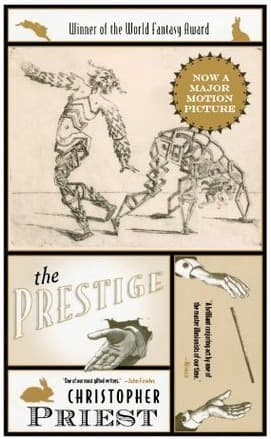
Christopher Priest (1901)
Genre
Fantasy / Historical Fiction / Mystery / Science Fiction
Reading Time
900 min
Key Themes
See below
Sign in to track this book
In a Victorian world of gaslight and illusion, two rival magicians begin a century-spanning feud, blurring the lines between stagecraft and terrifying science, leaving a legacy of obsession and dark secrets for their descendants to unravel.
The story begins with a framing device, introducing Borden and Angier through their descendants who try to piece together their ancestors' intertwined lives. The main story, set in late 19th-century London, details the growing rivalry between two young magicians: Alfred Borden and Rupert Angier. Their animosity starts during a séance performance where Borden accidentally causes the death of Angier's wife, Julia, during a water tank escape trick. Borden, acting as a plant, ties Julia's wrists with a knot he claims is standard, but Angier believes he deliberately tied it to prevent her escape, leading to her drowning. This incident fuels Angier's desire for revenge and to understand Borden's methods, especially his seemingly impossible 'New Transported Man' trick.
Alfred Borden, now known as 'The Professor', develops his illusion, 'The New Transported Man', where he appears to instantly move from one cabinet to another across the stage. This trick baffles audiences and fellow magicians, including Angier. Angier, performing as 'The Great Danton', wants to discover Borden's secret. He uses spies and tries to sabotage Borden's performances, but Borden's trick remains impenetrable. Angier's obsession begins to strain his relationship with his assistant, Olivia Wenscombe, who also becomes involved in the dangerous game of espionage between the two men. Angier's desire for an equally astonishing trick makes him more desperate.
Angier sends his assistant, Olivia Wenscombe, to spy on Borden, hoping she can uncover the secret to 'The New Transported Man'. Olivia, however, becomes romantically involved with Borden and falls in love with him, ultimately betraying Angier by revealing his spying efforts. This hurts Angier and intensifies his hatred for Borden. Angier then pursues a more radical solution for his own teleportation act. He hears rumors of a brilliant but eccentric scientist, Nikola Tesla, and believes Tesla might have the key to a truly instantaneous transportation device, not just an illusion. Angier travels to Colorado Springs to commission Tesla for this project, hoping to surpass Borden.
Nikola Tesla, initially hesitant, agrees to build a machine for Angier. The device is not a teleportation device in the traditional sense, but a machine that can perfectly duplicate any object or person. Angier, realizing the machine's true nature, uses it to create his own version of 'The Transported Man', which he calls 'The Real Transported Man'. Each performance involves Angier stepping into the machine, appearing across the stage, and then disposing of the original Angier (or the duplicate) in a hidden tank of water beneath the stage. This secret allows Angier to perform a truly inexplicable feat, but at the cost of a life each time, filling him with both triumph and dread.
Borden, baffled and enraged by Angier's seemingly impossible 'Real Transported Man', wants to uncover its secret. He attends Angier's performances repeatedly, examining every detail. During one show, Borden gets backstage and sees Angier's duplicate appear, followed by the original Angier falling into the hidden water tank. Believing Angier is drowning his own duplicates, Borden tries to save him, but in the struggle, Angier dies in the tank. Borden is found near the tank, wet and disoriented, leading to his arrest and conviction for Angier's murder, a crime he denies having intentionally committed.
Imprisoned and awaiting execution for Angier's murder, Borden begins to record his life story in a journal, addressing it to his daughter, Jess. During this time, the secret of Borden's 'New Transported Man' is revealed: Alfred Borden is two identical twin brothers, named Alfred and Fallon. They have maintained this deception their entire lives, sharing a single identity, career, and even a wife (Sarah). One twin would perform the trick, while the other would appear at the destination, making the 'teleportation' real in a sense. This secret explains their inconsistent personality traits and the confusion about their relationships, especially with Sarah and Olivia.
It is revealed that the Angier who 'died' in the tank was one of his duplicates. The 'original' Angier, having orchestrated his own apparent death to frame Borden, visits Borden in prison, using the alias 'Lord Caldlow'. He reveals his true identity and gloats over Borden's impending execution. Angier (as Caldlow) offers to spare Borden's life if he reveals the secret to 'The New Transported Man'. Borden remains silent, choosing to protect his brother and his legacy. The 'original' Angier watches as Alfred Borden (the twin who was caught) is hanged, believing he has achieved victory and revenge for Julia's death.
After Borden's execution, the surviving twin, Fallon (who had been posing as Borden's stage engineer), dedicates his life to avenging his brother. He tracks down Angier, who is now living as Lord Caldlow and continuing to perform his 'Real Transported Man' using Tesla's machine. During one of Angier's performances, Fallon enters the theatre and disrupts the trick. As Angier steps into the machine and a duplicate appears, Fallon ensures that the original Angier (or the one who goes into the tank) is truly trapped and drowns, unable to be rescued. This time, Angier's death is permanent, a mirror image of the death he orchestrated for Borden.
The story then returns to the contemporary framing device, where Borden's great-grandson, Nicholas, and Angier's great-granddaughter, Kate, piece together their ancestors' journals and hidden documents. Nicholas, a magician himself, is haunted by the mysteries of his family and the conflicting accounts. Kate, initially skeptical, becomes more involved as they uncover the rivalry's depths. They slowly unearth the truths of the twin Borden brothers, Tesla's machine, and the cycle of revenge. The journals, filled with both men's perspectives, offer fragmented and often biased accounts, making Nicholas and Kate detectives of their own family history.
Through their efforts and the discovery of clues, Nicholas and Kate finally understand the full, tragic scope of the rivalry. They realize that Borden's 'New Transported Man' was achieved through the lifelong sacrifice of two men sharing one identity, and Angier's 'Real Transported Man' was an act of self-cloning and murder, repeated nightly. They understand the personal costs of this obsession – the shattered families, the betrayals, and the ultimate deaths. The descendants grapple with the disturbing legacy of their ancestors, recognizing the cyclical nature of their families' conflict and the human cost of pursuing illusion and revenge.
The Protagonist/Antagonist
The twin Borden's arc is one of maintaining an impossible deception, leading to both professional triumph and personal tragedy, culminating in the execution of one and the vengeful survival of the other.
The Protagonist/Antagonist
Angier's arc is a downward spiral from a grieving husband to a vengeful, morally compromised showman who sacrifices himself repeatedly for the sake of his art and hatred, ultimately leading to his true death.
The Supporting
Olivia's arc sees her caught in a web of deceit, moving from loyal assistant to conflicted lover, and ultimately becoming a tragic figure who understands parts of the truth but is unable to escape the rivalry's destructive force.
The Supporting
Tesla's arc is brief but impactful, as he provides the ultimate plot device for Angier's trick, grappling with the moral responsibility of his invention before disappearing from the direct narrative.
The Supporting
Sarah's arc is one of escalating confusion and despair, as she struggles to understand her husband's dual nature, leading to her tragic demise.
The Supporting
Jess's arc is primarily symbolic, representing the future and the recipient of the Borden family's dark legacy, which is later explored by her descendant, Nicholas.
The Mentioned
Julia's arc is tragically cut short, serving as the catalyst for the entire plot, her death defining Angier's subsequent actions.
The Supporting
Nicholas's arc is one of discovery and understanding, as he slowly unravels the horrific truth of his family's history, bringing the past to light for the reader.
The Supporting
Kate's arc is one of gradual realization and understanding of her family's dark legacy, moving from skepticism to a profound comprehension of the rivalry's impact.
A central theme of 'The Prestige' is the destructive power of obsession and rivalry. Both Borden and Angier are consumed by their desire to outdo each other, leading them to extreme and morally compromising actions. Angier's quest for revenge for Julia's death becomes a drive to surpass Borden, while Borden's commitment to his illusion leads to a lifetime of deception. This rivalry costs them their families, their humanity, and their lives, showing how unchecked obsession leads to tragedy. The narrative shows how their single-minded focus blinds them to the consequences of their actions on themselves and others.
“Every great magic trick consists of three parts or acts. The first part is called 'The Pledge'; The magician shows you something ordinary... The second act is called 'The Turn'; The magician takes the ordinary something and makes it do something extraordinary... But you wouldn't clap yet. Because making something disappear isn't enough; you have to bring it back. That's why every magic trick has a third act, the hardest part, the one we call 'The Prestige.'”
The novel explores the nature of identity, especially through the Borden twins. Alfred and Fallon sacrifice their individual identities to maintain the illusion of 'Alfred Borden', sharing a life, a wife, and a career. This constant performance blurs who they truly are. Angier also sacrifices his moral identity, and his physical self (through the cloning machine), in his pursuit of the ultimate trick. The book questions what defines a person when their outward identity is a constructed lie or when their physical self is repeatedly duplicated and discarded. It shows the personal cost of such extreme self-sacrifice for art or obsession.
“We were two halves of a whole, but it was a whole that was a lie.”
The Prestige blurs the lines between science and magic. Borden's 'New Transported Man' is an illusion, relying on human deception. Angier, unable to replicate it, turns to the radical, almost magical science of Nikola Tesla, creating a machine that performs a 'real' teleportation (duplication). This contrast highlights the novel's exploration of what 'magic' is – masterful deception, or advanced science that appears magical to the uninitiated? The story suggests that what we perceive as magic is often just a trick, or science beyond our current understanding, and both have dangerous consequences.
“Man has always wanted to be able to move instantly from one place to another. Not to walk, not to run, not to fly... But to appear, to vanish. To leap through space. This is a dream. And now it is a reality.”
Deception is at the core of magic, and the novel examines its costs. The Borden twins' lifelong deception of their shared identity destroys Sarah and leads to Jess's emotional neglect. Angier's deceptions, both in his tricks and in his framing of Borden, lead to murder and his own moral decay. The book shows that while illusion can captivate, when it extends into personal lives and is driven by dark motives, it can shatter relationships, destroy lives, and lead to an inescapable cycle of vengeance. The 'prestige' of a trick often comes at a hidden, terrible price.
“We were magicians, not real people.”
The narrative is framed by the descendants of Borden and Angier trying to understand their ancestors' rivalry through fragmented journals and memories. This shows the theme of legacy – how the actions of one generation impact the next. The rivalry does not end with the magicians' deaths but continues to haunt and puzzle their great-grandchildren. The struggle to piece together the truth from biased and incomplete accounts shows how history is often subjective and how memory can be manipulated, like a magic trick. The descendants' journey is about reconciling with a dark and complex family past.
“Every diary is a record of a lie, or a distortion of the truth. It is not the whole story, it is a version of it.”
The story is told through the journals of the two rival magicians and a contemporary framing device.
The novel employs a dual narrative structure, presenting the story primarily through the personal journals of Alfred Borden and Rupert Angier. This allows for subjective, often contradictory, accounts of the same events, deepening the mystery and highlighting the unreliable nature of memory and perspective. A contemporary framing device, involving their descendants (Nicholas Borden and Kate Angier), ties these historical accounts together, creating an overarching puzzle for both the characters and the reader to solve. This structure immerses the reader in the rivalry's psychological depth and the challenge of discerning truth from illusion.
Both Borden and Angier present their own biased versions of events.
Due to the epistolary format, both Alfred Borden and Rupert Angier serve as unreliable narrators. Their journals are filled with their personal biases, justifications, and selective omissions, designed to portray themselves in a favorable light or to mislead. Borden's narrative is particularly unreliable due to the existence of the twin brothers, making his 'I' a shifting entity. Angier's accounts are colored by his grief and vengeful obsession. The reader must actively interpret and piece together the 'truth' from these conflicting perspectives, mirroring the descendants' struggle to understand their ancestors.
The final, inexplicable part of a magic trick, symbolizing the ultimate secret or consequence.
The term 'Prestige' is used both literally, as the third and most astonishing part of a magic trick (making something reappear after it has vanished), and metaphorically. In the context of the novel, the 'Prestige' represents the ultimate secret or the horrifying consequence of the magicians' rivalry. For Borden, it is the lifelong sacrifice of his dual identity. For Angier, it is the repeated act of self-cloning and murder. It signifies the profound, often dark, culmination of their deceptions and obsessions, the part that truly baffles and leaves a lasting, unsettling impact.
A scientific device that can duplicate objects and people, serving as the ultimate 'magic' trick.
Nikola Tesla's machine is a pivotal plot device that shifts the narrative from traditional stage magic to science fiction. It is a device capable of creating perfect duplicates, or clones, of whatever is placed within it. This machine is Angier's answer to Borden's 'New Transported Man', allowing him to perform a 'real' teleportation, albeit one with a horrifying cost. The machine represents the dangers of unchecked scientific ambition and the blurring of lines between science and magic, providing a literal (and deadly) 'prestige' to Angier's act, but at the cost of his humanity and multiple lives.
The secret identity of Alfred Borden, a lifelong deception and the core of his 'magic'.
The existence of identical twin brothers, Alfred and Fallon, who share the single identity of 'Alfred Borden', is the novel's most significant plot twist and central deception. This device explains Borden's seemingly impossible 'New Transported Man' trick, as one twin vanishes and the other appears. More importantly, it explains the inconsistencies in Borden's character, his relationships, and his motivations. The twins represent the ultimate sacrifice of personal identity for the sake of an illusion, and their secret has devastating consequences for everyone around them, especially Sarah, and ultimately leads to their downfall.
“Every great magic trick consists of three parts or acts. The first part is called 'The Pledge'. The magician shows you something ordinary...”
— Alfred Borden explaining the structure of a magic trick, a foundational concept in the novel.
“...The second act is called 'The Turn'. The magician takes the ordinary something and makes it do something extraordinary.”
— Borden continuing his explanation of a magic trick, detailing the 'Turn' phase.
“...But you wouldn't clap yet. Because making something disappear isn't enough; you have to bring it back. That's why every magic trick has a third act, the hardest part, the part we call 'The Prestige'.”
— Borden concluding his explanation of a magic trick, emphasizing the crucial 'Prestige'.
“The secret, I believe, is to be found in the absolute, unshakeable conviction that the trick is real.”
— Alfred Borden reflecting on the mindset required for a truly convincing magical performance.
“We were not men of science, we were men of illusion. But we were also men of ambition.”
— A general reflection on the nature of the dueling magicians, highlighting their professional identity and drive.
“Every man has a secret, and every secret has a price.”
— A recurring theme about the cost of hidden truths and the lengths people go to protect them.
“The greatest trick the devil ever pulled was convincing the world he didn't exist. The greatest trick a magician ever pulled was convincing the world he was unique.”
— A cynical observation about the nature of originality and the art of misdirection.
“To be a true magician, you must suffer for your art.”
— Implied throughout the narrative by the sacrifices the characters make for their craft.
“Our rivalry was the fuel that fed our creativity, but it was also the poison that corrupted our souls.”
— A summary of the complex and destructive relationship between Borden and Angier.
“What is the point of a secret if you cannot share it?”
— A question that arises as characters grapple with the isolation caused by their hidden lives.
“We were not just performing tricks; we were creating miracles.”
— A statement reflecting the magicians' belief in the profound impact of their illusions.
“The true art of magic is not to create an illusion, but to make the audience believe they have witnessed something real.”
— A more nuanced definition of magic, focusing on the audience's perception.
“I was a magician, and a magician never reveals his secrets. But even a magician can be undone by the secrets of another.”
— A reflection on the vulnerability of even the most guarded individuals when facing an equally secretive opponent.
“The greatest trick of all was to live a double life, to be two men at once, and make everyone believe you were just one.”
— A direct reference to the central secret of Alfred Borden's 'The Transported Man' trick.
Ready to see how well you understood this book? Take our interactive quiz with 10 questions.

Christopher Priest is a celebrated British author of speculative fiction, best known for his intricate and mind-bending novel, The Prestige, which was adapted into an Academy Award-winning film. His work often explores themes of illusion, identity, and the unreliable nature of memory. Priest is a recipient of the British Fantasy Award and the World Fantasy Award for his contributions to the genre.







