“The wind howled, a mournful dirge for a world that was.”
— Early description of the desolate, post-apocalyptic landscape.

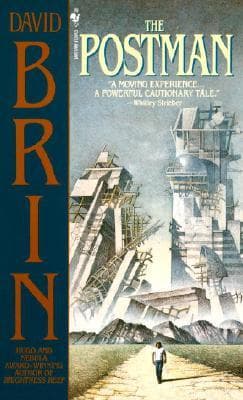
David Brin (1985)
Genre
Historical Fiction / Romance
Reading Time
321 min
Key Themes
See below
Sign in to track this book
In a post-apocalyptic America, a lone wanderer dons a dead postman's uniform and, through a powerful lie, rekindles the dream of a unified nation.
Gordon Krantz, a lone drifter in post-apocalyptic Oregon, scavenges for survival. He finds a skeleton in a collapsed mail jeep, still in a U.S. Post Office uniform. Needing warm clothing, Gordon takes the uniform, badge, helmet, and a satchel of undelivered mail. He initially dismisses the mail as useless, but a mischievous impulse leads him to wear the full uniform. Approaching a small settlement called The Homestead, he fabricates a story about the 'Restored United States of America' and himself being a federal postman, hoping to trade the illusion for food and shelter. The villagers, desperate for hope, cautiously accept his tale.
Gordon's lie about the 'Restored United States' and a functioning postal service unexpectedly resonates with the communities he visits. People are hungry for news and connection, and the uniform symbolizes a lost order they want. He begins to deliver the old mail he found, improvising stories about the recipients and the 'new government' to maintain the illusion. At a settlement called Pineview, he meets Dena, a young woman who is initially skeptical but becomes intrigued by his mission. Dena, a resourceful survivor, eventually joins Gordon, offering her skills and a grounded perspective to his growing charade. She recognizes the power of the hope he brings.
As Gordon and Dena travel, they encounter more settlements, each eager for news and a connection to the 'Restored United States.' Gordon, now fully embodying the role of 'the Postman,' begins to recruit others, training them as auxiliary postmen to carry messages. These recruits, often outcasts or those seeking purpose, become fiercely loyal. The movement, fueled by a shared desire for order and a common enemy, starts to grow beyond Gordon's initial intent. This growing visibility also draws the attention of the Holnists, a violent, militaristic survivalist group led by General Bethlehem, who see the Postman's ideals as a threat to their own vision.
General Bethlehem and his Holnist forces, a well-armed militia, see the Postman's movement as a direct challenge to their dominance. They believe in self-sufficiency through force and reject any notion of a returning federal government. Holnist patrols begin to intercept and destroy mail, terrorize settlements sympathetic to the Postman, and capture or kill auxiliary postmen. Gordon and Dena realize the increasing danger. Gordon, who started with a simple lie, now feels a deep responsibility for the lives and hopes he has inspired. The conflict escalates, forcing the Postman's followers to arm themselves and prepare for direct confrontation, shifting the movement from a symbolic act to active resistance.
Gordon, burdened by the growing conflict and his deception, travels to the ruins of Corvallis, seeking the legendary 'Oracle.' This Oracle is an advanced, partially functional artificial intelligence, a relic of the pre-war era. Gordon confesses his entire deception to the AI. He explains how he started with a lie and how it grew into a powerful symbol of hope for thousands. The Oracle, in its dispassionate analysis, confirms the impact of Gordon's actions. It recognizes that the 'lie' has become a self-fulfilling prophecy, fostering a genuine desire for reconstruction and unity. It advises Gordon to continue his work and embrace the role he has created.
Inspired by the Oracle's words and the loyalty of his followers, Gordon, now fully embracing his identity as the Postman, decides to confront the Holnists. He sends messages through his network, calling upon all communities that have benefited from the postal service to unite against General Bethlehem's tyranny. The message resonates. Towns and settlements, once isolated, begin to pool resources, share intelligence, and train for battle. Farmers, scavengers, and isolated families, bound by the shared dream of a restored America, prepare to fight for the future the Postman's lie has promised them. Dena organizes logistics and communications.
The forces loyal to the Postman, though less organized than the Holnists, demonstrate fierce determination and strategic understanding of their terrain. The battle is brutal, fought in the rugged Oregon wilderness. Gordon, despite his initial reluctance for violence, leads from the front, inspiring his diverse army. The Holnists, confident in their superior weaponry and discipline, are surprised by the tenacity and numbers of the Postman's followers, who are fighting for an ideal. Key skirmishes see heavy losses on both sides, highlighting the high stakes. The Postman's network coordinates movements and relays information.
In a decisive engagement, General Bethlehem and his Holnist command are cornered and defeated. Bethlehem is either killed or captured, effectively dismantling the Holnist organization as a major threat. This victory, though costly, is a triumph for the Postman's movement. It proves that unity and shared purpose can overcome brute force and tyranny. The remaining Holnist elements are scattered, and many of their former conscripts, disillusioned by their leader's defeat, surrender or abandon the cause. The defeat of the Holnists clears the path for the Postman's vision to truly take root, allowing communities to focus on rebuilding rather than constant defense.
With the Holnist threat largely neutralized, the informal network of postmen and allied communities begins to solidify into a more structured organization. The postal service, initially a communication network, starts to assume governmental functions, including establishing laws, mediating disputes, and coordinating resource sharing. Gordon, despite his discomfort with leadership, is seen as the de facto leader, the symbolic head of this burgeoning 'Restored United States.' He works with Dena and other trusted allies to establish principles for this new society, emphasizing cooperation, shared responsibility, and the rule of law. The challenge shifts from fighting an enemy to building a sustainable future.
Years later, Gordon Krantz, now an elder statesman, reflects on his journey. The 'lie' he invented has become the truth, a growing network of interconnected, self-governing communities striving for a better future. The postal service, once a desperate act, is now a vital institution, carrying not just letters, but the fabric of a recovering nation. Gordon understands that the power was never in the uniform or the specific messages, but in the hope and the shared dream of a unified America it symbolized. He recognizes that while challenges remain, the foundation for a new society has been laid, built on the improbable truth of a humble postman's deception.
The Protagonist
Gordon transforms from a cynical, lone survivor into the symbolic leader of a nascent government, accepting the responsibility of the hope he inspired.
The Supporting
Dena evolves from a wary observer to a key architect of the new society, providing practical leadership and support.
The Antagonist
General Bethlehem's arc is one of escalating tyranny and eventual downfall, as his ideology of force is overcome by the power of unity and hope.
The Supporting
The Oracle serves as a catalyst for Gordon's acceptance of his role, providing an objective validation of his mission's importance.
The Supporting
Bridge transforms from an aimless survivor into a dedicated and courageous member of the postal service, demonstrating the power of shared purpose.
The Mentioned
N/A - her story is static, serving as a symbolic representation of the past.
The main theme is how a fabricated story, fueled by a deep human need for hope and connection, can become a powerful, self-fulfilling truth. Gordon's initial lie about a 'Restored United States' and a functioning postal service, despite its self-serving origins, ignites a genuine desire for order and unity among disparate communities. This is clear as people risk their lives to protect the postal network. It shows that belief in a better future can be a more potent force than any physical army, as seen in the climactic battle against the Holnists.
“A lie that tells a truth is worth a hundred truths.”
The novel explores the challenges and moral complexities of rebuilding society after a catastrophic collapse. It examines the practicalities of establishing communication, governance, and defense in a fragmented world. The Postman's journey highlights the need for shared ideals, cooperation, and the rule of law to overcome anarchy and tyranny. The formation of the postal network, which evolves into a nascent government, shows the foundational steps needed to re-establish civilization, moving beyond mere survival to creating a sustainable, interconnected future.
“We need something to bind us together, or we'll just keep scattering until there's nothing left but dust.”
The story examines different forms of leadership, contrasting Gordon's reluctant, accidental, and inspiring leadership with General Bethlehem's autocratic, fear-based rule. Gordon, despite his initial deception, gradually accepts the responsibility that comes with inspiring thousands. His leadership is not about power, but about service and fostering a shared vision. Bethlehem, conversely, leads through intimidation and promises of dominance. The narrative suggests that true leadership in times of crisis is less about authority and more about cultivating collective belief and empowering individuals towards a common, constructive goal, as seen in the loyalty of the auxiliary postmen.
“A leader isn't someone who tells you what to do. A leader is someone who shows you what's possible.”
In a world shattered by war, communication and the human need for connection are paramount. The postal service, even when carrying old or fabricated mail, symbolizes the link between isolated communities and the yearning for news, shared experiences, and a sense of belonging. Delivering mail, regardless of its content, becomes an act of hope and defiance against isolation. This is evident in the desperation of villagers for news and the willingness of individuals to risk their lives to keep the postal routes open. It shows that information flow is as crucial as food or shelter for a recovering society.
“The message isn't just in the words. It's in the fact that someone bothered to send it at all.”
A powerful symbol of lost order and a catalyst for change.
The discovery of the U.S. Post Office uniform and satchel of mail is the inciting incident of the novel. The uniform itself acts as a potent symbol of the pre-war world's order, authority, and interconnectedness. It immediately grants Gordon a perceived legitimacy that his solitary, scavenging existence would never afford. The satchel of undelivered mail, though initially just old letters, becomes the physical manifestation of the need for communication and the lost connections. Together, they are the props that allow Gordon to weave his lie, which in turn becomes a powerful truth, demonstrating the power of symbols to shape reality.
A pre-war AI serving as a detached voice of reason and validation.
The Oracle is a sophisticated artificial intelligence, a relic from the pre-war era. Its function as a plot device is multi-faceted: it provides a moment of confession and objective validation for Gordon, confirming the profound impact of his 'lie' from a non-human perspective. It also serves as a narrative link to the advanced technology of the past, reminding the reader of what was lost. More importantly, the Oracle represents a source of detached, strategic wisdom, guiding Gordon at a critical juncture and reinforcing the idea that even in a shattered world, knowledge and reason can still provide direction.
The primary antagonistic force, embodying tyranny and chaos.
The Holnists, led by General Bethlehem, serve as the main external conflict and antagonist. They represent the forces of tribalism, military might, and a rejection of the ideals of cooperation and rebuilding that the Postman champions. Their presence creates immediate danger and provides a clear, tangible enemy for the nascent 'Restored United States' to unite against. The Holnists' ideology and actions highlight the destructive potential of unchecked power and the challenges of establishing a peaceful society in a lawless world, ultimately forcing the Postman's movement to evolve from a symbolic act to an armed resistance.
“The wind howled, a mournful dirge for a world that was.”
— Early description of the desolate, post-apocalyptic landscape.
“Hope was a dangerous thing, a flickering candle in a hurricane, but sometimes, it was all you had.”
— Gordon ponders the nature of hope in a world without much of it.
“I am the United States Postman. And I have letters for you.”
— Gordon's iconic declaration when first encountering a community, establishing his new identity.
“It wasn't the uniform that made the Postman, it was the belief in what it represented.”
— Gordon reflects on the deeper meaning behind his Postman persona.
“Lies could be useful, even necessary, when they served a greater truth.”
— Gordon justifies his initial deception about the existence of a 'Restored United States'.
“Civilization isn't just buildings and roads. It's the connections between people.”
— Gordon explains his philosophy on rebuilding society.
“The past wasn't dead; it was just waiting for someone to remember it.”
— Gordon realizes the power of history and shared memory.
“A good story, well told, could be as powerful as any weapon.”
— Gordon recognizes the importance of narrative in inspiring people.
“Fear was a tool, but so was courage. And courage was harder to break.”
— Gordon considers the motivations of both himself and his adversaries.
“Sometimes, the biggest battles were fought not with guns, but with ideas.”
— Gordon faces ideological challenges from various factions.
“The world had ended, but life, stubborn and persistent, found a way to begin again.”
— An observation about the enduring nature of life despite catastrophe.
“He didn't bring the mail. He brought the dream.”
— A character's realization about Gordon's true impact on communities.
“Even in ruin, there was beauty, if you knew where to look.”
— Gordon finds moments of appreciation amidst the devastation.
“The path to peace was never straight, and often paved with difficult choices.”
— Gordon grapples with the complexities of leadership and rebuilding.
Ready to see how well you understood this book? Take our interactive quiz with 10 questions.

David Brin is a renowned science fiction author, best known for his award-winning novels "Startide Rising" and "The Postman." He holds a Ph.D. in astrophysics from the University of California, San Diego, which informs his scientifically grounded and thought-provoking narratives. Brin's work often explores themes of humanity's future, societal evolution, and the nature of intelligence.







