“Five little puppies dug a tunnel under the fence and went out to see the wide, wide world.”
— Opening of the story, introducing the puppies' adventurous spirit.

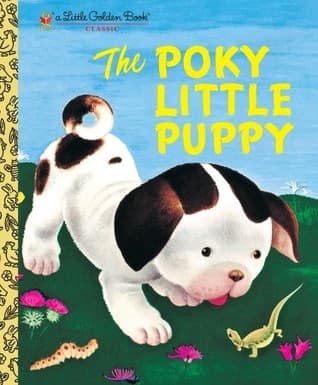
Janette Sebring Lowrey (1942)
Genre
Children's / Young Adult
Reading Time
5 min
Key Themes
See below
Sign in to track this book
Five little puppies dig a hole under the fence and go out to play in the meadow, but one poky puppy lags behind and misses out on dessert after supper.
Five little puppies, described as 'roly-poly' and 'fat-little-dumpy,' finish their supper of rice and milk. They decide to go on an adventure. They dig a hole right under the garden fence. Four of the puppies quickly wriggle through the new opening, eager to explore the world beyond their yard. The fifth puppy, however, is a bit slower and takes his time to follow his siblings.
While his four siblings eagerly run off to explore the world outside the fence, the fifth puppy, who is always a bit behind, gets distracted. He smells a delightful aroma. Following the scent, he finds a patch of delicious-smelling strawberry shortcake. He stops his journey to sniff and investigate the treat, momentarily forgetting about his adventurous siblings.
The four quicker puppies, having squeezed under the fence, quickly explore their new freedom. They race through the tall grass, their tails wagging. They chase butterflies, bark at a friendly frog, and roll in the fresh green clover. Each new sight and sound fills them with joy as they enjoy the newness of the world outside, completely absorbed in their adventure.
Meanwhile, the poky little puppy, still interested in the delicious scent, has found the strawberry shortcake. He eats every crumb. He licks the plate clean, enjoying each bite of the sweet treat. His enjoyment is complete, and he takes his time, satisfied with his impromptu dessert, while his four siblings are still exploring.
As the sun begins to set and the sky darkens, the mother dog's voice calls her puppies home for the night. Her barks are firm and clear, signaling it's time to return to the yard. The four adventurous puppies, who have been playing far and wide, hear her call but do not want to end their fun. They dawdle and take their time.
Eventually, the four puppies, hearing their mother's calls, make their way back towards the fence. They squeeze back through the hole they dug and return to their yard, but they are late. Their mother, unhappy with their tardiness and their fence-digging, decides to teach them a lesson. When it's time for supper, she gives them no dessert, sending them straight to bed as a consequence for their disobedience and late return.
The poky little puppy, having thoroughly enjoyed his strawberry shortcake, hears his mother's call as he finishes. He makes his way back, not dawdling like his siblings, but returning promptly after his solo adventure. Because he arrives on time and did not cause his mother to worry, he is greeted warmly. While his siblings are sent to bed without dessert, the poky puppy is given his own bowl of delicious rice pudding, a sweet reward for his timely return.
The next day, despite the previous evening's punishment, the four adventurous puppies again dig a hole under the fence. They are just as eager to explore and play outside the yard. Their mother, finding their repeat offense, becomes even more determined to teach them a lesson. When they finally return, late once more, she sends them to bed without any supper, a harsher consequence for their continued disobedience.
While his four siblings are exploring and getting into trouble, the poky little puppy, true to form, finds another delightful distraction. He finds a spot where someone has dropped chocolate custard. He enjoys every bit of it, savoring his secret treat. Again, he finishes his indulgence and returns home just as his mother calls, arriving on time and avoiding the punishment given to his tardy siblings.
For his consistent punctuality and good behavior, the poky little puppy continues to receive special rewards. On this particular evening, after his siblings are sent to bed without supper, the poky puppy is given a delicious bowl of rice pudding, just for himself. He enjoys his sweet dessert, content in his ability to enjoy his adventures and still return home on time, much to his mother's satisfaction.
After several days of the four puppies repeatedly digging under the fence and returning late, their mother decides it is enough. To stop their mischievous escapades and keep them safe, she takes action. She fills in the hole under the fence, patching it up completely. This ends the puppies' unauthorized adventures outside the yard, ensuring they stay within their boundaries.
With the fence now patched and no more opportunities for the puppies to sneak out, the nightly routine changes. The four adventurous puppies, having learned their lesson, stay within the yard. However, the poky little puppy receives the final, special reward. For always returning on time and not causing trouble, he is given a large, delicious bowl of rice pudding with brown sugar on top, a sweet end to his tale of quiet obedience and delicious discoveries.
The Protagonist
He consistently follows his own pace, leading to personal gratification and rewards for his timely returns, rather than developing through challenge.
The Supporting
They repeatedly test boundaries and face consequences, eventually learning to stay within the yard after the fence is mended.
The Supporting
She consistently enforces rules and consequences, eventually taking physical action to prevent further disobedience.
This theme is central to the story, contrasting the behavior of the poky puppy with his siblings. The four adventurous puppies repeatedly disobey their mother by digging under the fence and returning home late, leading to punishments like being sent to bed without dessert or supper. The poky puppy, despite his distractions, always returns on time, earning him delicious rewards. The story clearly shows that obedience leads to good outcomes, while disobedience results in bad ones.
“And when they got home, their mother, the Dog, said, 'For shame! No dessert for naughty puppies tonight!'”
While the four puppies seek immediate fun outside the fence, the poky puppy finds his own form of satisfying reward. He takes his time, enjoys his secret treats, and then returns home, often to a reward. His 'pokiness' allows him to enjoy unique experiences (like eating strawberry shortcake) that his siblings miss in their haste. Ultimately, his slower pace and timely return lead to greater, consistent rewards.
“But the poky little puppy, because he was always so poky, was just coming back through the hole in the fence. And he got a big bowl of rice pudding, with brown sugar on top.”
The story shows the distinct personality of the poky little puppy compared to his four siblings. While the others are a group of energetic explorers, the poky puppy moves at his own pace. His unique speed and priorities lead him down a different path, one that, in this story, proves to be more rewarding. This theme suggests that it is okay to be different and to move at one's own speed.
“The poky little puppy was a very poky puppy indeed.”
The cyclical pattern of puppies digging, mother calling, and consequences, with escalating punishments.
The story employs repetition to establish a clear pattern of behavior and its consequences. Each day, the four puppies dig under the fence and return late, while the poky puppy finds a treat and returns on time. The variation lies in the escalating punishments for the disobedient puppies (no dessert, then no supper) and the consistent rewards for the poky puppy (rice pudding, then rice pudding with brown sugar). This reinforces the moral lesson and makes the narrative predictable yet engaging for young readers.
The contrast between the poky puppy and his four siblings to highlight different behaviors and outcomes.
The four adventurous, disobedient puppies serve as foils to the poky little puppy. Their haste, rule-breaking, and subsequent punishments sharply contrast with the poky puppy's slow pace, secret indulgences, and eventual rewards. This literary device emphasizes the distinct personality and choices of the protagonist, making his positive outcomes stand out more prominently against the negative consequences faced by his siblings, thus reinforcing the story's moral lesson.
Represents boundaries, rules, and the temptation of the unknown.
The garden fence, and specifically the hole dug beneath it, symbolizes the boundary between safety and the unknown, between obedience and disobedience. For the four puppies, it represents a challenge to be overcome in pursuit of adventure and freedom. For the mother dog, it represents a breach of rules and a source of worry. Patching the hole ultimately signifies the re-establishment of order and the end of forbidden escapades, enforcing the lesson of staying within safe, established limits.
“Five little puppies dug a tunnel under the fence and went out to see the wide, wide world.”
— Opening of the story, introducing the puppies' adventurous spirit.
“Four little puppies scampered through the meadow, over the hill, and far away.”
— The puppies exploring, leaving one behind.
“But the poky little puppy dug another hole under the fence and went into the garden.”
— The poky puppy's unique behavior, leading him to a different path.
“And he ate all the rice pudding with pink sugar that his mother had made for their dessert.”
— The poky puppy's reward for his 'disobedience'.
“The four little puppies tumbled out of bed and ran out into the garden.”
— The next morning, the other puppies eager to play.
“But the poky little puppy was still fast asleep in his bed.”
— The poky puppy's laziness, contrasting with his siblings.
“And when he finally woke up, he found a big bowl of all gone rice pudding with pink sugar.”
— The poky puppy's disappointment at missing out.
“He ate it all up, every bit, and then he went out to play.”
— The poky puppy enjoying his special treat.
“But his mother had found the hole under the fence.”
— The mother's discovery of the puppies' escape route.
“And she had decided to fill it up.”
— The mother's action to prevent further escapes.
“So the four little puppies couldn't go out to see the wide, wide world anymore.”
— The consequence for the four obedient puppies.
“But the poky little puppy had learned his lesson.”
— The poky puppy's supposed realization.
“He never dug another hole under the fence.”
— The poky puppy's change in behavior.
“And his mother always gave him a nice big bowl of rice pudding with pink sugar for his dessert.”
— The ultimate reward for the poky puppy, despite his initial antics.
Ready to see how well you understood this book? Take our interactive quiz with 10 questions.
Dan Gemeinhart
4.5
Kate O'Hearn
4.4

Jeanne Birdsall
4.4

Jen Wang
4.4
Wendelin Van Draanen
4.3

John Marsden
4.3

Chris Van Allsburg
4.3
Jennifer A. Nielsen
4.2