“The mind is the great bitch.”
— Kate Leslie reflecting on the dominance of intellect over deeper being.

Genre
Literary Fiction / Spirituality / Romance
Reading Time
12-15 hours
Key Themes
See below
Sign in to track this book
In 1920s Mexico, a European woman confronts her own breakdown amid ancient pagan rituals, political unrest, and a dangerous romance.
Kate Leslie, a sophisticated Irish widow in her early forties, travels to Mexico with her American cousin, Owen Rhys. She is initially drawn by a vague promise of something different, but her first experiences disappoint her. She attends a bullfight in Mexico City with Owen and Cipriano Viedma, a Mexican general, and is deeply disturbed by its brutality and the crowd's excitement. This initial revulsion extends to the perceived emptiness of the European and American culture she left. She feels a deep spiritual emptiness within herself and in society, leading her to question Western civilization and personal identity. She longs for a deeper, more real connection to life and a sense of belonging.
Owen and Kate visit a hacienda owned by Don Ramón Carrasco, a prominent intellectual and landowner. Ramón is a magnetic figure who, disillusioned with Catholicism and Western ideals, tries to revive the ancient Aztec gods, especially Quetzalcoatl, as a new spiritual and nationalistic force for Mexico. He preaches a return to a more primitive, instinctual way of life, focusing on the male principle and a deep connection to the earth. Kate is initially skeptical and even repelled by some of Ramón's ideas, finding them both fascinating and disturbing. However, she is also drawn to his powerful presence and the sense of purpose he offers, which contrasts sharply with her own spiritual emptiness. This meeting marks the start of her involvement with his movement.
Kate attends one of Don Ramón's Quetzalcoatl ceremonies, held in a remote place. The ritual involves drumming, chanting, and a deep, almost hypnotic atmosphere meant to call upon the ancient gods. Ramón, dressed in traditional clothing, leads the proceedings, embodying the spirit of Quetzalcoatl. Kate is deeply affected by the primal energy and the participants' collective surrender. While she feels a powerful, almost physical pull toward the experience, she also feels significant inner resistance. Her European intellect and ingrained Christian beliefs clash with the pagan, instinctual nature of the ceremony. She sees the deep effect it has on the Mexican people, who seem to find genuine spiritual release, and begins to question her own resistance to such a deep, non-intellectual faith.
General Cipriano Viedma, a stoic and powerful military figure, publicly pledges his loyalty to Don Ramón and the Quetzalcoatl movement. Ramón names Cipriano as the earthly form of Huitzilopochtli, the god of war and the sun, complementing Ramón's role as Quetzalcoatl, the god of wisdom and the morning star. Cipriano's commitment is absolute. Kate observes Cipriano's silent strength and his fierce devotion, which begins to fascinate her. She sees in him a raw, pure masculinity and a connection to ancient, pre-Christian Mexico that both frightens and attracts her. Her initial intellectual dislike for the movement slowly gives way to a more emotional response, especially toward Cipriano.
Don Ramón actively tries to draw Kate deeper into the Quetzalcoatl faith. He engages her in long, passionate discussions, explaining the philosophy behind the revival and the need to return to a more primal, intuitive way of being. He challenges her European intellect and her dependence on mental ideas, urging her to surrender to the 'blood-consciousness' of the ancient gods. Kate is conflicted. Her intellect resists what she sees as a step backward, yet her deeper, unfulfilled self longs for the spiritual fulfillment Ramón promises. She struggles with what such a surrender means – a possible loss of her individual identity and the embrace of a belief system that seems foreign to her upbringing. This period is a turning point in her self-discovery.
In a surprising turn, Don Ramón proposes that Kate marry General Cipriano Viedma. This suggestion is not about romantic love, but a symbolic union within the new religious order. Ramón sees their marriage as a way for Kate to fully join the Quetzalcoatl movement and find her place within the revived Mexican spiritual landscape. The proposal shocks and confuses Kate. While she is drawn to Cipriano's powerful masculinity, the idea of marrying him, especially under these circumstances, challenges her independent, European identity. She grapples with the implications of such a commitment, questioning whether she can truly surrender herself to a man and a culture so different from her own.
After intense inner debate and more persuasion from Ramón, Kate reluctantly agrees to marry Cipriano. Her decision comes not from conventional love, but a deep, almost desperate longing for spiritual rebirth and a sense of belonging she has never truly found. The wedding is a symbolic, non-Christian ceremony, performed in the style of the new Quetzalcoatl faith. Kate undergoes a ritualistic change, shedding her European clothes and identity, and adopting a more traditional Mexican persona. This act signifies her surrender to the ancient gods and her commitment to the new order. The marriage is initially an unfamiliar and challenging experience, as she navigates a relationship based on instinct rather than intellectual companionship.
After her marriage, Kate takes the name Doña Malintzi, symbolically linking herself with a powerful female figure from Mexican history. She moves to Cipriano's hacienda and begins to adapt to a life very different from her past. Her relationship with Cipriano is based on a deep, unspoken, physical and spiritual connection, not intellectual conversation. She learns to appreciate the rhythms of the land, the simplicity of daily life, and the deep, almost animalistic bond she shares with her husband. Though still battling moments of doubt and longing for her former intellectual life, Kate finds a new sense of peace and fulfillment in this more primal existence, experiencing a rebirth of her sensual and spiritual self. She begins to understand the 'blood-consciousness' Ramón preached.
The Quetzalcoatl movement, though gaining support, faces opposition from various groups, including the Catholic Church and political factions. Ramón, as its leader, is sometimes targeted, and there are moments of tension and potential violence. However, the movement remains strong, supported by its followers' fervent belief. Ramón's authority as Quetzalcoatl, and Cipriano's as Huitzilopochtli, stays firm. Kate witnesses the unwavering faith of the Mexican people who have embraced the ancient gods, strengthening her own belief in the deep impact this spiritual revival is having. These external challenges further solidify her commitment to her new life and her husband.
Kate's cousin, Owen Rhys, who first came with her to Mexico, feels increasingly distant due to her transformation and full embrace of the Quetzalcoatl movement. He represents the Western, intellectual perspective Kate has largely left behind. He cannot accept the pagan rituals, the submission to primal forces, and Kate's marriage to Cipriano. Unable to understand or accept her new life, Owen eventually decides to leave Mexico. His departure is a significant moment for Kate, as it cuts her last tangible link to her European past and further isolates her within her new, indigenous-influenced existence. This isolation, however, also deepens her commitment to her chosen path, forcing her to rely entirely on her new identity and relationships.
Kate's marriage to Cipriano deepens into a relationship unlike any she has known. It is not based on intellectual conversation or romantic declarations, but on a deep, almost telepathic understanding and a powerful, instinctual bond. Cipriano, as Huitzilopochtli, represents a primal, masculine force, and Kate, as Doña Malintzi, learns to respond to this force in a way that goes beyond her former European self. Their connection is rooted in the shared spiritual purpose of the Quetzalcoatl movement and a deep respect for the earth and its energies. Kate finds a new kind of satisfaction and completeness in this silent, powerful union, discovering parts of herself she never knew existed, especially her capacity for a primal, sensual, and spiritual surrender.
As the story continues, Don Ramón, the charismatic leader, begins to show signs of stress. He experiences periods of illness and emotional fragility, which sometimes weaken his powerful image as Quetzalcoatl. These moments make Kate question the movement's stability and the absolute authority she had once given him. She sees the human vulnerability beneath the divine role. While her faith in the overall spiritual revival remains, her view of Ramón becomes more complex. She begins to understand that the movement's strength also lies in the collective belief and the inherent power of the ancient gods themselves, rather than solely on one man's charisma. This period brings a sense of acceptance but also a deeper, more grounded understanding of her chosen path.
Despite Ramón's personal challenges and outside opposition, the Quetzalcoatl movement continues to grow, attracting more followers and becoming a significant force in Mexican spiritual life. Kate, as Doña Malintzi and wife of Huitzilopochtli, finds her place firmly within this new order. She has undergone a deep transformation, shedding her old identity and embracing a life connected to the ancient gods and the Mexican land. She has found a sense of purpose and belonging that eluded her in Europe, a spiritual and sensual fulfillment that goes beyond intellectual understanding. The novel ends with Kate's acceptance of her new reality, her commitment to Cipriano, and her belief in the lasting power of the awakened gods to shape Mexico's future and her own soul.
The Protagonist
Kate transforms from a cynical, intellectually-driven European into Doña Malintzi, embracing a primal, instinctual, and spiritually-rooted life in Mexico, finding a new sense of self and belonging.
The Antagonist/Supporting
Ramón establishes and leads a powerful spiritual movement, but his personal struggles highlight the human challenges of embodying a divine role.
The Supporting
Cipriano transitions from a military general to a spiritual leader, embodying an ancient god and forming a profound, instinctual bond with Kate.
The Supporting
Owen remains static in his Western rationalism, ultimately unable to accept Kate's transformation and departing from her new life.
The Mentioned
Juana remains a consistent devotee, serving as an example of unshakeable faith in the new order.
The Mentioned
Doña Carlota remains resistant to the Quetzalcoatl movement, representing the enduring power of traditional Catholicism.
The novel explores Kate Leslie's desperate search for meaning and spiritual renewal in a world she sees as spiritually empty. Disillusioned with Western rationalism and Christianity, she is drawn to the primal, pagan spirituality offered by Don Ramón's Quetzalcoatl movement. This theme appears in her inner struggles, her initial repulsion yet eventual surrender to the ancient Mexican gods, and her quest for a 'blood-consciousness' that goes beyond intellect. Her journey from cynicism to a deep, though challenging, spiritual belonging is central to the story, as seen in her embrace of the Quetzalcoatl ceremonies and her marriage to Cipriano.
“What did I care for Europe, or for my own country? Nothing! Nothing! I was going to find my own way, and live my own life, and be myself.”
Lawrence explores his ideas on gender roles, focusing on a return to a more primitive, instinctual form of masculinity and femininity. Don Ramón is the wise, spiritual male principle (Quetzalcoatl), while Cipriano is the powerful, silent, and physically strong male (Huitzilopochtli). Kate's transformation into Doña Malintzi involves her surrender to and embrace of a more receptive, instinctual femininity in relation to these male forces. The novel suggests that true fulfillment comes from recognizing and balancing these primal energies, moving past intellectual relationships to a deeper, almost animalistic connection, as shown in Kate's marriage to Cipriano.
“She had wanted to be a queen, but she was only a woman. And a woman needs a man to be a king to her.”
The novel criticizes Western civilization, especially its focus on intellect, individualism, and Christian morality. Lawrence portrays modern European and American society as spiritually empty, overly rational, and disconnected from nature and primal instincts. Kate's initial disillusionment with bullfights and the superficiality of Mexico City life reflects this criticism. The Quetzalcoatl movement is presented as an answer, a radical alternative that offers a return to a more authentic, blood-and-earth consciousness, rejecting the perceived decay of the West for an ancient, instinctive way of life.
“The white man's world was a failure. It had gone too far in the head, and too little in the blood.”
The novel looks at the complex relationship between indigenous Mexican spirituality and imported Western religions. Don Ramón's movement is not just a rejection of Catholicism but an attempt to actively revive ancient Aztec gods, though reinterpreted through a modern view. This creates tension between genuine spiritual revival and a form of cultural mixing. Kate's struggle to embrace the Quetzalcoatl faith highlights the challenge of fitting a European intellectual background with a radically different, primal belief system. The novel explores whether a true return to ancient ways is possible or if it inevitably becomes a new, mixed spiritual form.
“No, we don't want to destroy the Church. We want to take the life out of it, and put it into the gods.”
Lawrence emphasizes the deep psychological and spiritual power of myth and ritual in shaping human experience and society. The Quetzalcoatl ceremonies, with their drumming, chanting, and symbolic representations of gods, are central to the novel. These rituals are not just performances but are designed to create deep, collective emotional and spiritual responses, allowing participants to connect with ancient archetypes and primal energies. Kate's transformation is largely helped by her participation in and eventual surrender to these powerful, transformative rituals, which offer a sense of communal belonging and spiritual transcendence that intellectual thought cannot provide.
“The drum beat on, and the darkness grew heavier, and the sense of the unknown, of the dark god, became more potent.”
Quetzalcoatl represents the integration of spirit and earth, intellect and instinct.
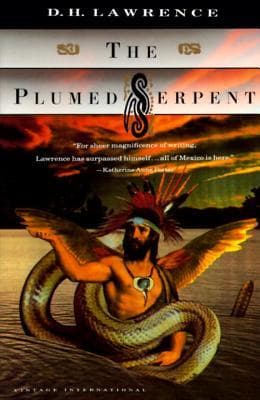
The Plumed Serpent, Quetzalcoatl, is the central symbolic image of the novel. It represents the union of opposites: the serpent (earth, physicality, instinct) and the plume (sky, spirit, intellect). This symbol embodies Don Ramón's philosophy of 'blood-consciousness'—a holistic way of being that integrates the physical and the spiritual, the primal and the refined. It is the ideal state that Kate Leslie strives for, moving beyond her purely intellectual European self to embrace a more complete, instinctual existence. The revival of Quetzalcoatl symbolizes Mexico's potential for spiritual rebirth and Kate's personal transformation.
Kate's physical journey to Mexico mirrors her internal spiritual quest.
Kate Leslie's physical journey from Europe to Mexico serves as a powerful metaphor for her internal spiritual and psychological quest. Her disillusionment with Western civilization drives her to seek something radically different, and Mexico, with its ancient cultures and vibrant landscape, becomes the crucible for her transformation. Each step deeper into the Mexican interior and into the Quetzalcoatl movement reflects her progressive shedding of old identities and her embrace of a new, more primal self. The journey is not just about changing location but about undergoing a profound inner metamorphosis.
Owen Rhys and Doña Carlota highlight Kate's transformation and the movement's challenges.
Owen Rhys, Kate's American cousin, acts as a foil by representing the Western rationalism and superficiality that Kate is trying to escape. His inability to understand or accept Kate's new life underscores the radical nature of her transformation. Similarly, Doña Carlota, Ramón's devoutly Catholic wife, serves as a foil to Ramón's movement, representing the traditional religious beliefs that the Quetzalcoatl revival seeks to supplant. These characters highlight the profound choices Kate makes and the societal resistance faced by the new spiritual order, emphasizing the depth and significance of the changes occurring.
Ancient Aztec myths are reinterpreted to create a new spiritual narrative.
Lawrence extensively uses allusions to ancient Aztec mythology, particularly the figures of Quetzalcoatl and Huitzilopochtli. However, these are not merely historical references; they are actively reinterpreted and embodied by living characters (Ramón as Quetzalcoatl, Cipriano as Huitzilopochtli) to create a new, living mythology. This device allows Lawrence to explore the power of myth in shaping identity and culture, suggesting that ancient gods can be 're-awakened' to provide spiritual guidance in a modern world. It blurs the line between historical myth and contemporary reality, giving the movement a profound, timeless resonance.
“The mind is the great bitch.”
— Kate Leslie reflecting on the dominance of intellect over deeper being.
“It is not enough to be free from something. One must be free for something.”
— Kate considering the nature of freedom and the need for a positive purpose.
“The living, quivering, hot blood of the living world. This is the only god.”
— Don Ramón speaking about his vision of a vital, immanent divinity.
“Men must be gods to one another again.”
— Don Ramón expressing his desire for a return to a more profound, deified human connection.
“The world is waiting for the great man to come again.”
— Kate observing the longing for a powerful, spiritual leader among the Mexican people.
“There are two ways of knowing: the way of the sun, and the way of the moon. The way of the sun is knowing through the mind, the way of the moon is knowing through the blood.”
— Don Ramón explaining different modes of perception and understanding.
“The white man's God is a dead God. He is a God of the mind, not of the blood.”
— Don Ramón criticizing Western Christianity and its perceived lack of vital force.
“To be alive is to be related to the living world.”
— A core theme emphasizing the importance of vital connection to nature and life itself.
“Love is not a feeling, it is a state of being.”
— Kate contemplating the deeper, more profound nature of love beyond mere emotion.
“The greatest pleasure of life is love.”
— A simple yet profound statement on the ultimate joy found in true connection.
“The dark gods are coming back.”
— Kate sensing the resurgence of ancient, powerful, and sometimes fearsome spiritual forces.
“One must be able to stand alone, in the silence of one's own soul.”
— Kate's internal struggle for self-reliance and inner peace amidst external chaos.
“The will of man is the will of God, if man is man enough.”
— Don Ramón suggesting that human will, when aligned with deeper being, can manifest divine purpose.
“The greatest sin is to be dead inside.”
— A reflection on the importance of vitality and passion over mere existence.
Ready to see how well you understood this book? Take our interactive quiz with 10 questions.

D.H. Lawrence was a prominent English novelist, poet, playwright, and essayist whose works explored themes of sexuality, industrialization, and the human condition. His most controversial and famous novel, "Lady Chatterley's Lover," challenged societal norms and censorship. Other notable works include "The Rainbow," "Women in Love," and "Sons and Lovers," solidifying his place as a significant figure in modernist literature.