“They'll hunt him, of course. All the men in the world will hunt him. But he'll get away. He's too clever for them. He'll get away.”
— Snitter's thoughts about Rowf's escape from the lab.

Richard Adams (1981)
Genre
Fantasy
Reading Time
12-15 hours
Key Themes
See below
Sign in to track this book
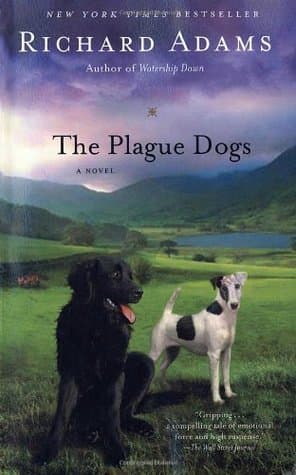
Two experimental dogs, scarred by human cruelty, escape into the wilderness with a fox, only to become targets of a massive hunt fueled by fear, misunderstanding, and the specter of the bubonic plague.
The story begins at ASR, an animal research facility in the Lake District, where dogs are subjected to painful experiments. Rowf, a large Labrador-mix, is repeatedly drowned and resuscitated in a tank, enduring trauma. Snitter, a smaller terrier-mix, has undergone brain surgery, leaving him with a distorted perception of reality and vivid hallucinations. One night, a human error leaves their cage door open, and the two dogs escape. They navigate the terrifying corridors, eventually making their way outside the fence into the harsh, rainy Cumbrian fells, unprepared for life in the wild.
After their escape, Snitter and Rowf quickly realize the brutal reality of the wilderness. They are starving, disoriented, and hunted by the ASR staff. Their initial attempts to find food are clumsy. Rowf, driven by instinct, tries to hunt small animals, while Snitter, disoriented from his surgery, struggles to adapt. They meet a fox, 'the Tod.' Initially wary, the Tod recognizes the dogs' desperation and lack of hunting skills. He teaches them how to scavenge, hunt small game, and avoid human detection, becoming a guide and protector in their new, dangerous world.
Despite the Tod's guidance, the dogs' hunger becomes unbearable as winter approaches. Driven by desperation and Rowf's instincts to hunt larger prey, they attack a flock of sheep on a nearby farm. While they only kill a few, the sight of the mauled animals incites outrage among local farmers and the press. The incident is sensationalized, with newspapers labeling Snitter and Rowf as 'man-eating monsters.' This incident transforms their escape from a local concern into widespread public panic, leading to demands for their capture and extermination.
The media frenzy and public fear escalate, prompting a massive hunt for the 'plague dogs.' Local farmers and gamekeepers, armed with shotguns, begin scouring the fells. Soon, the military is called in, deploying soldiers, helicopters, and trained tracker dogs. Snitter and Rowf, guided by the Tod, are forced to constantly move, hiding in caves, crevices, and dense undergrowth. The Tod helps them evade their pursuers, but the relentless pressure and the constant sound of human voices and vehicles take a toll on the dogs' physical and mental state, pushing them to their limits.
Adding to the panic, a former ASR scientist, Dr. Boycott, leaks information to the press, suggesting that the escaped dogs might carry a virulent strain of bubonic plague, which had been part of an unrelated experiment at the facility. This unconfirmed rumor, despite being unsubstantiated, throws the region into terror. The hunt is no longer just about dangerous animals; it becomes a public health crisis. The military presence intensifies, with orders to shoot the dogs on sight and incinerate their bodies to prevent any potential spread of disease, making their chances of survival almost non-existent.
The hunt becomes brutal. Snitter and Rowf endure close calls, narrowly escaping gunfire, traps, and military patrols. They witness the deaths of other animals caught in the crossfire and experience the terror of being pursued. During one intense chase, the Tod diverts a hunter away from the dogs. He is shot and mortally wounded. The dogs are devastated by the loss of their friend and mentor, who had been their only reliable guide and source of comfort. His death leaves them more vulnerable and despairing.
After the Tod's death, Snitter and Rowf are at their lowest point. They are starving, exhausted, and alone, with no clear direction. Snitter's fragmented memories, often mixed with his hallucinations, begin to coalesce around a vague image: the sea. He recalls a time before ASR, a time of warmth and safety associated with the vast expanse of water. Though Rowf doesn't understand, Snitter's insistent focus on reaching the sea becomes their new purpose. It's a goal born of desperation and a glimmer of hope for a final escape or a peaceful end.
Driven by Snitter's vivid, though fragmented, memories of the sea, the dogs begin their journey westward. They cross difficult terrain, navigate rivers, and continue to evade hunters and soldiers. Their physical condition deteriorates, but the faint hope of reaching the sea fuels their resolve. Along the way, they encounter human obstacles, from isolated farms to small villages, each encounter dangerous. Rowf, despite his skepticism about Snitter's 'sea-dream,' remains loyal, protecting his smaller companion and following his lead, even as their strength wanes.
After weeks of travel, Snitter and Rowf finally glimpse the vast, grey Irish Sea. Their relief is short-lived, however, as the military, having tracked them to the coast, closes in. They find themselves trapped on a narrow spit of land at the mouth of an estuary, with the sea on one side and armed soldiers on the other. Helicopters circle overhead, and boats patrol the water. The situation is hopeless. The dogs, exhausted and resigned, prepare for their end, with the sound of the waves and the approaching hunters filling the air.
Cornered and facing gunfire, Snitter and Rowf wade into the cold water of the estuary, choosing to face the sea rather than their pursuers. As the soldiers prepare to deliver the final shots, a strange, ethereal white boat appears through the mist. The boat, almost ghost-like, approaches the struggling dogs. Snitter, recalling his childhood memories, believes it to be a boat that will take them to safety, a 'white boat' from his past. With their last reserves of strength, the two dogs swim towards it, their fate uncertain, but with a renewed sense of hope.
The Protagonist
From a traumatized, hallucination-prone victim, Snitter evolves into the intuitive guide, leading them towards a hopeful, if uncertain, future.
The Protagonist
Rowf transforms from a hardened, fear-driven survivor into a loyal protector, finding purpose in caring for Snitter.
The Supporting
The Tod acts as a mentor figure, guiding the dogs through the initial dangers of the wild before making a selfless sacrifice.
The Supporting
His actions serve as a plot device to intensify the conflict, rather than a personal character arc.
The Supporting
Serves as a reactive character, representing the human community's initial fear and anger.
The Mentioned
A static representation of the human hunt.
The Supporting
A static figure of authority and systematic pursuit.
The Antagonist
Represent a static, past source of suffering, influencing the dogs' present struggles.
The novel critiques the ethics of animal experimentation, showing the suffering inflicted upon Snitter and Rowf at ASR. Adams highlights the arbitrary and brutal nature of the experiments, questioning their scientific validity and the moral cost. Snitter's brain damage and Rowf's water torture are examples of inhumane treatment, prompting readers to reflect on humanity's responsibility towards other species. The narrative argues against the idea that animal lives are expendable for human scientific gain, portraying the animals as sentient beings capable of suffering and complex emotions.
“For the animals, it was a world of pain and fear, of meaningless routines and pointless suffering.”
A central theme is the struggle for survival in the Cumbrian wilderness. Snitter and Rowf, accustomed to captivity, are unprepared for the realities of nature. The novel details their learning curve, from the desperate search for food to evading predators. The Tod's role as a mentor illustrates the knowledge and instinct required to thrive in such an environment. This theme explores the resilience of living beings when faced with threats and the contrast between domesticated existence and the wild's unforgiving demands.
“They were out, and free, but freedom had its own terrors.”
The novel exposes humanity's tendency to fear and demonize what it doesn't understand, especially animals. The sensationalized media reports and the public's immediate labeling of Snitter and Rowf as 'man-eating monsters' show this. The 'plague scare,' an unfounded rumor, amplifies this fear, leading to an over-the-top military response. This theme critiques how misinformation and panic can override reason, turning perceived threats into crises, and highlighting the disconnect between human perception and the actual motivations of animals.
“Man is a creature who can't stand the truth about himself, and so he invents monsters.”
Despite their different personalities, the bond between Snitter and Rowf is the emotional core of the novel. Rowf's protection of Snitter, and Snitter's reliance on Rowf, show the loyalty that develops between them. This companionship is their primary source of strength and comfort in the face of adversity. Their alliance with the Tod, a different species, highlights the power of shared struggle to forge unexpected bonds, proving that loyalty can transcend species and hardship, offering solace.
“They were two dogs, and they had each other.”
Both dogs, having been taken from any 'home' by ASR, are driven by a desire for safety and belonging. Snitter's fragmented memories of the sea and his childhood become a quest for a lost paradise. Their escape is not just from pain, but towards a place where they can simply exist without fear. The Tod, a creature of the wild, helps them find a temporary sense of belonging in the fells. Ultimately, their journey to the sea represents a desperate search for a final resting place or a return to a primal, safe state.
“He wanted to go home. He didn't know where home was, but he wanted to go there.”
Granting animals human-like thoughts and complex dialogue.
Adams uses anthropomorphism extensively, allowing the reader direct access to the thoughts, fears, and internal monologues of Snitter and Rowf. This device is crucial for building empathy and understanding their perspectives. The animals communicate with each other and with the Tod in complex ways, articulating philosophical reflections, tactical plans, and emotional states. While their actions remain canine, their inner lives are portrayed with human-like depth, making their suffering and struggle relatable and powerful, and serving as the primary vehicle for the novel's critique of human behavior.
A narrative lens that distorts reality and reveals psychological trauma.
Snitter's brain injury causes him to experience vivid hallucinations and a distorted perception of reality ('the men in white coats,' 'the black dogs'). This device serves multiple functions: it highlights the psychological damage inflicted by ASR, creates moments of intense disorientation and fear for the reader, and sometimes offers symbolic insights. His fragmented memories, particularly those of the sea, also act as a guiding, almost mystical, force for their journey, blurring the line between madness and intuitive hope, and offering a unique, unreliable narrator perspective on their ordeal.
A plot element that drives the story forward without being intrinsically important itself.
The rumor of the dogs carrying bubonic plague functions as a MacGuffin. While it dramatically escalates the scale and intensity of the hunt, the actual presence of the plague is never confirmed and is largely irrelevant to the dogs' internal journey or their suffering. Its purpose is to create extreme external conflict, justify the military's involvement, and highlight human fear and irrationality, rather than being a literal threat that the dogs must overcome. It serves as a powerful catalyst for the plot, transforming a local animal escape into a national crisis.
A wise, experienced character who guides the protagonists.
The Tod embodies the classic mentor archetype. He is a seasoned survivor of the wild, possessing invaluable knowledge and skills that Snitter and Rowf desperately lack. He teaches them how to hunt, find shelter, and evade humans. His pragmatic wisdom and understanding of the natural world are essential for their early survival. His eventual sacrifice is a pivotal moment, forcing the dogs to rely entirely on themselves and Snitter's internal compass, marking their transition from guided pupils to self-reliant survivors, albeit with immense loss.
Representations of hope, escape, and the unknown afterlife.
The sea, for Snitter, symbolizes a lost home, peace, and ultimate freedom, a place of safety before the trauma of ASR. It becomes their ultimate, almost mythical, destination. The 'white boat' that appears at the novel's climax is highly symbolic. It can be interpreted as a literal rescue, a hallucination, a symbol of death's embrace, or a spiritual transition to an afterlife. Its ambiguity allows for multiple interpretations, representing a final, profound escape from suffering and the promise of peace, whatever form that may take, for the two battered souls.
“They'll hunt him, of course. All the men in the world will hunt him. But he'll get away. He's too clever for them. He'll get away.”
— Snitter's thoughts about Rowf's escape from the lab.
“The world was a place of hunger and pursuit, of fear and flight, a place where, if you were to survive, you must be forever on the alert, forever ready to run.”
— Reflecting on the dogs' new reality outside the laboratory.
“They were not to know, of course, that the human race, in its wisdom, had decided to call their flight 'the escape of the plague dogs'.”
— Narrator's ironic commentary on the human perception of the dogs.
“It's all right for you, you're a dog. You don't know what it's like to be a man.”
— Rowf's bitter thought about Snitter's comparatively simpler perspective.
“To be alone in the world, without a friend, without a home, without a master, was to be nothing.”
— Snitter's deep-seated fear of loneliness and abandonment.
“The wind was cold and carried the smell of the sea, and the sea was a great, dark, unknown thing.”
— Describing the dogs' approach to the coast, symbolizing the unknown.
“They're just two poor dogs, trying to get away from a lot of cruel men.”
— A sympathetic human's view of the dogs' plight, contrasting with the official narrative.
“There was no such thing as 'safe'. Not in this world. Not for them.”
— The dogs' grim realization about their constant danger.
“He knew, with the absolute certainty of a dog, that if he stayed, he would die.”
— Rowf's primal instinct driving his escape from the laboratory.
“The more you think about it, the more you realise what a terrible place the world is.”
— Snitter's philosophical musings on the harshness of life.
“They were just a couple of strays, and the world had no room for strays.”
— The dogs' marginalized status in society.
“The human race was a mystery, full of strange and unpredictable actions.”
— The dogs' ongoing struggle to comprehend human behavior.
“Freedom, he thought, was a terrible thing when you had nowhere to go.”
— Snitter's realization about the burden of freedom without security.
“He was a dog, and dogs did not give up. Not until they were dead.”
— Rowf's unwavering determination despite relentless pursuit.
Ready to see how well you understood this book? Take our interactive quiz with 10 questions.
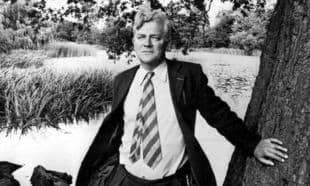
Richard George Adams was an English novelist and writer of the books Watership Down, Maia, Shardik and The Plague Dogs. He studied modern history at university before serving in the British Army during World War II. Afterwards, he completed his studies, and then joined the British Civil Service. In 1974, two years after Watership Down was published, Adams became a full-time author.







