“There are some places in the world that are like that. Like a magnet. You get pulled there, and you don't know why, and you can't leave.”
— Julie thinking about her attachment to the unnamed Middle Eastern country

Nadine Gordimer (2002)
Genre
Literary Fiction / Romance
Reading Time
360 min
Key Themes
See below
Sign in to track this book
A rebellious white woman and an undocumented Arab mechanic begin a passionate, cross-continental love affair in post-apartheid South Africa, challenging their ideas of who they are, where they belong, and how far they will go to escape their pasts.
Julie Summers, a young white woman from a wealthy Johannesburg family, finds her old car broken down in a rough part of the city. A young Arab mechanic, Abdu, helps her, fixing the car on the spot. Their first meeting is charged with curiosity and social awkwardness. Julie, who dislikes her privileged background and lives a bohemian life, is interested in Abdu's quiet intensity and his clear difference from her usual friends. Abdu, an undocumented immigrant from an unnamed Arab country, is cautious but also drawn to Julie's unconventional charm. This chance meeting marks the start of their unlikely relationship, bridging a cultural and socio-economic gap in post-apartheid South Africa.
Julie invites Abdu to live with her in her small, rented cottage. This decision is driven by her desire to defy her family's expectations and Abdu's need for stable shelter. Their relationship grows, characterized by a mix of physical intimacy, intellectual curiosity, and mutual dependence. Julie introduces Abdu to her artist friends, though he stays somewhat on the outside. Abdu, in turn, shares glimpses of his devout Muslim faith and his longing for his home country. Their daily life is affected by the constant threat of Abdu's illegal status, which hangs over them, making every interaction with authorities a source of worry.
The danger of Abdu's situation becomes clear when he is arrested during a police raid. Julie tries to intervene, using her family's connections and her own limited resources, but it is no use. Abdu is detained, facing imminent deportation. This event shatters their idea of a safe haven in Johannesburg and forces them to face the severe consequences of his undocumented status. Julie feels helpless and angry at the bureaucratic indifference and the injustices faced by immigrants like Abdu. The arrest highlights the power imbalance between her privileged background and his vulnerability.
After a period of worry and failed legal appeals, Abdu receives a final deportation order. He decides to return to his unnamed Arab country, accepting that his dream of a new life in South Africa is over. To Abdu's surprise and her family's astonishment, Julie says she will go with him. Her decision is a mix of love, loyalty, and a continued rebellion against her own privileged life, which she feels offers her no real purpose. She sees this as an act of commitment and a chance to truly escape her upbringing, embracing an unknown future with Abdu.
Julie and Abdu arrive in his remote, poor village in the desert. The landscape, customs, and way of life are a shock to Julie. The village is traditional, governed by old customs and a strong sense of community, with women's roles clearly defined. Abdu's family, at first wary of the foreign woman, eventually accepts Julie, though her presence is a source of curiosity and quiet judgment. Julie struggles to adapt to the lack of modern amenities, the intense heat, and the slow pace of life, which is dictated by nature and religious observance. She begins to learn Arabic and observe local customs.
As Julie slowly adapts to village life, finding a strange sense of belonging and purpose in its simplicity, Abdu becomes restless. He is welcomed back by his family, but his experiences abroad have made him an outsider in his own home. He struggles to re-integrate into the traditional life he once wanted, finding the lack of opportunity and strict social norms stifling after his taste of modern, individualistic South Africa. His dream of becoming a successful mechanic is stopped by the village's limited resources and the expectation that he will conform to traditional roles, causing tension between him and Julie.
Julie, at first an agnostic, becomes deeply involved in the daily life of Abdu's family and the village, observing the role of Islam in their existence. She sees the strength of their faith, the communal prayers, and how religious principles guide their interactions and provide comfort in their harsh environment. She learns about the social fabric, the support networks, and the quiet dignity with which the villagers face hardship. This challenges her Western, individualistic worldview, making her re-evaluate her own beliefs and her understanding of spirituality and community. She finds herself drawn to the sense of peace and order that faith provides to the villagers.
As Julie finds an unexpected sense of peace and belonging in the desert village, even learning to appreciate the daily rituals and communal life, Abdu grows frustrated and resentful. He feels trapped, his ambition stopped, and his dreams of a modern life lost. He begins to project his unhappiness onto Julie, seeing her as a symbol of the world he can no longer access. Meanwhile, Julie, detached from her privileged past and her family's expectations, begins to discover a new, authentic self. She finds a quiet strength and a purpose in simply existing within this new, challenging reality, far from the empty rebellion that defined her in South Africa.
The initial romantic bond between Julie and Abdu begins to break under the weight of their different experiences and expectations. Julie's adaptation, though imperfect, contrasts with Abdu's growing sadness. He struggles to reconcile his past hopes with his present reality, while Julie finds a new kind of freedom without her old life. The cultural gap that once seemed bridgeable now appears vast, creating an unspoken difference between them. Their love, born out of rebellion and necessity, is tested by the realities of their different identities and the shift in their individual journeys.
Ultimately, Julie decides to leave the village. Her departure is not a rejection of Abdu or the life she found there, but a recognition of her own changing path and the realization that Abdu is now rooted in his own world. She has changed deeply, shedding her youthful rebellion for a deeper understanding of self, community, and human connection. Abdu, though saddened, seems to understand, having found a certain acceptance of his fate. Julie returns to South Africa, not to her old life, but as a changed woman, carrying the marks of her journey and her experiences in the desert, forever altered by her 'pickup' of Abdu.
The Protagonist
Julie evolves from a directionless rebel into a woman with a profound understanding of self, culture, and the complexities of belonging, finding a quiet strength in adaptation rather than defiance.
The Co-Protagonist
Abdu's arc is one of dashed hopes and eventual resignation, as he is forced to return to the traditional life he sought to escape, losing some of his ambition in the process.
The Supporting
Remains largely static, unable to bridge the gap with Julie or understand her motivations.
The Supporting
Remains largely static, unable to fully connect with Julie's evolving identity.
The Supporting
Remains static, a pillar of her community's traditions.
The Supporting
Remains static, a symbol of tradition and community stability.
The Mentioned
Serve as a static backdrop, representing Julie's initial phase of rebellion.
The novel explores the fluid nature of identity, especially when people are displaced or choose to live outside their birth cultures. Julie, rebelling against her privileged South African identity, finds an unexpected sense of belonging in a remote Arab village. Conversely, Abdu, an undocumented immigrant in South Africa, wants a place to belong but finds himself an outsider even upon returning home. The characters struggle with where 'home' truly is—a physical place, a cultural context, or a state of mind. Julie's journey, from rejecting her birthright to finding a new, authentic self in an unfamiliar environment, shows how belonging can be found in unexpected places, often through adaptation and empathy, rather than just birthright or social status.
“She was learning to be, not to do. This was the teaching of the desert, its greatest and hardest lesson.”
Gordimer portrays the cultural clash between Western individualism and traditional Arab communalism. The relationship between Julie and Abdu is a smaller example of this larger theme, as they navigate their different backgrounds, beliefs, and expectations. In South Africa, Julie struggles to understand Abdu's quiet piety and his connection to his family. In the desert village, Julie faces the realities of a patriarchal, faith-driven society, while Abdu deals with the loss of his 'Western' hopes. The novel observes the difficulties and occasional successes in bridging these divides, suggesting that true understanding requires immersion and a willingness to let go of preconceived notions, as shown by Julie's deep dive into village life.
“He brought his silence with him, the silence of a man who has learned the discipline of waiting. She brought her talk, the nervous energy of one who expects to be heard.”
The contrast between Julie's inherited privilege and Abdu's lack of possessions as an undocumented immigrant is a central theme. Julie's 'rebellion' from her wealthy family is a choice, while Abdu's struggle for survival and legal status is a necessity. The novel shows how privilege, even when rejected, can offer a safety net (Julie's ability to travel, her father's attempted interventions). Conversely, lack of possessions leads to vulnerability, worry, and a constant fear of the state. This theme is most clear in Abdu's arrest and deportation, which exposes the power imbalances and injustices faced by the undocumented, contrasting sharply with Julie's relative freedom of movement and her eventual ability to choose her own path again.
“He was a pickup. She was a pickup. He was picked up by the police. She picked him up off the street.”
The nature of love between Julie and Abdu changes throughout the novel, moving beyond initial attraction and romantic idealism to a complex interdependence. Their relationship is formed out of necessity, rebellion, and a shared sense of being outsiders in different contexts. In South Africa, Julie's love offers Abdu stability and acceptance, while Abdu offers Julie an escape from her stifling world. In the desert, their roles reverse, with Julie adapting and finding meaning, while Abdu struggles. The novel suggests that love, especially across cultural divides, is not always about perfect harmony, but about shared journeys, mutual support, and the deep, sometimes painful impact individuals have on each other's destinies, even when those destinies ultimately diverge.
“They had picked up each other's lives, and now they were carrying them, heavy or light, together.”
Julie's entire journey is driven by a desire for authenticity. She rejects the superficiality and materialism of her family's world, seeking a 'real' life not defined by wealth or social status. Her relationship with Abdu and her immersion in the desert village are attempts to remove the artificiality of her upbringing and find a more genuine existence. This search leads her to embrace hardship, cultural difference, and a simpler way of life, ultimately changing her understanding of herself and what truly matters. By the end, she finds a quiet, internal authenticity that goes beyond external circumstances, a contrast to her earlier, more showy rebellion.
“She had always been escaping something. Now she was finding something.”
A multifaceted symbol representing chance encounters, rescue, and the act of choosing a new path.
The title itself, 'The Pickup,' functions as a powerful, multi-layered metaphor. It literally refers to Julie picking up Abdu in her broken-down car, initiating their relationship. It also signifies Abdu being 'picked up' by the police, leading to his deportation. On a deeper level, it represents the act of picking up a new life, a new identity, or even a new set of values. For Julie, it's picking up an entirely different way of being, shedding her old self. For Abdu, it's picking up the pieces of his life after his dreams are shattered. The device underscores the role of chance, choice, and consequence in shaping human destinies.
The stark contrast between urban South Africa and the desert village highlights thematic concerns.
Gordimer uses the direct juxtaposition of two vastly different settings – the bustling, post-apartheid Johannesburg and the remote, traditional Arab desert village – as a primary plot device. This contrast serves to illuminate the novel's central themes of identity, belonging, and cultural understanding. Johannesburg represents modernity, individualism, and racial complexity, while the desert village embodies tradition, community, and religious conservatism. By placing Julie and Abdu in each other's native environments, the author forces them (and the reader) to confront their own biases, adapt to alien customs, and experience the profound impact of culture on individual lives. This device effectively externalizes the internal conflicts of the characters.
Occasional shifts to a collective 'we' perspective, often representing the immigrant community.
While largely told from Julie's perspective, the novel occasionally employs a first-person plural 'we' when describing the experiences of illegal immigrants like Abdu in South Africa. This narrative shift serves to broaden the scope beyond individual experience, giving voice to the collective vulnerability, fear, and shared struggle of the undocumented community. It functions as a powerful device to universalize Abdu's plight, emphasizing that his story is one of many. This 'we' also helps to create empathy and a sense of shared humanity for those often marginalized and unseen by the dominant society, preventing Abdu's story from being isolated and highlighting systemic issues.
The deliberate decision to keep Abdu's homeland anonymous.
The decision to leave Abdu's home country unnamed is a significant plot device. It prevents the reader from imposing specific geopolitical stereotypes or preconceived notions onto the narrative. By keeping it anonymous, Gordimer universalizes Abdu's experience, making him representative of many who migrate from impoverished, traditional societies to the Western world. It shifts the focus from a specific political context to the broader human experience of displacement, cultural difference, and the search for home. This anonymity allows the village to stand as an archetype of a traditional, faith-bound community, rather than a specific, identifiable place, thus enhancing its symbolic weight.
“There are some places in the world that are like that. Like a magnet. You get pulled there, and you don't know why, and you can't leave.”
— Julie thinking about her attachment to the unnamed Middle Eastern country
“The past is a foreign country; they do things differently there.”
— A general reflection on the past, echoing a famous literary line, as Julie reflects on her life in South Africa.
“You can't choose your family, but you can choose your country.”
— Julie's internal struggle with her family's wealth and her desire to escape her South African background.
“He knew her, not from the things she said, but from the way she was silent.”
— Abdu's understanding of Julie's unspoken feelings and thoughts.
“The rich are always looking for something to make them feel poor, and the poor are always looking for something to make them feel rich.”
— A commentary on the class divide and the aspirations of the characters.
“Exile is not just a place, it's a state of mind.”
— Abdu's experience of being an undocumented immigrant and his yearning for his home country.
“Love is not a solution, it's a complication.”
— Julie's cynical view of relationships, influenced by her past experiences.
“The desert has a way of stripping you bare, of showing you what's real.”
— Julie's experience living in the harsh, unforgiving landscape of Abdu's village.
“To be without papers is to be without a voice, without a name, without a life.”
— Abdu's deep struggle and the dehumanizing experience of being an illegal immigrant.
“You don't know what you have until you lose it, and then you don't know what you've lost until you try to get it back.”
— Julie reflecting on her privileged life in South Africa after experiencing poverty.
“The only real freedom is to be free of wanting anything.”
— A philosophical musing on true liberation, as both characters grapple with their desires.
“Sometimes you have to go very far away to find out where you truly belong.”
— Julie's journey of self-discovery through displacement and cultural immersion.
“There are no easy answers, only harder questions.”
— The overarching theme of the novel, as characters confront complex moral and existential dilemmas.
Ready to see how well you understood this book? Take our interactive quiz with 10 questions.
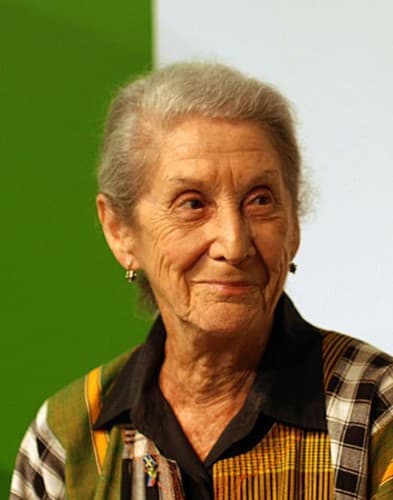
Nadine Gordimer was a South African writer and political activist. She received the Nobel Prize in Literature in 1991, recognized as a writer "who through her magnificent epic writing has ... been of very great benefit to humanity".







