“See, a man got to have some measure of a say about what happens in his life.”
— Boy Willie expressing his ambition and frustration with his circumstances.

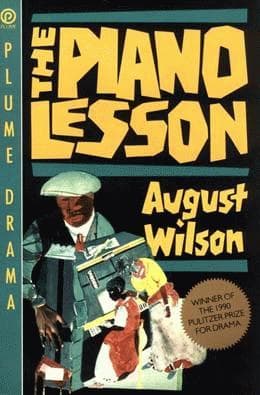
August Wilson (1990)
Genre
Historical Fiction
Reading Time
90 min
Key Themes
See below
Sign in to track this book
In 1936 Pittsburgh, a brother and sister argue over their family's antique piano, a powerful heirloom carved with the faces of their enslaved ancestors. They must decide whether to sell their past for a chance at a future or keep it as a reminder of their lasting legacy.
It's 1936 in Pittsburgh. Boy Willie Charles arrives at his sister Berniece's house with his friend Lymon, driving a truck full of watermelons. They've come from Mississippi. Boy Willie is loud and energetic, immediately announcing his plan to sell the family's old, carved piano. He wants to use the money from the piano sale, plus the watermelon sales, to buy the land in Mississippi that their ancestors worked as slaves. Berniece is shocked and firmly refuses to sell the cherished family item. Their uncle Doaker and his brother Wining Boy are also there, listening to the argument and the news from the South.
As the argument over the piano grows, Doaker tells the detailed and often painful story of the instrument. He explains how their great-grandfather, a slave on the Sutter plantation, carved the faces of his wife and son into the piano's wood, changing it from a symbol of oppression into a sign of family love and strength. He tells how Sutter later traded the family for the piano, and how Boy Willie and Berniece's father, Boy Charles, stole the piano from Sutter's house, leading to his brutal murder by white men. This history is why Berniece refuses to sell; the piano represents their family line and suffering.
Berniece is firm in her refusal to sell the piano, seeing it as a sacred memorial to her ancestors and a container of her family's blood and tears. She hasn't played it since her mother died, believing it holds too much sadness. Boy Willie, however, sees the piano as a way to an end – a way to buy the land his ancestors were denied. He believes owning land is the only way for Black people to truly be free and escape the cycle of sharecropping and subservience. He sees the piano as a reminder of the past, while he focuses on building a future.
Wining Boy, Doaker's brother and Berniece and Boy Willie's uncle, is a traveling blues musician who likes gambling and drinking. He offers a different view on life, often through his music and his rambling stories about his past. He brings a sense of the broader Black experience beyond the immediate family, touching on themes of travel, hardship, and the short-lived nature of success. His presence adds wisdom and sadness to the household, reminding everyone of the different ways people deal with their history and find meaning in their lives.
Avery Brown is a young, ambitious preacher who is dating Berniece. He represents a different path forward for Black people – one based on spirituality and community. He dreams of starting his own church and believes Berniece, with her strong character and connection to her heritage, would be an ideal partner. He encourages her to play the piano, suggesting it could be used to praise God, but Berniece remains unwilling, unable to separate the instrument from its painful past. Avery's presence shows the different hopes and beliefs within the Black community at the time.
As the tension over the piano increases, strange and unsettling things begin to happen in Berniece's house. The sound of Sutter's ghost, the former slave owner, is heard, and Boy Willie and Lymon claim to have seen him. These supernatural events are linked to the piano and the unresolved history it represents. The ghost's presence symbolizes the lasting injustices and the spiritual weight of the past that continues to affect the Charles family. It suggests that the past is not truly gone, and its unresolved issues continue to influence the present.
Lymon, Boy Willie's quiet friend, eventually tells Berniece about his past legal troubles in Mississippi, explaining why he is careful and somewhat withdrawn. He is a kind person, unlike Boy Willie's loudness. He develops a sweet, innocent connection with Berniece's young daughter, Maretha, buying her a doll. This interaction shows his desire for a stable life and a family, providing a softer contrast to the main argument. He is caught between his loyalty to Boy Willie and his growing understanding of Berniece's view on the piano.
The main argument grows stronger as Boy Willie and Berniece directly confront each other about their different ideas. Boy Willie argues that the piano, as a symbol of their past suffering, is holding them back. He believes that by selling it and buying the land, they can break free from dependency and build a real future. Berniece, however, insists that the piano is not just an object but a sacred item, filled with the spirits and sacrifices of their ancestors. To sell it would be to betray their memory and erase their history, leaving them without a connection to their identity.
Boy Willie, frustrated by Berniece's stubbornness, tries to sell the piano. He brings a potential buyer to the house, further increasing the tension. This act directly challenges Berniece's authority and her deeply held beliefs. The situation ends in a physical struggle between the siblings over the piano, representing the larger battle between honoring the past and taking opportunities for the future. The fight is not just about the piano itself, but about the very essence and direction of the Charles family.
As Boy Willie tries to physically remove the piano from the house, Sutter's ghost becomes more active and threatening, trying to reclaim the instrument. In a desperate act, Berniece, who has refused to play the piano for years, finally sits down and begins to play, singing a powerful spiritual. This act is a release, a way of calling upon her ancestors and confronting the lingering spirits of the past. Her music becomes a weapon and a shield, driving away Sutter's ghost and confirming the piano's role as a symbol of strength and memory rather than just something to be sold.
Berniece's powerful playing and singing successfully banish Sutter's ghost, asserting the family's spiritual ownership of the piano and its history. The intense spiritual battle ends with a sense of peace, though a fragile one. Boy Willie, seeing the deep power of his sister's act and the spiritual meaning of the piano, finally accepts that it cannot be sold. He leaves for Mississippi, still determined to buy the land, but with a deeper understanding of his family's legacy and Berniece's connection to it. The piano remains in the Charles home, its lesson understood.
The Protagonist
Berniece moves from a state of passive mourning and fear of the piano to actively engaging with its spiritual power, embracing her role as the keeper of her family's history.
The Protagonist/Antagonist
Boy Willie initially sees the piano only for its monetary value but comes to understand its spiritual power and historical significance, though he ultimately remains committed to his own path.
The Supporting
Doaker remains largely consistent, serving as the voice of historical memory and a stabilizing presence for the family.
The Supporting
Wining Boy's arc is less about internal change and more about his role as a recurring, symbolic figure representing the transient nature of life and the power of music.
The Supporting
Lymon gradually opens up about his past and shows a longing for stability, finding a brief connection with Maretha and a deeper appreciation for the family dynamic.
The Supporting
Avery remains consistent in his role as a suitor and a representative of the church, offering a clear alternative to Boy Willie's materialistic path.
The Supporting
Maretha is on the cusp of understanding her family's history, poised to inherit the 'piano lesson' for herself.
The Antagonist
The ghost's presence intensifies as the conflict over the piano escalates, culminating in its banishment by Berniece's music.
This main theme is shown in the conflict between Berniece and Boy Willie over the piano. Berniece holds onto the piano as a sacred reminder of her ancestors' struggles and sacrifices, seeing it as a clear link to their history and a warning against forgetting. She believes erasing the past by selling the piano would be a betrayal. Boy Willie, conversely, sees the piano as a burden, a symbol of suffering that holds them back. He believes that to move forward, they must turn the past (the piano) into money (the land) to build a new future free from the legacies of slavery and sharecropping. The play explores whether one must choose between honoring the past and taking chances for the future, or if both are possible.
““The only way you gonna get anywhere in this world is on the back of that piano. You got to get rid of it. You can't carry that old piano around with you all your life. You gotta get rid of it.””
The piano is not just an instrument; it is a carefully carved object with the faces of the Charles family's enslaved ancestors. It represents their entire heritage, a sign of their strength, creativity, and suffering. The conflict over its ownership and purpose directly addresses the question of Black identity in America. Is identity rooted in painful memories of the past, in owning land, or in spiritual and community ties? The play suggests that a full understanding of identity requires recognizing and combining all these elements, seeing that heritage is both a burden and a source of strength.
““Mama Ola say, as long as Berniece don't play that piano, Sutter's ghost ain't gonna rest. He trying to get the piano back. Say he gonna come back and get it.””
Sutter's ghost and the spiritual power given to the piano fill the play with supernatural elements. The ghost symbolizes the lasting injustices of slavery and the unresolved past that continues to affect the present. The family's belief in the ghost's influence, and Berniece's eventual use of the piano to banish it, highlights the strong spiritual traditions within the Black community. It suggests that the past is not just historical fact but an active, living force that requires spiritual involvement and resolution. The piano becomes a way for ancestral spirits to connect and a battleground for spiritual freedom.
““It's got blood on it. I ain't gonna play on it. Can't nobody play on it with all that blood.””
Boy Willie's main goal is to acquire the land his ancestors worked as slaves. For him, land ownership represents true freedom and an escape from the systemic economic exploitation Black people faced in post-slavery America. He sees it as the only way to break the cycle of sharecropping and achieve real self-determination. This theme highlights the ongoing struggle for economic fairness and the desire for real assets that can secure a future, contrasting sharply with Berniece's focus on intangible, spiritual wealth represented by the piano's history. The play explores the difficult choices people make when faced with limited chances for improvement.
““A n****r got to be able to stand up to the white man. He got to be able to own his own land.””
The ornately carved piano serves as the physical and metaphorical heart of the play.
The piano is the play's most significant symbol, embodying the entire history of the Charles family – from slavery and violence to artistic expression and resilience. Its carvings depict the faces of enslaved ancestors, making it a tangible link to their past. The conflict over its sale drives the plot, representing the clash between honoring heritage and pursuing economic advancement. It also acts as a spiritual conduit, attracting the ghost of Sutter and ultimately becoming the instrument through which Berniece confronts and banishes the past's lingering evils.
Characters recount family history, particularly Doaker, preserving the past through narrative.
The play heavily relies on storytelling, particularly through Doaker's detailed accounts of the piano's origins and the Charles family's history. This oral tradition is crucial for transmitting heritage across generations, especially in a community where written records of Black families were often scarce or destroyed. These narratives not only provide essential exposition but also imbue the piano with its profound significance, making the audience understand why Berniece is so fiercely protective of it. Wining Boy also contributes to this tradition through his blues stories and songs.
The spectral presence of the former slave owner heightens the drama and symbolizes unresolved historical trauma.
The manifestation of Sutter's ghost is a key plot device that injects a supernatural dimension into the play. It serves several functions: it externalizes the internal conflict and the lingering trauma of slavery, it raises the stakes of the conflict over the piano, and it provides a dramatic catalyst for Berniece's eventual, cathartic act of playing the instrument. The ghost is not just a scare tactic; it represents the unreconciled past and the spiritual battle for ownership of Black heritage and freedom from historical oppression.
The blues and spirituals played or discussed in the play carry deep cultural and emotional weight.
Music, both the blues played by Wining Boy and the spirituals Berniece eventually sings, functions as a powerful emotional and spiritual force. The blues express the hardships and resilience of the Black experience, while spirituals are a means of communal strength and connection to the divine. Berniece's refusal to play the piano for so long signifies her emotional paralysis, while her eventual playing of it, accompanied by a spiritual, becomes a moment of profound spiritual liberation and a way to confront and cleanse the lingering pain of the past.
“See, a man got to have some measure of a say about what happens in his life.”
— Boy Willie expressing his ambition and frustration with his circumstances.
“The only thing I want to do is get my land. I don't care about nothing else. I don't care about no piano.”
— Boy Willie's unwavering focus on buying land.
“You can't just walk away from history. It's not a house you can just pick up and move.”
— Berniece's reluctance to sell the piano, seeing it as more than just an object.
“Some things is best left alone. Some things ain't meant to be disturbed.”
— Doaker's warning about the spiritual presence tied to the piano.
“It ain't about the money, Berniece. It's about us having something to show for ourselves.”
— Boy Willie trying to convince Berniece to sell the piano for land.
“That piano is for us to pass on. For Maretha. For her to know this is who she is.”
— Berniece explaining why the piano is important for her daughter's identity.
“Everybody got their own way of looking at things. And that's what makes life interesting.”
— Lymon reflecting on the different perspectives within the family.
“You can't get away from your blood. No matter how far you run, it's still there.”
— Doaker talking about the inescapable bonds of family and history.
“A piano ain't got no place on a farm. A piano belong in a house.”
— Boy Willie's practical view of the piano's utility.
“You got to be strong enough to carry your burdens. Don't let them carry you.”
— Wining Boy offering advice, perhaps drawn from his own experiences.
“We done paid for that piano with our blood. We done paid for it with our lives.”
— Berniece emphasizing the historical cost and sacrifice associated with the piano.
“It's a way of saying that we were here. That we mattered.”
— Berniece's underlying reason for preserving the piano.
“You got to take your own stand. You got to learn to play your own song.”
— Doaker's advice to Maretha about finding her own path.
Ready to see how well you understood this book? Take our interactive quiz with 10 questions.

August Wilson was a celebrated American playwright, renowned for his "Pittsburgh Cycle," a ten-play series chronicling the African American experience through the 20th century. His most acclaimed works include "Fences," "The Piano Lesson," and "Gem of the Ocean," earning him numerous awards, including two Pulitzer Prizes. Wilson's powerful dramas are celebrated for their lyrical language and profound exploration of identity, culture, and history.







