“The old Pine Hill mansion certainly looked spooky enough to harbor a phantom.”
— Nancy Drew's initial impression of the mansion.

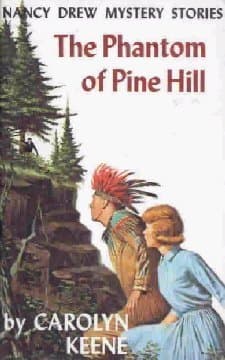
Carolyn Keene (1965)
Genre
Children's / Mystery / Young Adult
Reading Time
176 min
Key Themes
See below
Sign in to track this book
Nancy Drew and her friends investigate a historic mansion's haunting and a decades-old shipwreck to find lost wedding treasures and solve the mystery of Pine Hill.
Nancy Drew, Bess Marvin, and George Fayne go to Emerson University for its summer events. They stay with Professor Amand, a historian, at his family's mansion on Pine Hill. When they arrive, Professor Amand welcomes them and immediately shares the mansion's secret: a phantom haunts its library. He explains that the phantom is linked to a decades-old family story about a lost French wedding gown and valuable gifts that sank with the ship, the Lucy Belle, in a nearby cove. This introduction sets up the mystery Nancy and her friends will investigate, making them curious about the ghost and the lost treasures.
Soon after settling in, Nancy Drew explores the mansion's library, where the phantom supposedly lives. While looking at old books and shelves, she feels a chill and hears faint, unexplained noises. A book falls from a shelf by itself, and a shadowy figure briefly appears and vanishes, leaving a faint smell of old lace and lavender. This encounter is not scary but interesting for Nancy, confirming Professor Amand's claims and giving her direct proof that something unusual is happening at Pine Hill. Bess and George are doubtful at first, but Nancy's detailed story makes them curious.
Professor Amand, seeing Nancy's interest, tells more about the Lucy Belle legend. He explains that his ancestor, a young French bride, was sailing to America with her wedding gown, a valuable diamond tiara, and other precious gifts when the ship sank in Pine Hill Cove. The treasures were never found, and the phantom is believed to be the heartbroken bride, searching for her lost items. He shows the girls old family portraits and documents about the bride, Marie Amand, and the shipwreck, further involving them in the historical mystery and giving them important background for their investigation.
Nancy, Bess, and George decide to investigate Pine Hill Cove to find a link between the phantom and the lost treasures. They rent a small boat and carefully explore the area where the Lucy Belle supposedly sank. The cove is rocky, and the water is cloudy in places, making diving hard. They find some old, wood and rusted metal pieces covered in barnacles, but nothing clearly from the Lucy Belle or the wedding gifts. Their first search is difficult, showing how hard it is to find items lost decades ago, but Nancy remains determined, believing more clues exist.
As Nancy and her friends continue their investigation, strange things happen more often in the mansion. Objects move, doors open and close by themselves, and odd notes appear, seemingly from the phantom, hinting at the lost treasures. One evening, Nancy finds a small, old locket in the library, which she thinks might have belonged to Marie Amand. These events suggest that the 'phantom' might not be supernatural, or at least, someone is trying to mislead or scare them, possibly to stop them from finding the lost items. The girls realize they are dealing with more than just a haunting.
While looking through old family documents in Professor Amand's study, Nancy finds a hidden compartment in an old desk. Inside, she finds a fragile, leather-bound diary belonging to a relative who lived around the time the Lucy Belle sank. The diary entries suggest that the sinking might not have been an accident, hinting at sabotage or a deliberate act by someone who wanted the valuable cargo. The diary also mentions a specific hiding place in the mansion for the treasures if they were ever found. This discovery changes Nancy's investigation from a simple search for lost items to uncovering a possible crime.
During their investigation, Nancy, Bess, and George often see a shifty man named Mr. Finch, who says he is a distant Amand relative and a history lover. However, his actions are suspicious; he is often seen near the library or the cove, and he seems too interested in their progress. Nancy suspects he is not just a history enthusiast but is also looking for the lost treasures, possibly even creating some of the 'phantom' events to scare others away. This introduces a human antagonist to the mystery, making the treasure hunt more competitive and dangerous.
Putting together clues from the diary and the phantom's notes, Nancy realizes a secret passageway must be in the mansion. After carefully examining the library, she finds a hidden door behind a large bookshelf. This passageway leads to a series of hidden rooms and corridors that go through the house, explaining how the 'phantom' could move unseen and create its spooky effects. Finding the passageway confirms Nancy's suspicion that the phantom's actions are not supernatural and are being controlled by a person for their own gain.
Nancy sets a trap, waiting in the library one night. When the 'phantom' appears, she confronts it, revealing it to be Mr. Finch, disguised in an old lace veil and flowing clothes. Finch confesses that he found the diary and the hidden passages years ago and had been using the phantom legend to stop others from finding the treasure. He planned to find the treasures himself, believing them to be his rightful inheritance. He admits to creating the spooky effects and leaving the misleading notes, hoping to scare Professor Amand and the girls away from the mansion and the cove.
With Finch exposed, he is forced to reveal the final clue, which leads Nancy to a hidden compartment inside the secret passageway, near an old fireplace. Inside, carefully kept in a waterproof chest, are the lost treasures: the beautiful French wedding gown, slightly yellowed but still lovely, the sparkling diamond tiara, and other valuable gifts meant for Marie Amand. This discovery brings great joy and relief to Professor Amand, who is happy to see his family's legacy returned. The mystery of the Pine Hill phantom and the Lucy Belle's treasures is finally solved, bringing an end to a decades-old puzzle.
After the treasures are found and Mr. Finch is caught, Professor Amand makes sure the valuable items are safe. He thanks Nancy, Bess, and George for their detective work. The phantom's shadow is lifted from Pine Hill, and the mansion feels lighter. The girls enjoy the rest of Emerson University's summer events, celebrating their success. The wedding gown and tiara become cherished family heirlooms, no longer lost at sea but safely kept, showing Nancy Drew's sharp investigative skills and adventurous spirit.
The Protagonist
Nancy's arc is consistent; she starts as a skilled detective and ends having successfully applied her abilities to solve a new, challenging case.
The Supporting
Bess overcomes some of her initial fears to actively participate in the investigation, showing her bravery when it truly matters.
The Supporting
George consistently demonstrates her practicality and courage, serving as a steadfast anchor for the group throughout the mystery.
The Supporting
Professor Amand begins as a puzzled observer and becomes a grateful recipient of Nancy's detective work, finding peace in the resolution of his family's long-standing mystery.
The Antagonist
Mr. Finch starts as a shadowy figure manipulating events and is ultimately exposed as the human 'phantom' and thwarted in his attempts to steal the treasures.
The Mentioned
Marie Amand's story is static, serving as the historical impetus for the mystery. Her 'arc' is resolved through the recovery of her lost items.
The novel shows how historical events and family stories can affect current mysteries. Professor Amand's family home and the story of Marie Amand and the Lucy Belle are central to the plot, showing how past tragedies and lost items can become compelling puzzles. Nancy's investigation is driven by the thrill of the chase and a wish to bring closure to a decades-old family story, restoring a piece of history. Finding the wedding gown and tiara is not just about finding treasure; it is about honoring a lost legacy.
““History,” Professor Amand declared, “is not merely a collection of dates and names, but the living breath of those who came before us, shaping who we are today.””
A main theme is the conflict between supernatural explanations and logical thinking. The 'phantom' first appears to be a real ghost, fueling local superstitions and fear. However, Nancy Drew, with her analytical mind, always looks for rational explanations for the strange events. She does not dismiss the idea of a ghost but focuses on finding human causes for the odd occurrences. This theme resolves when the 'phantom' is revealed to be Mr. Finch, proving that human deception, not the supernatural, was behind the haunting, which supports Nancy's investigative approach.
““There’s usually a logical explanation for everything, no matter how spooky it seems at first,” Nancy remarked, her eyes scanning the library for clues.”
The novel explores how greed can make people go to great lengths of deception and manipulation. Mr. Finch, wanting to claim the valuable lost treasures for himself, creates the phantom haunting. He uses fear and misdirection to stop others from investigating, hoping to get the riches. His actions show how avarice can corrupt, leading him to pretend to be a ghost and use various tricks. This theme highlights the moral difference between Nancy's search for truth and Finch's selfish pursuit of gain.
““Some people will do anything for money, even pretend to be a ghost,” George observed, shaking her head in disbelief.”
Nancy's success in solving the mystery largely comes from the support and different skills of her friends, Bess and George. Bess's occasional shyness is balanced by her sharp observations, while George's athleticism and practicality are helpful during physical investigations. They consistently combine their resources, discuss theories, and support each other. Their teamwork shows that even the best detective benefits from a strong group of trusted friends, making the complex task of solving a mystery easier and more enjoyable.
““We’re a team, and we’ll figure it out together,” Nancy assured Bess and George, a confident smile on her face.”
A classic setting for mystery, providing atmosphere and opportunities for secrets.
The historic mansion on Pine Hill serves as a quintessential 'haunted house' setting. Its age, secret passages, and alleged ghostly inhabitant create an atmosphere of suspense and intrigue. The mansion itself holds many secrets, from hidden compartments to concealed entrances, which are integral to the plot. It acts as both a source of the mystery and a primary location for its unraveling, allowing for spooky encounters and the eventual discovery of hidden truths.
A valuable item or collection that drives the plot and motivates characters.
The lost French wedding gown, diamond tiara, and other valuable gifts from the Lucy Belle serve as the central 'macguffin' of the story. The desire to find these treasures motivates both Nancy's investigation and Mr. Finch's deception. The historical significance and monetary value of the items create a strong incentive for their recovery, providing a clear objective for the protagonist and a compelling motive for the antagonist, thereby propelling the plot forward.
A hidden route within a building used for clandestine movement and discoveries.
The secret passageway within the Pine Hill mansion is a crucial plot device. It explains how the 'phantom' (Mr. Finch) was able to move unseen, create mysterious effects, and appear and disappear at will. Its discovery is a turning point, demystifying the 'haunting' and pointing towards a human culprit. Furthermore, the passageway eventually leads Nancy to the ultimate hiding place of the lost treasures, making it vital for both the unraveling of the deception and the resolution of the treasure hunt.
A historical document containing crucial information for solving the mystery.
The old diary belonging to a distant Amand relative is a pivotal device for revealing past secrets. Discovered by Nancy, it provides historical context, hinting at foul play concerning the sinking of the Lucy Belle and offering clues about a potential hiding place for the treasures. The diary serves as a direct link to the past, allowing Nancy to piece together events that occurred decades ago and understand the true nature of the mystery beyond simple legend, guiding her investigation towards the truth.
“The old Pine Hill mansion certainly looked spooky enough to harbor a phantom.”
— Nancy Drew's initial impression of the mansion.
“Nancy Drew never shied away from a challenge, especially when it involved a puzzling mystery.”
— Describing Nancy's adventurous spirit.
“A good detective always pays attention to the smallest details.”
— Nancy's advice on investigation.
“Sometimes the most obvious explanation is the one we overlook.”
— Nancy pondering a difficult clue.
“The 'phantom' seemed to be a master of disappearing acts.”
— Nancy's frustration with the elusive figure.
“Even in the darkest corners, there's always a glimmer of truth waiting to be uncovered.”
— Nancy's optimistic outlook during a difficult investigation.
“Fear can make people see things that aren't really there.”
— Nancy considering the psychological impact of the phantom.
“Bess and George, as always, were ready to dive into danger alongside their friend.”
— Highlighting the loyalty of Nancy's companions.
“The creaking stairs and whistling wind only added to the mansion's eerie atmosphere.”
— Describing the spooky ambiance of Pine Hill.
“It takes courage to face the unknown, but it takes even more to face a friend in trouble.”
— Nancy reflecting on her commitment to helping others.
“Every secret has a key, and Nancy was determined to find it.”
— Nancy's resolve to solve the mystery.
“The phantom was more than just a ghost; it was a carefully constructed illusion.”
— Nancy's realization about the true nature of the 'phantom'.
“Justice, in the end, always finds a way to prevail.”
— Nancy's firm belief in the outcome of her investigations.
“The greatest mysteries often hide in plain sight, disguised as ordinary occurrences.”
— Nancy's insight into the nature of complex cases.
Ready to see how well you understood this book? Take our interactive quiz with 10 questions.

Carolyn Keene is the pseudonym for the authors of the Nancy Drew Mystery Stories series. Under this pen name, numerous authors have penned over 170 books since 1930, captivating young readers with thrilling mysteries and adventures. The series, including notable titles like "The Secret of Red Gate Farm" and "Mystery of Crocodile Island," has become a cultural phenomenon, selling millions of copies worldwide and inspiring adaptations across various media.

Dan Gemeinhart
4.5

Kate O'Hearn
4.4

Jeanne Birdsall
4.4

Jen Wang
4.4

Wendelin Van Draanen
4.3

John Marsden
4.3

Chris Van Allsburg
4.3

Jennifer A. Nielsen
4.2