“There was a time when the people of Ember thought they were the only people in the world. Now they knew there were others, and they were different.”
— Reflecting on the discovery of the other city, Sparks.

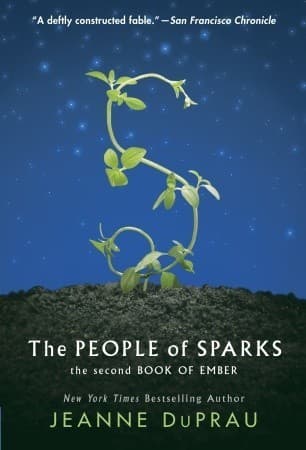
Jeanne DuPrau (2004)
Genre
Fantasy / Children's / Science Fiction / Young Adult
Reading Time
338 min
Key Themes
See below
Sign in to track this book
Having escaped their dying underground city, Lina and Doon must now navigate the surface world where anonymous acts of sabotage threaten to ignite a war between their people and the established inhabitants.
Lina Mayfleet, Doon Harrow, and the 400 other people from Ember leave their underground city and come into the bright, confusing world above. Tired and disoriented, they find a small village called Sparks. The villagers, led by Mayor Cole and Mrs. Murdo, are at first welcoming, offering the Emberites shelter in an old hotel and sharing their limited resources. The Emberites, used to rationing, are amazed by the natural world and the simple abundance of Sparks. However, the Sparks villagers worry about the many new people and the strain on their supplies, which creates tension despite the initial welcome.
As weeks pass, the good feelings between the Emberites and the people of Sparks start to fade. The Emberites, used to a structured life where everything was provided, struggle to adapt to farming and being self-sufficient. Their inexperience leads to wasted food and broken tools, further reducing Sparks' already strained resources. The Sparks children, like Tick and Maddy, often make fun of the Emberites' lack of knowledge about the natural world. Lina tries to bridge the gap by drawing pictures of Ember, hoping to explain their past, but many Sparks villagers see the Emberites as lazy and demanding. The Emberites feel mistreated and misunderstood.
To manage the increasing resource strain, Mayor Cole announces an "Emberite Day," where the Emberites are expected to work for their food. This decision, meant to help them become self-reliant, causes resentment among many Emberites who feel it is unfair. Soon after, minor acts of sabotage begin: tools are broken, crops are damaged, and food is stolen. Both sides suspect the other. Doon, observing, notices that the damage seems to target Sparks' resources. He suspects an Emberite group led by Tick, who is openly hostile towards the newcomers.
Lina and Doon, worried by the growing conflict, decide to investigate the sabotage on their own. Doon, working in the Sparks workshop, notices that tool damage is often too precise to be accidental. He suspects someone is deliberately trying to worsen relations. Lina tries to talk with both Emberites and Sparks villagers to understand their viewpoints. Both observe the growing animosity, fueled by misunderstandings and fear. They realize that if the sabotage continues, the fragile peace between the two communities will break down, possibly leading to violence and the Emberites' expulsion.
Doon continues his investigation, carefully examining damaged items and watching the villagers. He eventually catches Tick, a young Sparks boy who works in the workshop, breaking a tool on purpose. Confronted, Tick admits to being the main saboteur. He is motivated by deep fear and resentment towards the Emberites, believing they drain Sparks' resources and threaten their way of life. He wants them to leave and thinks that by creating chaos and making the Emberites seem destructive, he can achieve this. His actions, however, only increase tensions.
Tick, feeling bolder and desperate, plans a major act of sabotage: he sets fire to one of Sparks' food storehouses. The fire is put out quickly, but the damage is significant. This act confirms the fears of many Sparks villagers. In the panic and anger, the people of Sparks demand the Emberites' immediate expulsion. A heated confrontation breaks out between the two groups, with threats and accusations. Mayor Cole, under great pressure, reluctantly agrees to send the Emberites away, setting a deadline for their departure, fearing for his own people's safety.
Facing expulsion, the Emberites prepare to leave Sparks. Not all Sparks villagers agree with the decision. Mrs. Murdo and a few others, including Maddy, decide to go with the Emberites, believing it is wrong to abandon them. Doon, Lina, and the Emberites, with their new allies, set off into the unknown. Their destination is unclear: they hope to find another city or community beyond Sparks, inspired by an old map Lina found in Ember. The journey is hard and uncertain, filled with fear and a little hope.
During their journey, the Emberites find an abandoned, advanced settlement. Inside, they find records and remains of the 'star-people'—the original inhabitants of this advanced community. From these discoveries, they learn that the 'star-people' were scientists and engineers who had planned for the future, including building Ember and providing resources for those who would emerge. They also discover that the people of Sparks are descendants of a group who chose a simpler, farming life, separate from the 'star-people's' technological path. This explains their different ways of living and their limited knowledge of the world beyond their village.
With knowledge of their shared history and Ember's purpose, Lina, Doon, and the Emberites return to Sparks. They present their findings to Mayor Cole and the villagers, explaining that both groups are connected and that the 'star-people' had intended for them to coexist and help each other. The discovery that the Emberites were not just 'strangers' but part of a larger, planned future, along with understanding the 'star-people's' intentions, finally removes the fear and mistrust. Tick, seeing the truth, expresses regret for his actions, and the communities begin to understand each other's views.
With new understanding and a shared purpose, the people of Sparks and the former Emberites begin to work together. They combine their knowledge: the Emberites' cleverness and the Sparks' farming skills. They start to rebuild and improve their combined community, learning from past mistakes. The abandoned 'star-people' settlement becomes a resource for both groups, offering tools and knowledge for a better future. The story ends with the two communities, once almost at war, now united by a common goal of creating a sustainable and harmonious society, showing the power of empathy and cooperation.
The Protagonist
Lina learns that good intentions aren't always enough and that true understanding requires confronting difficult truths, ultimately becoming a bridge between two disparate cultures.
The Protagonist
Doon learns to temper his anger with patience and understanding, realizing that truth and justice are best served through careful observation and communication, not just confrontation.
The Supporting
Mayor Cole moves from a position of cautious hospitality to one of fear-driven expulsion, finally achieving understanding and embracing cooperation after learning the truth.
The Supporting
Mrs. Murdo remains a steadfast beacon of kindness and support, demonstrating unwavering empathy and courage in the face of conflict.
The Antagonist/Supporting
Tick transforms from a fearful and destructive antagonist into a remorseful individual who learns the value of empathy and cooperation.
The Supporting
Maddy develops from a curious observer into a bridge-builder, demonstrating that empathy and friendship can overcome cultural divides.
The Mentioned/Supporting
Poppy remains a consistent symbol of hope and innocence, representing the future that the adults are striving to build.
The Supporting
Casper consistently embodies wisdom and a balanced perspective, serving as a moral anchor for the Sparks community.
The Supporting
Mr. Harrow maintains his pragmatic and supportive nature, adapting to the new world and providing a stable influence for Doon.
This theme is about the fear and mistrust between the Sparks villagers and the Emberite newcomers. The Sparks villagers see the Emberites as strange, lazy, and a drain on resources. The Emberites feel misunderstood and unfairly judged. This prejudice appears in name-calling, separation, and acts of sabotage and demands for expulsion. The book shows how fear of difference can quickly lead to conflict, showing the dangers of judging people based on their origins or perceived differences instead of their individual character. Tick's actions come directly from this fear of outsiders.
“What if there were too many of them, and not enough for us? What if they were greedy and wanted everything for themselves?”
Both communities face survival challenges, but in different ways. The Emberites, having lived underground their whole lives, struggle to adapt to the natural world, farming, and being self-sufficient. They are used to a system where everything was provided. The Sparks villagers, while good at their farming life, find their limited resources strained by the arrival of 400 new people. The theme explores human resilience when resources are scarce and the environment changes drastically. It shows the need to learn new skills and ways of thinking to thrive in an unfamiliar world. Their eventual cooperation helps their collective survival.
“Survival was a matter of knowing what to do, how to do it, and having the tools and the will to keep on doing it.”
At first, the two communities disagree, unable to cooperate due to fear and misunderstanding. The book shows that real progress and survival require collaboration. Lina and Doon's efforts to connect the groups, Mrs. Murdo's kindness, and the shared discovery of their common history all lead to the realization that their strengths work well together. The Emberites' cleverness and the Sparks' practical skills are more effective when combined. The story's resolution highlights how unity and mutual respect can overcome difficulties and build a stronger, more resilient society.
“They were two parts of a whole, two pieces of a puzzle that had been separated for generations.”
The plot is about finding truth—about the sabotage and the deeper history connecting Ember and Sparks. The Emberites arrive with little knowledge of the surface world, and the Sparks villagers have forgotten their own origins and connection to the 'star-people.' Bad information and lack of understanding fuel the conflict. Doon's investigation and the discovery of the 'star-people's' records reveal the full story. This theme shows how knowledge, especially about history and shared heritage, can end prejudice and build understanding, leading to reconciliation and a more informed future.
“Ignorance was a kind of darkness, just as potent as the darkness of Ember.”
Mayor Cole's struggle to lead his community while balancing his people's needs with the newcomers' demands shows the difficulties of leadership. He makes tough decisions under pressure, sometimes flawed, but ultimately tries to protect his village. The book also implicitly explores the responsibility of individuals like Lina and Doon to act when leaders are overwhelmed or make mistakes. It shows that good leadership needs not just authority, but also empathy, foresight, and the courage to seek truth and build unity, even when it is unpopular. His eventual acceptance of the Emberites' findings shows his growth.
“A leader's job was to keep the people safe, even if it meant making choices that hurt some.”
The fundamental difference in upbringing and knowledge between the Emberites and Sparks villagers.
This device is central to the entire conflict. The Emberites, having lived underground with artificial light and a pre-determined food supply, are utterly naive about the natural world, farming, and the concept of 'day' and 'night'. The Sparks villagers, on the other hand, are self-sufficient farmers but are ignorant of advanced technology and the purpose of Ember. This clash of cultures leads to misunderstandings, accusations of laziness, and ultimately, open hostility. It highlights how different upbringings can create deep divides, even between people who are fundamentally good, until shared knowledge bridges the gap.
A series of destructive acts that escalate conflict and drive the plot.
The escalating acts of vandalism and destruction of property in Sparks serve as the primary plot driver. This mystery forces Doon to become a detective, observing and analyzing clues to uncover the culprit. The sabotage creates tension, fuels prejudice, and pushes the narrative towards a crisis point where the Emberites face expulsion. It's a classic mystery structure used to raise stakes, create suspicion, and ultimately reveal the motivations of the antagonist (Tick), leading to a deeper understanding of the underlying xenophobia.
Archival documents that reveal the shared history and purpose of both communities.
These records, discovered in the abandoned advanced settlement, function as a crucial plot device for exposition and resolution. They provide the historical context that explains the existence of Ember, the purpose of the underground city, and the connection between the 'star-people' (the original builders) and the people of Sparks. Without these documents, the Emberites would remain ignorant of their origins and unable to convince the Sparks villagers of their shared heritage. The records serve as the ultimate truth-teller, dispelling misinformation and fostering understanding, leading directly to the reconciliation of the two groups.
Artistic representations used to bridge communication gaps and express inner worlds.
Lina's habit of drawing, carried over from Ember, serves as a significant symbolic and practical device. Initially, her drawings of Ember help her explain her past to the Sparks villagers, though often misunderstood. Later, they become a means for her to process her experiences and visualize possibilities. More broadly, drawing represents a form of communication that transcends language barriers and cultural differences, allowing for a glimpse into another's perspective. It highlights the power of art to foster empathy and understanding, even in the face of prejudice and fear.
“There was a time when the people of Ember thought they were the only people in the world. Now they knew there were others, and they were different.”
— Reflecting on the discovery of the other city, Sparks.
“The world was not a simple place where everyone was either good or bad. It was a complicated place, full of people who were a mixture of both.”
— Lina's growing understanding of the complexities of the world and human nature.
“It was one thing to be brave when you knew what you were fighting against. It was another to be brave when you didn’t know what was coming next.”
— Doon's internal struggle with the unknown challenges of the new world.
“They had learned to live in darkness, and now they had to learn to live in light. It was not as easy as it sounded.”
— The adjustment difficulties faced by the Emberites in the sunny world of Sparks.
“The most dangerous thing, perhaps, was not to know what you didn't know.”
— Thoughts on the ignorance that can lead to conflict.
“When people are afraid, they do foolish things. And when they are very afraid, they do cruel things.”
— Observing the escalating tensions and fear between the two groups.
“A new beginning was not always a clean slate. Sometimes it was just a new set of problems.”
— The realization that escaping Ember didn't solve all their troubles.
“They had saved themselves from darkness, but they had not yet saved themselves from each other.”
— Highlighting the internal conflicts and divisions within the group.
“Hope was a difficult thing to hold onto when everything around you seemed to be falling apart.”
— The feeling of despair during a particularly challenging period.
“It wasn't enough to just survive. They had to learn how to live.”
— The deeper lesson of adapting to a new world beyond mere existence.
“Sometimes the biggest battles are fought not with weapons, but with words, or even with silence.”
— Reflecting on the nature of conflict and resolution.
“The future was not a place they went to, but a place they built.”
— Understanding their agency in shaping their destiny.
“To truly see another person, you had to look beyond what they had, or where they came from, and see what was inside them.”
— Lina's evolving perspective on understanding and accepting others.
“Change was always difficult, even when it was for the better.”
— A general observation on the human resistance to change, even positive change.
Ready to see how well you understood this book? Take our interactive quiz with 10 questions.







