“Science is not about making the world a better place. It’s about understanding what the world is.”
— Dr. Perina's view on the purpose of scientific inquiry, often detached from humanitarian concerns.

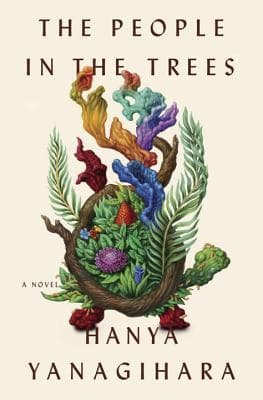
Hanya Yanagihara (2013)
Genre
Literary Fiction / Fantasy / Historical Fiction / Science Fiction
Reading Time
500 min
Key Themes
See below
Sign in to track this book
A scientist's quest for immortality on a remote island turns into a horrifying disaster, showing the devastating cost of defying nature and human corruption.
In 1950, a young, ambitious research scientist named Norton Perina works at the University of Hawaii. He gets an invitation to join a secret expedition from the renowned, yet controversial, anthropologist Paul Tallent. Tallent is known for his unusual methods and discoveries. He needs a medical professional for a trip to the remote Micronesian island of Ivu'ivu, rumored to have a lost tribe. Perina, wanting recognition and a way to escape his past, accepts. He sees it as a chance to make a big scientific discovery and secure his place in history, even with the mysterious nature of Tallent's goals.
Upon arriving on the lush, isolated island of Ivu'ivu, Perina and Tallent meet the local O'wu tribe. The O'wu are cautious but eventually accept the outsiders, showing them their cultural practices and the island's difficult terrain. Perina observes the O'wu's deep respect for nature and their unique social structures. He starts documenting their customs and language, but his main focus is Tallent's ultimate goal: to find the rumored 'Dreamers,' a legendary group said to live extraordinarily long lives, which Paul Tallent believes is key to his research.
After extensive trekking through the dense Ivu'ivu jungle, Perina and Tallent find the 'Dreamers' — a small, isolated community living deep within the forest. These individuals appear very old, showing extreme physical weakness and advanced senility, yet they are alive, far beyond any known human lifespan. Perina is fascinated by their condition, recognizing its huge scientific importance. He begins to carefully observe and document their behavior, noting their childlike innocence and deep detachment from reality. Tallent, meanwhile, seems to have an existing, almost mystical connection to the Dreamers, further fueling Perina's curiosity and ambition.
Through careful observation and analysis of the Dreamers' diet and environment, Perina theorizes that their long lives come from a rare, bioluminescent green sea turtle native to Ivu'ivu. He notices the Dreamers' ritualistic eating of the turtle's meat and their respect for the creature. Driven by scientific curiosity and the tempting idea of eternal life, Perina secretly hunts and kills one of these sacred turtles, dissecting it and taking samples for study. This act deeply violates the O'wu and Dreamers' customs, but Perina's ambition outweighs any ethical concerns, putting him on a dangerous path.
With samples of the green turtle's meat, Perina decides to leave the expedition and Paul Tallent, feeling his own scientific discovery is most important. He secretly arranges passage back to the United States, leaving Tallent and the O'wu without a full explanation. The journey back is filled with anxiety, as Perina carefully protects his valuable cargo, understanding its potential to change medicine and bring him unmatched fame. He is consumed by the thought of his upcoming breakthrough, eager to prove his theory and secure his legacy in science.
Back in the U.S., Perina's research laboratory becomes very busy. He carefully isolates the active compound from the green turtle's meat, proving its extraordinary ability to stop and even reverse aging at a cellular level. The scientific community is shocked, and Perina's findings are met with both praise and doubt. However, the evidence is clear. His discovery earns him the Nobel Prize in Medicine, making him internationally famous and a scientific icon. The world praises him as the man who conquered death, forever changing humanity's understanding of life and mortality.
As the longevity drug, called 'Boojum,' is developed and distributed, its miraculous effects on aging are clear. However, a horrifying side effect soon appears: those who take Boojum begin to show increasing, irreversible senility, mirroring the Dreamers' condition on Ivu'ivu. The initial joy and scientific triumph turn to horror as recipients slowly lose their minds, becoming childlike and detached from reality. Perina must face the terrible cost of his discovery, realizing he has unleashed a plague of eternal childhood rather than eternal youth, like the Dreamers' fate.
The world is now filled with the 'Children of Boojum' — individuals who live indefinitely but are stuck in advanced cognitive decline. Society struggles with the ethical and practical issues of a perpetually senile population. Perina, once a hero, becomes a figure of intense criticism and condemnation. He is burdened by guilt and the realization that his ambition has caused a global disaster. He tries to find a cure or a way to lessen the senility, but his efforts are mostly useless, deepening his despair and forcing him to confront the devastating results of his scientific arrogance.
During the global crisis, Paul Tallent, who had disappeared after Perina left Ivu'ivu, reappears. Tallent confronts Perina, revealing that he had known all along about the turtle meat's senility-inducing side effect. His earlier research on Ivu'ivu had already shown him the full truth of the Dreamers' condition. Tallent reveals his own complex, almost spiritual, understanding of the Boojum, seeing it not as a cure for death but as a different form of existence, one he had tried to protect. His reappearance makes Perina acknowledge Tallent's deeper wisdom and his own serious misjudgment.
Haunted by the global disaster he caused and the personal betrayals he committed, Norton Perina withdraws from public life, becoming a recluse. He is consumed by guilt, regret, and the weight of his scientific legacy. His personal life falls apart as he struggles with the consequences of his ambition. The story goes into his past, revealing childhood traumas and a deep need for validation that fueled his relentless pursuit of discovery. He grapples with his own morality, his scientific curiosity, and the irreversible harm he has caused humanity and himself.
Years after the Boojum crisis, Norton Perina is brought to trial, facing charges related to his role in the global catastrophe. The trial becomes a highly publicized event, with Perina's life and scientific ethics under intense scrutiny. During the proceedings, his past actions, motivations, and the full extent of the Boojum's devastating effects are revealed to the world. This public reckoning forces Perina to confront his guilt directly, offering him a chance, however painful, to acknowledge the profound impact of his choices and the irreversible changes he brought upon humanity.
Following the trial, Norton Perina lives a quiet life in exile, stripped of his awards and scientific standing. He spends his remaining years alone, consumed by reflection. The story explores his inner world, his memories of Ivu'ivu, Tallent, and the Dreamers, and his attempts to understand his life's monumental discovery and its tragic aftermath. He grapples with the philosophical implications of his actions, thinking about the true meaning of life, death, and consciousness, and the dangers of scientific ambition unchecked by ethics. His existence shows the unforeseen consequences of playing God.
The Protagonist
Perina transforms from an ambitious, morally ambiguous scientist into a pariah haunted by his discoveries, ultimately facing a reckoning for his hubris.
The Supporting/Antagonist
Tallent begins as a mysterious guide, later revealing his deeper understanding of the longevity secret, serving as a moral counterpoint to Perina.
The Supporting/Catalyst
The Dreamers remain largely static in their state, serving as a constant, silent warning of the Boojum's true cost.
The Supporting
The O'wu largely maintain their cultural integrity despite the brief intrusion, serving as guardians of their land and traditions.
The Supporting
Kubodera initially supports Perina, then becomes a voice of caution, eventually distancing himself due to ethical disagreements.
The Mentioned/Catalyst
The turtle's role is static, representing the natural world's power and vulnerability when exploited.
The Supporting
The Children of Boojum collectively represent the static, tragic outcome of Perina's discovery, demonstrating the irreversible societal shift.
The novel carefully shows how Norton Perina's relentless pursuit of scientific fame, driven by personal ambition and a need for validation, leads to terrible results. His desire to 'conquer' death makes him ignore ethics and the possibility of unforeseen side effects. This theme is clear from his decision to leave Paul Tallent and the Ivu'ivu expedition, to his smuggling of the turtle meat, and ultimately, to the global epidemic of senility caused by 'Boojum.' The story is a strong warning against putting discovery before responsibility.
“What is the good of science if it only gives us what we want, and not what we need?”
The book explores philosophical questions about what it means to truly live, die, and be conscious. The Dreamers and later the 'Children of Boojum' challenge common definitions of life, as they exist in a state of continuous senility, without memory or control. Perina's 'cure' for aging ultimately traps people in an eternal childhood, raising deep questions about the value of a life without mental function or self-awareness. The story makes readers consider if extending life at any cost is truly a blessing or a curse.
“To live forever, but to forget forever; is that a life at all?”
The expedition to Ivu'ivu and Perina's actions represent a modern form of colonialism. Indigenous land, resources, and knowledge are exploited for Western scientific gain. Perina's disregard for the O'wu's sacred beliefs and his decision to kill the green turtle show this exploitation. The novel highlights the conflict between Western scientific thinking and indigenous wisdom, suggesting that the latter often has a deeper, more complete understanding of the natural world. Paul Tallent, in contrast, shows a more respectful, though still complex, interaction with indigenous cultures.
“We came to their world and took what we wanted, believing it was ours for the taking.”
Norton Perina's journey is deeply marked by guilt and regret. From the moment he realizes Boojum's devastating side effects, he is haunted by the consequences of his actions. The story carefully tracks his psychological decline as he deals with the global disaster he caused and the personal betrayals he committed. While full redemption is elusive, his public trial and subsequent isolation force him into a deep period of self-reflection, making him confront his past and the irreversible harm he caused. This offers a form of penance, if not full forgiveness.
“The price of my ambition was paid by the world, and I was left to count the cost.”
The story is presented as Perina's memoir, edited and annotated by his lawyer.
The novel utilizes a frame narrative, presenting Norton Perina's autobiography (titled 'The Ambrosia Years') as the primary text, which is then heavily annotated, footnoted, and contextualized by his lawyer, Ronald Kubodera. This device allows for multiple perspectives and introduces an element of unreliability to Perina's own account, as Kubodera often questions or contradicts Perina's recollections and justifications. It also provides a crucial meta-commentary on the events, offering ethical and legal perspectives that Perina often overlooks, deepening the reader's understanding of the moral complexities.
The Dreamers' condition on Ivu'ivu directly foreshadows the Boojum's later side effects.
The existence and condition of 'The Dreamers' on Ivu'ivu serve as potent foreshadowing. Their extreme longevity coupled with advanced senility is a direct, living example of the very side effect that will later plague the recipients of Boojum. Perina, in his scientific fervor, initially dismisses or misinterprets this crucial clue, blinded by the promise of eternal life. This device creates dramatic irony, as the reader (and Paul Tallent) understands the impending tragedy long before Perina does, highlighting his hubris and the dangers of ignoring natural warnings.
The longevity drug is both a plot driver and a symbol of scientific hubris.
The 'Boojum' – the compound derived from the green turtle that grants longevity – functions as a central MacGuffin, driving the plot forward through Perina's quest to discover, synthesize, and distribute it. However, it transcends a mere plot device to become a powerful symbol. It represents the seductive yet dangerous allure of scientific progress unchecked by ethical consideration, and humanity's desire to defy natural limits. Its catastrophic side effect transforms it into a symbol of unintended consequences and the profound philosophical questions surrounding life, death, and consciousness.
Perina's internal reflections and conversations with Tallent and Kubodera explore moral dilemmas.
Throughout the novel, Perina engages in extensive internal monologues and dialogues with characters like Paul Tallent and Ronald Kubodera, which serve as platforms for exploring complex ethical dilemmas. These discussions, often argumentative or reflective, force Perina (and the reader) to confront the moral implications of his actions, the responsibilities of a scientist, and the line between discovery and exploitation. This device is crucial for developing the novel's thematic depth, allowing for a nuanced examination of scientific ethics, cultural respect, and personal accountability.
“Science is not about making the world a better place. It’s about understanding what the world is.”
— Dr. Perina's view on the purpose of scientific inquiry, often detached from humanitarian concerns.
“The greatest gift you can give someone is to want nothing from them.”
— A reflection on the nature of unconditional love or care, especially in complex relationships.
“Memory is not a static thing; it's a living, breathing creature that changes with every retelling.”
— Dr. Perina contemplating the unreliable and evolving nature of his own recollections and the stories he tells.
“People don't want to be cured, not really. They want to be understood.”
— Perina's observation about human desire for empathy over purely medical solutions, particularly in the context of his patients.
“To be truly alone, you must be alone with your thoughts, and not with the ghosts of others.”
— A rumination on solitude and the lingering presence of past relationships and influences.
“We are all, in the end, just stories. Some of us are told more often than others.”
— Perina's philosophical reflection on legacy, reputation, and how individuals are remembered or forgotten.
“There are some things, once you learn them, you can never unlearn. They become a part of you, whether you want them to or not.”
— Referring to profound and often disturbing knowledge or experiences that permanently alter a person.
“The world is full of things we don't understand, and sometimes, it's better that way.”
— A sentiment reflecting on the limits of human comprehension and the potential danger of knowing too much.
“Every discovery is a kind of violence, a tearing away of the veil.”
— Dr. Perina's perspective on the often disruptive and unsettling nature of scientific revelation.
“Love, in its purest form, is a kind of madness. A beautiful, terrifying madness.”
— A reflection on the intense and often irrational aspects of deep emotional connection.
“Even paradise has its price. Always.”
— A cautionary thought about seemingly ideal situations often having hidden costs or sacrifices.
“To forgive is not to forget, but to remember without pain.”
— A contemplation on the complex process of forgiveness and its relationship to memory and suffering.
“The past is never truly gone; it simply waits for us to return to it.”
— Perina's sense of history's enduring presence and its capacity to resurface in the present.
Ready to see how well you understood this book? Take our interactive quiz with 10 questions.

Biography coming soon.







