“It is a curious thing, the death of a parent. We are told to expect it, but it's never something you can prepare for.”
— Reflecting on the loss of parents and its impact.

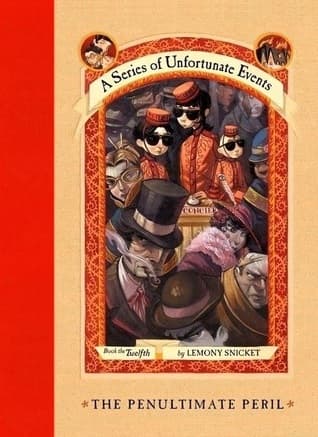
Lemony Snicket (2005)
Genre
Fantasy / Children's / Mystery / Young Adult
Reading Time
240 min
Key Themes
See below
Sign in to track this book
In their second-to-last, dangerous adventure, the Baudelaire orphans enter a mysterious hotel, navigate many secrets and disguises, and confront their enemy, Count Olaf, in a race to find the truth and perhaps justice.
Violet, Klaus, and Sunny Baudelaire arrive at the Hotel Denouement, disguised as concierges, told to meet one of their parents there. The identical triplet brothers, Frank and Ernest Denouement, the hotel managers, immediately put them to work. The hotel is a large, complex building where all guests are given rooms based on an alphabetical system, causing much confusion. The children are looking for the last sugar bowl, a mysterious item important to V.F.D.'s past, hoping to find answers about their parents and the organization. They meet familiar faces, including the Quagmires, who also seek answers, and are surprised by the hotel's strange guests and rules.
Klaus finds that the hotel's guest register is missing many names. This makes him suspicious, as such a detail could hide a known villain. The Baudelaires figure out that Count Olaf must be at the hotel, likely in disguise, and probably one of the Denouement brothers. They also learn that the hotel is a secret meeting place for both good and bad V.F.D. members. The children start investigating the guests, trying to tell who is good and who is with Olaf, all while keeping their concierge disguises and doing odd jobs for the hotel's unusual clients.
Justice Strauss and Jerome Squalor arrive at the Hotel Denouement, wanting to hold a fair trial for Count Olaf. They try to get the guests and the Baudelaires to join a proper legal process. However, Olaf, disguised as 'Detective Dupin,' twists the situation, blaming the Baudelaires for various crimes and turning people against them. The hotel's unique structure, with its two sides (one for noble V.F.D. members, one for villains), makes it hard to find the truth, and the trial quickly becomes chaotic. The children realize that the legal system, in this setting, is easily corrupted and may not give them the justice they want.
The Baudelaires struggle to tell apart the identical triplet managers, Frank and Ernest Denouement. They suspect one is a good V.F.D. member, and the other works with Count Olaf. To add to the confusion, they hear about a third, rumored brother, Dewey Denouement, said to be the most secretive and possibly holding key information about the sugar bowl and their parents. The children realize that finding Dewey is essential to understanding the V.F.D. split and their family's history. This task is made harder by the triplets' identical looks and their habit of speaking in riddles and partial truths.
The Baudelaires discover that the hard-to-find sugar bowl contains not just sugar, but a strong antidote to the Medusoid Mycelium, a deadly fungal poison. This news greatly increases the importance of their search, as the sugar bowl becomes vital for survival. They also learn that Count Olaf and his friends are spreading the Medusoid Mycelium as a weapon. The children understand that getting the sugar bowl is not just about finding V.F.D. secrets, but about stopping widespread harm. The urgency of their mission grows as they see the immediate danger from the fungus.
The Baudelaires finally meet Dewey Denouement, the third, previously hidden, triplet. Dewey is a good V.F.D. member who has been secretly gathering and organizing all information about the organization in a hidden archive under the hotel's pond. He reveals that the sugar bowl holds the cure for the Medusoid Mycelium and that it is important to V.F.D.'s efforts to fight Olaf. Dewey explains the history of the split and why the sugar bowl is important for preventing more tragedies. He offers the children a bit of hope, giving them answers and a way forward.
In a main fight, Count Olaf, trying to shoot the Baudelaires with a harpoon gun, accidentally kills Dewey Denouement. The children are shocked and upset by this sad event, as Dewey was their last hope for direct answers and help. Olaf, always manipulative, tries to blame the Baudelaires for Dewey's murder, further making them seem like villains to the other guests. This incident shows Olaf's increased cruelty and the Baudelaires' despair, leaving them without a trusted adult ally and facing serious accusations.
After Dewey's death, Count Olaf sets the Hotel Denouement on fire, trapping the remaining guests and V.F.D. members inside. The fire quickly spreads through the complex hotel, causing widespread panic and disorder. The Baudelaires, still reeling from Dewey's death and being blamed for it, must navigate the burning building, trying to save themselves and others. The fire represents the complete breakdown of order and the destruction of the last known V.F.D. meeting place. It forces the children to make impossible choices and face the ultimate test of their cleverness and bravery.
Amidst the flames and confusion, the Baudelaires manage to escape the burning Hotel Denouement. However, in their desperate attempt to flee and save the other guests, they lose the sugar bowl, which falls into the ocean. This loss is a crushing blow, as it means the antidote to the Medusoid Mycelium is now gone, and their long search for it has ended in failure. They are left with only their wits and each other, facing an uncertain future with Count Olaf still free and the world believing them to be murderers and arsonists. The children must face the harsh reality of their ongoing misfortunes.
After escaping the burning hotel, the Baudelaires find themselves on a boat with Count Olaf, who also managed to flee the fire. In a final, desperate act, they manage to overpower and capture him. However, their victory is mixed and uncertain. They are now adrift at sea with their enemy, cut off from the rest of the world, and still widely seen as villains. The children consider their next step, realizing that even with Olaf captured, their troubles are far from over. The future remains unclear, setting the stage for the final book in their story.
The Protagonist
Violet grapples with the moral complexities of the V.F.D. schism, facing difficult choices that blur the lines between right and wrong as she tries to protect her siblings.
The Protagonist
Klaus confronts the limitations of knowledge and logic in a world driven by moral ambiguity, learning that sometimes instinct and difficult choices are necessary.
The Protagonist
Sunny continues to grow physically and verbally, asserting her agency and contributing more directly to the Baudelaires' survival and decision-making.
The Antagonist
Olaf's villainy escalates to new heights, culminating in a direct act of murder and arson, solidifying his role as an irredeemable force of destruction.
The Supporting
Dewey appears as a beacon of hope and knowledge for the Baudelaires but is tragically killed, reinforcing the theme of the world's inherent unfairness.
The Supporting
Frank struggles to maintain order and protect the noble V.F.D. members within the chaotic hotel, ultimately failing to prevent its destruction.
The Supporting
Ernest actively aids Count Olaf, demonstrating how easily deception and villainy can masquerade as normalcy.
The Supporting
Esmé remains a steadfast accomplice to Count Olaf, her vanity and cruelty intensifying as she participates in the hotel's destruction.
This theme is key to 'The Penultimate Peril,' as the Hotel Denouement itself is split into two sides, one for good V.F.D. members and one for villains, yet they look the same from the outside. The identical Denouement triplets – Frank (good), Ernest (evil), and Dewey (good) – show this uncertainty perfectly, making it almost impossible for the Baudelaires to tell friend from enemy. Count Olaf's 'trial' further blurs these lines, as Justice Strauss's attempts at fairness are easily ruined by Olaf's tricks and the cooperation of other adults. The children must make moral decisions without clear guidance, showing how complex their world is.
“It is a popular misconception that all V.F.D. members are noble, and that all enemies of V.F.D. are villainous. In fact, it is much more complicated than that.”
The idea of justice is repeatedly weakened in this book. Justice Strauss's honest attempt to hold a proper trial for Count Olaf at the Hotel Denouement quickly turns into a silly show. Olaf, disguised as 'Detective Dupin,' manipulates the process, turning public opinion against the Baudelaires and ensuring he is found innocent. The adult guests, instead of looking for truth, are easily swayed by appearances and sensationalism. This shows how easily the legal system can be twisted by power and lies, leaving the innocent vulnerable and the guilty unpunished, further isolating the Baudelaires in their search for fairness.
“Justice, like a well-made curry, can be a complicated and spicy dish, and one that is often best served with a generous dollop of something cool and creamy, if you want to avoid burning your mouth.”
The Baudelaires' constant search for information about V.F.D. and their parents' past is a main force, but this book shows the heavy burden that comes with it. Dewey Denouement's secret archive, while giving important answers about the sugar bowl and the Medusoid Mycelium, also makes him a target, leading to his death. The children learn that some truths are dangerous and that knowing too much can lead to greater risk. The V.F.D. split itself is a secret that has caused great suffering, showing how hidden information can divide and destroy.
“Knowledge is like a library, and sometimes a library is on fire.”
True to the series, 'The Penultimate Peril' highlights the continuous bad luck the Baudelaires face. The loss of Dewey Denouement, a kind and knowledgeable adult who offered real help, is especially devastating. His accidental death by Olaf's harpoon gun takes away a key ally and source of information from the children. Also, the destruction of the Hotel Denouement, the last known V.F.D. meeting place, and the loss of the sugar bowl (and its antidote) into the ocean, mean the complete breakdown of their hopes and efforts. These combined losses reinforce the bleak reality of their lives and the widespread nature of tragedy in their world.
“It is a sad but true fact that sometimes the most helpful people are the ones who are no longer around to help.”
A labyrinthine hotel serving as a V.F.D. meeting place and a metaphor for the world's divisions.
The Hotel Denouement is a crucial setting, designed with a deliberately confusing alphabetical room system. It serves as a secret meeting place for both noble and villainous V.F.D. members, literally divided into two sides. This physical division mirrors the moral ambiguity of the V.F.D. schism and the blurred lines between good and evil. Its labyrinthine structure and the identical triplet managers (Frank, Ernest, Dewey) create an environment of constant confusion and deception, making it difficult for the Baudelaires to discern allies from enemies. The hotel ultimately becomes a symbol of the failing V.F.D. organization when it is destroyed by fire.
A mysterious object containing the antidote to the Medusoid Mycelium.
The sugar bowl, a long-standing MacGuffin in the series, is revealed to contain the antidote to the Medusoid Mycelium. This revelation elevates its importance from a mere V.F.D. relic to a vital object for survival. Its contents represent hope and a potential solution to a deadly threat. The Baudelaires' desperate pursuit of the sugar bowl drives much of the plot, only for it to be tragically lost at sea during the hotel fire, symbolizing the continued denial of a simple solution to their complex problems and the pervasive nature of misfortune.
A deadly fungal poison used as a weapon by Count Olaf.
The Medusoid Mycelium is a highly dangerous, fast-acting fungal poison that causes death almost instantly. It is introduced as a new and terrifying threat, weaponized by Count Olaf and his associates. The fungus raises the stakes of the Baudelaires' quest, as the sugar bowl's antidote becomes essential for combating this biological weapon. Its presence underscores the escalating dangers the children face and highlights the extreme villainy of Olaf, who is willing to unleash such a devastating force upon the world. The fungus represents a new, more insidious form of peril.
Frank, Ernest, and Dewey Denouement, who embody the moral ambiguity of the V.F.D. schism.
The identical triplet brothers, Frank, Ernest, and Dewey Denouement, serve as a powerful plot device to illustrate the theme of moral ambiguity. Frank is a noble V.F.D. member, Ernest is allied with Count Olaf, and Dewey is a secretive, noble V.F.D. archivist. Their identical appearances make it nearly impossible for the Baudelaires to distinguish between them, forcing the children to rely on subtle cues and moral judgment rather than outward appearances. This device highlights the difficulty of discerning good from evil in a fractured world and contributes to the pervasive sense of confusion and mistrust.
“It is a curious thing, the death of a parent. We are told to expect it, but it's never something you can prepare for.”
— Reflecting on the loss of parents and its impact.
“The world is a vast and complicated place, and there are a great many things in it that are true, even if you do not believe them.”
— A general observation on the nature of truth and belief.
“It is a sad but true fact that sometimes the most important things in life are the ones that are the hardest to talk about.”
— Discussing the difficulty of addressing significant topics.
“The Baudelaire orphans knew that it is one thing to be in a dangerous situation, and another thing entirely to be in a dangerous situation with no idea how you got there.”
— The Baudelaires find themselves in a perilous and confusing predicament.
“It is a rare and beautiful thing when the truth and justice align, but it is a common and tragic thing when they do not.”
— Contemplating the often-unjust nature of the world.
“There are many things in life that are difficult to understand, but few are as difficult as the human heart.”
— Musing on the complexities of human emotions and motivations.
“The phrase 'at your leisure' is a polite way of saying 'whenever you get around to it, if ever,' and it often means 'never at all.'”
— Snicket's commentary on polite but often empty phrases.
“It is a terrible thing to be lonely, but it is an even more terrible thing to be lonely with someone else.”
— Reflecting on the nature of companionship and isolation.
“The world is quiet here.”
— A recurring, enigmatic phrase associated with V.F.D. and a sense of peace or resignation.
“Even the most well-intentioned people can make terrible mistakes, and even the most terrible mistakes can sometimes lead to something good.”
— Considering the duality of intentions and outcomes.
“Sometimes, the most important thing a person can do is simply to listen.”
— Highlighting the value of active listening and empathy.
“The truth, like a good story, is often best told in pieces, so that the listener can put them together themselves.”
— Discussing the fragmented nature of truth and storytelling.
“There are some things that cannot be explained, no matter how much you try, and sometimes the best thing to do is to simply accept them.”
— Acknowledging the limits of understanding and the need for acceptance.
“The most important decisions in life are rarely made quickly, and almost never made easily.”
— Reflecting on the weight and difficulty of significant choices.
Ready to see how well you understood this book? Take our interactive quiz with 10 questions.

Biography coming soon.







