“‘When I was your age, I was an astronaut. I went to the moon.’”
— From 'The Paper Menagerie,' the narrator's mother speaking about her aspirations.

Ken Liu (2016)
Genre
Fantasy / Historical Fiction / Science Fiction
Reading Time
464 pages (variable depending on story)
Key Themes
See below
Sign in to track this book
Ken Liu's collection blurs the lines between memory, mythology, and humanity's many futures, with stories ranging from magical paper tigers to historical accounts changed by technology.
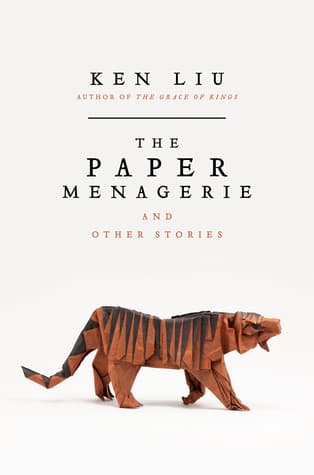
Jack, a young boy in America, receives origami animals from his Chinese immigrant mother, who gives them life with her magic. These paper creatures, especially Laohu the tiger, are his companions and a link to his mother's culture. As Jack gets older, he faces bullying and ridicule for his mother's 'foreign' ways. He becomes ashamed of the paper animals and asks for a 'normal' American toy. His mother puts the animals away. Jack distances himself from his Chinese heritage, refusing to speak Chinese and embracing American culture. After his mother's death, he finds a box with her old belongings, including the faded paper animals, and a letter written in Chinese.
Jack asks a Chinese-speaking neighbor to translate his mother's letter. The letter tells of his mother's past in China: her childhood during the Cultural Revolution, her arranged marriage to an American serviceman as a 'mail-order bride,' and her struggles to adapt to a new country and raise a son who rejected her culture. She describes how she put her love, memories, and spirit into the paper animals, making them a piece of her soul. As the letter is read, the paper animals, especially Laohu, regain their color and begin to move, showing the lasting power of his mother's magic and love, even after death. Jack feels regret and understands his mother's sacrifices.
The story introduces Dr. Akemi Kirino and Dr. Evan Wei, who develop the Kirino-Teleportation (K-T) field. This technology allows observers to see past events without changing them, creating a perfect historical record. Their first project looks at Unit 731, the Japanese Imperial Army's biological warfare research facility during World War II, known for its human experimentation. The goal is to bring truth to the historical record, especially for denied or distorted events. They recruit 'observers' willing to see these traumatic events, noting the psychological toll. The project aims to provide closure and accountability, but also raises ethical questions about witnessing and memory.
As the K-T field project progresses and images from Unit 731 are shown, it causes great controversy. Japanese nationalists protest, calling the project biased historical revisionism and an attempt to shame their nation. The observers, especially one named Jerry, struggle with the trauma of seeing the atrocities, leading to mental health issues. The technology's limit, only allowing observation of events where 'consciousness' was present (excluding events like the Big Bang), becomes a point of debate. The story looks at the ethical questions of 'ending history' by presenting an unchangeable truth, and whether such truth can truly lead to reconciliation or just deepen existing divisions. The project faces pressure and questions its viability.
Hiroto, a Japanese engineer, pilots the *Challenger*, a solar sail spacecraft carrying humanity's last survivors after a solar flare made Earth uninhabitable. He is on a mission to find a new home, using an experimental solar sail technology that needs precision and focus. The story shows the responsibility on Hiroto's shoulders and the burden of being a guardian of humanity's future. Flashbacks show the careful planning and the rushed evacuation from Earth, emphasizing the sacrifices and losses. Hiroto's connection to Japanese culture, especially *mono no aware* (an appreciation of the transience of things), shapes his view of humanity's fate.
During the journey, the *Challenger* has a critical malfunction: a tear in the solar sail. Repairing it requires a dangerous spacewalk and a manual maneuver that risks the mission. Hiroto, using his engineering knowledge and dedication, realizes he must make a sacrifice. He manually adjusts the sail, knowing the maneuver will likely cost him his life due to radiation exposure or extreme conditions. He repairs the sail, ensuring the *Challenger*'s journey towards a new star system. His sacrifice embodies *mono no aware*, accepting the beauty and tragedy of transient existence for humanity's survival, leaving the future to the next generation.
The story is in a small Idaho town during the American Gold Rush, focusing on a Chinese immigrant community. Lao Wai, a Chinese cook, tries to start a business and integrate into the white settlement. The Chinese immigrants face racism, discrimination, and violence from white miners, who see them as economic threats and cultural outsiders. Tensions rise as Chinese miners are targeted, their claims taken, and their lives threatened. The story shows the harsh realities and injustices faced by Chinese laborers seeking opportunity in the American West, showing the clash of cultures and the struggle for survival amid prejudice.
To ease tensions and show his community's value, Lao Wai hosts a Chinese New Year feast, inviting the skeptical and often hostile white townsfolk. By preparing and sharing Chinese food, Lao Wai introduces the white community to aspects of Chinese culture, challenging their ideas. Sharing food, with its flavors and communal aspect, begins to break down some barriers. While not a complete solution to the racism, the feast marks a step towards understanding and a temporary break from hostility, showing the power of cultural exchange and shared humanity through a simple act of hospitality.
Presented as an academic paper, this story explores the methods alien species use to create, store, and transmit 'books' or knowledge. From species that eat books for knowledge, to those that grow them from their bodies, or store information in living organisms, the narrative shows a range of biological and cultural adaptations. The 'paper' details the physical forms, the social rituals around knowledge transfer, and the philosophical ideas of these practices. It shows how the concept of 'book' is fluid and connected to a species' biology, environment, and society, offering a humorous and thought-provoking comment on human ideas about information and learning.
Humanity has gone beyond its physical form, uploading its consciousness into a vast, interconnected digital entity called the 'Wave.' This collective mind travels through the cosmos, experiencing the universe in new ways. The story follows a specific 'node' within the Wave, thinking about individuality, memory, and the purpose of post-human existence. They encounter other life forms and explore the universe's mysteries, dealing with the loss of their physical bodies and the idea of a shared, eternal consciousness. The narrative explores the philosophical ideas of this digital afterlife, questioning the meaning of life, death, and identity when boundaries between individuals disappear.
Set in Imperial China, this story features Master Li, a clever litigation master (a lawyer-like figure) who uses his wit, legal knowledge, and sometimes trickery to win cases for his clients, often against corrupt officials. He is known for his elaborate schemes and his ability to manipulate the rigid legal system. The narrative introduces the Monkey King, Sun Wukong, not as a literal character but as a symbol of rebellion and trickery that Master Li often uses. The story shows the injustices of the imperial legal system and the struggle of ordinary people to find justice against power. Master Li's methods are often morally ambiguous but effective in getting what he sees as a just outcome.
Master Li is hired to defend a man accused of a crime he did not commit, facing powerful and corrupt magistrates. To win, Master Li creates an elaborate plan that involves manipulating superstitions, staging dramatic events, and referencing the Monkey King legends to create doubt and fear among the corrupt officials. He uses his understanding of human psychology and cultural reverence for figures like the Monkey King to outsmart his opponents. By outwitting the authorities and exposing their corruption through clever, theatrical means, Master Li frees his client, solidifying his reputation as a master of litigation and a champion of the underdog, like the mythical Monkey King challenging divine authority.
The Protagonist
From rejecting his heritage to understanding and embracing his mother's legacy, Jack undergoes a significant transformation of identity and empathy.
The Supporting
She endures a life of displacement and cultural struggle, finding solace and expression in her unique magic, leaving a legacy of love for her son.
The Protagonist
From an idealistic scientist seeking truth, she confronts the complex and often painful realities of historical reconciliation and the limitations of technology.
The Protagonist
He navigates the scientific triumph of the K-T field through the ensuing political and ethical minefield, questioning the ultimate utility of 'pure' truth.
The Protagonist
From a meticulous engineer, he evolves into a selfless hero who makes the ultimate sacrifice for humanity's future.
The Protagonist
He endeavors to find acceptance and build bridges in a prejudiced society, using his cultural heritage as a tool for connection.
The Protagonist
He consistently uses his intellect and trickery to challenge a corrupt legal system, upholding a personalized form of justice.
The Protagonist
From an individual human consciousness, they evolve into a node in a collective, experiencing the universe and identity in new, non-physical ways.
The Supporting
From a vibrant companion, he becomes dormant due to rejection, then reawakens as a symbol of rediscovered love and heritage.
This theme is clearest in 'The Paper Menagerie', where Jack's struggle to balance his Chinese heritage with his desire to fit into American society creates the main conflict. His rejection of his mother's language and magical paper animals shows the pressures immigrant children face to assimilate, often losing their cultural roots. The story suggests that true identity comes from embracing, not denying, one's heritage. 'All the Flavors' also explores this through Lao Wai's attempts to integrate and keep his culture amid prejudice in the American West. The tension between keeping cultural identity and wanting acceptance is a recurring idea.
“You loved the paper animals. I made them for you, to keep you company. But then you grew up, and you didn't want them anymore. You wanted to be like the other children. You wanted to be American.”
'The Man Who Ended History: A Documentary' directly addresses this theme by introducing a technology that can perfectly record past events, ending historical debate. The story questions whether an objective truth, especially of traumatic events like Unit 731, can lead to reconciliation or just open old wounds and create new conflicts. It explores the psychological burden of witnessing history and the complexities of memory, both individual and collective. The story suggests that history is not just facts, but a narrative shaped by perspective, emotion, and interpretation, which can never be fully 'ended'.
“History is not what happened. History is what we choose to remember. And sometimes, what we're forced to forget.”
Many stories explore love, loss, and sacrifice. In 'The Paper Menagerie', the mother's unconditional love for Jack is central, ending in her sacrifice of putting her spirit into the paper animals. Her death and Jack's regret show the lasting power of familial love. 'Mono No Aware' shows Hiroto's selfless sacrifice for humanity's survival, driven by a deep love for life and duty. These narratives show how love, even in its absence or through painful acts, can be a powerful force for characters.
“I loved you, Jack. I loved you with all my heart. And I made them for you, so that you would always know that.”
This theme is in stories like 'The Waves' and 'Mono No Aware'. 'The Waves' imagines a future where humanity has gone beyond physical bodies, existing as a collective consciousness exploring the cosmos. It looks at philosophical questions of identity, individuality, and purpose in a post-human existence. 'Mono No Aware' presents a more immediate future, where humanity is near extinction and relies on technology and human sacrifice to find a new home. Both stories explore the human spirit's resilience, the possibilities and challenges of advanced technology, and our species' ultimate fate in a vast universe.
“We were not individuals anymore, not in the old sense. We were the Wave, and the Wave was all of us, and all of us were One.”
'The Litigation Master and the Monkey King' shows this theme in Imperial China's corrupt legal system. Master Li, the main character, works in a morally ambiguous space, using trickery and manipulation to get what he believes is justice for his clients. The story shows the flaws in rigid systems and the ingenuity needed to navigate them when traditional morality fails. 'The Man Who Ended History' also looks at the morality of revealing absolute historical truth, questioning whether it serves justice or creates new injustices through its impact on collective memory and national identity.
“Justice, my young friend, is not about the law. It is about what people believe to be right, and what they can be persuaded to accept.”
The integration of magical elements into a realistic setting.
Most notably present in 'The Paper Menagerie', magical realism seamlessly blends the fantastical (paper animals brought to life) with the mundane reality of an immigrant family's life in America. The magic isn't questioned or explained scientifically; it simply exists as a natural part of the mother's character and cultural heritage. This device allows for a deeper exploration of themes like cultural identity, love, and loss, using the magic as a metaphor for the intangible bonds and heritage that define human experience. It grounds the extraordinary in the everyday, making the emotional impact more profound.
Story told through letters, academic papers, or other documents.
This device is central to 'The Paper Menagerie', where the mother's posthumous letter is the key to unlocking the story's emotional core and Jack's understanding. In 'The Man Who Ended History: A Documentary', the story is structured as a collection of interviews, academic excerpts, and news reports, mimicking a documentary format to present different perspectives on the K-T field. 'The Bookmaking Habits of Select Species' is presented as an academic paper. These formats lend an air of authenticity and objectivity, even to fantastical elements, and allow for multiple viewpoints or delayed revelations that heighten dramatic effect.
Objects or concepts representing deeper cultural or philosophical ideas.
The paper animals in 'The Paper Menagerie' are potent symbols of the mother's love, her Chinese heritage, and the fragile connection between generations. The concept of *mono no aware* in the story of the same name is a philosophical metaphor for the poignant appreciation of transience and the beauty of fleeting existence, guiding Hiroto's actions. The Monkey King in 'The Litigation Master and the Monkey King' serves as a symbolic figure of rebellion against authority and clever subversion, influencing Master Li's legal tactics. These cultural symbols enrich the narratives and provide deeper layers of meaning.
Disruption of chronological order to reveal backstory or context.
While not every story uses this extensively, 'The Paper Menagerie' employs flashbacks through the mother's letter to reveal her traumatic past and the context of her immigration, which profoundly impacts Jack's present understanding. 'Mono No Aware' uses flashbacks to show the desperation of Earth's evacuation and the rigorous training Hiroto underwent, adding depth to his character and the mission's stakes. This device allows for the gradual unveiling of information, building suspense or providing crucial context that shapes the reader's perception of current events and character motivations.
A story within a story, or a narrative commenting on its own telling.
'The Man Who Ended History: A Documentary' uses a meta-narrative structure, presenting itself as a documentary and thus commenting on the nature of historical truth and its representation. The story itself is about the act of recording and interpreting history. Similarly, 'The Bookmaking Habits of Select Species' functions as a frame story, presenting a 'scholarly' article that contains the various, often bizarre, 'stories' of alien bookmaking. This device allows Ken Liu to explore complex ideas about narrative, knowledge, and perception by structuring the storytelling itself as part of the thematic exploration.
“‘When I was your age, I was an astronaut. I went to the moon.’”
— From 'The Paper Menagerie,' the narrator's mother speaking about her aspirations.
“‘A story is a paper boat, sailing on a river of ink. The boat is the language, the river is the culture. It takes you to different shores, but the boat is always there.’”
— From 'The Paper Menagerie,' the narrator's mother explaining the power of stories.
“‘Love is a choice, not a feeling.’”
— From 'The Paper Menagerie,' the narrator reflecting on his parents' relationship.
“‘What is memory but a story we tell ourselves about the past?’”
— From 'The Algorithms for Love,' a character contemplating the nature of memory and identity.
“‘The past is never dead. It’s not even past.’”
— From 'The Literomancer,' a character discussing the lingering effects of history.
“‘Every act of creation is first an act of destruction.’”
— From 'Mono no Aware,' a philosophical reflection on the cyclical nature of existence.
“‘We are all just stories in the end. Just make sure yours is a good one.’”
— From 'The Regular,' a character offering a poignant piece of advice.
“‘To be human is to be an archive of your own experiences.’”
— From 'The Bookmaking Habits of Select Species,' exploring the concept of self and knowledge.
“‘The universe doesn’t care about your feelings, but it does care about your actions.’”
— From 'The Man Who Ended History: A Documentary,' a character discussing responsibility.
“‘Truth is a matter of perspective, and perspective is a matter of power.’”
— From 'The Man Who Ended History: A Documentary,' concerning historical narratives and control.
“‘Grief is the price we pay for love.’”
— From 'All the Flavors,' a character reflecting on loss and attachment.
“‘Sometimes, the bravest thing you can do is just keep living.’”
— From 'The Paper Menagerie,' a quiet observation about resilience.
“‘We build our own cages, and then we wonder why we can’t fly.’”
— From 'The Perfect Match,' a commentary on self-imposed limitations.
“‘The future is not something we enter. The future is something we create.’”
— From 'Good Hunting,' an empowering statement about agency and destiny.
Ready to see how well you understood this book? Take our interactive quiz with 10 questions.
Biography coming soon.







