“For there is no more terrible a sight than that of a man who has lost his mind.”
— Augustus Landor reflecting on the state of the world and human nature.

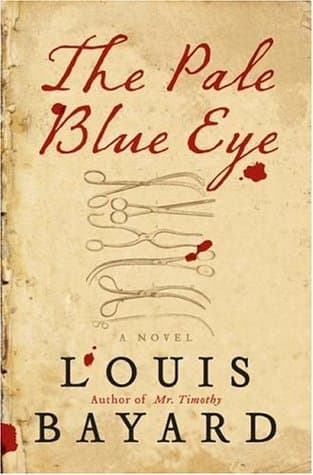
Louis Bayard (2006)
Genre
Thriller / Historical Fiction / Mystery
Reading Time
9-10 hours
Key Themes
See below
Sign in to track this book
In 1830, a jaded detective partners with a young, eccentric Edgar Allan Poe to unravel a series of gruesome murders and stolen hearts at West Point, plunging them into a world of dark secrets and shattered trust.
In October 1830, at the United States Military Academy at West Point, Cadet Leroy Fry's body is found hanging from a tree, an apparent suicide. The Superintendent, Colonel Sylvanus Thayer, wanting to avoid scandal, initially dismisses it. However, the next morning, a more horrifying discovery is made: Fry's body, held in the infirmary, has been desecrated, and his heart surgically removed. Faced with a clear murder and potential damage to the Academy's reputation, Thayer quietly hires Augustus Landor, a respected retired New York City detective living nearby, to investigate unofficially and keep the academy's name out of public view. Landor, a widower haunted by his past, reluctantly agrees, seeing a chance to escape his own sadness.
Augustus Landor begins his investigation at West Point, navigating the strict, secretive military academy. He interviews cadets and officers, encountering silence and suspicion. During his inquiries, he meets Cadet Edgar Allan Poe, a melancholic and intelligent young man known for his poetry, erratic behavior, and drinking. Poe, though initially a suspect due to his morbid interests, quickly shows a keen deductive mind and unusual perceptiveness that impresses Landor. Despite Poe's oddities and the academy's disapproval, Landor decides to take Poe on as an unofficial assistant, recognizing the cadet's unique ability to understand human psychology.
As Landor and Poe investigate, another cadet, Stoddard, is found murdered similarly to Fry—his body also desecrated and his heart removed. This second murder confirms the ritualistic nature of the killings, chilling the Academy. Landor and Poe discover cryptic symbols and texts related to the occult, suggesting the killer might be involved in a secret society or practicing dark magic. Pressure mounts on Landor as Colonel Thayer demands results, while Academy authorities, particularly Captain Hitchcock, grow suspicious of Landor's methods and Poe's involvement, fearing a scandal.
Landor and Poe focus their investigation on cadets close to Fry and Stoddard, including Cadet Ballinger, Cadet Lundy, and Cadet Marquis. They find evidence of a secret society within West Point, dedicated to arcane rituals, which the victims may have joined. Poe's knowledge of obscure texts and his ability to interpret symbolic clues are helpful, leading them to suspect the murders are not random but part of a larger, sinister plan. The atmosphere at West Point becomes tense, with fear and suspicion among the cadets.
The precise surgical removal of the hearts leads Landor and Poe to investigate West Point's medical staff, especially Dr. Daniel Marquis, the Academy's physician, and his family. Poe becomes infatuated with Dr. Marquis's daughter, Lea, a beautiful but sickly young woman who seems to share Poe's melancholic nature and interest in the macabre. Their growing romance adds a personal layer to Poe's investigation, drawing him into the Marquis family's world. Landor, meanwhile, observes the family closely, noting their guarded behavior and the doctor's evasiveness about autopsies and body handling.
Cadet Ballinger, a key suspect, is found gravely injured; his heart was targeted but not fully removed, suggesting the killer was interrupted. This near-miss increases the urgency of the investigation. Landor, convinced the killer is within the Academy, decides to set a trap. He uses Poe's insights into the killer's likely motivation and his own detective experience to plan how to lure the murderer out. The tension builds as Landor and Poe prepare for a confrontation, knowing the killer is intelligent, cunning, and deeply involved in the West Point community, making every move dangerous.
Landor's trap successfully draws out Cadet Lundy, who confesses to the murders. Lundy reveals himself to be a deranged individual, driven by a twisted interpretation of occult rituals and a desire for power and immortality. He had meticulously planned the killings, believing that by consuming his victims' hearts, he could gain their strength and knowledge. The confrontation is violent, but Landor and Poe subdue Lundy. The Academy is relieved to have the killer caught, seemingly ending the horrific spree. However, Landor still feels a lingering unease, a sense that something crucial remains unaddressed.
Despite Lundy's confession and the apparent resolution, Landor is troubled by inconsistencies and unanswered questions. Certain details of the murders, particularly the precision of the heart removal, do not align with Lundy's known abilities or his capture. He suspects Lundy may have been a pawn, or at least not the sole perpetrator. Landor confides his doubts in Poe, who, despite his infatuation with Lea, begins to share Landor's growing unease. They revisit the evidence, searching for overlooked clues that might point to a more complex and sinister truth behind the ritualistic killings at West Point.
Landor's deeper investigation leads him back to Dr. Marquis and his family. He uncovers the truth: Dr. Marquis, a former surgeon, meticulously removed the hearts, driven by a desperate attempt to cure his daughter, Lea's, terminal illness. He believed, based on ancient texts and his own distorted medical theories, that transferring 'life force' from healthy young men could save her. Lea, aware of her father's actions, was complicit, even orchestrating some events, manipulating Poe with her charm and shared morbid interests. Cadet Lundy was merely a disturbed accomplice, easily manipulated by the Marquis family.
Landor confronts Dr. Marquis and Lea with his discoveries. The truth shatters Poe, who is devastated by Lea's betrayal and the realization that his beloved was involved in such heinous acts. In a climactic confrontation, Lea, consumed by her illness and complicity, makes a desperate attempt to escape or inflict further harm. Landor, with Poe's assistance, prevents further tragedy. The Marquis family's dark secret is fully exposed, revealing a chilling tale of desperation, medical malpractice, and manipulative deceit, all hidden beneath West Point's strict discipline and reputation. The Academy's image is irrevocably tarnished.
With the full truth revealed, Dr. Marquis is apprehended, and Lea's fate, though tragic, is sealed by her illness and complicity. The Academy must deal with the scandal, though Colonel Thayer tries to contain the damage. Landor, his health and spirit further strained by the ordeal, prepares to return to his solitude, forever changed by the horrors he uncovered. Poe, heartbroken and disillusioned by Lea's betrayal, decides to leave West Point. His intense friendship with Landor has shaped his perspective. The experience fuels his morbid interests and contributes to the dark themes that will define his future writing, setting his path as a writer of the macabre.
The Protagonist
Landor initially seeks escape from grief, but the investigation forces him to confront his own past and the dark secrets he harbors, leading to a devastating personal revelation.
The Supporting/Deuteragonist
Poe evolves from a reclusive cadet into an active participant in the investigation, his observational skills honed, but his emotional vulnerability leads to a heartbreaking betrayal that shapes his future.
The Antagonist/Supporting
Lea's apparent innocence gradually unravels to reveal her as a central, manipulative figure in the murders, driven by a desperate desire for life, ultimately leading to her tragic demise.
The Antagonist
Dr. Marquis's arc reveals him as the mastermind behind the ritualistic murders, driven by a desperate, misguided attempt to save his daughter, leading to his downfall and exposure.
The Supporting
Thayer's initial dismissal of the murders and subsequent attempts to control the investigation highlight his rigid adherence to institutional image, ultimately forcing him to confront the dark truths hidden within his academy.
The Supporting/Antagonist
Lundy's initial portrayal as the sole killer serves as a red herring, revealing him later as a manipulated, disturbed individual, highlighting the deeper conspiracy at play.
The Mentioned
As the first victim, Fry's death acts as the inciting incident, revealing the dark undercurrents and hidden crimes within West Point.
The Mentioned
Stoddard's death confirms the serial and ritualistic nature of the killings, intensifying the investigation and deepening the mystery.
The Supporting
Ballinger's near-death experience serves as a pivotal moment, providing a direct link to the killer's methods and intensifying the urgency of the investigation.
This theme explores how deep grief and desperation can lead people to commit horrific acts, twisting their moral compass. Dr. Daniel Marquis's love for his dying daughter, Lea, pushes him to believe in and practice ancient, barbaric rituals, thinking he can save her by sacrificing others. Similarly, Lea's fear of death and hope for survival lead her to manipulate Poe and aid her father. Landor himself grieves for his lost family, making him susceptible to being misled and fueling his initial reluctance to engage with life. The novel shows how these powerful emotions, unchecked, can warp judgment and break ethical boundaries.
“Grief, I have learned, is a cunning adversary, capable of twisting the most noble intentions into a grotesque parody of love.”
The novel skillfully contrasts outward appearances with hidden truths. West Point, with its strict discipline and honorable facade, hides a dark side of secret societies, murder, and moral decay. Characters like Lea Marquis appear fragile and innocent but hold manipulative and deadly secrets. Dr. Marquis, the respected physician, is revealed as a cold-blooded killer. Even Landor, the seasoned detective, is not immune, as his own past and his daughter's disappearance are shrouded in deception. This theme highlights how unreliable perception is and the dangers of judging by surface impressions.
“The most dangerous secrets are not those we hide from others, but those we hide from ourselves.”
This theme directly addresses Edgar Allan Poe's early genius and how the traumatic events at West Point contribute to his literary style. Poe's morbid interests, acute observational skills, and melancholic temperament are all amplified by his direct involvement in the gruesome murders and his heartbreaking betrayal by Lea. The horrors he witnesses, the psychological depths he explores, and the disillusionment he experiences provide fertile ground for the dark, gothic, and psychologically complex tales he would later write. The novel presents this period as a crucible that shaped the literary master of the macabre.
“There are some wounds that bleed not from the body, but from the soul, and their ink stains all that follows.”
The novel explores the complex nature of justice, especially when crimes are driven by extreme desperation. While the Marquis family's actions are horrific, their motivations stem from a deep, though twisted, love. Landor's pursuit of justice is complicated by his own past and his understanding of human fallibility. The case's resolution, while catching the culprits, offers little true redemption for anyone involved. The theme questions whether true justice can be achieved when the lines between victim and perpetrator are blurred by despair and love, leaving a lingering sense of moral ambiguity.
“Justice, I have found, is rarely a clean thing. It leaves as many scars as it heals.”
Misleading clues or characters designed to divert the reader's attention from the true culprit.
The character of Cadet Lundy serves as a significant red herring. His initial confession and the apparent ease with which he is apprehended lead both the Academy and the reader to believe the case is solved. His disturbed nature and fascination with the occult make him a plausible, albeit incomplete, suspect. This diversion allows the true orchestrators, Dr. Marquis and Lea, to operate in the shadows for longer, deepening the mystery and making the final revelation more shocking. Poe's initial suspicion of Lundy also contributes to this misdirection.
A narrator whose credibility has been compromised, often due to personal biases or hidden information.
Augustus Landor, the first-person narrator, is an unreliable narrator, particularly concerning his own past and motivations. His profound grief over his wife's death and the mysterious disappearance of his daughter significantly color his perceptions and judgments. He withholds crucial information about his personal history, and his emotional state often leads him to misinterpret events or overlook critical details. This unreliability is gradually revealed, culminating in the shocking truth about his own family's fate, forcing the reader to re-evaluate everything they thought they knew.
Hints or clues about future events, often creating suspense and anticipation.
The novel employs extensive foreshadowing, particularly through Poe's morbid interests and poetic inclinations. His fascination with death, his unsettling poems, and his keen insights into the darker aspects of human nature subtly hint at the gruesome and ritualistic nature of the murders. Landor's recurring thoughts about his missing daughter and his own buried secrets also foreshadow the eventual revelation of his personal tragedy. The sickly nature of Lea Marquis and Dr. Marquis's evasiveness regarding the autopsies also provide early, subtle clues about their involvement.
The use of dark, mysterious, and often isolated settings to create a sense of dread and suspense.
The setting of West Point in 1830, with its imposing stone architecture, rigid military discipline, and isolated location in the Hudson Highlands, provides a perfect gothic backdrop. The cold October nights, the mist-shrouded grounds, and the hidden nooks and crannies of the academy contribute to an oppressive and mysterious atmosphere. This gothic setting enhances the themes of hidden secrets, ritualistic violence, and psychological decay, creating a pervasive sense of dread and tension that permeates the entire narrative.
“For there is no more terrible a sight than that of a man who has lost his mind.”
— Augustus Landor reflecting on the state of the world and human nature.
“The past is a foreign country; they do things differently there.”
— Landor's internal monologue about memory and the passage of time.
“There are some things, you see, that simply cannot be explained away by logic or science.”
— A character discussing the supernatural or inexplicable events.
“Grief, I have learned, is not a state but a process, one that never truly ends.”
— Landor's thoughts on his personal losses and enduring sorrow.
“The world, my friend, is full of shadows, and sometimes, the darkest ones are cast by the brightest lights.”
— A philosophical observation about appearances and reality.
“A secret is a burden, and burdens, if carried too long, will crush a man.”
— A character reflecting on the weight of hidden truths.
“There are certain moments in life when one knows, with absolute certainty, that everything is about to change.”
— A pivotal moment of realization for a character.
“The human heart is a dark forest, and one can get lost in its depths.”
— A metaphorical description of human emotions and motivations.
“Justice, you see, is not always about what is right, but about what can be proven.”
— A cynical view on the legal system and the pursuit of justice.
“Every man has his demons, and mine, I assure you, are legion.”
— Landor's self-deprecating remark about his inner struggles.
“To truly see, one must often close one's eyes to the obvious.”
— A detective's insight into solving a complex mystery.
“Fear, my dear boy, is a powerful motivator, and it can drive men to do terrible things.”
— A character explaining the underlying cause of violent acts.
“The most dangerous lies are the ones we tell ourselves.”
— A character confronting their own self-deception.
“There is a kind of beauty in despair, a stark, unyielding truth that strips away all pretense.”
— A morbid yet profound observation on the nature of hopelessness.
Ready to see how well you understood this book? Take our interactive quiz with 10 questions.

Biography coming soon.







