“It was her mother, Nancy, who had died, and her father, Huw, who had gone mad, but it was Alison who felt herself to be dead and mad.”
— Introducing Alison's emotional state after her parents' tragedy.

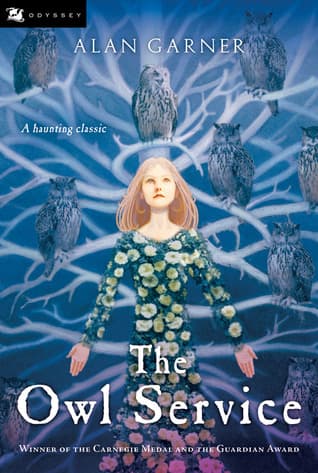
Alan Garner (1967)
Genre
Fantasy / Children's / Mystery / Young Adult
Reading Time
240 min
Key Themes
See below
Sign in to track this book
In a remote Welsh valley, three teenagers unwittingly reawaken an ancient, tragic curse through a set of floral plates, forcing them to relive a doomed love triangle that has echoed through generations.
Alison, her mother Margaret, and her stepfather Clive, arrive at a remote house in a Welsh valley for their summer holiday. Roger, Clive's son from a previous marriage, and Gwyn, the son of the house's caretaker, Huw, are also present. Alison is immediately drawn to a scratching noise in the attic above her bedroom. Investigating, she finds a stack of old, dirty dinner plates with a peculiar floral pattern. Intrigued, she begins tracing the patterns onto paper. To her surprise, when she cuts out the traced shapes and folds them, they form the distinct shape of an owl. This discovery begins the strange occurrences that will unfold in the valley.
Alison continues making paper owls from the plate patterns, but she notices they disappear shortly after being made. The atmosphere in the house becomes strained, especially between Alison, Roger, and Gwyn. Roger, feeling displaced by Alison and Gwyn's connection to the valley, often makes snide remarks. Gwyn, protective of his heritage, is wary of the newcomers. Alison finds herself fascinated by the plates and the legends surrounding them, feeling an inexplicable pull towards the valley's ancient past, which seems to appear through the vanishing owls and the heightened emotions among the children.
Gwyn, initially reluctant, begins to share the local legend connected to the valley. He explains the ancient Welsh myth of Blodeuwedd, a woman conjured from flowers, who was given as a wife to Llew Llaw Gyffes. However, Blodeuwedd fell in love with another man, Gronw Pebr, and together they plotted Llew's death. As punishment, Blodeuwedd was transformed into an owl, doomed to only fly at night and be hated by other birds. Gwyn's telling of the tale deeply affects Alison, who feels an uncanny connection to Blodeuwedd. Roger dismisses it as superstition, further widening the rift between the three.
As more paper owls are made and vanish, the legend starts to enter reality. Flowers appear inexplicably in Alison's room, and the children experience strange weather, including unnatural storms. Alison's personality changes; she becomes volatile, possessive, and emotionally unstable, mirroring Blodeuwedd's tragic story. She feels a strong, almost involuntary, attraction to Gwyn, while also feeling dread and entrapment. Roger grows concerned for Alison's mental state, believing she is overwhelmed by the valley's influence, while Gwyn is both drawn to and terrified by the unfolding events.
Huw, Gwyn's father and the caretaker, reveals a piece of the puzzle: he, Margaret (Alison's mother), and Clive's father, Bertram, were the previous generation caught in the legend's cycle. Huw was 'Gronw', Margaret 'Blodeuwedd', and Bertram 'Llew'. This explains Margaret's deep anxiety and Huw's protective, yet resigned, demeanor. The children realize they are not just hearing a story but are destined to replay it. This knowledge intensifies their fear and the sense of inevitability, as they grapple with the implications for their own relationships and futures.
Driven by the unfolding events and the increasing intensity of Alison's transformations, the children discover physical objects linked to the Blodeuwedd legend. They find an ancient scythe, rumored to be the weapon used to kill Llew, and a large stone with a hole in it, where Llew was supposedly struck. These discoveries confirm their belief that the legend is not just a story, but a cyclical curse that repeats itself with each generation. The presence of these artifacts deepens the sense of foreboding and reinforces the idea that they are trapped within a predetermined narrative.
The emotional and supernatural tension reaches its peak. Alison, consumed by the spirit of Blodeuwedd, becomes demanding and manipulative, torn between her affection for Gwyn and her growing resentment towards Roger. She tries to draw Gwyn into the 'Gronw' role, while Roger desperately tries to break the spell. In a climactic scene, Alison, in a near-trance state, commands Gwyn and Roger, her voice and mannerisms shifting to those of Blodeuwedd. The air crackles with an otherworldly energy, and the house itself seems to pulse with the ancient magic of the valley.
In the terrifying climax, as the boys struggle to understand and control the situation, Alison's transformation completes. She doesn't physically turn into an owl, but her essence, her being, becomes that of Blodeuwedd, the owl. Her eyes blaze, her movements become bird-like, and she emits a high, piercing shriek. The paper owls, previously made and vanished, seem to coalesce around her, and the very air in the room takes on the presence of a giant, menacing bird. This psychological and spiritual transformation leaves Roger and Gwyn horrified, believing the curse has once again run its course, trapping Alison in the same fate as Blodeuwedd.
Just as despair sets in, Huw arrives, revealing the true nature of the curse. He explains that the legend is not about three people re-enacting a tragedy, but about the valley's need for a scapegoat, a 'Blodeuwedd' figure to bear the burden of its past sorrows and betrayals. The 'owl service' itself is a manifestation of this ancient magic. Huw believes that the legend is not just a story of love and betrayal, but a powerful, elemental force that demands a sacrifice to maintain its balance, and that Alison has become that sacrifice.
Roger, despite his earlier skepticism, pieces together Huw's words and the events. He realizes that the curse is not about the specific roles of Llew, Gronw, and Blodeuwedd, but about the *words* and *perceptions* that bind them. The legend repeats because people *expect* it to repeat, trapping Blodeuwedd in her owl form. He understands that the 'owl service' is not just about making owls, but about the very act of *seeing* the owl, of *naming* it. He recognizes that by focusing on the flowers, rather than the owls, he might be able to break the cycle.
In a desperate attempt to free Alison, Roger confronts her, not with pleas to resist the owl, but by urging her to see the original pattern on the plates: the flowers. He shouts at her, trying to force her gaze back to the floral designs, to remember that Blodeuwedd was made from flowers, not owls. He believes that if Alison can perceive herself as the flower-maiden once more, the curse of the owl can be broken. Gwyn, initially confused, begins to understand Roger's radical approach, recognizing that the power lies in perception and naming.
Roger's desperate insistence on the 'flowers' rather than the 'owls' seems to work. Alison, writhing and shrieking, slowly begins to calm. The intense, oppressive atmosphere in the room gradually dissipates. While she doesn't physically transform back, the oppressive spirit of Blodeuwedd leaves her, and she returns to her own self, albeit deeply shaken and traumatized. The children are left exhausted but free from the immediate grip of the legend. The experience leaves an indelible mark on all three, particularly on Alison, who has faced an ancient, powerful force and emerged from its shadow, forever changed by the summer in the valley.
The Protagonist
Alison transforms from an innocent, curious girl into a vessel for the ancient Blodeuwedd, before being ultimately freed by Roger's insight, leaving her traumatized but changed.
The Protagonist/Hero
Roger evolves from a cynical, detached stepbrother into an actively protective and insightful figure who ultimately finds the way to break the ancient curse.
The Protagonist/Foil
Gwyn moves from a secretive and wary local boy to a participant in the legend, grappling with his role as a potential 'Gronw', and witnessing the power of his heritage.
The Supporting
Huw reveals his past involvement in the curse, shifting from an enigmatic figure to a crucial informant, guiding the children towards understanding the legend.
The Supporting
Margaret remains largely static, unable to escape the trauma of her past role in the legend, serving as a cautionary tale.
The Supporting
Clive remains largely oblivious to the supernatural events, serving as a contrast to the children's deep immersion in the legend.
The novel explores how ancient myths can transcend time and appear in the present. The Welsh legend of Blodeuwedd is not just a story but a living, cyclical force that actively shapes the characters' lives. The plates, the paper owls, and Alison's transformation all act as conduits for this myth, showing its enduring power. The children are literally forced to re-enact a tragedy, showing how deeply ingrained cultural narratives can influence individual destinies, as seen when Alison embodies Blodeuwedd, and Roger and Gwyn are drawn into the roles of Llew and Gronw.
““It's not just a story. It happens. It happens to us.””
A central theme is the struggle for identity, particularly Alison's. She is an ordinary girl who is gradually taken over by the ancient spirit of Blodeuwedd. This transformation is both psychological and supernatural, leading her to question who she is and what controls her actions. The theme also extends to Roger and Gwyn, who are forced into roles by the legend, challenging their own self-perceptions. The novel suggests that identity can be fluid, influenced by external forces, and that breaking free requires a conscious act of reclaiming one's self from imposed narratives, as Roger attempts to do by focusing on the 'flowers' for Alison.
““I'm not Alison. I'm Blodeuwedd.””
The story blurs the lines between reality and the supernatural, suggesting that what one perceives can shape reality. The plates, for example, can be seen as either flowers or owls, and this perception directly impacts the unfolding events. Roger's realization that breaking the curse involves changing the *perception* of the 'owl' to the 'flower' is key. The adults' inability to see the supernatural elements highlights how their own perceptions limit their understanding, while the children's open minds allow them to witness and participate in the magic, making them both victims and potential liberators.
““It's not what you see, it's what you think you see.””
The novel explores the complex and often strained relationships within the newly formed family unit of Alison, Roger, Margaret, and Clive. The underlying tension is made worse by the re-awakening of the Blodeuwedd legend, which also reveals the intergenerational trauma carried by Margaret and Huw from their own past involvement. The children are not only dealing with their own immediate family issues but are also inheriting and re-enacting the unresolved conflicts of the previous generation, showing how past events can echo through families and shape future relationships and destinies.
““They've been here before. My father, and your mother. And Bertram.””
At its heart, the Blodeuwedd legend is a tragic tale of love, betrayal, and jealousy, and these themes are powerfully replayed through the children. Alison, as Blodeuwedd, is torn between her feelings for Gwyn and her complex relationship with Roger, mirroring Blodeuwedd's betrayal of Llew for Gronw. The intense emotions of attraction, possessiveness, and resentment among the teenagers are heightened by the supernatural influence, showing how these primal human emotions can become destructive when fueled by ancient forces and unresolved conflicts, leading to a cyclical pattern of heartbreak and disaster.
““She loved Gronw. She hated Llew.””
The catalyst for the entire supernatural plot.
The old, grimy dinner plates in the attic are the central magical artifact. Their floral pattern, when traced and cut, forms owls that mysteriously disappear. These plates are not just objects; they are a direct conduit to the Blodeuwedd legend, manifesting the curse and initiating Alison's transformation. They represent the cyclical nature of the legend, perpetually offering the choice between 'flowers' (Blodeuwedd's origin) and 'owls' (her curse).
Representing transformation, curse, and potential redemption.
The owl symbolizes Blodeuwedd's curse, her transformation, and the dark, nocturnal aspect of the legend. It represents betrayal and the hatred of other birds. Conversely, the flowers symbolize Blodeuwedd's origin as a beautiful maiden created from blossoms, representing purity and potential freedom from the curse. The struggle between seeing 'owls' or 'flowers' on the plates becomes a metaphor for the struggle to break the cycle of the curse, with Roger's final insight hinged on the power of the 'flowers'.
An isolated, ancient landscape that holds and perpetuates the legend.
The remote Welsh valley is more than just a backdrop; it is an active participant in the story. Its ancient landscape, steeped in Celtic mythology, acts as a vessel for the Blodeuwedd legend. The isolation of the valley intensifies the children's experience, cutting them off from external reality and forcing them to confront the supernatural forces. The valley itself seems to have a memory and a will, perpetuating the curse through generations, and its weather and flora react to the unfolding events.
Tangible links to the historical and mythical past of the legend.
These two artifacts – the scythe (representing the weapon used to kill Llew) and the stone (where he was struck) – serve as powerful physical anchors to the Blodeuwedd legend. Their discovery by the children grounds the supernatural events in a tangible, historical reality, making the myth feel less like a story and more like a recurring historical event. They heighten the sense of dread and inevitability, confirming to the children that they are indeed re-enacting an ancient tragedy.
“It was her mother, Nancy, who had died, and her father, Huw, who had gone mad, but it was Alison who felt herself to be dead and mad.”
— Introducing Alison's emotional state after her parents' tragedy.
“The owls are coming. The owls are coming.”
— Gwyn's ominous warning, often repeated, hinting at the curse.
“She looked at the paper flowers. They were flowers, but they were also owls. The petals were wings, the leaves were feathers, the stamens were beaks.”
— Alison's realization about the dual nature of the pattern.
“It's the service, see. The owl service. It's always been here.”
— Gwyn explaining the cyclical nature of the curse and the plate's role.
“He knew it was dangerous, but he couldn't stop. He had to know.”
— Roger's internal struggle with his curiosity about the mystery.
“You can't change what's happened, only what's happening.”
— Gwyn offering a glimmer of hope or a challenge regarding the present.
“The house was alive. It breathed, it watched, it waited.”
— Describing the oppressive, watchful atmosphere of the old house.
“It's not just the plate. It's the mountain. It's everything.”
— Gwyn broadening the scope of the curse beyond the physical object.
“She felt herself being pulled, drawn into the pattern, becoming part of it.”
— Alison's terrifying experience of merging with the curse's cycle.
“He saw the flowers, and then he saw the owls. And then he saw the girl.”
— Roger's dawning understanding of the pattern's full meaning and the girl's fate.
“It was the same story, over and over, always the same.”
— The realization of the cyclical nature of the tragedy.
“The past isn't dead. It's not even past.”
— A character reflecting on how historical events continue to influence the present.
“You can't fight a story. You can only live it.”
— Gwyn's fatalistic view on the inescapable nature of the curse's narrative.
“She was the owl, the flower, the girl. All three, and none.”
— Alison's ultimate transformation and loss of individual identity.
Ready to see how well you understood this book? Take our interactive quiz with 10 questions.

Alan Garner is a celebrated English author renowned for his impactful contributions to children's and young adult fantasy literature. His seminal works, including 'The Owl Service' and 'The Weirdstone of Brisingamen,' explore themes of mythology, folklore, and the British landscape with a distinctive, often challenging, narrative style. Garner's unique voice and deep engagement with ancient British culture have earned him critical acclaim and a dedicated readership.







