“We are all the other, in some way or another.”
— Narrator reflecting on the duality of human nature and identity.

Genre
Thriller / Fantasy / Mystery
Reading Time
360 min
Key Themes
See below
Sign in to track this book
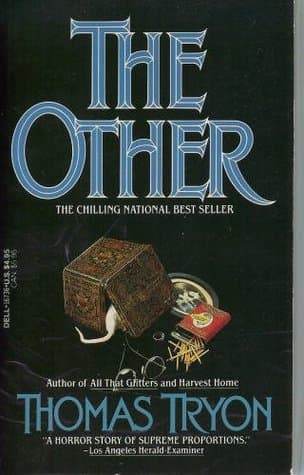
In 1930s Connecticut, the bond between thirteen-year-old twins becomes a terrifying mystery of personality transference that shatters the peaceful country setting.
The story, told by the adult Niles Perry remembering the summer of 1935, starts in the rural Connecticut town of Pequot Landing. Niles and his identical twin brother, Holland, are thirteen years old. They live with their extended family: their mother Alexandra, their grandmother Ada, their Aunt Vee, and their older brother Gardner with his wife Eunice. The twins have a close bond. That summer has a series of unsettling events, starting with the accidental death of their cousin, Russell. Russell falls into a well during hide-and-seek. The details of his death are suspicious, though at first it is called a tragic accident. This incident casts a shadow over the seemingly innocent summer, suggesting a darker side to the twins' lives and their family.
Niles spends much of his time with his Russian grandmother, Ada, who lives in a small cottage on the family property. Ada believes in mystical things. She teaches Niles a 'game' involving projection and empathy, where he imagines himself as another person or object. This game, at first seen as harmless, becomes a way for Niles to explore his own mind and the lives of those around him. At the same time, the story reveals the Perry family's tragic past: the death of the twins' father, Frank, who fell from a ladder, and the suicide of their Uncle George, Frank's brother, who hanged himself. These events suggest a pattern of bad luck, making some villagers view the Perry family with superstition and fear.
The unsettling events increase when Mrs. Rowe, an elderly neighbor and family friend, dies of a heart attack. The details are odd: she was found dead in her home, after being severely scared. It is later revealed she was terrified by someone, or something, wearing a grotesque mask. Holland, known for his mischievous and sometimes cruel pranks, is immediately suspected by Niles, who struggles with his brother's increasingly disturbing behavior. This incident marks a turning point. It is the first death directly linked to a deliberate act of terror, not an 'accident.' This further deepens Niles's worry about Holland's true nature.
A valuable family ring, belonging to Aunt Vee, goes missing. While the family searches, Holland seems strangely uninterested. Later, during a visit to a traveling carnival, Holland disappears, only to reappear with a suspicious, knowing look. Niles notices Holland showing an unusual interest in a sideshow exhibit with a deformed man, and Holland makes a disturbing comment about 'making things happen.' The missing ring eventually appears with Holland, who says he found it. These small, increasing incidents make Niles more uneasy about his twin. He questions Holland's innocence and his ability to do bad things.
The twins' mother, Alexandra, already fragile and quiet since her husband's death, gets a mysterious illness. She becomes weaker and bedridden, needing constant care. During her illness, the family doctor gives her medication. However, one night, she is fatally poisoned. The family is sad, and the doctor is confused by the sudden change. Niles, seeing his mother's suffering and the strange circumstances of her death, starts to connect the events. He suspects Holland's involvement, though he struggles to accept such a horrible possibility about his own brother. This event is a major blow to the family and further isolates the twins.
As the summer goes on, Holland's behavior becomes openly cruel and manipulative. He tortures small animals, shows no regret for his actions, and seems to enjoy others' pain. Niles, despite his close bond with Holland, is increasingly disgusted and scared by his twin's actions. Holland's dark side is no longer just hinted at; it is openly shown through his mean pranks and the cold indifference he shows toward the results. Niles tries to explain Holland's actions, but the evidence of his brother's badness becomes clear, forcing Niles to face the terrifying reality of who Holland is.
A fire starts in the family barn, destroying it. Afterward, Eunice, Gardner's wife, makes a horrifying discovery. She finds the dismembered body of the carnival sideshow performer, the deformed man Holland had been interested in, hidden in the barn's wreckage. This discovery is a shocking revelation, confirming the full extent of Holland's murderous abilities. Eunice, scared by what she has found and connecting it to the other tragedies, becomes a direct threat to Holland's secret. Her knowledge of the truth puts her in danger, setting the stage for a final, desperate act.
Eunice, having learned the truth about Holland's crimes, confronts him. In a terrifying struggle, Holland kills her, pushing her down the stairs. Ada, who has been subtly aware of the darkness around the twins, finally understands the full extent of Holland's psychopathy. She knows Holland is responsible for all the deaths and is a danger to everyone, especially Niles. Realizing how serious the situation is and the threat Holland poses, Ada takes strong action to protect Niles, the only innocent one left, and to make sure Holland can no longer harm anyone. This marks Ada's change from a mystical observer to an active part in the unfolding tragedy.
Ada takes Niles aside and tells him the truth: Holland died at birth. The 'Holland' Niles has known and loved for thirteen years is not real. He is a part of Niles's imagination, a sign of Niles's own dark impulses, projected into an imaginary twin. Ada explains that Niles, unable to cope with the loss and trauma of his brother's death, created Holland. Over the years, Holland has grown into a separate, bad personality, a 'doppelganger' through whom Niles has committed all the bad acts. This revelation breaks Niles's world, forcing him to face the horrifying reality that he is the murderer, not Holland.
After telling the truth, Ada takes Niles to the well where Russell died. She understands that Niles, or rather, the Holland part of Niles, is too dangerous to live, and that Niles cannot survive with Holland continuing to exist. In a heartbreaking and desperate act, Ada gives Niles a choice: to let Holland continue to exist, or to end Holland's bad actions. She encourages Niles to jump into the well, intending for both parts of his personality to die, ending the cycle of violence. Niles, dealing with the horrifying truth and his own involvement, makes a choice that will forever decide his fate and Holland's.
The story ends with the adult Niles, now in a mental asylum, thinking about the events of that summer. He is a broken man, still troubled by the memory of Holland, who, despite Ada's efforts, seems to stay in some form within his mind. The final lines of the book show that Holland is still 'with' Niles, suggesting that combining or getting rid of the bad personality was not completely successful. Niles lives a life of quiet sadness, forever marked by the bad things done by his 'other' self, trapped in a constant psychological struggle. He is a tragic example of a fractured mind.
The Protagonist
Niles's arc is one of tragic self-discovery, moving from innocent confusion to the horrifying realization of his own complicity and mental illness.
The Antagonist/Psychological Manifestation
Holland's 'arc' is one of escalating violence and control, culminating in his psychological 'death' or suppression, though he continues to haunt Niles.
The Supporting/Mentor
Ada's arc moves from a mystical observer to a desperate protector, sacrificing herself to save her grandson.
The Supporting/Victim
Alexandra's arc is one of tragic decline, from a grieving mother to a helpless victim.
The Supporting
Gardner remains largely static, representing the normal world that fails to grasp the supernatural/psychological horror.
The Supporting/Victim
Eunice's arc is one of dawning realization and tragic confrontation, leading to her death.
The Mentioned/Victim
Her brief arc serves to establish Holland's malevolent capabilities.
The Mentioned/Victim
His death serves as the inciting incident for the plot.
The main theme is about Niles Perry's fractured identity and his dark side showing up as 'Holland.' The novel explores how trauma and repression can lead to a complete split in personality, blurring the lines between self and other. Niles struggles to accept his gentle nature with the horrible acts committed by his 'twin.' This makes the reader question identity and the potential for evil in a person. The 'game' Ada teaches Niles, involving projection and empathy, supports this theme, showing how one can take on or project other selves.
“For thirteen years, I had thought I was two people. It turned out I was one.”
The book explores whether evil is natural or comes from circumstances. Holland, as Niles's repressed darkness, represents a pure, unchecked form of badness. His actions are without regret, driven by a wish to cause pain and control. The novel suggests that even in an innocent person like Niles, a capacity for deep evil can exist, especially when fed by trauma and psychological separation. The story challenges the reader to face the common and terrifying depth of human badness, especially when it comes from within.
“Holland had no conscience. He was a pure vessel for mischief, for cruelty, for destruction.”
As told by the adult Niles from an asylum, the novel constantly questions how reliable memory is and how hard it is to find truth. Niles's memories are filtered through his fractured mind, at first showing Holland as a separate being. The slow reveal of Holland's true nature makes all past events need reinterpretation, showing how memory can be changed to protect oneself from unbearable truths. The story's structure itself becomes a plot device, making the reader part of Niles's initial delusion before revealing the horrifying reality of his past.
“How much of what we remember is true, and how much is simply what we want to believe?”
The peaceful summer of 1935 in rural Connecticut sets the scene for a loss of innocence, both for Niles and for the seemingly calm community. The series of 'accidents' and murders breaks the illusion of safety and childhood purity. Niles, once a gentle boy, has to face the monstrous acts committed by his 'other' self, losing his innocence forever. The once-charming rural setting becomes stained by death and psychological horror, reflecting the internal corruption that has grown within the main character.
“That summer, the world changed for me. It became a place where shadows could kill.”
The Perry family has a history of tragedy, including the father's death and the uncle's suicide. This suggests a pattern of bad luck and hidden trauma through generations. These unresolved past events create a good environment for Niles's psychological breakdown and Holland's appearance. The family's inability to openly deal with its grief and underlying tensions adds to the growing horror, as secrets remain and cause more destruction. Ada's knowledge of the past and her attempts to guide Niles highlight the weight of inherited trauma.
“Our family had a way of collecting tragedies, like old photographs in an album.”
The adult Niles's perspective is skewed, hiding the true nature of events until the climax.
The entire story is narrated by the adult Niles Perry, reflecting on the summer of 1935 from the confines of a mental institution. His narration initially presents Holland as a distinct, separate individual, leading the reader to believe in the existence of two twins. This unreliable perspective is crucial to the novel's suspense and the shocking twist, as it slowly reveals the narrator's fractured mind and his gradual coming to terms with the horrifying truth that Holland is a part of him. The reader experiences the events through Niles's distorted lens, making the final revelation all the more impactful.
The psychological manifestation of a malevolent 'other' within the protagonist.
The central conceit of 'The Other' relies heavily on the doppelganger or evil twin trope, though it's given a psychological rather than supernatural twist. Holland initially appears as Niles's identical twin, but is ultimately revealed to be a dissociative identity, the embodiment of Niles's repressed dark impulses and trauma. This device creates immense psychological horror, as the 'evil' is not an external force but an internal one, making escape impossible. It explores the terrifying idea that one's own mind can harbor a malevolent 'other' capable of unspeakable acts.
Subtle clues and unsettling events hint at the darker truth throughout the narrative.
Tryon masterfully uses foreshadowing to build suspense and hint at the novel's dark revelations. From the very first 'accident' of Russell in the well, to Holland's increasingly cruel behavior, to Ada's cryptic warnings and her 'game,' subtle clues are woven into the narrative. The family's history of tragedy (Frank and George's deaths) also serves as a portent of further misfortune. These elements create a pervasive sense of unease and allow the reader, in retrospect, to see how the truth was always subtly present, even if obscured by Niles's narration.
Ada's mystical game of projection, which inadvertently facilitates Niles's dissociation.
Ada teaches Niles a 'game' involving mental projection and empathy, where he imagines himself as other people or objects. This seemingly innocent, mystical practice serves as a crucial plot device. It not only establishes Ada's connection to the supernatural/psychological but also acts as a metaphorical and literal mechanism for Niles's dissociation. The 'game' allows Niles to project his own dark impulses and create the distinct personality of Holland, giving form and agency to his repressed desires. It is the tool that unknowingly helps split his psyche, enabling the horrors to unfold.
The seemingly idyllic New England countryside provides a stark contrast to the internal horror.
The novel's setting in the seemingly peaceful, idyllic rural Connecticut town of Pequot Landing in the 1930s creates a classic Rural Gothic atmosphere. The beauty and tranquility of the countryside, with its old family estate, barn, and well, stands in stark contrast to the psychological horror and escalating violence. This juxtaposition heightens the sense of dread, as the terror emerges from within a seemingly wholesome environment. The isolated nature of the estate also contributes to the family's insularity and the containment of their dark secrets.
“We are all the other, in some way or another.”
— Narrator reflecting on the duality of human nature and identity.
“The past is a ghost that haunts the present.”
— Character discussing how childhood events shape adult life.
“In every family, there are secrets buried like bones.”
— Describing the hidden tensions within the Perry family.
“Sometimes the dead are more alive than the living.”
— Narrator musing on the lingering presence of deceased characters.
“Fear is a mirror that shows us what we truly are.”
— During a tense moment of psychological revelation.
“The line between reality and nightmare is thinner than we think.”
— As the supernatural elements blur with everyday life.
“A twin is both a reflection and a shadow.”
— Exploring the complex relationship between Niles and Holland Perry.
“Grief is a house with many rooms, and some are locked forever.”
— Character coping with loss after a tragic accident.
“What we remember is often just what we choose to forget.”
— Narrator questioning the reliability of memory.
“In the stillness of the summer, evil grows like a weed.”
— Setting the ominous tone in the small town of Pequot Landing.
“To love someone is to risk becoming them.”
— Reflecting on the absorbing bond between the twins.
“The truth is a knife that cuts both ways.”
— As hidden realities come to light with violent consequences.
“Childhood is a country we can never return to, but never truly leave.”
— Narrator on the lasting impact of early experiences.
“Some doors are better left unopened.”
— Warning about delving too deep into family mysteries.
Ready to see how well you understood this book? Take our interactive quiz with 10 questions.
Biography coming soon.







