“With a kind of tense delight they watch the race, but it is not important. The pleasure is not simple, but profound.”
— Describing the festival of summer in Omelas.

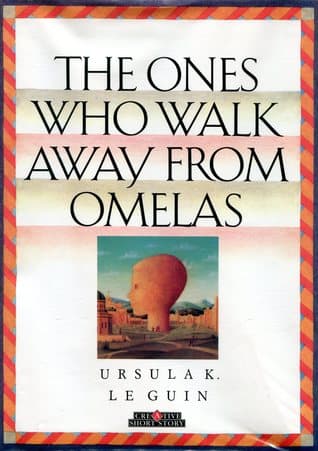
Ursula K. Le Guin (1973)
Genre
Fantasy / Science Fiction / Philosophy
Reading Time
15 min
Key Themes
See below
Sign in to track this book
In the utopian city of Omelas, perpetual joy is bought by the perpetual suffering of one child, forcing its citizens to choose between complicity and a solitary walk into the unknown.
The story opens with a description of the Festival of Summer in Omelas, a city of joy and prosperity. Music, laughter, and children playing fill the air. The narrator details the city's beauty: bright banners, spirited horse races, and an atmosphere of happiness. Citizens, in bright clothing, move with ease, their faces showing contentment. There is no guilt, no shame, and no need for police or soldiers, as the people are good and live in harmony. The narrator invites the reader to imagine this perfect city, even suggesting adding details like orgies or drugs, only to dismiss them as unnecessary, emphasizing Omelas's pure bliss.
The narrator explains that Omelas is an advanced society, yet one that has rejected many common societal constructs. There are no kings, soldiers, stock exchange, advertising, or atom bombs. Religion, in the traditional sense, is absent; there are no gods, priests, or temples for formal worship, only a reverence for life and a shared understanding of their collective well-being. The people of Omelas are intelligent, passionate, and live full, complex lives. They have managed to shed the ugliness and suffering that often come with human progress. Their happiness is not simple-minded but deep, born from an appreciation for their collective existence.
The narrator then introduces the truth that underpins Omelas's perfect existence: a single, wretched child is kept in a small, windowless room beneath the city. This child is malnourished, neglected, and miserable, living in its own filth and fear. Its suffering is absolute and constant, without hope of relief. The citizens of Omelas know about this child, and their happiness depends directly on its torment. If the child were ever brought into the light, cleaned, comforted, or shown any kindness, Omelas's prosperity, beauty, and joy would vanish. This is the terrible bargain they have made.
Every citizen of Omelas, upon reaching an age of understanding (typically between eight and twelve years old), is brought to see the suffering child. They witness its misery, its emaciated body, and its vacant eyes. This experience disturbs and often traumatizes the young Omelians. They cry, feel disgust, anger, and a deep sense of injustice. They struggle to reconcile this horror with the beautiful world they inhabit. The narrator states that this is not a hidden secret, but a known, accepted fact, central to their society. The children understand the direct link between the child's suffering and their collective happiness.
After their initial shock, the young people of Omelas begin to deal with the ethical problem. They are told and come to understand that there is no other way for their city to exist in such perfect happiness. To relieve the child would be to destroy everything they value. They must confront the reality that some evils are necessary for the greater good, a utilitarian calculation. This understanding, though painful, becomes a cornerstone of their moral framework. They learn to live with the knowledge, accepting that the child's suffering, however horrific, is the price they pay for their collective bliss, and that their own joy is a burden of responsibility.
The vast majority of Omelians, after seeing the child and processing the implications, choose to remain in Omelas. They learn to live with the knowledge, perhaps building their own happiness on that grim sacrifice. They understand that their happiness is not naive, but a conscious choice made with full awareness of its cost. This shared knowledge of the child's plight binds them together in a unique, if morally ambiguous, way. Their maturity and moral depth grow from confronting this injustice, as it forces them to appreciate their joy and freedom with a deeper understanding of its origins.
Despite the justifications and societal acceptance, some individuals cannot bear the weight of the child's suffering. These are the 'ones who walk away from Omelas.' After seeing the child and understanding the terms of their happiness, they quietly, often alone, leave the city. They walk out through the city gates, past the beautiful buildings and joyous crowds, and head towards the mountains, or across the fields, into the unknown. They do not know where they are going, and the narrator states that they never return. Their destination is a mystery, a silent rejection of the city's cruelty, choosing an uncertain, perhaps harsher, future over complicity in such an injustice.
The narrator describes the departure of these individuals as a solitary act. They walk alone, without companions or farewells, their faces set towards the desolate hills or the dark, glimmering sea. Their path is unmarked, and there is no guarantee of finding another city, another utopia, or even survival. They are walking away from everything they have ever known, from comfort, beauty, and guaranteed happiness, driven solely by a moral compass that cannot tolerate the city's secret. Their act is one of moral conviction, a refusal to participate in a system built on suffering, even if it means an unknown and potentially dangerous future.
The narrative states that the destination of those who walk away is unknown. They are not going to a specific place; they are simply walking away from Omelas. The narrator offers no details about what they might find or what becomes of them. This ambiguity highlights the moral choice they have made: to abandon a perfect, known reality for an uncertain one, driven by an unshakeable refusal to compromise their ethical integrity. Their journey symbolizes moral autonomy and the rejection of a utilitarian calculation that sacrifices one for the many, leaving the reader to ponder the true nature of happiness and the price of utopia.
The Omniscient Storyteller
The narrator's 'arc' is not personal but rather in their evolving revelation to the reader, moving from idyllic description to stark moral challenge.
The Sacrificial Figure
The child has no arc; its unchanging suffering is central to the story's thematic core.
The Collective Protagonist/Antagonist
They experience an internal arc of moral reckoning, moving from innocent joy to a conscious, complicated acceptance of their society's ethical foundation.
The Moral Agents
Their arc is defined by their ultimate moral decision to leave, transforming from beneficiaries of Omelas into silent dissenters.
The Innocent Beneficiaries
Their arc is from unadulterated joy to the cusp of a profound moral awakening and loss of innocence.
This theme explores the moral implications of sacrificing an individual for the greater good. Omelas's perfect happiness depends on the misery of one child. This forces readers to confront the ethical problem of utilitarianism: is it ever right to inflict extreme suffering on one being if it ensures the well-being of thousands? The story challenges the definition of a 'good' or 'utopian' society, suggesting that true happiness cannot be built on such a foundation, or that if it is, it comes with a moral cost that some cannot pay. The citizens' struggle to rationalize this bargain is central.
“They were not simple folk, you see, though they were happy. But we do not say the child has no place among us, for it has a place. And it is not for us to say what it is, or what it is not.”
This theme looks at how individuals and societies choose to live with moral compromises. The citizens of Omelas know about the child's suffering and its role in their happiness. Their choice to stay means they are complicit in the injustice, rationalizing it as a necessary evil. The story examines the psychological and ethical toll of such complicity, and how people can adapt to, or integrate, horrific truths into their daily lives. It questions whether true innocence or goodness can exist when one's bliss depends on another's torment, and highlights the moral burden carried by those who choose to remain.
“Theirs is not a simple-minded happiness. They know very well that they, like the child, are not free. They are free to choose, but not free of the choice.”
The story contrasts the collective good of Omelas with the individual moral conscience of 'the ones who walk away.' While the majority accepts the utilitarian bargain for society's harmony and prosperity, a few individuals cannot ignore their inner ethical compass. These individuals prioritize their personal integrity and moral purity over the comforts and joys of the collective. Their departure symbolizes a refusal to participate in a system they find unjust, highlighting the power of individual moral conviction and the difficulty of maintaining it against overwhelming societal pressure.
“They know they will not come to a place without suffering. They know they will not find a place where all are innocent. But they have made their choice.”
Le Guin challenges common ideas of utopia by showing a society that looks perfect but is built on a horrific secret. The story asks if a true utopia can exist if it requires such a dark foundation. It suggests that perhaps all forms of societal perfection come with a hidden cost, or that the concept of a perfect society is flawed if it cannot ensure universal well-being. By making the reader question Omelas's 'goodness,' the story explores the truth that idealized societies often demand sacrifices that might be morally unacceptable.
“The trouble is that we have a bad habit, encouraged by pedants and sophisticates, of considering happiness as something rather stupid. Only pain is intellectual, only evil interesting.”
The narrator directly engages the reader, inviting participation and challenging assumptions.
The narrator frequently uses 'you' and 'we,' drawing the reader into the story and making them an active participant in imagining Omelas. This device is crucial for building the initial idyllic vision, as the narrator encourages the reader to add details to make Omelas 'more believable.' More importantly, it forces the reader to directly confront the moral dilemma, making them feel implicated in the choice presented by the city's secret. By asking 'Do you believe it?', the narrator challenges the reader's capacity for belief and their ethical judgment.
A single innocent being whose suffering is necessary for the well-being of the collective.
The suffering child serves as a classic scapegoat figure. Its perpetual misery is the explicit condition for the happiness, prosperity, and peace of Omelas. This device highlights the moral abhorrence of sacrificing an innocent for the greater good, forcing a direct confrontation with utilitarian ethics. The child's lack of name, gender, or specific identity makes it a universal symbol of pure, undeserved suffering, amplifying the ethical weight of its sacrifice and making its plight more abstract yet universally poignant.
The fate and destination of 'the ones who walk away' are left unknown.
The story ends without revealing where 'the ones who walk away' go or what becomes of them. This ambiguity is a powerful device. It emphasizes that their act is one of pure moral conviction, not a pursuit of a different, pre-defined utopia. The lack of a clear destination underscores the difficulty and loneliness of choosing an uncompromising ethical path. It leaves the reader to ponder the implications of their choice and whether a truly ethical society is even possible, or if walking away is simply a rejection without an alternative solution.
A seemingly perfect society used to highlight fundamental ethical flaws.
Omelas is initially presented as an ideal, joyful, and peaceful city, a quintessential utopia. This idyllic setting serves as a stark contrast to the horrific secret at its core. By creating such a beautiful and desirable world, the story maximizes the moral shock when the truth is revealed. The utopian setting is not merely a backdrop but a central element that allows Le Guin to explore the inherent contradictions and potential moral compromises that might underpin any 'perfect' society, forcing the reader to question the very possibility and definition of utopia.
“With a kind of tense delight they watch the race, but it is not important. The pleasure is not simple, but profound.”
— Describing the festival of summer in Omelas.
“They were not naive and happy children—though their children were, in fact, happy and naive. But their children did not make their parents' happiness.”
— Explaining that the happiness of Omelas is not childish.
“They know that if the wretched one were brought up into the sunlight out of that dreadful place, if it were cleaned and fed and comforted, that would be a good thing, indeed; but if it were done, in that day and hour all the prosperity and beauty and delight of Omelas would wither and be destroyed.”
— Describing the knowledge of the suffering child.
“The terms are strictly inalterable.”
— Referring to the conditions for Omelas's prosperity.
“The door is always unlocked; it is always possible to go out into the darkness.”
— Describing the option for those who cannot accept Omelas's terms.
“They leave Omelas, they walk ahead into the darkness, and they do not come back.”
— Describing the act of walking away.
“One thing I know there is none of in Omelas is guilt.”
— The narrator discussing the nature of Omelas's joy.
“Perhaps it was for this reason that they did not use the machine, which is, after all, the great symbol of the modern world.”
— Explaining why Omelas has no machines, despite its advanced state.
“But we do not say the child is happy. No, only that it is not in pain, or that it is not in the worst of pain.”
— A description of the child's minimal existence, before its true suffering is revealed.
“They know that they, like the child, are not free.”
— Realization of the citizens of Omelas about their own freedom.
“The people of Omelas are not simple folk, you see, though they are happy.”
— The narrator emphasizing the complexity of Omelas's citizens.
“They know that they owe their happiness to the child's abject misery.”
— The fundamental truth understood by every citizen of Omelas.
“It is a beautiful city, a joyous city, and its people are good people. But they are not innocent.”
— The narrator's summary of Omelas and its inhabitants.
“The place they go towards is a place even less imaginable to most of us than the city of happiness.”
— The narrator speculating on the destination of those who walk away.
Ready to see how well you understood this book? Take our interactive quiz with 10 questions.

Ursula Kroeber Le Guin was an American author best known for her works of speculative fiction, including science fiction works set in her Hainish universe, and the Earthsea fantasy series. She was first published in 1959, and her literary career spanned nearly sixty years, producing more than twenty novels and over a hundred short stories, in addition to poetry, literary criticism, translations, and children's books. Frequently described as an author of science fiction, Le Guin has also been called a "major voice in American Letters". Le Guin said she would prefer to be known as an "American novelist".







