“All you can do is all you can do. And sometimes, all you can do isn't enough. But it's still all you can do.”
— Essun's internal monologue about the limits of her power and effort.

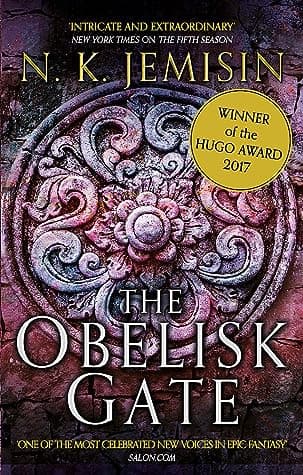
N.K. Jemisin (2018)
Genre
Fantasy / Science Fiction
Reading Time
540 min
Key Themes
See below
Sign in to track this book
As a world-ending season approaches, a mother with immense power must master ancient magic under a mad savior's guidance to either save or destroy a dying civilization, all while searching for her lost daughter.
After Tirimo's destruction, Essun, carrying Hoa's petrified body, arrives at Castrima, a hidden underground geode city. Ykka, the city's leader and a powerful orogene, welcomes her. Castrima is a sanctuary where orogenes live openly, free from fear or servitude, and learn to use their powers. Essun is wary at first, having been betrayed before, but the immediate acceptance and the sight of children learning orogeny freely begin to change her mind. She learns that Castrima runs on a large orogenic engine, sustained by its inhabitants, and is a key stronghold against the worsening Season.
Essun is surprised to find Alabaster Tenring, her former lover and the 'world-crusher,' alive in a hidden chamber in Castrima. He is very ill, his body turning to stone from the power he uses, but his mind is clear. Alabaster reveals the obelisks' true nature: they are pieces of a shattered moon, full of immense power. He is trying to reassemble them to create a 'gate' to restore Earth's orbit. He explains that the moon was broken thousands of years ago to save humanity from a greater threat, and the Seasons are a direct result of its absence. He plans to teach Essun how to use the Obelisk Gate.
Hoa, whom Essun thought was a petrified man, reveals himself to be a Stone Eater, an ancient, sentient being made of rock. He explains that Stone Eaters protect the Earth, created by the ancient 'Guardians' to protect humanity and the planet. He reveals he has watched Essun for a long time, guiding her indirectly, and returned to her as a 'petrified' form to be near her. Hoa's revelation is a major moment, as Essun gains a powerful, if mysterious, ally and starts to understand her world's deeper history and the forces at play.
Meanwhile, Essun's daughter, Nassun, travels with Schaffa, her former Guardian, who rescued her after Jija killed Uche. Schaffa, though badly hurt and dying, cares deeply for Nassun and believes she is essential to the world's survival. During their journey, Nassun's orogenic powers awaken with terrifying strength, far beyond Essun's. She discovers she can 'tune' into the obelisks and draw power directly from them, a skill even Alabaster struggles with. Schaffa guides her, helping her control her dangerous abilities, and teaches her about the world and orogenes' role, though from a Guardian's viewpoint.
Under Alabaster's increasingly urgent guidance, Essun begins her training to use the Obelisk Gate. Alabaster teaches her about the 'silver thread' – the invisible network connecting all obelisks – and how to access its power. This training is hard and dangerous, as Essun must learn to sense and manipulate the obelisks' immense energies without destroying herself or others. Alabaster stresses the need for 'tuning' and 'alignment,' concepts beyond mere brute force orogeny. He pushes her to understand the gate's deeper purpose and the sacrifices needed to achieve their goal.
As Essun trains, she starts to understand that orogeny and using the Obelisk Gate are not just about raw power, but about a deep connection to the Earth and its energies. Alabaster reveals that the obelisks' 'magic' is linked to the Earth's spirit, a sentient entity. Essun learns to listen, to feel the planet's vibrations and intentions, rather than just forcing her will on it. This deeper understanding changes how she sees her abilities and the world, moving her away from the destructive ways of her past training as a sessapinae.
Nassun's power continues to grow, allowing her to 'tune' obelisks with an ease that amazes Schaffa. She can feel their song, their purpose, and manipulate them with a precision Essun and Alabaster struggle to achieve. However, Nassun also starts to question Schaffa's true intentions and the Guardians' nature. She senses a hidden agenda, a deeper, more manipulative purpose behind their actions. Her bond with Schaffa is strong, but her natural distrust of authority, from her traumatic past, makes her wary of his ultimate goals, especially when he speaks of 'saving humanity' in a way that feels conditional.
Through their journey and Schaffa's fragmented memories, Nassun learns more about the Guardians' ancient history. She learns they are not just overseers of orogenes, but were created by the original civilization to manage the consequences of the moon's destruction. Their purpose was to stop humanity from destroying itself and the planet without the moon's stabilizing influence. This revelation complicates Nassun's view of them; they are both oppressors and protectors, their methods harsh but born from an ancient, desperate need. Schaffa's own internal conflict shows this duality.
Castrima is attacked by the Sanctorate, who have found its location. The battle is brutal, with the Sanctorate using advanced weapons and their own sessapinae. Essun must use her training with Alabaster, using the silver thread to defend the city. She manipulates the Earth's crust, creating barriers and causing small quakes, but the strain is immense. The attack shows Castrima's weakness despite its defenses and the growing desperation of the outside world. Essun's connection to the Obelisk Gate becomes a critical, yet draining, weapon.
As his body quickly turns to stone and he nears death, Alabaster makes a final, great sacrifice. He uses his last immense power to fully connect Essun to the Obelisk Gate, completing her 'tuning' and ensuring she can use its full potential. This act is both a transfer of power and a passing of responsibility. Alabaster dies peacefully, having trained his successor and set the stage for the moon's return. His death is a deep loss for Essun, but also a trigger, strengthening her resolve to finish their shared task.
With Alabaster's sacrifice, Essun fully realizes her potential. She understands she is not just using the Obelisk Gate, but that she *is* the Gate – a conduit for the Earth's power, connected to every obelisk across the Stillness. She can feel the entire network, the planet's pulse, and the whisper of the moon's shattered pieces. This change is both empowering and terrifying, as she now has the immense responsibility of bringing the moon back. She is no longer just an orogene, but something more, something ancient and powerful, embodying the very forces she seeks to control.
Nassun, having learned the truth about the Guardians and the moon, makes a firm choice. She rejects the Guardians' long-standing plan of control, believing their methods have only caused suffering. Instead, she seeks her own way to end the Seasons, one that might involve destroying the source of the world's pain, even if it means destroying the world itself. Her immense, intuitive power and deep empathy for orogenes' suffering drive her towards a radical solution, setting her on a path that will collide with Essun's mission to restore the moon.
The novel ends with Essun and Nassun, mother and daughter, now immensely powerful orogenes, on very different paths. Essun, now the living Obelisk Gate, is committed to Alabaster's plan of restoring the moon and ending the Seasons by re-establishing the planet's orbit. Nassun, however, guided by her own pain and a different view of the world's problems, seeks to use her power to permanently cut off humanity from the Earth's pain, possibly by destroying the planet's ability to suffer altogether. Their separate journeys, driven by love and loss, are set to clash in the final book.
The Protagonist
From a grieving, vengeful mother, Essun transforms into the living Obelisk Gate, embracing her immense power and the responsibility to restore the moon.
The Secondary Protagonist
Nassun evolves from a traumatized child into a powerful, independent orogene who develops her own unique vision for saving the world, diverging from her mother's path.
The Supporting Character / Mentor
Alabaster, having set the stage for change, dedicates his last days to training Essun, making the ultimate sacrifice to ensure their mission continues.
The Supporting Character / Mystical Guide
Hoa reveals his true nature and deep connection to Essun, shifting from a passive companion to an active, albeit subtle, guide.
The Supporting Character / Antagonist (ambiguous)
Schaffa struggles with his identity and purpose, torn between his love for Nassun and his ancient programming, ultimately revealing the deeper, tragic history of the Guardians.
The Supporting Character
Ykka maintains her role as a steadfast leader, providing stability and hope for the orogene community in Castrima amidst global chaos.
The Supporting Character
Innon grows in his understanding of Alabaster's sacrifice and the larger mission, becoming a quiet but crucial helper.
The Mentioned / Antagonist / Elemental Force
The Earth's suffering and agency are further revealed, positioning it as the ultimate force to be appeased or controlled.
The novel explores the various forms of power – personal, political, elemental – and the dangers of trying to control it. Orogenes have great power over the Earth, yet society controls and oppresses them. The Guardians try to control orogenes, and the Sanctorate tries to control the world. Alabaster and Essun aim to control the Obelisk Gate to restore the moon, while Nassun seeks to control her own power to end suffering. The story asks if true power lies in domination or in understanding and working with natural forces, as seen in Essun's 'tuning' with the silver thread compared to brute force orogeny.
“You don't just use the Obelisk Gate, child. You become it.”
The mother-daughter bond is central, driving both Essun and Nassun's actions. Essun's search for Nassun fuels her survival and her willingness to learn from Alabaster. Nassun's trauma from her family's destruction and her desire for security shape her own powerful journey. Both mothers (Essun, and implicitly the Guardians who act as parental figures) make sacrifices for their children, but also cause pain, showing the complex, often contradictory nature of parental love. Alabaster's sacrifice for Essun also reflects this theme, as he gives his life to empower his 'successor' to complete their shared mission.
“There are some things that are worse than death. Betrayal is one of them. Abandonment is another.”
Both Essun and Nassun carry deep, unhealed trauma from their pasts – Essun from losing her children and husband, and Nassun from her father's violence and her mother's perceived abandonment. The novel explores how trauma shapes their identities, relationships, and how they try to save the world. Castrima offers Essun a place for healing and acceptance, while Nassun's journey with Schaffa forces her to face her pain and turn it into immense power. The book suggests that true healing might not mean forgetting, but integrating pain into a new understanding of self and purpose.
“You can't fix what you don't acknowledge. And you can't heal what you don't feel.”
The Stillness is a world always on the edge of extinction, and characters must make impossible choices to survive. Castrima, a refuge for orogenes, shows the will to survive, but it is always threatened. The Guardians' ancient decision to break the moon, while saving humanity, led to thousands of years of suffering. Essun and Alabaster's plan to restore the moon requires great sacrifice, and Nassun's alternative path also comes with a huge cost. The novel constantly questions what 'survival' means and if any price is too high to pay for it.
“This is the way the world ends... for the last time.”
The main conflict of the series is rooted in the relationship between humanity and the Earth. The revelation of Father Earth as a sentient, suffering entity changes 'natural disasters' into acts of a conscious, vengeful planet. Orogeny is not just magic, but a direct link to this planetary consciousness. The novel criticizes humanity's exploitation and disregard for its environment, showing the Seasons as the Earth's furious reaction. The protagonists' ultimate goal is to restore balance, highlighting themes of ecological responsibility and the deep connection of all life with the planet.
“The Earth is not a silent, unthinking thing. It feels. It remembers. And it is angry.”
A network of floating obelisks that can be wielded by powerful orogenes.
The Obelisk Gate is the central plot device, revealed to be a system of ancient, powerful obelisks that are fragments of the shattered moon. These obelisks are connected by an invisible 'silver thread' and can be 'tuned' by exceptionally powerful orogenes like Alabaster, Essun, and Nassun. They serve as conduits for immense geostrophic energy, capable of controlling geological events on a massive scale. The ultimate goal is to reassemble them into a 'gate' to restore the moon's orbit, thus ending the Seasons. The Gate represents both a weapon of immense destruction and the potential for salvation.
The name of the continent and the world, perpetually ravaged by 'Seasons' of geological catastrophe.
The Stillness is not merely a setting but a plot device that drives the entire narrative. Its constant geological instability, known as 'Seasons,' creates an urgent, existential threat that forces humanity to adapt, evolve, and make desperate choices. The Seasons are revealed to be a direct consequence of the moon's absence, making the restoration of the moon the ultimate solution to the world's plight. The harsh environment and constant danger shape the characters' resilience, resourcefulness, and their understanding of the planet's sentience.
Ancient, sentient beings made of rock who observe and occasionally intervene.
Stone Eaters are mysterious, ancient beings composed of rock and mineral, capable of moving through the earth and manipulating geological forces. They are revealed to be guardians of the Earth, created by an ancient civilization, and possess vast knowledge of the world's history and the Obelisk Gate. Hoa is the primary Stone Eater, acting as a silent observer and occasional guide for Essun. Their enigmatic nature and hidden agendas contribute to the story's sense of ancient mystery and the deeper forces at play, often providing crucial information or subtle assistance at pivotal moments.
An ancient order tasked with controlling orogenes and maintaining societal order.
The Guardians are an ancient, powerful order responsible for 'managing' orogenes, often through brutal training and servitude. They are revealed to be an ancient construct, created by the civilization that broke the moon, to prevent humanity from destroying itself in the absence of the moon's stabilizing influence. Schaffa is the primary Guardian character. While seemingly antagonists, their true purpose is complex and rooted in a desperate attempt to preserve humanity, albeit through morally ambiguous and oppressive means. Their existence highlights themes of control, historical burden, and the ethical dilemmas of power.
“All you can do is all you can do. And sometimes, all you can do isn't enough. But it's still all you can do.”
— Essun's internal monologue about the limits of her power and effort.
“This is what you must remember: the ending of one thing is the beginning of another. You have been broken, but you are not unmade.”
— Schaffa speaking to Essun, offering a perspective on loss and change.
“Power is not a thing to be hoarded. It is a thing to be used. And sometimes, to be given away.”
— A lesson about the nature of power, often reflected in the magic system.
“The world is not a safe place for anyone, but it is especially unsafe for those who are different.”
— A reflection on the prejudice faced by orogenes and other 'different' individuals.
“Sometimes, the only way to save something is to break it first.”
— A recurring theme, particularly in how characters deal with the world and its systems.
“There are no monsters, only people. And sometimes, people do monstrous things.”
— Essun's realization about the true nature of evil and antagonists.
“Survival is not enough. Not when you have something to fight for.”
— A character's motivation to move beyond mere existence and strive for more.
“The past is a wound that never truly heals. But it can be stitched up, and learned from.”
— Reflections on historical trauma and its impact on the present.
“Love is a dangerous thing. It makes you weak, and it makes you strong.”
— Essun's complex relationship with her loved ones and the risks involved.
“You cannot fight a force of nature. You can only learn to redirect it.”
— A metaphor for dealing with immense, uncontrollable powers, both magical and societal.
“Hope is a choice, not a given. And sometimes, it's the hardest choice to make.”
— Characters grappling with despair and the decision to continue fighting.
“The greatest prison is the one you build for yourself, out of fear and regret.”
— A critique of self-imposed limitations and emotional burdens.
“Every act of creation is first an act of destruction.”
— A fundamental principle of the world's magic and geology, mirroring real-world processes.
“Sometimes, the greatest strength lies in admitting you need help.”
— Essun's journey often involves learning to rely on others despite her independence.
Ready to see how well you understood this book? Take our interactive quiz with 10 questions.

Biography coming soon.







