“The wind howled a mournful song around the old house, a prelude to the terrors within.”
— Describing the atmosphere of the house at the beginning of the story.

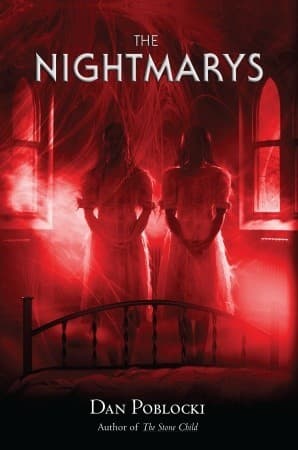
Dan Poblocki (2010)
Genre
Thriller / Fantasy / Children's / Mystery / Young Adult
Reading Time
360 min
Key Themes
See below
Sign in to track this book
His brother's decaying face haunts his waking hours, and his best friend succumbs to monstrous visions. Timothy must uncover the new girl Abigail's dark secret before his nightmares become real.
The Protagonist
Timothy transforms from a fearful and reactive boy into a brave individual who actively fights against the nightmares, learning to trust himself and others.
The Supporting/Anti-hero
Abigail moves from being a harbinger of fear to a reluctant hero, actively working to suppress her powers and protect others, ultimately making a sacrifice.
The Supporting
Stuart devolves from a normal boy into a victim consumed by fear and nightmares, eventually recovering but bearing the scars of his ordeal.
The Supporting/Mentioned
Jake remains largely static in a coma, but his recovery symbolizes hope and the potential for healing after the supernatural conflict.
The Supporting
Ms. Periwinkle's character arc is minimal, primarily serving to confirm the reality of the supernatural events to Timothy.
The Antagonist
The collective Nightmarys remain a destructive force, only contained or defeated through the intervention of Abigail and Timothy.
The novel shows how fear, both personal and shared, can become real and destructive. Timothy's worry about his brother's coma, Stuart's hidden insecurities, and the town's general unease all add to the Nightmarys' power. The book demonstrates how fear can corrupt people, as seen in Stuart's change, and how it can be used to create a terrifying reality. The characters must confront their fears directly, rather than letting them build up, to defeat the supernatural threat.
““Nightmares feed on fear. They grow stronger when you’re afraid.””
The line between dreams and reality blurs throughout the story. Timothy's nightmares begin to enter his waking life, making it hard for him to tell what is real. This theme highlights how perception is subjective and how mental states can greatly affect one's experience of the world. The appearances of Jake, the specimen jars, and Stuart's monsters challenge Timothy's understanding of what is possible, forcing him to accept a reality stranger than he imagined.
““You can’t always tell the difference between what’s real and what’s not, especially when you’re scared.””
Despite the terrifying events, friendship and loyalty are central to the story. Timothy's constant concern for Stuart, even when his friend becomes aggressive and scary, drives much of his actions. His willingness to trust and help Abigail, despite her frightening nature and the danger she brings, forms the main alliance against the Nightmarys. These relationships provide strength and motivation against overwhelming fear, suggesting that human connection protects against dark forces.
““I couldn’t leave him. He was my best friend, no matter what was happening to him.””
The book touches on the impact of trauma, both personal and shared. Jake's war injury and coma are significant personal trauma for Timothy and his family, which feeds the nightmare cycle. Abigail herself results from shared trauma and fear, showing how unresolved pain can appear destructively. The story suggests that facing and understanding the source of trauma, rather than hiding it, is necessary for healing, both for individuals like Timothy and for beings like Abigail.
““Some fears are so old, so deep, they create something else entirely.””
Nightmares become tangible realities, blurring the line between dream and wakefulness.
This device is central to the plot. Timothy's personal fears, such as his brother's decaying image or Stuart's monstrous transformation, are not confined to his sleep but appear in the real world. This creates a constant sense of dread and confusion, making it difficult for Timothy to trust his own senses. It serves to externalize internal psychological states, giving the abstract concept of fear a horrifying physical presence and driving the conflict forward.
Timothy's perception of reality is constantly challenged, making him question what is real.
While Timothy is the protagonist, his experiences are so bizarre and terrifying that he himself doubts their veracity. The reader experiences the events through his confused and fearful perspective, which enhances the mystery and suspense. This device is particularly effective in the early stages of the story, making the audience wonder if Timothy is hallucinating or if a supernatural threat is truly at play, mirroring Timothy's own internal struggle.
Abigail's arrival precipitates and explains the supernatural events.
Abigail serves as the primary catalyst for both the escalating horror and the eventual understanding of the threat. Her presence seems to amplify the nightmares, but she also holds the key to explaining their origin and offering a potential solution. Without her, Timothy would be lost in a world of inexplicable terror. She acts as both a source of danger and a guide, propelling Timothy into the supernatural conflict and providing the necessary exposition for the reader.
A mythical object sought to contain Abigail's powers and stop the nightmares.
The dreamcatcher acts as a classic MacGuffin, providing a clear objective for Timothy and Abigail's quest. Its existence gives them a tangible goal in a world of abstract fear. While its specific properties are crucial to the plot, its primary function is to drive the characters' journey, giving them purpose and direction as they navigate the dangerous landscape of manifesting nightmares. Its eventual use provides a resolution to the immediate threat.
“The wind howled a mournful song around the old house, a prelude to the terrors within.”
— Describing the atmosphere of the house at the beginning of the story.
“Nightmares aren't just bad dreams; they're echoes from another place, trying to break through.”
— A character explaining the nature of the Nightmarys to the protagonist.
“Fear has a smell, a metallic tang that fills your mouth even before you know why you're afraid.”
— The protagonist's sensory experience of growing fear.
“Sometimes the things you try hardest to forget are the very things that come back to haunt you.”
— A reflection on repressed memories and their consequences.
“The shadows in this house weren't just the absence of light; they were alive, watching.”
— The protagonist's growing sense of being observed by unseen forces.
“A dream is a fragile thing, easily shattered, but a nightmare leaves scars.”
— Contrasting the fleeting nature of good dreams with the lasting impact of nightmares.
“The truth isn't always comforting. Sometimes it's a monster in itself.”
— A character's realization about the dark revelations unfolding.
“You can't outrun what's already inside your head.”
— A character struggling with internal fears and past trauma.
“The house breathed around them, a slow, creaking inhale and exhale of ancient wood and forgotten secrets.”
— Personifying the old house as a living entity.
“Not all monsters hide under the bed. Some wear familiar faces.”
— A chilling discovery about the true nature of a perceived ally or loved one.
“Hope is a dangerous thing in a place like this. It makes the fall so much harder.”
— A character's cynical view on maintaining optimism in a dire situation.
“The line between reality and nightmare was blurring, smudged by exhaustion and terror.”
— The protagonist's deteriorating mental state.
“Sometimes, the only way to defeat a monster is to understand what it truly fears.”
— A strategic insight into overcoming the antagonist.
“The past isn't just history; it's a living thing, waiting to grab you if you let it.”
— A warning about the enduring power of past events and their influence.
Ready to see how well you understood this book? Take our interactive quiz with 10 questions.







