“He knew, with a certainty that chilled him to the bone, that he was being watched.”
— Joona Linna's initial feeling of unease as he delves into the case.

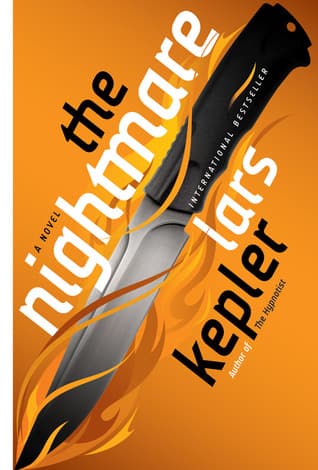
Lars Kepler (2012)
Genre
Thriller / Mystery
Reading Time
528 min
Key Themes
See below
Sign in to track this book
A drowned woman with dry clothes and a a man hanged in an empty room pull Detective Inspector Joona Linna into a Stockholm mystery where impossible deaths are just the beginning.
The novel begins with the discovery of a young woman, Amanda, drowned on an abandoned pleasure boat in the Stockholm archipelago. Her clothes are dry. The next day, in a separate incident, Björn Eklund is found dead, hanging from a lamp hook in his bare apartment in Stockholm. There is no furniture or object he could have used to climb. Detective Inspector Joona Linna of the National Criminal Police investigates both cases. He immediately senses a disturbing connection between the two deaths, despite initial reports. The strange circumstances of each death suggest a calculated pattern that defies explanation, leading Joona to uncover a deeper, more sinister truth.
Joona Linna discovers that Björn Eklund had a younger sister, Penelope, who witnessed a traumatic event linked to her brother's death but is now catatonic. Joona realizes conventional interrogation will not work. He decides to find Erik Maria Bark, the famous hypnotist whose career ended years ago after a patient's hypnosis session led to a murder and cover-up. Despite Erik's reluctance and the professional risks, Joona persuades him to hypnotize Penelope. He hopes to retrieve crucial memories that could link the two victims and identify the killer. This decision brings Erik back to the world he tried to escape.
Under Erik Maria Bark's hypnosis, Penelope Eklund's suppressed memories emerge. She describes 'The Sandman,' a figure who has haunted her family for years, responsible for her older sister Felicia's disappearance. Penelope recounts a terrifying childhood where she and her siblings suffered psychological manipulation and abuse by a cult-like figure who preyed on children, creating fear and obedience. The hypnosis session is harrowing. It reveals not just the events around Björn's death but a deeper history of a family terrorized by a shadowy group. This suggests the current deaths are not isolated but part of a long, horrific story. The Sandman is a real and dangerous entity.
As Erik Maria Bark becomes more involved in the case, the danger increases. His son, Josef, is abducted from their home. This is a clear message from 'The Sandman' to stop interfering. This personal attack forces Erik to face his past and the possibility that his previous, failed hypnosis session, which led to a child's death and another's framing, might connect to this nightmare. Josef's abduction turns Erik from a consultant into a desperate father, directly involved in Joona Linna's investigation. He is now driven to save his son, even if it means revisiting the darkest parts of his life and confronting The Sandman's threat.
Joona Linna and Erik Maria Bark investigate the history of the Eklund family and The Sandman. They uncover a connection to a remote, state-run orphanage. They discover that The Sandman is not supernatural but a highly intelligent, manipulative person who, years ago, conducted horrific psychological experiments on children at the orphanage, including Felicia Eklund, the missing sister, and others. These experiments involved sensory deprivation, manipulation, and trauma to break the children's wills and turn them into obedient, silent agents. This reveals that the current deaths link to a long pattern of abuse and control, showing The Sandman's meticulous, long-term plan for revenge and manipulation, with the Eklund family at its center.
As the investigation continues, it becomes clear that Felicia Eklund, the long-missing sister, is not a victim in the usual sense. She has become deeply involved with The Sandman. Joona and Erik realize that Felicia, after years of manipulation and abuse, has become a cold, calculating accomplice, perhaps the main person carrying out The Sandman's agenda. Her disappearance was not an abduction but a recruitment. She is The Sandman's tool, using her childhood trauma and learned skills to commit the strange and seemingly impossible murders. This twist shows the extent of The Sandman's psychological control and the tragic fate of his victims, turning one of them into a perpetrator, blurring the lines between victim and villain.
Knowing The Sandman's meticulous nature and desire for control, Joona Linna plans a risky trap. He uses the media and leaked information to manipulate The Sandman, anticipating his next move. The plan ends in a tense confrontation where Joona and his team close in, leading to a violent and chaotic showdown. The Sandman, a brilliant and ruthless individual, proves to be a formidable adversary, always one step ahead. The confrontation is not just physical; it is a battle of wits and psychological warfare. Joona risks everything to stop the killer and rescue Josef, who is still captive, likely by Felicia, under The Sandman's remote direction.
In a climactic sequence, Joona Linna and Erik Maria Bark find and rescue Josef, though with significant personal cost and trauma. The Sandman's network is dismantled, and the immediate threat is gone. However, the novel emphasizes that the psychological damage from The Sandman's horrific experiments and manipulations runs deep. Josef is safe, but the experience has left its mark. Erik Maria Bark, having faced his past and saved his son, begins to heal, though his professional reputation remains shattered. Joona Linna, the relentless investigator, reflects on the evil he has faced. He knows that while this nightmare is over, the darkness it represents lingers, affecting everyone involved.
The Sandman's true identity is revealed: a former doctor who worked at the orphanage years ago, Jurek Walter. He was not just an abusive caretaker but a brilliant, psychopathic individual who used the orphanage to test his theories on psychological control and to create 'perfect,' obedient agents. His motivations come from a twisted ideology of power and manipulation, stemming from his own traumatic past. He faked the 'deaths' of children, including Felicia, removing them from official records to integrate them into his network. This explains the meticulous planning and the impossible nature of the initial crimes, as Jurek operates with complete disregard for human life and a chilling ability to control others, even from behind bars.
Despite being caught and imprisoned in a high-security psychiatric facility, Jurek Walter, the Sandman, orchestrates a cunning and brutal escape. His escape shocks the police force and sends Joona Linna on a desperate, personal hunt. Joona knows that Jurek's freedom means an immediate and extreme threat to everyone involved in his capture, especially Erik Maria Bark and his family, and potentially Joona's own loved ones. The escape highlights Jurek's cunning and his ability to manipulate even the most secure systems. Joona becomes consumed by the need to recapture Jurek, understanding that the Sandman will stop at nothing to get revenge and continue his terror. This makes the stakes higher than ever.
The Protagonist
Joona's arc involves confronting a deeply personal and professional nemesis in Jurek Walter, pushing his limits and revealing the profound personal cost of his dedication.
The Supporting
Erik's arc is one of reluctant redemption, confronting his past trauma to save his son and ultimately finding a path to healing.
The Antagonist
Jurek's arc is one of escalating terror and a relentless pursuit of his twisted goals, culminating in his dramatic escape and continued reign of terror.
The Supporting
Felicia's arc is a tragic journey from victimhood to becoming an unwitting instrument of evil, highlighting the devastating power of psychological manipulation.
The Supporting
Penelope's arc involves a journey from trauma-induced catatonia to the painful retrieval of repressed memories, crucial for the investigation.
The Supporting
Josef's arc is one of innocent victimhood and eventual rescue, symbolizing the collateral damage of the antagonist's actions.
The Supporting
Saga's arc involves her growth as an investigator and her unwavering support for Joona, even in the face of extreme danger.
The novel explores how past traumas, especially childhood abuse and psychological manipulation, shape individuals and drive future events. Erik Maria Bark is haunted by a past professional failure, which directly affects his willingness to use hypnosis again. The Eklund siblings, particularly Felicia and Penelope, are victims of Jurek Walter's horrific experiments at the orphanage. Felicia's transformation into an accomplice shows this theme. The Sandman himself is driven by a twisted past, his motivations rooted in power. The past does not just set the scene; it actively dictates the present horror.
““The past is never dead. It's not even past.””
Lars Kepler shows the chilling nature of evil through Jurek Walter. The Sandman is not a monster of brute force but a master of psychological manipulation. He can break wills, control minds, and turn victims into perpetrators. His methods at the orphanage, including sensory deprivation and conditioning, show his understanding of the human psyche, which he weaponizes. The 'impossible' murders show his ability to control others remotely and create inescapable dread. This theme highlights that true evil often resides not in physical strength, but in the power to corrupt and control minds.
““He didn't just kill bodies; he killed souls, then made them dance.””
This theme is most clear in Erik Maria Bark's journey. Disgraced and guilt-ridden, Erik gets a chance at redemption when his son is abducted, forcing him to face his past and use his skills for good. His initial reluctance turns into a desperate determination to save Josef, which also serves as atonement for his past failures. Joona Linna also faces his own limitations and Jurek Walter's profound evil, pushing him to his limits. The novel suggests that facing one's demons, both internal and external, is a necessary, though painful, path to healing and a new beginning.
““Sometimes, the only way out is through the darkest parts of yourself.””
Felicia Eklund's character is central to this theme. Initially a victim of Jurek Walter's abuse, she becomes his accomplice, carrying out his crimes. This raises questions about her responsibility and how much a traumatized and manipulated individual can be held accountable for their actions. The novel makes readers consider the complex psychological aftermath of extreme abuse and how it can warp a person's sense of self and morality. This blurs the lines between innocent victim and cold-blooded perpetrator, making the villain more terrifying through his ability to corrupt.
““Was she a monster, or merely a broken reflection of one?””
Murders that defy logical explanation, setting the stage for a deeper mystery.
The initial deaths of Amanda and Björn Eklund are presented as 'impossible crimes'—a drowned woman with dry clothes, and a man hanged in a bare room with no means to climb. This device immediately hooks the reader and Joona Linna, signaling that the killer operates outside conventional understanding. It forces the investigation to look beyond simple forensics and into the realm of advanced psychological manipulation and meticulous planning, ultimately revealing Jurek Walter's genius for making his actions seem supernatural or unexplainable to confuse and terrorize his targets and the authorities.
Unlocks repressed memories and reveals crucial plot information.
Erik Maria Bark's hypnosis is a central plot device. It serves as the only means to access Penelope Eklund's traumatized, repressed memories, which are crucial for understanding the history of The Sandman and the Eklund family. This device allows for the gradual unveiling of the backstory, creating suspense and providing exposition in a dynamic way, rather than through simple narration. It also highlights Erik's unique abilities and his internal conflict, making him an indispensable, albeit controversial, figure in the investigation. The risks associated with hypnosis amplify the tension around its use.
Initial suggestions of a supernatural entity, later revealed to be human evil.
The initial descriptions of 'The Sandman' and the seemingly impossible nature of the crimes suggest a supernatural or mythic entity, playing on childhood fears and the unknown. This serves as a red herring, diverting initial suspicions and amplifying the sense of dread. The eventual revelation that The Sandman is a human being, Jurek Walter, makes the evil even more terrifying, as it is grounded in human depravity and psychological manipulation rather than a fantastical force. This device underscores the novel's focus on the depths of human evil.
The antagonist directly threatens the families of the investigators.
The abduction of Erik Maria Bark's son, Josef, and the implied threats to Joona Linna's own family, transforms the investigation from a professional duty into a deeply personal quest for both protagonists. This device raises the emotional stakes significantly, making the conflict more intense and driving the characters to take greater risks. It also serves to highlight the antagonist's ruthlessness and his ability to exploit the personal vulnerabilities of those who oppose him, making the hunt for Jurek Walter a matter of life and death, not just justice.
“He knew, with a certainty that chilled him to the bone, that he was being watched.”
— Joona Linna's initial feeling of unease as he delves into the case.
“The truth was a labyrinth, and every turn led deeper into darkness.”
— A reflection on the complexity and grim nature of the investigation.
“Sometimes, the most terrifying monsters are the ones we create ourselves.”
— A thematic observation about the psychological aspects of crime.
“Silence can be the loudest scream.”
— Describing the oppressive atmosphere surrounding a victim or a crime scene.
“He had seen too much to believe in simple solutions.”
— Joona Linna's jaded but realistic perspective on justice.
“Every secret has a shelf life.”
— Indicating the inevitability of hidden truths coming to light.
“The past is never truly dead; it just waits for the right moment to return.”
— Reflecting on the long-lasting impact of past events on the present.
“Fear is a powerful weapon, especially when wielded by the unseen.”
— Discussing the psychological terror inflicted by the antagonist.
“He felt like a man walking on thin ice, every step a gamble.”
— Joona Linna's precarious position as he closes in on the killer.
“There are wounds that never heal, only scar over.”
— A poignant observation on the lasting effects of violence and trauma.
“The line between hunter and hunted blurred with every passing moment.”
— Describing the escalating stakes and reversal of roles in the climax.
“He understood then that true darkness wasn't the absence of light, but the presence of something far worse.”
— A profound realization about the nature of evil encountered.
“Hope was a dangerous thing in this world, but despair was a deadlier one.”
— A thematic statement on the psychological struggle of the characters.
“Sometimes, the only way out is through.”
— A mantra of perseverance in the face of overwhelming odds.
Ready to see how well you understood this book? Take our interactive quiz with 10 questions.

Biography coming soon.







