“If I have learned anything in this long life of mine, it is this: in love we find out who we want to be; in war we find out who we are.”
— Opening lines of the novel, reflecting on the dual themes of love and war.

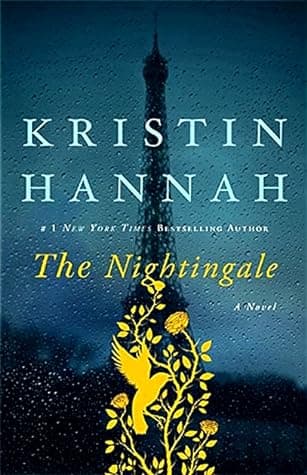
Kristin Hannah (2015)
Genre
Historical Fiction / Romance
Reading Time
550 min
Key Themes
See below
Sign in to track this book
During the Nazi occupation of France, two sisters choose different, dangerous paths of resistance and sacrifice to protect what they love and defy war.
In Carriveau, France, 1939, Vianne Mauriac's husband, Antoine, leaves for the war, leaving her and their daughter, Sophie. Vianne, practical and careful, struggles with the Nazi invasion. Meanwhile, her younger sister, Isabelle Rossignol, an eighteen-year-old rebel, is expelled from her fourth boarding school. Their estranged father, Julien, sends Isabelle to live with Vianne, which adds to their tense relationship. Isabelle feels trapped in Carriveau and wants to help the war effort, while Vianne prioritizes her family's safety, often clashing with Isabelle's impulsiveness.
As the Germans invade Carriveau, Captain Wolfgang Beck takes over Vianne's home for himself and his soldiers. Vianne and Sophie must live in a small part of their own house, always watched by the enemy. This situation humiliates and frightens Vianne, who navigates it to protect Sophie and survive. She puts up with Beck's presence, trying to seem compliant while secretly hating his intrusion and her lost privacy. Isabelle, unable to stand the occupation, tries to flee to Paris.
Isabelle reaches Paris and experiences its fall, meeting Gaëtan, a partisan, and falling in love. She tries to join his Resistance group, but he dismisses her. After a bombing and Gaëtan's betrayal, leaving her behind, Isabelle is heartbroken but more determined to fight. She returns to Carriveau briefly, then goes to her father's apartment in Paris. There, a British agent recruits her and gives her the codename 'The Nightingale.' Her tasks are to distribute anti-German propaganda and later, guide downed Allied airmen to safety across the Pyrenees.
As the war continues, Vianne faces increasing hardship. Food is scarce, and the German presence is oppressive. When her best friend, Rachel de Champlaine, and Rachel's son, Ari, are rounded up as Jews, Vianne is horrified. After Rachel is deported, Vianne, despite her fear, begins to shelter Jewish children sent to her by the local orphanage, changing their names and creating new identities to protect them. She risks everything, including Sophie's safety and her own life, to save these children, forming bonds with them while appearing to be a compliant Frenchwoman to Captain Beck.
Isabelle, as 'The Nightingale,' goes on dangerous missions guiding downed Allied airmen through the Pyrenees mountains to Spain. Each journey is full of danger, from harsh weather and starvation to German patrols. She works with other Resistance members, including a contact named Captain Dubois. Isabelle endures physical and emotional pain, seeing the suffering of the airmen and the realities of war. Her courage and commitment to freedom become known among the Allied forces, though her identity remains secret to most.
Life in Carriveau becomes harder. Rachel, Vianne's friend, dies in a concentration camp, a blow to Vianne. The children she shelters, including Ari, become her family. Food shortages worsen, and the German occupation increases, leading to random violence and more fear among the villagers. Vianne continues to make difficult choices, even resorting to prostitution with Captain Beck to get food and safety for the children and Sophie. This decision shames her but comes from desperate love and protection.
During one mission, Isabelle is betrayed and captured by the Gestapo. She undergoes interrogation and torture but refuses to give information about the Resistance network. She is then sent to Ravensbrück concentration camp, a women's camp, where she endures horrific conditions, starvation, and forced labor. Despite the suffering, Isabelle's defiance remains. She meets other courageous women in the camp and continues to resist in small ways, finding strength in her resolve and the memory of her missions.
After the war, Antoine returns home, changed by his time as a prisoner of war. Vianne is overjoyed but also carries the secrets of her wartime actions, especially her relationship with Captain Beck and the birth of their son, Guillaume. She worries about how Antoine will react to Guillaume, who looks German. Despite the initial awkwardness and unspoken traumas, Vianne and Antoine slowly rebuild their lives, with Antoine accepting Guillaume as his son, recognizing Vianne's sacrifices.
Isabelle is liberated from Ravensbrück, but her body is damaged by the camp's brutality. She reunites with Gaëtan, who finds her very weak and ill. They share a brief reunion, confirming their love. Isabelle, however, is too weak to recover. She dies shortly after her return, a silent hero whose contributions to the Resistance remain largely unknown. Her death is a great loss for Vianne, who grieves her sister's sacrifice and the heavy price of war.
Decades later, in Oregon, an elderly Vianne Mauriac (now Isabelle Rossignol) receives an invitation to a ceremony honoring the women of the Resistance. This makes her think about her past and the true identity of 'The Nightingale.' The story reveals that Vianne took on Isabelle's identity after her sister's death to protect her memory. At the ceremony, she plans to tell the truth about Isabelle's heroism and her own role in saving Jewish children, facing the painful memories she has kept hidden.
At the ceremony, Vianne tells her son, Julien (the adult Guillaume), the full story of his biological father, Captain Beck, and her wartime sacrifices, including sheltering Jewish children. Julien, who has always known he was different, is moved by his mother's courage. Vianne attends the ceremony, where she is recognized not only for her sister's bravery but also for her own quiet acts of resistance. The story ends with Vianne finding peace in sharing her truths and ensuring that both her and Isabelle's legacies of courage and love continue.
The Protagonist
Transforms from a fearful, compliant woman into a resilient survivor and a quiet hero who sacrifices her dignity for her loved ones, eventually finding the courage to share her hidden truths.
The Protagonist
Evolves from a reckless, naive young woman into a hardened, legendary Resistance fighter, sacrificing her life for freedom and others.
The Supporting
Endures the horrors of war as a POW, returning home a changed man who demonstrates profound forgiveness and acceptance.
The Supporting
Serves as a conflicted figure of the occupation, demonstrating both the brutality of war and unexpected moments of humanity.
The Supporting
A child who grows up amidst the horrors of war, representing the innocence Vianne strives to protect.
The Supporting
A tragic figure whose suffering and death highlight the devastating impact of the Holocaust on innocent lives.
The Supporting
A partisan who falls in love with Isabelle, betraying her initially but ultimately reuniting with her in her final moments, embodying the tragic nature of wartime love.
The Supporting
Reveals a hidden bravery and patriotism beneath a gruff exterior, becoming a silent supporter of the Resistance and his daughters.
The Supporting
A child who survives the Holocaust thanks to Vianne's bravery, representing the hope for the future.
The Mentioned/Supporting
Grows up unaware of his biological father, eventually learning the truth of his origins and his mother's sacrifices, bringing closure to her past.
The novel explores different kinds of courage: Isabelle's open acts of resistance as 'The Nightingale' versus Vianne's quiet, internal struggles for survival and protection. Isabelle guides downed airmen, while Vianne risks her life to shelter Jewish children and endure the German occupation. The book suggests that courage is not always grand gestures but often found in the daily choices made to preserve humanity, such as Vianne's decision to prostitute herself for food. Both sisters show bravery against evil.
“In love we find out who we want to be. In war we find out who we are.”
The difficult relationship between Vianne and Isabelle forms the emotional center of the novel. Initially, their different personalities and approaches to life cause friction. Vianne sees Isabelle as reckless; Isabelle sees Vianne as timid. However, the war gradually creates a strong bond of love, respect, and understanding. They both make sacrifices for their family, and Vianne carries Isabelle's legacy, showing the strength of sisterly love, even after death.
“Sisters are more than a relationship; they are a destiny.”
Kristin Hannah shows the 'women's war'—the struggles, sacrifices, and resistance by women on the home front. Vianne's story shows women protecting children, getting food, enduring occupation, and doing vital, secret acts of defiance. Isabelle's role in the Resistance further shows women's active participation. The novel reveals that war happens not just on battlefields but also in homes and through the daily acts of resilience by women.
“They were women, and women were supposed to be able to do anything.”
The novel explores the psychological and emotional cost of war. Both Vianne and Isabelle experience loss, trauma, and moral compromises that affect them long after the fighting ends. Vianne hides her memories of Captain Beck and her sacrifices, while Isabelle is physically and emotionally damaged by her time in Ravensbrück. The story, told by an elderly Vianne looking back, emphasizes the lasting impact of these experiences and the importance of confronting and sharing these memories for healing and understanding history.
“How do you go on, when in every passing face you see a ghost?”
The characters, especially Vianne, face impossible ethical problems in their fight for survival. Vianne's decision to shelter Jewish children goes against German law and puts her own daughter at risk. Her choice to have a sexual relationship with Captain Beck to keep her family safe is a profound act of self-sacrifice that blurs moral lines. The novel shows war as a place where clear right and wrong often disappear, forcing people to make choices that are both heroic and deeply compromising.
“Sometimes, in war, the only way to survive is to be a monster.”
Alternating chapters between Vianne and Isabelle's experiences.
The novel skillfully employs a dual narrative structure, alternating between the perspectives of the two sisters, Vianne and Isabelle. This allows readers to experience the war from two distinct vantage points: Vianne's 'home front' struggle with occupation and survival, and Isabelle's active, dangerous role in the Resistance. This device highlights the diverse ways women experienced and resisted the war, creating a comprehensive and emotionally resonant portrait of WWII France. It also underscores their contrasting personalities and the eventual convergence of their love and sacrifice.
An older Vianne recounts the past, adding suspense and introspection.
The story is framed by an elderly Vianne (living under Isabelle's name) in Oregon, decades after the war. This framing device immediately establishes a sense of historical significance and personal reflection. It creates suspense by hinting at a hidden past and a secret identity, drawing the reader into the mystery of 'The Nightingale.' This perspective allows for introspection on the lasting impact of war, the nature of memory, and the eventual need for truth and recognition, providing a poignant conclusion to the sisters' intertwined fates.
A symbolic moniker representing hope, courage, and hidden identity.
Isabelle's codename, 'The Nightingale,' serves as a powerful symbol throughout the novel. The nightingale is known for its beautiful song, often sung in the dark, symbolizing hope and beauty amidst despair. For Isabelle, it represents her hidden identity as a Resistance fighter, her ability to operate unseen in the shadows, and the hope she brings to the downed airmen she saves. The eventual revelation of who 'The Nightingale' truly was (Isabelle, but remembered through Vianne's adopted identity) adds layers to the theme of legacy and unspoken heroism.
Vianne's home as a microcosm of occupied France and a sanctuary.
Vianne's home in Carriveau serves as a potent symbol. Initially, it represents her safe, ordered world, which is brutally invaded and occupied by Captain Beck. It becomes a microcosm of occupied France, where the enemy lives within. Paradoxically, it also transforms into a sanctuary for Jewish children, a place of secret resistance and fierce protection. The home represents Vianne's personal battleground, where she fights to preserve her family, her dignity, and the lives of the innocent within its walls, highlighting the intimate and personal nature of the 'women's war'.
“If I have learned anything in this long life of mine, it is this: in love we find out who we want to be; in war we find out who we are.”
— Opening lines of the novel, reflecting on the dual themes of love and war.
“Men tell stories. Women get on with it. For us it was a shadow war. There were no parades for us when it was over, no medals or mentions in history books.”
— Vianne reflects on the unrecognized contributions of women during WWII.
“Love. It was the beginning and end of everything, the foundation and the ceiling and the air in between.”
— Vianne contemplates the power of love amidst hardship.
“Some stories don't have happy endings. Even love stories. Maybe especially love stories.”
— Isabelle reflects on the bittersweet nature of love during war.
“Wounds heal. Love lasts. We remain.”
— A hopeful note about enduring through trauma and loss.
“I always thought it was what I wanted: to be loved and admired. Now I think perhaps I'd like to be known.”
— Isabelle's realization about the depth of human connection.
“In the end, the only thing you truly own is your story.”
— Reflection on personal legacy and the importance of one's narrative.
“Hope is a moth, soft-winged and fragile, but it is the only thing that stands between us and the dark.”
— Vianne describes the delicate yet essential nature of hope.
“War is not a game. It is a disease. It infects everyone it touches.”
— Isabelle's observation on the pervasive impact of war.
“Sometimes you have to be brave in the smallest of ways, in the ways that only you will ever see.”
— Vianne's thought on quiet, personal courage.
“The heart is a resilient little muscle. It beats and beats and beats, long after it should have stopped.”
— Reflection on emotional and physical endurance during hardship.
“We are all fragile, Isabelle. It's the cracks that let the light in.”
— Vianne comforts Isabelle, emphasizing strength in vulnerability.
“There are two kinds of people in this world: those who take and those who give. And in the end, it's the givers who win.”
— Isabelle's belief in the power of selflessness and sacrifice.
“Memory is a tricky thing. It is at once the prison and the key.”
— Reflection on how memories can both haunt and heal.
Ready to see how well you understood this book? Take our interactive quiz with 10 questions.

Biography coming soon.







