The Student's Lament
The story opens with a young Student weeping bitterly beneath an oak tree. He loves a Professor's daughter, who has promised to dance with him at the Prince's ball if he brings her a red rose. He cannot find a single red rose in his garden. He laments that without this rose, he will be unable to win her affection, and his love will be in vain. He believes the red rose is the only path to his beloved's heart, equating it with true love itself. He feels that the small cost of a rose is a cruel barrier to his happiness.
The Nightingale's Compassion
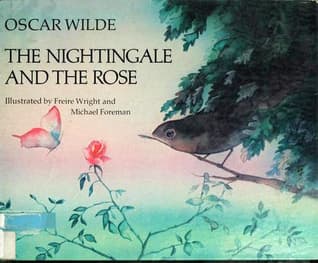
A Nightingale, perched in an oak tree, observes the Student's distress. She has sung of love her entire life, believing it to be beautiful and precious. Witnessing the Student's sorrow over what he perceives as a lost love, she is moved. She initially believes his tears are genuine expressions of true love, thinking that what she has sung in her songs is finally being manifested in human form. She feels a connection to his suffering, interpreting his despair as a sign of the power and purity of his affection for the girl. This inspires her to help him.
The Quest for a Red Rose
Driven by her empathy, the Nightingale flies off to find a red rose for the Student. Her first stop is a rose-tree at the center of the lawn. She asks for a red rose, but the tree only has white roses, explaining that its roots are in the white snow. She then flies to another rose-tree, which bears yellow roses, its roots deep in the golden sand. Each rose-tree she encounters can only produce roses of its own color, leaving the Nightingale increasingly desperate. The quest shows the natural limitations of the world in fulfilling the Student's specific desire.
The Scarlet Sacrifice
Finally, the Nightingale reaches a third rose-tree, which confirms it can produce red roses, but only under a dire condition. The tree explains that to create a red rose in winter, the Nightingale must sing to it all night long, with her breast pressed against a thorn. Her heart's blood must flow into the rose-tree's veins, staining the petals crimson. This is the only way to transform the pale moonlight into the color of a rose and the lifeblood into its passion. The rose-tree lays out the stark, painful sacrifice required, presenting the Nightingale with a life-or-death choice.
The Nightingale's Decision
The Nightingale, after a moment of contemplation, decides to accept the grim condition. She returns to the Student and tells him of the sacrifice she is about to make, urging him to be a 'true lover' and promising to create a red rose for him. The Student, however, does not understand her language and simply dismisses her as a creature of art, not utility. Unfazed by his indifference, the Nightingale remains committed to her purpose, driven by her idealized vision of love. She resolves to give her life, believing that love is worth any price, even her own existence.
The Song of Creation
As the moon rises, the Nightingale presses her breast against the rose-tree's thorn and begins to sing. She sings of the birth of love, of its passion and its pain. Slowly, agonizingly, her lifeblood drains into the rose-tree. The thorn pierces deeper into her heart as she sings of love's perfection, its joy, and its ultimate sacrifice. The rose-tree begins to bloom, its petals changing from pale white to crimson as her blood flows into it. She sings one final, beautiful note as the rose reaches its perfect scarlet hue, and then she dies, the thorn still in her heart.
The Student's Discovery
The next morning, the Student wakes up and looks out his window. To his delight, he sees a magnificent scarlet rose blooming on the rose-tree. It is the most beautiful red rose he has ever seen, a perfect symbol of his 'love.' He plucks it with joy, completely unaware of the Nightingale's death at the base of the tree. His focus is solely on the object itself and its perceived utility in achieving his desires. He marvels at its beauty, congratulating himself on his good fortune, and prepares to take it to the Professor's daughter.
The Professor's Daughter's Rejection
The Student rushes to the Professor's daughter, presenting her with the exquisite red rose. However, she dismisses it curtly, stating that the Chamberlain's nephew has sent her some real jewels, which are far more valuable than a mere rose. She emphasizes that jewels are more expensive and therefore better, revealing her materialistic and superficial nature. She also implies that a rose doesn't match her dress, further demonstrating her lack of appreciation for the Student's gesture and, by extension, the Nightingale's ultimate sacrifice. Her priorities are clearly shallow and self-serving.
The Student's Disillusionment
The Student, heartbroken and disillusioned by the Professor's daughter's rejection, throws the red rose into the street, where it is run over by a cart-wheel. He declares that love is a foolish thing, full of impracticality and disappointment, and not nearly as useful as Logic or Metaphysics. He returns to his room, pulls out a large dusty book, and resumes his studies, concluding that love is a complete waste of time and effort. His initial idealism about love is shattered, replaced by a cynical and academic perspective, completely missing the profound, selfless act that created the rose.