“But that is another story and shall be told another time.”
— A recurring phrase used to end chapters or sections, emphasizing the ongoing nature of the story.

Michael Ende (1979)
Genre
Fantasy / Children's / Young Adult
Reading Time
780 min
Key Themes
See below
Sign in to track this book
A lonely boy named Bastian literally enters a magical book, going on a quest through Fantastica to save it from a creeping Nothingness, finding courage and himself along the way.
Bastian Balthazar Bux is a shy, often bullied boy who finds comfort in books. One rainy morning, running from bullies, he goes into Karl Konrad Koreander's antique bookstore. Mr. Koreander, a stern but observant man, is reading a strange book with an Auryn symbol on its cover, called 'The Neverending Story'. Bastian is fascinated and impulsively steals the book, leaving a note promising to return it. He takes the book to his school's dusty attic, a private place, and begins to read, not knowing the story will soon become his own.
As Bastian reads, he learns about Fantastica, a wonderful land with fantastic creatures. But this world is dying, slowly eaten by a force called the Nothing, which leaves only emptiness. All the creatures of Fantastica are scared and confused, unable to stop it. The Childlike Empress, Fantastica's kind ruler, is also very sick, and her illness is linked to her world's fate. The wise and powerful beings of Fantastica believe only a human child can save them by giving the Empress a new name.
To find a cure for her illness and save Fantastica, the Childlike Empress calls the young Green-skinned warrior, Atreyu, from the Grassy Ocean. Despite his youth, Atreyu is known for his courage and skill. She gives him the Auryn, a powerful amulet also known as 'The Gem' or 'The Serpent Bite', which offers protection and guidance but no power. His quest is to find a human child to give her a new name, a task that seems almost impossible since no human has entered Fantastica in a long time. Atreyu, with his loyal horse Artax, begins his dangerous journey.
Atreyu's quest takes him through dangerous lands. He asks the ancient Morla, the Giant Turtle, who sends him to the Southern Oracle. During his journey through the Swamps of Sadness, his horse Artax dies from the swamp's despair, leaving Atreyu heartbroken. He almost dies himself but is saved by the luckdragon Falkor, who becomes his loyal friend. Together, they reach the Southern Oracle, where Atreyu must pass through the Sphinx Gates and face the trials of Uyulala, the Oracle's voice, to learn the truth about the Empress's illness and the human savior.
Uyulala tells Atreyu that the Childlike Empress is dying because humans have stopped believing in Fantastica, and the Nothing comes from their forgotten dreams and stories. The only way to save her is for a human child to enter Fantastica and give her a new name. As Atreyu hears this, Bastian, reading in the attic, realizes the story is talking directly to him, and he is the human child meant to save Fantastica. His name is called out by the characters in the book, blurring the lines between reader and story.
The Childlike Empress, near death, tells Atreyu his quest has failed because he did not bring the human. However, she reveals the human is present, reading their story. With her last strength, she sends Atreyu to find the Old Man of Wandering Mountain, who has the 'Neverending Story' itself. As the Nothing consumes the last parts of Fantastica, Bastian, scared but moved by the Empress's situation, finally shouts a new name: 'Moonchild'. With this, he is surrounded by a bright light and finds himself in the heart of Fantastica.
Bastian wakes in the Garden of the Childlike Empress, who is now healthy. He gives her the new name, Moonchild, and she thanks him. She explains that the Auryn, which he now wears, lets him make wishes come true in Fantastica. Each wish, however, costs him a memory from his human world. Bastian, at first excited by his new power and identity as a hero, starts using the Auryn to change himself, get companions, and explore Fantastica, enjoying its endless possibilities.
Bastian, with Falkor and Atreyu, goes on many adventures. He wishes for strength, courage, beauty, and even creates new creatures and places. With each wish granted by the Auryn, a memory of his past life in the human world disappears. He becomes more powerful, more confident, but also more arrogant and distant from his true self. Atreyu, seeing Bastian change and slowly lose his humanity, grows worried, recognizing the dangerous path Bastian is taking toward forgetting who he truly is.
Bastian's growing power and fading memories lead to a serious fight with Atreyu. Bastian, influenced by the sorceress Xayide, starts to believe he should be the Emperor of Fantastica. He even hurts Atreyu in anger, causing a deep split between the former friends. Bastian, almost completely without his human memories, travels to the City of Old Emperors, a place where humans who have lost all their memories are trapped in Fantastica forever. He is close to becoming one of them, having forgotten his name and purpose.
With only a few memories left, Bastian is desperate. He realizes the Auryn's true purpose is not just to grant wishes, but to guide him back to his original world. He meets the Blind Miner, who helps him understand he must find the Water of Life to get his memories back and return home. With the remaining parts of his true self, Bastian takes a final, difficult journey through the House of Change and other symbolic places, shedding the false identities he made in Fantastica.
Bastian finally reaches the Water of Life, guarded by the two serpents of the Auryn, who offer him a drink. He drinks, and all his lost memories and love return. He also finds Atreyu and Falkor waiting for him. They reconcile, and Atreyu helps Bastian gather the pieces of his imagination and creativity, which have been spread throughout Fantastica. With his identity fully back and a new sense of self, Bastian says goodbye to his friends and Fantastica, returning to his world through a portal, now changed and ready to face his life.
Bastian returns to the antique bookstore, where Mr. Koreander is waiting, seemingly aware of Bastian's journey. Bastian, now confident and open, tells Mr. Koreander about his adventures in Fantastica, and the bookseller says he has also visited Fantastica. Bastian then goes home, where he finally talks to his grieving and distant father about his experiences. His new courage and self-awareness begin to heal the divide between them, and Bastian, no longer bullied or lonely, finds new meaning in life, sharing the wonders of Fantastica with others.
The Protagonist
Transforms from a bullied, insecure child into a powerful but misguided hero, eventually rediscovering his true self and courage.
The Protagonist/Supporting
Embarks on a perilous quest for Fantastica's salvation, demonstrating courage and selflessness, and later acts as a guide for Bastian's return to humanity.
The Supporting
Begins gravely ill, is saved by Bastian, and continues her eternal role as the heart of Fantastica.
The Supporting
Serves as a steadfast companion and source of wisdom for both Atreyu and Bastian throughout their respective quests.
The Supporting
Introduces Bastian to the story and acts as a knowing mentor figure at the beginning and end of Bastian's journey.
The Antagonist
Manipulates Bastian, attempting to seize power, and ultimately crumbles into dust as Bastian begins to regain his true self.
The Supporting
Provides cryptic guidance to Atreyu, revealing the path to the Southern Oracle.
The Supporting
Reveals the crucial prophecy to Atreyu, explaining the interconnectedness of Fantastica and the human world.
The Mentioned
Dies tragically in the Swamps of Sadness, a pivotal moment in Atreyu's quest.
The main theme of 'The Neverending Story' is the importance of imagination and stories. Fantastica itself is made of human dreams, fantasies, and narratives. The Nothing, which threatens Fantastica, shows the loss of imagination, forgotten stories, and growing cynicism in the human world. Bastian's act of reading and entering the story shows how engaging with stories can bring worlds to life. His ability to create new creatures and places with his wishes directly demonstrates the power of a creative mind. The book, with its red and green text, invites the reader to become part of the story, like Bastian's journey.
“For Fantastica, whose life is born of the dreams and thoughts of humankind, was dying. And because Fantastica was dying, the dreams and thoughts of humankind were also dying.”
Bastian's journey explores identity. At first, he is an insecure boy who feels unseen. In Fantastica, he gains great power and confidence, but at the cost of losing his memories and forgetting his real self. The Auryn, while granting wishes, also takes away his past, making him face the danger of losing his humanity while seeking power and outside approval. His eventual quest to find the Water of Life is a symbolic journey to reclaim his true identity and integrate his experiences. It shows that real strength comes from knowing and accepting oneself, not from outside power or made-up identities.
“He had wanted to be a new person, but he had forgotten his old one. And that was the real danger.”
The Auryn gives Bastian the power to make wishes, but this power has a cost: the loss of a memory from his human world. This theme explores the two sides of desire and the unexpected results of uncontrolled power. Bastian initially makes wishes for surface reasons, like strength or beauty, without understanding the deep impact on his identity. His journey shows that real fulfillment does not come from endless desires, but from understanding the value of what is lost and the responsibility that comes with power. The story warns about the dangers of escaping reality without learning from the experience.
“Every time you use the Auryn, you lose a piece of your old life. You forget something of your world.”
The book shows a connection between the human world and Fantastica. Fantastica is kept alive by human imagination, and it, in turn, inspires humans and gives them stories. The 'Nothing' is a sign of human indifference and forgotten dreams, directly affecting Fantastica's health. Bastian's ability to enter the story and the narrative talking directly to him (and the reader) blurs the lines between fiction and reality. This emphasizes that stories are not just passive entertainment but active forces that shape and are shaped by human experience. The novel suggests that ignoring or undervaluing imagination leads to a spiritual emptiness in both worlds.
“There are many ways to Fantastica. One of them is the Neverending Story. And I am only one of its messengers. For all the others are also in you. Fantastica can be created in a thousand ways. Each one of you has his own, but it is always the same Fantastica.”
The theme of loss and grief appears throughout the story. Bastian's initial loneliness and escape come from his unresolved grief over his mother's death and his father's emotional distance. Atreyu experiences deep grief when he loses his horse, Artax, in the Swamps of Sadness. The entire land of Fantastica grieves its slow end due to the Nothing. These elements highlight the emotional state of the characters and the world, suggesting that acknowledging and processing loss is important for healing and moving forward. Bastian's return home and reconciliation with his father show a step toward healing his own grief.
“Only those who are able to feel sadness can also feel joy.”
A magical amulet that grants wishes but consumes memories.
The Auryn is a powerful medallion depicting two intertwined serpents, one light and one dark, biting each other's tails. It serves as both a plot device and a central symbol. For Atreyu, it grants protection and guidance on his quest. For Bastian, it grants the power to make wishes and shape Fantastica, but at the cost of losing his memories from the human world. It represents unchecked power and the potential for self-destruction, but ultimately also the path to self-discovery and the balance between two worlds. Its dual nature reflects the cyclical themes of creation and destruction, life and death, and the interconnectedness of all things.
A meta-fictional device that blurs the line between reader and story.
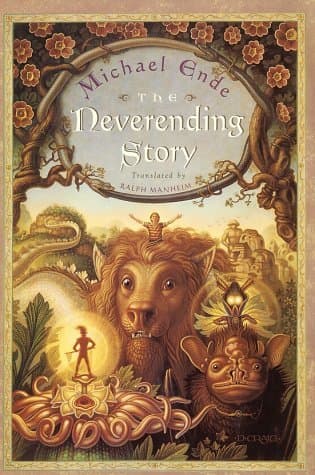
The book 'The Neverending Story' itself is a meta-fictional plot device. Bastian reads a story that eventually reveals him to be its protagonist, directly addressing him and pulling him into its narrative. This blurs the boundary between the reader and the fictional world, emphasizing the interactive and transformative power of storytelling. The book's unique physical appearance (two colors of text, special cover) further reinforces its magical nature and its role as a portal, inviting the actual reader to experience a similar immersion, mirroring Bastian's journey of becoming part of the story he is reading.
A mysterious void consuming Fantastica, representing loss of imagination.
The Nothing is the primary antagonist and a powerful symbolic plot device. It is not a creature or a force with malicious intent, but rather an absence, a void that devours Fantastica, leaving only emptiness. It symbolizes the loss of human imagination, dreams, and stories in the human world. Its relentless advance drives the entire plot of the first half of the book, forcing the characters to seek a human savior. Its existence highlights the symbiotic relationship between Fantastica and humanity, and the devastating consequences when that connection is severed or ignored.
A consequence of the Auryn's power, symbolizing the loss of self.
The gradual loss of Bastian's memories as he makes wishes with the Auryn is a crucial plot device that drives his character arc and highlights the dangers of unchecked power and escapism. This culminates in the introduction of the City of Old Emperors, a desolate place where humans who have completely lost their memories of the human world reside, trapped in Fantastica forever. This device serves as a stark warning to Bastian, forcing him to confront the ultimate price of his wishes and the importance of his true identity and connection to his original world. It underscores the theme of self-discovery and the perils of forgetting who you are.
A magical substance that restores memories and connects worlds.
The Water of Life is a powerful symbolic and plot device that Bastian must find to restore his lost memories and return to the human world. It represents the source of all life, creativity, and memory, and it is guarded by the two serpents of the Auryn. Drinking from it not only restores Bastian's forgotten past but also imbues him with the capacity to bring the 'excess' of Fantastica's life (his wishes and creations) back to his own world. It signifies the integration of his two selves and the healing of his fragmented identity, allowing him to return as a whole person, capable of love and creation.
“But that is another story and shall be told another time.”
— A recurring phrase used to end chapters or sections, emphasizing the ongoing nature of the story.
“Fantasia is the world of human fantasy. It is as big as the human imagination.”
— Explained by the Childlike Empress to Bastian, describing the nature of Fantasia.
“Do what you wish.”
— The Childlike Empress's instruction to Bastian, granting him the power to shape Fantasia with his desires.
“Nothing is lost. Everything is transformed.”
— Spoken by the Childlike Empress, referring to the cyclical nature of Fantasia and its rebirth.
“People who have no hopes are easy to control; and whoever has the control has the power.”
— Reflection by the narrator on the nature of power and manipulation in the story.
“The more wishes one makes, the more one forgets the most important wish of all.”
— A warning to Bastian as he becomes consumed by his own desires in Fantasia.
“Only the right name gives beings and things their reality. A wrong name makes everything unreal.”
— Explained by the gnome Engywook, highlighting the importance of names and identity in Fantasia.
“He who has never been sick is not whole.”
— A philosophical insight shared during Bastian's journey, suggesting growth through adversity.
“Every real story is a neverending story.”
— A key theme of the book, emphasizing that stories and imagination have no true end.
“To have faith is to have wings.”
— A metaphorical statement encouraging belief and courage, often associated with Falkor the luckdragon.
“The boundaries between the worlds are beginning to dissolve.”
— Described as the Nothing threatens to consume Fantasia, blurring reality and fantasy.
“You have to be able to let go of everything you're clinging to.”
— Advice given to Bastian to help him find his way back from losing himself in Fantasia.
“Without love, no one can find the way back.”
— A crucial realization for Bastian as he learns to reconnect with his true self and the real world.
Ready to see how well you understood this book? Take our interactive quiz with 10 questions.
Biography coming soon.







