“The wind was blowing off the Gulf, driving the rain in sheets, and the air smelled of salt and ozone and something else, something indefinable that was uniquely New Orleans.”
— Dave Robicheaux's initial observations of a storm in New Orleans.

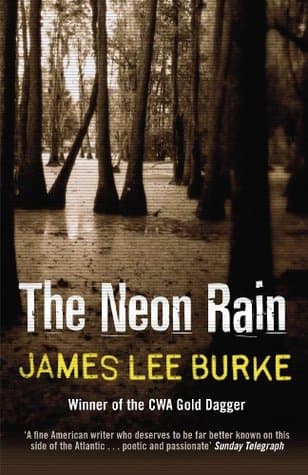
James Lee Burke (1987)
Genre
Thriller / Mystery
Reading Time
360 min
Key Themes
See below
Sign in to track this book
Haunted by Vietnam and alcohol, New Orleans detective Dave Robicheaux navigates drug lords and arms smugglers to solve a prostitute's murder, confronting the city's dark side and his own fractured self.
New Orleans Homicide Detective Dave Robicheaux, dealing with his wife Annie's recent death and his ongoing alcoholism, finds a prostitute, LaRose, dead in a bayou. The brutal scene, with LaRose tied to a tree and tortured, affects Robicheaux deeply. His boss, Lieutenant Guidry, wants to quickly close the case, suggesting it is a typical drug-related killing. Robicheaux's instincts tell him otherwise. He starts to investigate, facing resistance from his department and the criminal world. The discovery brings back painful memories of his time in Vietnam and his struggles with sobriety. This makes him question his ability to find justice and survive in New Orleans' morally unclear environment.
Robicheaux continues his investigation into LaRose's murder. He finds a possible link between her and a arms dealer named André DesJardins, a man known for being ruthless and well-connected. Robicheaux visits a bar where LaRose worked and talks with a bartender named Cletus, who gives him vague but troubling information. He also meets with Bubba Rocque, a local mob figure and old acquaintance, who subtly warns him to stay off the case, implying DesJardins is untouchable. Despite the warnings, Robicheaux feels he must find the truth, driven by duty and a need for meaning in his own broken life. His actions increasingly conflict with the city's established power structures.
Dave Robicheaux finds André DesJardins and confronts him directly. DesJardins, a charming but threatening figure, denies involvement in LaRose's murder but subtly intimidates Robicheaux. During their tense meeting, Robicheaux senses DesJardins is involved in something much bigger than prostitution. He learns that DesJardins is a major player in an international arms smuggling operation, specifically dealing with explosives for Central American rebels. Robicheaux realizes LaRose's death might be linked to this illegal trade, perhaps because she knew too much. The scale of the criminal enterprise becomes clear, making the investigation far more dangerous and complicated than a simple murder case.
As Robicheaux investigates more deeply, the threats against him grow. His apartment is searched, and he receives anonymous calls and warnings. DesJardins's thugs physically assault him, a clear message to stop. These attacks not only threaten his life but also begin to break down his already fragile emotional state, pushing him closer to drinking again. The violence strengthens Robicheaux's resolve, making him even more determined to expose DesJardins, despite the personal cost. The line between his professional duty and personal revenge starts to blur as the threats become more personal.
Feeling alone, Robicheaux contacts Cletus, the bartender from LaRose's workplace, who reluctantly gives more information. Cletus reveals that LaRose had been involved with DesJardins and had found details of his arms deals. He also directs Robicheaux to another prostitute, Loretta, who might know more. Robicheaux also seeks out his old friend, Father Jimmie Salizar, a priest who runs a local mission. Salizar, though hesitant to get involved with the criminal underworld, offers Robicheaux moral guidance, strengthening Robicheaux's belief that he must pursue justice, even if it means risking everything.
Robicheaux eventually finds Loretta, who is scared but agrees to talk to him. She confirms LaRose's involvement with DesJardins and reveals that LaRose had seen documents about the arms deals, specifically mentioning a shipment of C4 explosives. Loretta also says that DesJardins has a hidden warehouse where he stores his illegal goods. This new information confirms Robicheaux's theory about the arms smuggling. However, his search for Loretta leads him into a trap set by DesJardins's men. He barely escapes, which further escalates the conflict and confirms that DesJardins knows about Robicheaux's progress.
Robicheaux discovers that Lieutenant Guidry, his boss, is not only aware of DesJardins's operation but actively involved, providing protection. This betrayal deeply hurts Robicheaux, eroding his trust in the system he serves. Realizing he cannot rely on official channels, he decides to act on his own. He plans to expose DesJardins and his network, knowing it will put him in extreme danger and likely cost him his career, if not his life. He intends to gather concrete evidence of the arms deal and present it in a way that cannot be ignored.
Using Loretta's information, Robicheaux finds DesJardins's hidden warehouse. He gets inside and discovers a large amount of weapons and explosives, confirming the scale of the arms operation. DesJardins and his men, including Guidry, confront him, leading to a brutal and chaotic gunfight. Robicheaux, driven by grief and a strong sense of justice, fights for his life, determined to bring down the criminal enterprise. The warehouse becomes a battleground where personal revenge and the pursuit of justice meet in a violent ending, forcing Robicheaux to face his own capacity for violence and survival.
Robicheaux survives the shootout at the warehouse, though he is seriously wounded. DesJardins is killed, and Guidry is exposed. However, Robicheaux's actions, while bringing down a major criminal, are considered outside police rules. He faces an internal investigation and is forced to resign from the New Orleans Police Department. The events leave him physically and emotionally scarred, but also with a grim satisfaction that justice, in his own way, was done for LaRose. He must now deal with the personal cost of his search for truth and the deep scars left by the city's corruption and his own past.
After everything settles, Robicheaux decides to leave New Orleans. He goes back to his childhood home in New Iberia, Louisiana, hoping for a quieter life away from the city's widespread corruption and violence. He buys a bait shop, trying to find peace and sobriety in the bayou country. While he finds some calm, the past—Annie, LaRose, and the brutal world he left behind—continues to affect him. He is a changed man, marked by his battles but with a renewed sense of purpose, though a more solitary one. The ending suggests that while he has escaped the immediate danger, his fight for personal redemption is not over.
The Protagonist
Robicheaux starts as a grief-stricken, alcoholic detective struggling with his past and ends as a physically and emotionally scarred man, having found a measure of justice but losing his career in the process.
The Antagonist
DesJardins is introduced as an untouchable criminal mastermind and is ultimately brought down by Robicheaux, albeit at a great cost to the detective.
The Supporting/Antagonist
Guidry starts as a seemingly indifferent superior and is exposed as a corrupt official, ultimately facing consequences for his complicity.
The Mentioned
Her character is static as she is deceased, but her memory drives much of Robicheaux's emotional journey.
The Supporting
LaRose's character is static as she is deceased, but her murder sets the entire plot in motion and serves as Robicheaux's primary motivation.
The Supporting
Bubba's character remains consistent, serving as a conduit for information and warnings.
The Supporting
Cletus starts as a scared, unhelpful witness and gradually reveals more information, becoming a key informant.
The Supporting
Loretta starts as a terrified witness and becomes a crucial informant, risking her safety to help Robicheaux.
The Supporting
Father Salizar's character is consistent, serving as a source of moral and emotional support for Robicheaux.
The novel clearly contrasts Robicheaux's individual pursuit of justice with the widespread corruption within the New Orleans police force and political system. From Lieutenant Guidry's involvement to DesJardins's untouchable status, the story shows how power and money can undermine legal and ethical rules. Robicheaux's decision to act outside the law to achieve what he believes is right highlights the moral questions that arise when the system itself is broken. This theme is shown by Robicheaux's forced resignation despite bringing down a major criminal, illustrating that justice, especially for the marginalized, often comes at a high personal cost.
“"The city was a sewer, and he was just another rat swimming in it, but he was going to make sure this one rat didn't get away with murder."”
Dave Robicheaux's character is shaped by his grief over his wife, Annie's, recent death. Her absence is a constant presence, fueling his self-destructive habits, including his struggle with alcoholism. His dedication to solving LaRose's murder is partly an attempt to find meaning in a world without personal joy, and perhaps a subconscious way to make up for past mistakes or to fight against the senselessness of death. This theme explores how deep loss can both weaken and motivate a person, driving them to extreme actions in search of comfort or purpose.
“"Annie was gone, and with her, a part of him that he knew would never come back. The neon rain just kept falling."”
Robicheaux's struggle with alcoholism is a central part of the story, acting as both a personal demon and a way to cope with his trauma. The 'neon rain' itself can represent the appealing, but ultimately harmful, draw of the city and his personal weaknesses. His attempts to stay sober are constantly challenged by work stress and his grief. The pursuit of justice for LaRose becomes a path, however violent, toward a kind of redemption, a way to direct his destructive impulses into something meaningful, even if it does not lead to a typical recovery.
“"The drink tasted like forgiveness, or oblivion, which was often the same thing."”
New Orleans is not just a setting but a character itself, representing decay, moral uncertainty, and hidden dangers. The French Quarter's dark mystery and the bayou's murky depths reflect Robicheaux's troubled mind and the city's hidden side. The novel portrays New Orleans as a place where beauty and depravity exist together, where history and corruption are deeply linked. The 'neon rain' symbolizes the city's attractive yet damaging influence, a place that both supports and nearly destroys its residents, constantly testing Robicheaux's sense of right and wrong.
“"New Orleans was a beautiful, haunted woman, forever inviting you to dance in her arms, then stealing your wallet and stabbing you in the back."”
Robicheaux's experiences in Vietnam are often mentioned, showing the lasting psychological effects of war. This past trauma influences his understanding of violence, his ability to use it, and his jaded view of the world. LaRose's brutal murder and the increasing violence of DesJardins's world reopen these old wounds, forcing Robicheaux to confront his own capacity for brutality and survival. This theme explores how past violence shapes a person's current actions and perceptions, creating a cycle of trauma that is hard to escape.
“"He had seen enough blood in Vietnam to last a lifetime, but it seemed the world was determined to show him more."”
Immerses the reader directly into Robicheaux's troubled mind.
The novel is told from Dave Robicheaux's first-person perspective, providing intimate access to his thoughts, struggles, and moral dilemmas. This narrative choice allows the reader to experience his grief, his battle with alcoholism, and his internal conflict between duty and personal vengeance directly. It enhances the noir atmosphere by filtering the dark events through his jaded and often unreliable viewpoint, making his personal journey as central as the murder mystery itself and highlighting his isolation within a corrupt world.
Symbolizes the seductive yet corrupting atmosphere of New Orleans and Robicheaux's internal struggles.
The title 'The Neon Rain' acts as a pervasive metaphor throughout the novel. The 'neon' represents the artificial, alluring, and often seedy glow of New Orleans nightlife, its glamour masking deeper corruption and despair. The 'rain' symbolizes cleansing, but also constant sorrow, decay, and the relentless, inescapable nature of Robicheaux's personal demons and the city's pervasive corruption. It encapsulates the oppressive atmosphere that both attracts and threatens Robicheaux, reflecting his internal world and the external environment that nearly consumes him.
Reveals Robicheaux's traumatic past and ongoing psychological battles.
The narrative frequently employs flashbacks to Robicheaux's time in Vietnam and his memories of his deceased wife, Annie. These are often triggered by current events, highlighting the lasting impact of past traumas on his present actions and emotional state. Coupled with extensive internal monologues, these devices reveal Robicheaux's deep-seated grief, his struggles with alcoholism, and his moral wrestling. They provide crucial character development, explaining his motivations and the profound personal cost of his pursuit of justice, creating a complex and tormented protagonist.
Reflects the murky morality and hidden dangers of the story.
The Louisiana bayou serves as both a literal setting for the discovery of LaRose's body and a powerful symbol throughout the novel. Its murky waters, dense vegetation, and hidden depths mirror the moral ambiguity, concealed corruption, and dangerous secrets that Robicheaux uncovers in New Orleans. The bayou represents a primal, untamed aspect of the region, where civilization's rules are thin, and violence can erupt unexpectedly. It is a place of both natural beauty and terrifying isolation, reflecting Robicheaux's own complex inner landscape and the untamed nature of justice he seeks.
“The wind was blowing off the Gulf, driving the rain in sheets, and the air smelled of salt and ozone and something else, something indefinable that was uniquely New Orleans.”
— Dave Robicheaux's initial observations of a storm in New Orleans.
“There's a lot of things in this world that'll make you crazy, but nothing like a bad woman.”
— Dave reflecting on a dangerous female character, likely early in his investigation.
“The past is never dead. It's not even past.”
— Dave contemplating how past events and trauma continue to influence the present.
“Evil isn't just a word; it's a force, and it has its own kind of beauty.”
— Dave's philosophical musings on the nature of the antagonists he faces.
“Sometimes you just gotta take a deep breath and jump into the deep end, even if you don't know how to swim.”
— Dave making a risky decision to pursue a lead despite the dangers.
“The truth is a hard thing to nail down in a city like this. It's always shifting, like the mud in the river.”
— Dave expressing frustration with the elusive nature of truth in New Orleans.
“Alcohol doesn't solve problems, it just postpones them and makes them bigger.”
— Dave, a recovering alcoholic, reflecting on his struggles with sobriety.
“There are some wounds that just don't heal, no matter how much time passes.”
— Dave thinking about personal losses and the enduring pain of his past.
“The city was a dark, beautiful woman, full of secrets and dangers.”
— Dave's personification of New Orleans, highlighting its allure and peril.
“Justice is a word a lot of people use, but few understand what it really means.”
— Dave contemplating the complexities and often elusive nature of true justice.
“He had seen enough of the world to know that the monsters weren't always in the shadows.”
— Dave realizing that evil can reside in seemingly respectable individuals.
“Sometimes the only way to find out what you're made of is to get pushed to the edge.”
— Dave facing a life-threatening situation and having to rely on his instincts.
“The rain always washes something clean, but it also uncovers what was hidden underneath.”
— Dave observing the aftermath of a storm, a metaphor for revelations in the plot.
“Every man has a weakness, and if you know it, you own him.”
— A character, possibly an antagonist, discussing leverage and control over others.
Ready to see how well you understood this book? Take our interactive quiz with 10 questions.







