“Sometimes you have to give up to find your way back.”
— Early in the novel, reflecting on the nature of survival and giving in to circumstances.

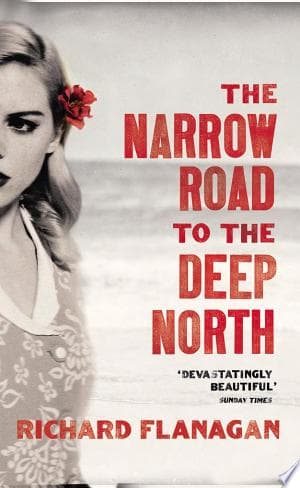
Richard Flanagan (2014)
Genre
Literary Fiction / Historical Fiction
Reading Time
9-12 hours
Key Themes
See below
Sign in to track this book
An Australian surgeon, held in a Japanese POW camp on the Burma Death Railway, struggles with starvation and cholera, while remembering a passionate affair and facing the lasting costs of love, war, and survival.
The novel begins with Dorrigo Evans, a respected Australian surgeon and national hero, at a dinner in his honor. Despite his public success, Dorrigo feels empty. His thoughts often return to his time as a prisoner of war on the Burma Railway (the 'Line') during World War II. He is haunted by the men he could not save, the brutality he saw, and the memory of Amy, his uncle's wife, with whom he had an affair before the war. The story frequently moves between his present, a series of public appearances and private struggles, and the past that shaped him, especially his time in the POW camps.
The story goes into Dorrigo's time as a POW, focusing on the terrible conditions on the Burma Railway. As a surgeon, Dorrigo constantly fights cholera, dysentery, starvation, and the brutal treatment from his Japanese captors. He performs many amputations and basic surgeries, often with poor tools and medicine, trying to save his men. The Japanese officers, Major Nakamura and Captain Ogawa, are shown as complex figures, capable of extreme cruelty and occasional, almost accidental, kindness. Dorrigo's leadership and medical skills are tested daily as he watches his fellow soldiers die slowly, forming a strong bond with the survivors.
Mixed with the grim reality of the POW camp are clear flashbacks to Dorrigo's affair with Amy, his Uncle Jack's wife, in Tasmania before the war. Their relationship is passionate, forbidden, and changes Dorrigo deeply. They meet secretly, their stolen moments filled with intense emotional and physical connection that contrasts sharply with the desolation of the railway. Amy represents life, beauty, and a strong sense of being understood. This love story becomes the emotional center that supports Dorrigo through his darkest moments on the Line, a memory he holds onto for hope and meaning, even as he feels guilty for betraying his uncle.
In the POW camp, Dorrigo receives a smuggled letter from Amy. The letter is a lifeline, a real connection to the world he left behind and a confirmation of her continued love. However, it also brings great pain, showing the vast distance and uncertain future. The letter becomes a strong symbol of his past life and the love that drives his will to survive, even though he knows his chances of returning to that life, or to Amy, are small. This secret communication strengthens his inner world, setting him apart from the other prisoners in a way, as he carries this secret hope and burden.
The war ends, and the surviving Australian POWs are freed. Dorrigo, thin and traumatized, returns to Australia. The change back to civilian life is hard; he finds himself a hero, but feels disconnected from the 'normal' world. His experiences on the Line have left a lasting mark, making ordinary life seem unimportant. He struggles with the expectations placed on him as a survivor and hero, feeling guilty for surviving and carrying the weight of the men he could not save. The horrors he went through permanently change his view of time and reality.
When he returns, Dorrigo learns of Amy's presumed death in a flood, a devastating blow that breaks his last link to his pre-war self. He marries Ella, Amy's sister, a woman who loves him deeply and tries to understand his trauma, but cannot fully reach him. Dorrigo becomes a celebrated surgeon, achieving professional success and public recognition. He has children and builds a comfortable life, but his inner world remains tied to the railway and Amy's memory. His marriage to Ella is one of quiet companionship and respect, but it lacks the passion and strong connection he shared with Amy, leaving him feeling adrift.
Years after the war, Dorrigo learns that Amy did not die in the flood; she survived and lived a quiet, solitary life. They arrange to meet, a moment of great anticipation and dread. Their reunion is brief and deeply unsatisfying. The years, the war, and their separate lives have created a gap between them that cannot be closed. The passionate lovers they once were no longer exist; they are replaced by two strangers burdened by memory and regret. This meeting shows that some losses cannot be reversed, and that even a strong love like theirs cannot fully escape the damage of time and experience.
The novel also shows the post-war lives of Major Nakamura and Captain Ogawa, Dorrigo's Japanese captors. Nakamura, who oversaw much of the brutality, becomes a respected businessman, struggling with his own memories and the impact of his wartime actions. Ogawa, a more conflicted character, faces his own challenges and thinks about war and humanity. These sections offer a complex view of the conflict, refusing to paint the Japanese soldiers as simple villains. Instead, they explore their humanity, cultural context, and their own post-war suffering and attempts at reconciliation or denial. Their stories mirror Dorrigo's own struggles.
As Dorrigo gets older, his public life continues to thrive, but his private world becomes more isolated. His memory fails, a cruel irony for a man whose identity is so linked to his past. He continues to question his fame, feeling like a fraud whose achievements are built on others' suffering. His relationships with his children are distant, and his marriage to Ella, though long-lasting, remains emotionally unfulfilled. He thinks about love, loss, and the impossibility of truly escaping one's past, realizing that the railway defined him more than any other experience.
Dorrigo's life ends, a quiet conclusion to a life lived loudly but internally. In his final moments, his thoughts return to the men on the Line, to Amy, and to the strong, inescapable connection between love and death. He realizes that all his achievements are meaningless compared to the experiences of love and suffering he endured. The novel ends with a reflection on life's temporary nature, memory's lasting power, and the idea that true love, like true suffering, leaves a mark that shapes one's entire existence.
The Protagonist
From a passionate young man to a traumatized POW, Dorrigo evolves into a celebrated but emotionally hollow public figure, ultimately realizing the true cost of his survival and the enduring power of love and loss.
The Supporting
From a vibrant young woman in a passionate affair, Amy becomes a figure of enduring memory for Dorrigo, later revealed to have survived and lived a quiet life, only to find her connection with Dorrigo irrevocably broken.
The Supporting
Ella maintains a steadfast devotion to Dorrigo, striving to build a family and life with him despite his emotional distance, ultimately accepting the limitations of their relationship.
The Antagonist/Supporting
From a ruthless wartime commander, Nakamura transitions to a respected businessman in post-war Japan, haunted by his past but often outwardly unrepentant, reflecting on his actions from a Japanese perspective.
The Supporting
Darky endures immense suffering and survives Dorrigo's surgery only to succumb to the harsh conditions, becoming a poignant symbol of the men Dorrigo could not save.
The Supporting
Bigelow survives the railway, maintaining his sardonic wit, and continues to navigate a post-war life, always carrying the invisible scars of his past.
The Supporting
From a dutiful and often cruel wartime officer, Ogawa attempts to come to terms with his past in post-war Japan, grappling with personal and societal changes.
The Supporting
Jack remains a stable, albeit unaware, figure in Dorrigo's early life, serving as a catalyst for Dorrigo's guilt over his affair with Amy.
The Mentioned
The Old Man serves as a spiritual anchor for the POWs, offering solace and an example of unwavering faith until his death on the Line.
The novel shows the lasting psychological and physical scars of war, specifically the POW experience on the Burma Railway. Dorrigo's entire post-war life is overshadowed by the horrors he saw and lived through. He suffers from survivor's guilt, emotional distance, and difficulty finding meaning in 'normal' life. The constant flashbacks, the memories of the dead, and the physical decline of the men show how war changes people completely, making a true return impossible. Even the Japanese officers carry their own burdens, showing that trauma affects everyone.
“Forever after, there were for them only two sorts of men: the men who were on the Line, and the rest of humanity, who were not.”
Love, in its different forms, is a main theme. The passionate affair between Dorrigo and Amy is a strong force, supporting Dorrigo through his darkest times on the Line. This love is contrasted with the quiet, lasting, but less passionate love he shares with Ella. The novel explores how love can bring hope and meaning, but also how it can be changed or lost by time, circumstances, and war trauma. The 'loss' includes not just Amy, but also the loss of innocence, comrades, and a former self.
“A man’s life was like a river, the father had said. When he was young, it flowed swiftly and in the right direction. But in middle age, the river broadened, and the current slowed. It was then that, unless a man was careful, he could lose his way.”
Memory is shown as both a help and a burden. For Dorrigo, memories of Amy bring comfort, while memories of the railway are a constant torment. The novel often moves between past and present, blurring time, emphasizing that the past is never truly gone for those who have experienced deep trauma. Dorrigo's struggle with his aging memory, and how he filters or reinterprets events, shows that memory itself is subjective and unreliable. The story's structure reinforces this, showing how the present is always informed by the past.
“He understood then that a man's life was not a series of events at all, but a series of accidents. He understood that he was a man who had done many things, but had been nothing.”
Dorrigo is publicly known as a war hero, but he feels like an imposter. The novel questions common ideas of heroism, suggesting that real heroism might be in quiet acts of resilience and kindness, not in public praise. Dorrigo carries the burden of the men he could not save, feeling that his fame comes from their suffering. This theme explores the difference between public perception and private reality, and the weight of living up to an image that does not match one's inner self, especially when that self is broken by trauma.
“The great lie of war, of course, was that it was a test of a man's courage. It was not. It was a test of a man's luck.”
The novel clearly shows how war and captivity dehumanize both prisoners and captors. The POWs are reduced to basic survival instincts, losing dignity and individuality. Yet, within this, acts of humanity, friendship, and self-sacrifice appear. Conversely, the Japanese soldiers, though often brutal, are also shown to have their own complexities, fears, and cultural rules, challenging simple ideas of good and evil. The novel explores how circumstances can push people to extreme acts, but also how humanity can still exist.
“In the end, all that was left was hunger. A man could not be a man without food.”
Interweaving past and present to mirror Dorrigo's fragmented memory.
The novel jumps frequently between Dorrigo's present life as an acclaimed surgeon and his past experiences as a POW on the Burma Railway, as well as his pre-war affair with Amy. This non-linear structure mirrors Dorrigo's own fractured memory and the way his past constantly intrudes upon his present. It allows Flanagan to build suspense, reveal character depth gradually, and highlight the enduring impact of trauma, showing how certain memories are ever-present despite the passage of time. The shifts are often sudden, reflecting the intrusive nature of traumatic recall.
Represents suffering, endurance, and the irreversible impact of war.
The Burma Railway, or 'the Line,' is more than just a setting; it is a powerful symbol. It represents the ultimate test of human endurance and the nadir of human suffering and cruelty. For Dorrigo and the other POWs, it becomes a metaphor for their lives – a brutal, inescapable path. It also symbolizes the indelible mark that trauma leaves, forever dividing humanity into 'those who were on the Line, and the rest.' The physical construction of the railway parallels the psychological construction and destruction of the men who built it.
A tangible link to the past and a symbol of hope and ultimate loss.
The smuggled letter from Amy that Dorrigo receives in the POW camp is a potent symbol. It represents a fragile lifeline to his former life, a confirmation of love, and a source of hope that helps him endure. Yet, it also underscores the vast distance and the unlikelihood of a future together. When he later learns of Amy's presumed death, the letter becomes a relic of a lost world. Its physical presence and its emotional weight highlight the enduring power of human connection amidst utter desolation, but also the futility of holding onto a past that can never truly be reclaimed.
Allows insight into multiple characters' inner lives and historical contexts.
The novel employs a third-person omniscient narrator, which grants the reader access not only to Dorrigo's complex inner world but also to the perspectives of other characters, including the Japanese officers Nakamura and Ogawa, and Amy. This narrative choice allows for a multifaceted exploration of the war, its aftermath, and the motivations of all involved. It enables Flanagan to provide historical context, cultural insights, and a broader understanding of the human condition, moving beyond a singular, subjective viewpoint to offer a more universal and empathetic portrayal of suffering and survival.
Enriches themes of transience, beauty, and the Japanese perspective.
Flanagan integrates elements of Japanese culture, particularly haiku poetry and references to Zen Buddhist philosophy, throughout the narrative. These elements serve multiple purposes: they offer glimpses into the cultural mindset of the Japanese captors, enriching their characterizations beyond simple villainy; they provide moments of stark beauty and contemplation amidst the horror, underscoring themes of transience and the search for meaning; and they subtly highlight the philosophical differences and clashes between the Western and Eastern perspectives on life, death, and honor. The haiku often punctuate moments of profound observation or despair.
“Sometimes you have to give up to find your way back.”
— Early in the novel, reflecting on the nature of survival and giving in to circumstances.
“War makes you an animal, but it doesn't make you any less human.”
— A character's internal reflection on the dehumanizing yet paradoxically humanizing aspects of war.
“A good book, he had discovered, was an experience that was always a little sad.”
— Dorothy's observation about the bittersweet nature of finishing a profound book.
“We are all just a series of moments, some good, some bad, some forgotten.”
— A meditation on the fragmented nature of memory and identity over a lifetime.
“To be a good doctor, you need to know when to give up, and when to keep fighting.”
— Dorrigo Evans's professional philosophy, applicable to life beyond medicine.
“Love was not a feeling, he knew, but an act.”
— Dorrigo's realization about the active, rather than passive, nature of love.
“The greatest enemy of truth is often not the lie, but the myth.”
— A philosophical observation on the pervasive nature of cultural narratives and their impact on reality.
“What is it to be a man, but to be a story?”
— A character musing on the essence of human existence as a narrative construct.
“The past is never dead. It's not even past.”
— A poignant reflection on the enduring impact of historical events and personal traumas.
“Hope, he had come to believe, was not a thing to be found, but a thing to be made.”
— Dorrigo's mature understanding of hope as an active choice rather than a passive discovery.
“Every life is a story, but not every story is a life.”
— A deep thought on the distinction between lived experience and its narrative representation.
“He understood then that true courage was not the absence of fear, but the triumph over it.”
— A character's realization about the nature of bravery in the face of overwhelming odds.
“The only way to keep the dead alive is to keep talking about them.”
— A powerful statement on remembrance and the importance of storytelling for those who are gone.
“Sometimes the greatest love is the love you let go of.”
— Dorrigo's reflection on the complexities of love and sacrifice.
Ready to see how well you understood this book? Take our interactive quiz with 10 questions.

Richard Miller Flanagan is an Australian writer, who has also worked as a film director and screenwriter. He won the 2014 Man Booker Prize for his novel The Narrow Road to the Deep North.







