“There is a house, a napping house, where everyone is sleeping.”
— Opening line introducing the setting.

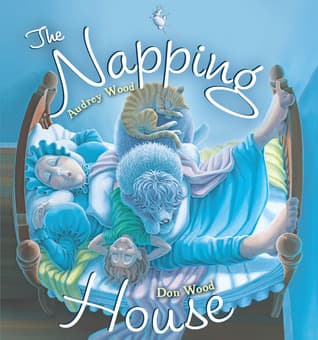
Audrey Wood (1984)
Genre
Children's
Reading Time
5 min
Key Themes
See below
Sign in to track this book
A wakeful flea's tiny bite hilariously unravels a towering pile of slumbering creatures, transforming a moonlit napping house into a burst of sunlit chaos.
The story introduces a 'napping house' where 'everyone is sleeping.' The first scene is shown in soft, cool blue and purple tones, showing the peaceful, sleepy atmosphere. The house is a 'cozy bed in a napping house,' setting the main location. The text is cumulative, adding new elements to the sleepy scene with each line. This opening sets the stage for the gentle, rhythmic story, inviting the reader into a world of quiet sleep.
The story moves to the first character: 'a snoring granny.' She is on the 'cozy bed in a napping house.' Her snoring is noted, adding a gentle, rhythmic sound to the silent scene. The cumulative structure continues, repeating previous elements while adding the granny. Her deep sleep is a key element, setting the tone for the other characters who will join her in sleep. The illustrations keep the cool, sleepy color palette.
Next, 'a dreaming child' is introduced, nestled on the 'snoring granny.' The child is deeply asleep, adding another layer of quiet to the scene. The cumulative text now includes the child, the granny, the bed, and the house. The illustration shows the child peacefully sleeping, adding to the growing pile of sleeping beings. The focus remains on the undisturbed sleep of everyone in the house, building anticipation for what might disrupt this peace.
The sleep heap grows with 'a dozing dog.' This dog is sleeping soundly on the 'dreaming child.' The cumulative phrasing continues, showing the increasing number of sleepy occupants. The dog's presence adds to the whimsical nature of the sleeping pile, where various creatures are stacked. The peaceful, undisturbed nature of their sleep is still important, and the cool color scheme continues in the illustrations.
After the dog, 'a snoozing cat' joins the pile, sleeping on the 'dozing dog.' The cat's serene sleep further shows the quiet and stillness of the napping house. The cumulative rhyme now includes the cat, the dog, the child, the granny, the bed, and the house. Each new character is introduced with a description of their sleep, building a sense of deep, collective rest. The illustration shows the cat curled up, adding to the precarious yet peaceful stack of sleepers.
The smallest addition to the sleeping pile is 'a slumbering mouse.' The mouse is introduced sleeping on the 'snoozing cat,' completing the stack of sleeping creatures. The cumulative text is now at its longest, listing all characters and their positions. The mouse's tiny size compared to the others adds humor and precariousness to the stack. Despite the growing number of inhabitants, the house remains 'a napping house, where everyone is sleeping,' keeping the illusion of perfect peace.
The peace is subtly threatened by 'a wakeful flea.' Unlike all other characters, the flea is 'wakeful,' showing a shift in the story's sleepy atmosphere. It is introduced as 'on that slumbering mouse,' completing the vertical stack of characters. The flea's alertness contrasts with the deep sleep of everyone else, hinting at an upcoming change. The illustrations subtly show the flea's tiny, active presence, despite the ongoing blue hues.
The wakeful flea 'bites the mouse.' This small, sudden action starts the chain reaction that follows. The bite is a sharp contrast to the previous state of peaceful sleep. This moment marks the turning point in the story, as the long-held peace is about to be shattered by this tiny, yet significant, event. The cumulative tension built through the stacking of characters now begins to unravel.
Startled by the flea's bite, the 'slumbering mouse' 'jumps.' This sudden movement causes a ripple effect, waking the 'snoozing cat' beneath it. The awakening sequence begins, reversing the cumulative build-up of sleep. The mouse's jump is the first visible disruption, breaking the perfect stillness of the napping house. The illustrations begin to hint at more movement and a slight shift in the color palette towards brighter tones.
The now-awake 'snoozing cat' 'arches' its back in surprise or annoyance. This action, in turn, wakes the 'dozing dog' that was sleeping beneath it. The chain reaction continues with increasing momentum, each awakened creature disturbing the next. The cat's arching motion adds to the dynamic shift in the scene, moving further from the initial stillness. The illustrations likely show the cat in a more active, less sleepy pose.
The awakened 'dozing dog' 'thumps' its tail or body, a more significant disturbance. This thumping action wakes the 'dreaming child' who was sleeping on top of it. The awakening sequence gains force, with each character's reaction being more pronounced than the last. The dog's thumping introduces a louder, more impactful sound into the previously quiet house, signaling the end of the deep sleep.
The now-awake 'dreaming child' 'bumps' the 'snoring granny.' This final bump is enough to awaken the granny, who was at the bottom of the pile. With the granny now awake, the entire chain reaction is complete, and 'everyone is awake!' The 'napping house' is now fully awake. The illustrations transition dramatically from cool blues to warm colors, symbolizing the dawn and the complete reversal of the sleepy atmosphere.
With everyone wide awake, the 'napping house' becomes 'a wide-awake house.' The illustrations burst with bright, cheerful colors, showing the sun shining and all characters looking alert and active. The cumulative rhyme is reversed, describing the now-awake characters and the lively atmosphere. The story ends with joy and activity, a complete contrast to the quiet, sleepy beginning, bringing the narrative to an energetic close.
The Supporting
Remains in a state of deep sleep until she is the final one to be awakened, transitioning from snoring to wide-awake.
The Supporting
Starts in a deep dream state, then is awakened and becomes active, bumping the granny.
The Supporting
From a dozing state, it is awakened and thumps, contributing to the chain reaction.
The Supporting
Starts snoozing, then arches when awakened, waking the dog.
The Supporting
Deeply slumbering until bitten by the flea, then jumps, starting the awakening sequence.
The Catalyst/Antagonist
Remains wakeful throughout, acts as the initial disruptor by biting the mouse.
The main theme explores the transition from deep sleep to full wakefulness. The book carefully builds a scene of rest, with each character adding to a cumulative state of sleep, only to systematically undo it through a chain reaction of awakenings. This cycle is visually reinforced by the shift from cool, muted blues and purples (sleep) to bright, yellows and oranges (wakefulness), showing the natural progression from night to day and from quiet to activity. The flea is the tiny, inevitable spark that starts this daily transition.
“And on that granny / there is a child / a dreaming child / on a snoring granny / on a cozy bed / in a napping house, / where everyone is sleeping.”
This theme shows how even the smallest action can have big consequences. The entire state of the napping house, with its stack of sleeping inhabitants, is overturned by the single, tiny 'bite' of a 'wakeful flea.' This small event triggers a cascade of increasingly larger reactions — a mouse's jump, a cat's arch, a dog's thump, and a child's bump — ultimately waking everyone. It shows how events are connected and how a seemingly insignificant cause can lead to a dramatic and complete change.
“And on that mouse / there is a flea / a wakeful flea / who bites the mouse...”
The book uses a cumulative structure to build a sense of growing stillness and then reverses it to create a sense of escalating activity. Initially, each new character is added to the sleeping pile with a repetitive, rhythmic phrase, deepening the atmosphere of sleep. Once the flea bites, this cumulative structure is inverted, with each character's awakening directly causing the next, leading to a rapid, energetic unraveling of the sleepy scene. This structure mirrors the journey from quiet rest to busy activity.
“a snoring granny / on a cozy bed / in a napping house, / where everyone is sleeping. / And on that granny / there is a child / a dreaming child...”
A repetitive, building narrative structure.
The entire story is built upon a cumulative rhyme scheme, similar to 'The House That Jack Built.' Each new character or element is added to the previous line, creating a rhythmic, predictable, and ever-growing sequence. This device is crucial for establishing the increasing layers of sleep in the first half of the book, and then for systematically reversing that sequence during the awakening, making the narrative highly engaging and memorable for young readers. It builds anticipation and then satisfyingly releases it.
Visual progression from cool to warm colors to denote time and mood.
Don Wood's illustrations employ a striking color shift as a key plot device. The initial scenes, depicting the napping house, are dominated by cool, muted blues, purples, and grays, effectively conveying the quiet, sleepy atmosphere of night or early morning. As the characters awaken and the house becomes 'wide-awake,' the colors dramatically shift to bright, vibrant yellows, oranges, and reds, symbolizing the arrival of full daylight and the energetic mood of a new day. This visual progression directly reinforces the story's theme of awakening and transformation.
A sequence of events where each action triggers the next.
The awakening of the napping house is driven by a perfect chain reaction. The flea's bite causes the mouse to jump, which causes the cat to arch, which causes the dog to thump, which causes the child to bump, which finally wakes the granny. This device provides a clear, cause-and-effect structure to the plot's climax, making the unfolding events logical and satisfying. It highlights the interconnectedness of the characters and actions within the confined space of the napping house.
Giving human-like actions or states to animals.
While not explicitly speaking, the animals in 'The Napping House' are given human-like qualities through their participation in the cumulative sleeping pile and their specific reactions to being awakened. The 'dozing dog,' 'snoozing cat,' and 'slumbering mouse' are all portrayed as sharing a human-like capacity for deep, peaceful sleep within the domestic setting. Their synchronized awakening reactions (jumping, arching, thumping) further humanize their roles in the story's chain of events, making them relatable characters.
“There is a house, a napping house, where everyone is sleeping.”
— Opening line introducing the setting.
“And on that granny there is a child, a dreaming child on a snoring granny.”
— Describes the pile of sleepers.
“A slumbering mouse on a snoozing cat, on a dozing dog, on a dreaming child, on a snoring granny.”
— Builds the cumulative sleeping chain.
“A wakeful flea bites the mouse.”
— The disruption that starts the chaos.
“And the mouse scares the cat, who claws the dog, who thumps the child, who bumps the granny.”
— Chain reaction of waking up.
“Who breaks the bed.”
— Climax of the chaos.
“In the napping house, where no one now is sleeping.”
— Final line showing the changed state.
“A cozy bed in a napping house, where everyone is sleeping.”
— Early description emphasizing comfort.
“On a snoring granny, a dreaming child, a dozing dog, a snoozing cat, and a slumbering mouse.”
— Repetitive structure highlighting order.
“Everyone is napping in the napping house.”
— Refrain throughout the story.
“The flea that started it all.”
— Implied cause of the disruption.
“From slumber to wakefulness in one bite.”
— Summarizes the flea's action.
“A pile of sleepers, peaceful and deep.”
— Describes the initial scene.
“The bed that couldn't hold the wakeful heap.”
— Refers to the broken bed aftermath.
Ready to see how well you understood this book? Take our interactive quiz with 10 questions.

Audrey Wood is a celebrated children's author, renowned for her imaginative and rhythmic picture books. Her most beloved works include 'The Napping House,' 'Quick as a Cricket,' and 'Heckedy Peg.' Wood's distinctive storytelling and engaging illustrations have earned her a place as a beloved figure in children's literature.

Dan Gemeinhart
4.5

Kate O'Hearn
4.4

Jeanne Birdsall
4.4

Jen Wang
4.4
Wendelin Van Draanen
4.3

John Marsden
4.3

Chris Van Allsburg
4.3
Jennifer A. Nielsen
4.2