“For now, she can't imagine a day without him. For now, she believes in her mother's words, in the possibility of a love that goes on and on.”
— Ashima's early feelings about Ashoke, before their arranged marriage.

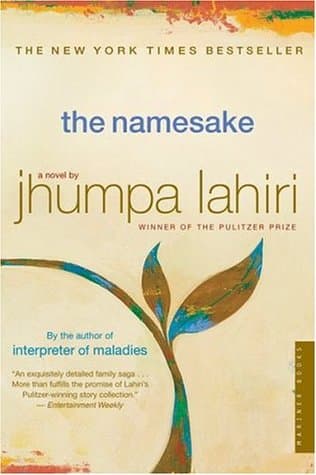
Jhumpa Lahiri (2003)
Genre
Literary Fiction
Reading Time
350 min
Key Themes
See below
Sign in to track this book
Gogol, a young man burdened by his unusual name and Indian heritage in America, goes on a journey of self-discovery, cultural conflict, and changing family ties.
Ashima Ganguli, newly married to Ashoke Ganguli in an arranged marriage, arrives in Cambridge, Massachusetts, in 1968. She feels very lonely and experiences culture shock, missing her family and the familiar sights and sounds of Calcutta. Ashoke, a quiet academic, is more used to American life from his studies. Ashima spends much of her time alone in their small apartment, cooking Bengali food and writing letters home, feeling more isolated as her pregnancy continues. A key event is her hospital visit for childbirth, where she feels completely alone without her family, showing her vulnerability and detachment from her new surroundings.
When Ashima gives birth to her son, naming him becomes complicated. The letter from Ashima's grandmother, containing the official 'good name,' is delayed. The hospital requires an official name for the birth certificate. Ashoke, remembering a train accident in his youth where he was saved while reading a book by Nikolai Gogol, suggests 'Gogol' as a temporary 'pet name.' This name, meant to be temporary, is mistakenly recorded as his official name on his birth certificate, setting up a lifetime of identity struggles for their son, Gogol Ganguli.
Gogol grows up in suburban Massachusetts, attending American schools and celebrating American holidays, but also living with Bengali traditions at home. From an early age, he dislikes his name, Gogol, finding it strange and embarrassing, especially when classmates and teachers mispronounce or make fun of it. He feels it does not represent him and makes him feel like an outsider, caught between his parents' Bengali heritage and his American upbringing. This internal conflict gets worse when his parents later tell him the story behind his name, which he finds both interesting and a burden.
As a teenager, Gogol, increasingly bothered by his name, decides to legally change it to Nikhil, the 'good name' his parents had originally planned. The process is a significant step in showing his individuality and his desire to get rid of the perceived burden of 'Gogol.' While his parents are at first hurt and confused by his decision, they eventually accept it. However, the name change does not immediately solve his identity crisis; he finds himself in situations where family and close friends know him as Gogol, and new acquaintances and professional peers know him as Nikhil, leading to a split existence.
At Yale University, Nikhil (formerly Gogol) fully accepts his new identity. He studies architecture and moves away from his parents' Bengali traditions. He starts a relationship with Ruth, a white American student, with whom he feels a deep connection and shared understanding, especially about their independent spirits. Their relationship shows his assimilation into American culture and his attempt to create an identity separate from his family's expectations. However, their different backgrounds and his remaining ties to his family's world eventually create subtle tensions that hint at future problems.
After college, Nikhil moves to New York City and becomes an architect. He falls in love with Maxine Ratliff, a wealthy, bohemian, and confident American woman. He becomes deeply involved in her family's sophisticated, open, and seemingly carefree lifestyle, spending summers at their lakeside home in New Hampshire. This relationship represents Nikhil's deepest immersion into American life, feeling a sense of belonging he rarely experienced with his own family. However, his parents' Bengali traditions and expectations, particularly around family gatherings and duties, begin to clash with Maxine's world, creating a divide.
Ashoke Ganguli, who had taken a teaching position in Ohio, dies suddenly of a heart attack while alone. This event deeply affects Nikhil. He travels to Ohio to identify his father's body and handle the funeral arrangements, a responsibility that falls heavily on him as the eldest son. Ashoke's death forces Nikhil to confront his Bengali heritage and the deep, unspoken bond he shared with his father. He realizes how much he took his father for granted and begins to think about his own identity in relation to his family and culture, causing a separation from Maxine, who struggles to understand his grief.
After his father's death, Nikhil grows distant from Maxine, and their relationship ends. He then meets Moushumi Mazumdar, a Bengali-American woman he vaguely knew from childhood, at a party. Moushumi, like Nikhil, has struggled with her dual identity and has tried to distance herself from her Bengali roots. They share a common background and understanding of the immigrant experience, leading to a passionate romance and eventually marriage. Their relationship at first feels like a comforting return home, a shared attempt to bridge their two worlds, but also carries the weight of their parents' expectations.
Despite their shared heritage, Nikhil and Moushumi's marriage begins to fail. Moushumi feels restricted by the expectations of married life and the Bengali community, resenting the perceived predictability of their shared existence. She begins an affair with a French academic, Dimitri, a man from her past. Her infidelity, stemming from her own unresolved identity issues and a desire for freedom, deeply hurts Nikhil. The affair is eventually discovered, leading to the painful and unavoidable collapse of their marriage, showing the complexities of cultural identity and personal desire.
After Ashoke's death, Ashima at first struggles with deep grief and loneliness, thinking about returning to Calcutta. However, she gradually finds a new sense of independence and purpose. She sells the family home in Massachusetts and begins to split her time between America and India, letting go of some of the traditional expectations that had bound her. She learns to drive, travels, and hosts parties, showing a quiet strength and a changing identity, no longer defined only by her role as Ashoke's wife or the head of a nuclear family.
On Christmas Eve, Nikhil attends Ashima's last party in the family home before she sells it. He finds himself surrounded by family friends and memories. Ashima gives him a copy of Nikolai Gogol's 'The Overcoat,' the book his father was reading during the train accident, and a gift from his father years ago. Reading the book, Nikhil finally understands the deep meaning of his original name and his father's love. This moment brings a sense of peace and understanding, allowing him to reconcile his dual identities and accept his past.
As Nikhil reads 'The Overcoat,' he gains a deeper understanding of his father's story and the unplanned legacy of his name, Gogol. He understands that 'Gogol' is not just an embarrassing mistake but a deep link to his father's survival and love. This realization allows him to finally combine the two parts of his identity — the Bengali 'Gogol' and the American 'Nikhil' — into a complete whole. He recognizes that his name, in all its forms, is a part of his unique journey, shaping who he is and where he belongs.
The Protagonist
Gogol transforms from a resentful child burdened by his name to a man who, after his father's death and personal trials, comes to understand and embrace the complex layers of his identity, including his namesake.
The Supporting
Ashoke remains steadfast in his subtle love and guidance for his family, his quiet presence shaping Gogol's journey even after his death.
The Supporting
Ashima evolves from a homesick, dependent wife to a resilient, independent woman who finds her own way to navigate her bicultural existence.
The Supporting
Sonia's arc is less central but shows her growing into a supportive, independent young woman who understands her family's unique situation.
The Supporting
Maxine serves as a catalyst for Gogol's attempt to fully assimilate, but her inability to understand his cultural complexities ultimately highlights the limitations of his pursuit of an exclusively American identity.
The Supporting
Moushumi, initially a beacon of shared understanding for Gogol, ultimately demonstrates the tragic consequences of unresolved identity conflict, culminating in the destruction of her marriage.
The novel explores the complex and often difficult process of forming an identity when caught between two distinct cultures. Gogol's struggle with his name is the central idea for this theme, as he tries to shed his Bengali heritage to fit into American society, only to feel lost. Ashima's early isolation and eventual adaptation, and Moushumi's restless search for self, further show how people deal with where they belong, both geographically and culturally. The characters constantly search for a place where their internal and external selves can align, often finding that true belonging comes from accepting the mix of their existence, as Gogol does when he finally embraces 'Gogol' and 'Nikhil' as parts of a whole.
“For being a foreigner, Ashima is beginning to realize, is a sort of lifelong pregnancy – a perpetual wait, a perpetual preparation, an endless giving birth to oneself, over and over again.”
Lahiri details the challenges faced by first-generation immigrants like Ashoke and Ashima, from the initial culture shock and loneliness to the struggle of raising children in a foreign land while trying to keep their cultural heritage. The novel shows the sacrifices made, the constant negotiation between old traditions and new customs, and the quiet strength needed to build a new life. It also highlights the generational gap, where the children, like Gogol and Sonia, experience a different kind of displacement, feeling neither fully American nor fully Bengali, and often misunderstanding their parents' struggles and reasons.
“They are a family of four, but for the moment they are two distinct units, the parents and the children, the Bengalis and the Americans.”
The main theme is names. Gogol's name, given by accident and carrying the weight of his father's near-death experience, becomes a symbol of his identity crisis. It represents his parents' past, his Bengali heritage, and his feeling of being an outsider. His legal name change to Nikhil is an attempt to control his identity and shed the burden of his past. However, the novel shows that a name is more than just a label; it carries history, memory, and connection. Ultimately, Gogol learns that true self-acceptance involves embracing the complex story behind his name, rather than rejecting it.
“He hates the fact that his name is both unique and common, inextricably linked to a novelist he has never read.”
The novel explores the close bonds and unspoken understandings within the Ganguli family. It highlights the love, duty, and occasional misunderstandings between parents and children, especially in the context of immigration. Ashoke and Ashima's quiet affection and their efforts to provide a good life for their children are central. Gogol's changing relationship with his parents, particularly his delayed understanding of his father's motivations and love, forms a significant part of his journey. The communication gaps, cultural expectations, and the eventual reconciliation of these relationships show the lasting power of family, even across generations and cultures.
“Without the burden of his name, he would have been a different person. He would have been someone else.”
A literal and symbolic device representing identity, heritage, and fate.
Gogol's name is the most prominent plot device. It is both a literal name and a powerful symbol. Literally, it is a 'pet name' that accidentally becomes his official name, causing him lifelong embarrassment and a sense of being misidentified. Symbolically, it represents the unpredictable nature of fate, the burden of inherited history (his father's accident), and the profound struggle of a first-generation immigrant to reconcile their heritage with their desired identity. The act of changing his name and his eventual understanding of its origin drives much of the narrative conflict and his character arc.
A literary allusion that links Ashoke's past to Gogol's identity.
Nikolai Gogol's short story 'The Overcoat' serves as a crucial literary allusion and a tangible link between Ashoke's past and his son's identity. Ashoke was reading this book during the train accident that nearly killed him, making the author's name a symbol of his survival and a deep, personal significance. For Gogol, the book initially holds no meaning beyond the source of his despised name. However, when he finally reads it after his father's death, it becomes a key to understanding his father's love, his own identity, and the profound, unspoken connections within his family, completing his journey of self-discovery.
A recurring motif highlighting connection, distance, and cultural divides.
Letters play a significant role throughout the novel. Ashima's early letters home underscore her loneliness and longing for India. The delayed letter containing Gogol's official name initiates the central conflict. Later, phone calls and the increasing ease of international communication mark the passage of time and the diminishing geographical distance, yet psychological and cultural distances often remain. The difficulty in openly communicating deep feelings, especially between Ashoke and Gogol, highlights the unspoken truths and emotional gaps that exist within the family, often bridged only by significant events or revelations.
A sensory device representing cultural heritage, comfort, and adaptation.
Food and cooking serve as a powerful plot device, anchoring the characters to their Bengali heritage and illustrating their adaptation. Ashima's meticulous preparation of Bengali dishes in America is a way she maintains connection to her homeland and expresses love. Contrasting meals – from traditional Bengali feasts to American fast food, and the sophisticated cuisine at Maxine's family home – highlight the cultural shifts and divisions experienced by the characters. Food is a source of comfort, a symbol of tradition, and a tangible representation of the cultural spaces the Ganguli family inhabits and navigates.
“For now, she can't imagine a day without him. For now, she believes in her mother's words, in the possibility of a love that goes on and on.”
— Ashima's early feelings about Ashoke, before their arranged marriage.
“Ashima thinks of Calcutta, of the small, stuffy room she shared with her younger sister, of the family cook who made their meals, of the neighbors who knew everything about them.”
— Ashima reflecting on her past life in India while in America.
“He is a foreigner in his own life.”
— Gogol's internal struggle with his name and identity.
“Americans, he's noticed, are always moving on. From one house to another, from one city to another. They divorce, they remarry. They buy new things. They shed their pasts with an ease that amazes him.”
— Ashoke's observation of American culture.
“That's the thing about books. They let you travel without moving your feet.”
— Ashoke sharing his love for reading with Gogol.
“She has learned to be a foreigner, and in doing so, she has learned to be herself.”
— Ashima's journey of adapting to life in America.
“The name, Ashoke had explained, means 'one who brings joy.' But he had meant it ironically. For he had only brought sorrow.”
— Ashoke's explanation of Gogol's original name, Nikolai.
“She sees now that she will never again be without people who remember her, who know her.”
— Ashima finding a sense of belonging in America after years.
“For the first time in his life, he understands the reason his parents had named him Gogol.”
— Gogol finally understanding the story behind his unusual name after his father's death.
“He knows that his parents, in their own way, are in love with America.”
— Gogol realizing his parents' complex relationship with their adopted country.
“She'd been an only child, and had never had to share anything, not her parents, not her toys, not her thoughts.”
— Moushumi's background as an only child.
“Gogol, too, is learning to be alone, to be an only child, something he has never been.”
— Gogol's experience after his sister moves away.
“Without people in their lives, they are like books that have been written but never read.”
— Ashima reflecting on the importance of human connection.
“It is the only name he has ever known, the only one he has ever heard his parents utter.”
— Gogol's deep connection to his birth name, despite his efforts to change it.
Ready to see how well you understood this book? Take our interactive quiz with 10 questions.

Nilanjana Sudeshna "Jhumpa" Lahiri is a Bengali American author known for her short stories, novels, and essays in English and, more recently, in Italian.







