“Stat rosa pristina nomine, nomina nuda tenemus.”
— The very last line of the novel, a Latin phrase often translated as 'Yesterday's rose exists only in its name; we hold only bare names.'

Umberto Eco (2014)
Genre
Historical Fiction / Mystery
Reading Time
15-20 hours
Key Themes
See below
Sign in to track this book
In a 14th-century Italian abbey, a wise Franciscan friar must solve a series of murders and theological puzzles before the killer silences all witnesses and the truth itself.
In November 1327, Franciscan friar William of Baskerville and his young Benedictine novice, Adso of Melk, travel through the snow-covered Italian Alps to a wealthy Benedictine abbey known for its library. William is there to mediate a theological dispute between the Franciscans and the Papal envoys about Christ's poverty. Upon their arrival, Abbot Abo of Fossanova tells William that one of the abbey's illuminators, Adelmo of Otranto, has died, seemingly from a fall. Despite the official ruling of suicide, William, a former inquisitor with a sharp mind, suspects murder and begins to investigate, making some monks uncomfortable. Adso carefully observes his master's methods, learning about logic and observation.
The next day, the investigation deepens when another monk, Venantius of Salvemec, a Greek translator, is found dead in a vat of pig's blood. This second death, clearly a murder, confirms William's suspicions and creates fear in the abbey. William begins to look into the relationships between the monks, learning about the abbey's strict rules for its famous, complex library, which is off-limits to most, especially at night. He discovers that Adelmo and Venantius were both scholars with library access. William and Adso start to explore the abbey's layout, particularly the scriptorium and surrounding areas, looking for clues connecting the victims to the abbey's intellectual center.
William finds a coded message left by Venantius, written in Greek and mentioning a mysterious book. He realizes the murders are linked to the inaccessible library. Despite the library's rules and its reputation as a labyrinth, William and Adso decide to explore it at night. They navigate its intricate passages, hidden doors, and mirror traps, encountering the blind, old librarian, Jorge of Burgos, who strongly guards its secrets and disapproves of certain texts. Their night visits are dangerous and reveal the library's size, its intellectual treasures, and its dangers, slowly showing the complex architecture and knowledge system within.
The murders continue, increasing fear and suspicion in the abbey. Berengar of Arundel, the assistant librarian, disappears and is later found drowned in a bath, his tongue blackened. This death suggests a connection to the library and a mysterious, poisonous substance. Soon after, Severinus of Sankt Wendel, the herbalist, is found dead in his laboratory, his skull crushed by a celestial globe. Severinus had been working on a manuscript he believed held a clue to the murders. These deaths follow a pattern, seemingly mirroring the seven trumpets of the Apocalypse, a detail William notes with alarm, suggesting a religiously motivated killer or a madman obsessed with prophecy.
The arrival of the Papal delegation, led by the powerful and ruthless Inquisitor Bernardo Gui, greatly complicates William's investigation. Gui, a former adversary of William, cares more about finding heretics than solving the murders. He quickly arrests Remigio of Varagine, the cellarer, and Salvatore, his mentally challenged assistant, for heresy, using weak evidence and torture to get confessions. Gui's presence creates a tense political atmosphere, overshadowing William's search for the murderer. The theological debate over Christ's poverty also begins, with the Franciscans and Papal legates clashing fiercely, highlighting the deep ideological divisions of the era.
During his night explorations with William, Adso has a disturbing encounter with a local peasant girl who has snuck into the abbey for food. This brief, passionate encounter marks a significant moment in Adso's spiritual and personal growth, challenging his vows and showing him the complexities of human desire. Meanwhile, William becomes convinced that the murders are linked to a specific, dangerous book hidden in the library – possibly the second book of Aristotle's Poetics, which discusses comedy. He believes the murderer is eliminating anyone who comes close to discovering or reading this forbidden text, which he suspects is poisonous.
Malachi of Hildesheim, the head librarian, becomes the fifth victim, found dead in the scriptorium, again with a blackened tongue. This death further confirms the apocalyptic pattern William has observed, specifically the fifth trumpet. The theological debate between the Franciscans, led by Ubertino of Casale and Michael of Cesena, and the Papal legates, led by Gui, becomes more heated and unproductive. William, however, remains focused on the library and the elusive book, realizing that the murderer is carefully planning these deaths to match biblical prophecy, using the fear of divine judgment to hide his true motive: guarding a forbidden philosophical text.
William and Adso finally put the clues together, realizing that the key to the labyrinth is deciphering the library's structure and the coded messages in its catalog. They discover the hidden chamber where the forbidden book is kept. There, they confront the real killer: the blind, old monk, Jorge of Burgos. Jorge, a strict and fanatical ascetic, reveals that he has been poisoning the pages of the second book of Aristotle's Poetics, which praises laughter and comedy. He believes it is a dangerous, blasphemous text that would weaken faith and order. He has systematically murdered anyone who came close to discovering or reading it.
In a struggle, Jorge tries to force William to consume the poisoned pages. William resists, but in the ensuing chaos, Jorge deliberately starts a fire, intending to destroy the forbidden book and the entire library with it, believing it is God's will to purge the world of such dangerous knowledge. The fire quickly spreads throughout the large, timber-filled library, consuming countless irreplaceable manuscripts, ancient texts, and centuries of accumulated knowledge. William and Adso try to save what they can, but the inferno is too powerful, engulfing the entire abbey in a catastrophic blaze that lasts for days, symbolizing the destruction of reason and the triumph of fanaticism.
As the abbey burns to ashes, William and Adso must flee. They watch in despair as the flames consume the magnificent library, a repository of human knowledge and wisdom. The theological debate is abandoned, and the Papal delegation leaves in disarray. William and Adso salvage a few charred fragments of books from the ruins, a reminder of the immense loss. William is deeply affected by the tragedy, his rational mind struggling to understand the fanaticism that led to such destruction. Adso, now older and wiser from his experiences, reflects on the fragility of truth, the power of ideology, and the enduring mystery of human nature as they leave the desolate abbey.
The Protagonist
William begins as a confident rationalist but ends deeply shaken by the destructive power of fanaticism and the fragility of knowledge, questioning the limits of reason.
The Narrator/Supporting
Adso transforms from an innocent novice into a disillusioned but wiser old man, profoundly shaped by the abbey's tragic events and William's mentorship.
The Antagonist
Jorge remains static in his fanaticism, unwavering in his belief that he must protect the abbey from dangerous ideas, leading to the ultimate destruction of the library.
The Antagonist/Supporting
Bernardo Gui's character remains consistent, functioning as a foil to William's methods and embodying the institutional abuses of power.
The Supporting
Abo's authority and composure steadily erode as the murders and political tensions intensify, culminating in his complete loss of control over the abbey's fate.
The Supporting
Remigio's arc is tragic; his past catches up to him, leading to his false confession and execution at the hands of Bernardo Gui.
The Supporting
Malachi's fear and complicity lead to his demise as he becomes another victim of Jorge's machinations.
The Supporting
Severinus's arc is brief but crucial; his scientific curiosity leads him to a fatal discovery.
The novel explores the tension between rational inquiry and firm religious belief. William of Baskerville represents reason, using logic and observation to solve the murders, often clashing with the superstitious fears and unquestioning faith of many monks. Jorge of Burgos, on the other hand, represents extreme dogmatism, believing that certain knowledge (like the second book of Aristotle's Poetics) is dangerous and must be suppressed to protect faith. The tragic burning of the library symbolizes the destruction of reason and knowledge when fanaticism overcomes intellectual freedom, showing the constant struggle between these two forces in human history.
“''The only truths that are useful are those that can be demonstrated.''”
The abbey's complex library is central to the novel, a metaphor for the vastness, complexity, and dangers of knowledge. It is a place of both enlightenment and confinement, a repository of human wisdom and a site of forbidden texts. The struggle over access to the library and its contents, especially the second book of Aristotle's Poetics, drives the plot. The novel explores how knowledge can be preserved, organized, hidden, and controlled, and the ethical implications of such control. The library's destruction comments on the fragility of human achievement and the vulnerability of knowledge to extreme ideologies.
“''A library is not an instrument for distributing the truth but a place for its creation.''”
A recurring theme, clearly stated by Jorge of Burgos, is the perceived danger of laughter and comedy. Jorge believes that laughter undermines authority, challenges fear, and leads to doubt, thus threatening the Church's established order. The forbidden book, Aristotle's Poetics on comedy, symbolizes this perceived threat. William, conversely, sees laughter as a human trait, capable of both good and bad, but ultimately part of understanding the world. The novel suggests that suppressing laughter and critical thought can lead to fanaticism and violence, as seen in Jorge's murderous actions to prevent the spread of comedic ideas.
“''Laughter is the broom of the world.''”
Umberto Eco, a semiotician, fills the novel with an exploration of signs, symbols, and interpretation. William's detective work is a semiotic exercise: he reads clues (footprints, a broken spectacle lens, a cryptic message) as signs that must be correctly interpreted to reconstruct events and identify the killer. The library itself is a system of signs and symbols, from its architecture to the organization of its books and the languages within them. The novel highlights the ambiguity of signs, the potential for misinterpretation, and the subjective nature of meaning, especially in a world dealing with biblical prophecies and symbolic patterns.
“''The world is a great book, Adso, and those who do not travel read only one page.''”
The political and theological background of the novel is the conflict between various interpretations of Christian doctrine, particularly the Franciscan emphasis on poverty and the Papacy's more worldly stance. This leads to accusations of heresy and the ruthless actions of the Inquisition, personified by Bernardo Gui. The novel explores how the definition of 'heresy' can be manipulated for political gain and how fear of different ideas can lead to persecution and violence. The Dolcinians, a real historical heretical movement, are central to the backstory of several characters, showing how these ideological struggles influence individual lives and wider society.
“''When the voice of the heretic is silenced, it is the voice of truth that is silenced.''”
A vast, complex, and forbidden library serving as the central mystery and a metaphor for knowledge.
The abbey's library is not merely a setting but a character in itself and a crucial plot device. Its labyrinthine structure, with hidden passages, mirror tricks, and an intricate cataloging system, directly impedes William's investigation, forcing him to decipher its secrets. It symbolizes the complexities of knowledge, its potential for both enlightenment and danger, and the way institutions control access to information. The library's inaccessibility and the secrets it holds are the primary drivers of the murder plot, as the killer protects its most forbidden text.
The murders follow the pattern of the seven trumpets of the Apocalypse, creating a false trail and heightening suspense.
The seven murders in the abbey appear to follow the biblical pattern of the seven trumpets of the Apocalypse from the Book of Revelation. This device serves multiple functions: it misleads characters and readers, suggesting a religiously fanatical killer following prophecy; it builds suspense and a sense of impending doom; and it allows William to demonstrate his rational approach by discerning the underlying, non-supernatural motive despite the symbolic overlay. The pattern is a deliberate deception created by the killer to obscure his true, intellectual motive.
A specific, forbidden book with poisoned pages that is the direct cause of the murders.
The poisoned book, specifically the second volume of Aristotle's Poetics dealing with comedy, is the ultimate macguffin and the direct instrument of the murders. It represents the dangerous knowledge that Jorge of Burgos seeks to suppress. Its existence and the killer's efforts to prevent anyone from reading it drive the entire murder plot. The physical act of poisoning the pages symbolizes the idea that certain knowledge can be 'toxic' to specific belief systems, leading to extreme measures to prevent its dissemination.
A classic murder mystery framework used to explore deeper philosophical and historical themes.
Eco employs a classic detective story structure, featuring a brilliant, observant detective (William) and his naive sidekick (Adso) investigating a series of seemingly inexplicable murders in a closed, isolated setting. This familiar framework makes the complex historical and philosophical content more accessible. The mystery acts as a vehicle to explore themes of semiotics, the nature of truth, and the conflict between reason and faith, allowing the reader to engage with intellectual ideas through the compelling narrative of a whodunit.
“Stat rosa pristina nomine, nomina nuda tenemus.”
— The very last line of the novel, a Latin phrase often translated as 'Yesterday's rose exists only in its name; we hold only bare names.'
“How much more beautiful an enigma is than a solution!”
— William of Baskerville reflecting on the nature of mysteries and human desire for answers.
“Books are not made to be believed, but to be subjected to inquiry. When we consider a book, we must ask ourselves not what it says but what it means.”
— William of Baskerville discussing the critical reading of texts.
“The only truths that are useful are those that can be proven false.”
— William of Baskerville discussing the scientific method and empirical evidence.
“The greatest evil is not done by evil people, but by good people who are afraid.”
— Adso of Melk's reflection on the motivations behind the Inquisition's actions.
“Laughter is a diabolical wind that deforms the features of the face and makes men similar to monkeys.”
— Jorge of Burgos expressing his vehement opposition to laughter and comedy.
“I have been for many years a reader of books, and I have never found one that did not contain some truth, even if it were a novel.”
— William discussing the value of all forms of literature.
“Fear creates Gods; courage abolishes them.”
— A statement made by William, reflecting on the origins of religious belief.
“The good of a book lies in its being read. A book is a sign of a sign, and like all signs, it is useful only if it refers to something else.”
— William's thoughts on the purpose and function of books.
“Learning does not consist only of knowing what we must or can do, but also of knowing what we must not or cannot do.”
— William imparting wisdom to Adso about the breadth of knowledge.
“Perhaps the only thing we have in common is that we are all human beings, and we are all afraid of something.”
— Adso pondering the universality of human experience and fear.
“The most beautiful things are those that are useless.”
— A statement that challenges utilitarian perspectives, possibly from William or a reflection by Adso.
“Thus, the first thing I learned was that the world is a book, and that every page of it is full of mysteries.”
— Adso's early realization about the world through William's teachings.
“For there is no limit to the number of books in the world, and there is no limit to the number of truths that can be found in them.”
— William reflecting on the vastness of knowledge contained in books.
Ready to see how well you understood this book? Take our interactive quiz with 10 questions.
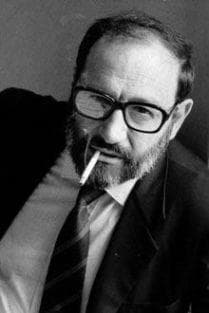
Umberto Eco was an Italian medievalist, philosopher, semiotician, novelist, cultural critic, and political and social commentator. In English, he is best known for his popular 1980 novel The Name of the Rose, a historical mystery combining semiotics in fiction with biblical analysis, medieval studies and literary theory, as well as Foucault's Pendulum, his 1988 novel which touches on similar themes.







