““I’m not afraid of anything,” Nancy declared, her chin tilted defiantly. “Not when there’s a mystery to solve.””
— Nancy's unwavering determination to pursue a lead, despite potential dangers.

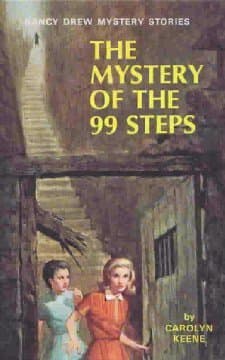
Carolyn Keene (1966)
Genre
Children's / Mystery / Young Adult
Reading Time
120 min
Key Themes
See below
Sign in to track this book
Nancy Drew's quest to find a mysterious flight of 99 steps, sparked by a friend's unsettling dream, plunges her into a dangerous French adventure where a sinister warning and a financier's secret intertwine with her own perplexing puzzle.
The story starts with Nancy Drew visiting her friend, Suzanne Dubois, who is bothered by a dream about a scary, shadowy figure and a voice repeating, 'Ninety-nine steps.' Suzanne, an American girl whose parents live in France, thinks the dream relates to a property her ancestors once owned in the Loire Valley. As Nancy begins to look into it, she receives a warning from a man named Monsieur Neuf (meaning 'nine' in French), who tells her to stop looking for the steps. This meeting immediately makes Nancy more suspicious and strengthens her resolve to help Suzanne, connecting the dream to a possible real-world mystery.
At the same time, Nancy's father, Carson Drew, a well-known lawyer, is hired by a rich American financier, Mr. Fraina, who has been inexplicably scared into selling many investments at a loss. Mr. Fraina says he saw a ghost and heard strange noises, making him believe he is being haunted. Carson Drew's investigation soon points to a connection with France, specifically a chateau in the Loire Valley, which happens to be near where Suzanne's ancestors lived. This coming together of cases gives Nancy a good reason to travel to France with her father, despite Monsieur Neuf's earlier warning.
Nancy, with her friends Bess Marvin and George Fayne, travels to France with Carson Drew. Their first base is an inn near Suzanne's ancestral home. Upon arrival, they immediately begin asking discreetly about local stories, old properties, and any mention of '99 steps.' They quickly notice they are being watched, and Monsieur Neuf's presence, as he seems to have followed them from the United States, confirms their suspicions of a deeper plot. The girls explore various chateaux and historical sites, hoping to find a clue, while Carson Drew focuses on Mr. Fraina's case, interviewing local contacts and checking property records.
Nancy, Bess, and George eventually find the chateau Suzanne's ancestors once owned. The current owner, a reclusive woman, does not want to talk about the property's history, especially any stories about ghosts or hidden passages. The girls discover that the chateau has a reputation for being haunted, a detail that matches Mr. Fraina's experiences. During their exploration, Nancy finds clues suggesting that Suzanne's dream might be a subconscious memory or a hint related to a valuable, missing family heirloom, possibly hidden inside the chateau, and that the '99 steps' are important to its concealment.
As Nancy gets closer to the truth, Monsieur Neuf and his group increase their actions. The girls have several close calls: their car is messed with, they are locked in a cellar, and they receive threatening notes. Monsieur Neuf, often with a sneering companion, makes it clear he wants them to stop their investigation. Nancy realizes that Neuf is not just trying to scare them away but is actively involved in the scheme that is frightening Mr. Fraina and likely trying to stop the heirloom connected to Suzanne's family from being found. The threats confirm they are on the right path.
While Nancy looks for the '99 steps,' Carson Drew continues to make progress on Mr. Fraina's case. He discovers that Mr. Fraina is not the only rich person who has been forced to sell investments at a loss. A criminal organization is using psychological tactics, including staged 'hauntings' and threats, to manipulate the stock market. They target rich people who are superstitious or easily scared, forcing them to sell their holdings, which the criminals then buy at low prices. Carson Drew realizes that the 'ghostly' events are elaborate tricks designed to cause fear and help them make money.
Nancy's investigation into the 99 steps and Carson Drew's financial case begin to come together. Nancy realizes that the same criminal group, led by Monsieur Neuf, is behind both the attempt to stop her from finding the steps and the scheme to cheat Mr. Fraina. The '99 steps' are not just a personal mystery for Suzanne but a key part of the criminals' larger plan, likely related to hidden wealth or a valuable item that would expose their operations. The heirloom Suzanne's family lost is tied to a significant fortune, and the criminals are trying to either get it or stop it from being found.
After much searching, Nancy, with Bess and George, finally finds the 99 steps. They are not a grand staircase but a hidden, narrow flight of steps behind a movable wall or tapestry inside the old chateau. The steps lead down into a secret passage or crypt. This discovery confirms Suzanne's dream was more than just a dream, but a key to an ancestral secret. The passage leads to a hidden room, where the valuable family heirloom, a collection of antique jewelry and documents proving ownership of significant assets, is found.
As Nancy and her friends uncover the treasure and the evidence, Monsieur Neuf and his gang appear, trying to take the heirloom and silence the Drews. A tense confrontation happens inside the chateau's secret passages. Luckily, Carson Drew had expected this and had already called the French police, who arrive just in time. Monsieur Neuf and his group are caught, unable to escape with their stolen goods or prevent their financial manipulation scheme from being exposed. The criminals are revealed to be a group of fraudsters who used old stories and fear to achieve their goals.
With Monsieur Neuf and his gang in custody, both mysteries are fully solved. The valuable heirloom and documents are recovered and returned to Suzanne's family, restoring their rightful inheritance. Mr. Fraina and other victims of the financial scheme recover their losses, and the fraudsters' methods are exposed. Nancy Drew, along with her father and friends, receives praise for their bravery and cleverness. Suzanne's recurring nightmare finally stops, as the secret it guarded has been brought to light. The Drews return to the United States, leaving behind a successfully solved double mystery in France.
The Protagonist
Nancy's belief in Suzanne's dream evolves from initial curiosity to firm conviction as she uncovers real-world connections, ultimately proving the power of intuition and persistence.
The Supporting
Carson's professional legal investigation merges with Nancy's intuitive quest, demonstrating how different approaches can lead to a unified solution.
The Supporting
Bess overcomes her initial anxieties to bravely assist Nancy in dangerous situations, solidifying her role as a dependable friend.
The Supporting
George consistently demonstrates her courage and practicality, proving to be an indispensable asset in the investigation.
The Supporting
Suzanne's distress over her dream transforms into relief and understanding as Nancy uncovers its real-world significance and restores her family's heritage.
The Antagonist
Monsieur Neuf's efforts to intimidate Nancy and conceal his criminal activities are ultimately exposed and defeated, leading to his capture.
The Supporting
Mr. Fraina's fear and financial distress are resolved as Carson Drew exposes the fraudulent scheme, restoring his peace of mind and assets.
This theme shows how different events or personal problems can be connected by a shared cause or criminal activity. Nancy's search for the '99 steps,' from Suzanne's dream, first seems like a personal mystery. At the same time, Carson Drew's investigation into Mr. Fraina's financial problems is a serious legal matter. The story skillfully links these two parts, showing that Monsieur Neuf and his gang are the common link, using threats and manipulation for both personal gain and to protect a larger secret related to the steps. This connection highlights that solutions often require looking past initial appearances.
“'Could it be that my father's case and Suzanne's strange dream were somehow connected? It seemed incredible, yet a nagging suspicion told me they were.'”
The story emphasizes the value of intuition and the power of dreams. Suzanne's dream about '99 steps' is not ignored as just fantasy but acts as the main reason for Nancy's investigation. Nancy, despite others' initial doubt, trusts her friend's experience and her own feelings that the dream has a deeper, real meaning. The eventual finding of the physical 99 steps and the hidden treasure proves this theme, suggesting that the subconscious can offer important clues that logical thought alone might miss. It encourages readers to consider the value of non-tangible insights.
“'Sometimes, Bess, dreams are more than just dreams. They can be warnings, or even clues to something hidden deep inside our minds.'”
Throughout the story, there is a consistent idea that things are not always what they seem. The 'haunted' chateau and the 'ghostly' figures frightening Mr. Fraina are revealed to be tricks set up by criminals. Monsieur Neuf, at first just a mysterious figure, is shown to be a calculating leader. The '99 steps' themselves are not a grand, obvious feature but a hidden, secret passage. This theme reinforces the detective's role in removing layers of deception to find the truth, teaching that one must look beyond surface appearances to understand the real situation.
“'The 'ghosts' were nothing more than clever tricks, designed to frighten people into doing exactly what the criminals wanted.'”
Nancy Drew, along with Bess and George, consistently shows courage when faced with increasing threats and dangerous situations. From Monsieur Neuf's first warnings to direct sabotage attempts and physical confrontations, the girls never back down. Nancy's strong will to solve the mystery and help her friends, even when her own safety is at risk, shows this theme. Bess, despite her initial shyness, finds her own courage, and George consistently proves her bravery. This theme highlights the importance of determination and courage when dealing with criminals and personal fears.
“'We can't give up now, not when we're so close. We just have to be extra careful.'”
Suzanne's nightmare of '99 steps' acts as the primary catalyst and a symbolic clue for the entire mystery.
Suzanne's recurring dream serves as the foundational plot device, initiating Nancy's investigation. It is not a literal instruction but a symbolic representation of a hidden secret (the steps) and a past trauma or unresolved issue (the shadowy figure). This dream effectively introduces an element of the supernatural or premonition, drawing the reader into the mystery, while simultaneously providing a concrete, albeit enigmatic, objective for Nancy to pursue. Its resolution is directly tied to the discovery of the physical steps and the family heirloom.
Two seemingly separate cases – Suzanne's dream and Mr. Fraina's financial troubles – are revealed to be interconnected.
The 'double mystery' device is central to the plot's complexity. Nancy's personal quest for the '99 steps' and Carson Drew's professional legal case involving Mr. Fraina initially appear distinct. However, the narrative expertly merges them, revealing that the same criminal organization is behind both, exploiting the history of the chateau for financial gain and preventing the discovery of the heirloom. This device allows for a broader scope of investigation, enhances the stakes, and provides a satisfying convergence of plotlines towards a single resolution.
The 'haunted' nature of the chateau and the 'ghostly' figures are used to mislead both characters and readers.
The concept of the chateau being 'haunted' and the 'ghostly' apparitions frightening Mr. Fraina serve as a significant red herring. These supernatural elements are presented early on to create an atmosphere of mystery and potential danger. However, they are ultimately revealed to be elaborate hoaxes and illusions meticulously crafted by Monsieur Neuf's gang to instill fear and facilitate their criminal activities. This device cleverly misdirects attention from the true, human perpetrators and their financial motives, adding a layer of deception that Nancy must penetrate.
A long-lost family treasure or fortune concealed within an old property, driving the antagonists' actions.
The ancestral secret, manifested as a valuable family heirloom (jewelry, documents, etc.) hidden within the Dubois family's former chateau, is the ultimate prize motivating Monsieur Neuf and his gang. This device provides a tangible goal for Nancy's search for the '99 steps' and explains why the criminals are so desperate to prevent its discovery. The heirloom represents not only wealth but also historical significance, tying into Suzanne's family lineage and providing a strong emotional and material incentive for the resolution of the mystery.
““I’m not afraid of anything,” Nancy declared, her chin tilted defiantly. “Not when there’s a mystery to solve.””
— Nancy's unwavering determination to pursue a lead, despite potential dangers.
“The old mansion seemed to breathe secrets, its very stones whispering tales of the past.”
— Describing the atmosphere of the mysterious estate Nancy is investigating.
““There’s always a logical explanation, if you just dig deep enough,” Nancy mused, examining a clue.”
— Nancy's belief in rational problem-solving when faced with perplexing evidence.
“The winding staircase, with its ninety-nine steps, seemed to beckon her into the unknown.”
— Nancy's initial encounter with the titular staircase, a central element of the mystery.
““Even the smallest detail can unlock the biggest secret.””
— Nancy's advice to Bess and George about paying close attention to minor clues.
“A good detective never gives up, no matter how tangled the threads of the case become.”
— Nancy's internal monologue reflecting on her persistence in the face of difficulties.
““Sometimes the most obvious answer is the one we overlook.””
— Nancy considering different possibilities after hitting a dead end in her investigation.
“The thrill of discovery was a powerful magnet, pulling her deeper into the puzzle.”
— Nancy's enjoyment of the investigative process and the excitement of nearing a solution.
““Trust your instincts, but always verify with facts.””
— Nancy explaining her investigative approach to her friends.
“The past, she realized, often held the key to the present.”
— Nancy making a connection between historical events and the current mystery.
““Danger is just another word for challenge when you’re a detective.””
— Nancy's confident response to a warning about the risks involved in her investigation.
“The old clock ticked away, each second bringing her closer to the truth.”
— A moment of suspense as Nancy nears the resolution of the mystery.
““Every secret has a voice, if you only know how to listen.””
— Nancy reflecting on how clues, even seemingly silent ones, reveal information.
“The ninety-nine steps were more than just a staircase; they were a pathway to a forgotten story.”
— Nancy's understanding of the deeper significance of the central mystery element.
Ready to see how well you understood this book? Take our interactive quiz with 10 questions.

Carolyn Keene is the pseudonym for the authors of the Nancy Drew Mystery Stories series. Under this pen name, numerous authors have penned over 170 books since 1930, captivating young readers with thrilling mysteries and adventures. The series, including notable titles like "The Secret of Red Gate Farm" and "Mystery of Crocodile Island," has become a cultural phenomenon, selling millions of copies worldwide and inspiring adaptations across various media.

Dan Gemeinhart
4.5

Kate O'Hearn
4.4

Jeanne Birdsall
4.4

Jen Wang
4.4

Wendelin Van Draanen
4.3

John Marsden
4.3

Chris Van Allsburg
4.3
Jennifer A. Nielsen
4.2