“He had no plans, no prospects, and no money, but he was free. He was a man who had walked away from his life, and in doing so, had become invisible.”
— Early description of Nashe's state after inheriting money and quitting his job.

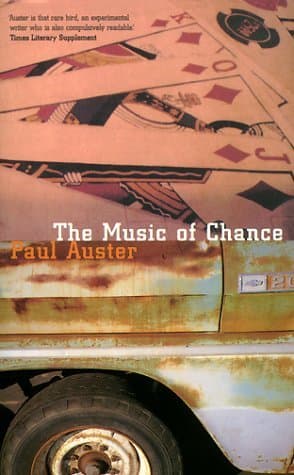
Paul Auster (1990)
Genre
Literary Fiction
Reading Time
240 min
Key Themes
See below
Sign in to track this book
After a fireman squanders an inheritance on aimless wandering, he and a brash gambler lose everything in a rigged poker game, forcing them to repay their debt by building a mysterious stone wall for two eccentric millionaires in a desolate Pennsylvania field.
Jim Nashe, a firefighter from Boston, gets a large inheritance from his estranged father. Feeling free, he leaves his job, home, and young daughter, Juliette, without a word. He buys a red Saab and begins an aimless journey across the United States, wanting complete freedom and rejecting his old duties. He spends his days driving, eating in diners, and sleeping in motels, watching the world without joining it. This lasts over a year, during which he spends his inheritance, a process he finds both exciting and frightening as the money shrinks.
With almost no money left, Nashe picks up a young hitchhiker named Jack Pozzi in rural Pennsylvania. Pozzi is a professional gambler, charming but quick-tempered, who has just been beaten and robbed after a bad card game. He tells Nashe about two eccentric millionaires, Flower and Stone, who live in an isolated mansion and host high-stakes poker games. Pozzi believes he has a sure way to win a lot of money from them, and he convinces Nashe to invest his remaining $10,000 as the money for the game, promising to split the winnings. Nashe, drawn by Pozzi's confidence and the chance for a final gamble, agrees.
Nashe and Pozzi drive to the secluded mansion owned by William Flower and Charles Stone. The estate is large and somewhat run-down, with an odd, almost theatrical feel. Flower and Stone are unusual: Flower is cheerful and dramatic, while Stone is quiet and threatening. They welcome Nashe and Pozzi, and the poker game begins. Pozzi plays with intense focus, and at first, his strategy seems to work, as they build a good lead. Nashe, watching, feels a mix of hope and dread, knowing that all his remaining freedom and future depend on this one game.
The poker game continues for hours, with big swings. Despite Pozzi's early success, the game eventually turns. In a key hand, Pozzi, confident in his strategy, goes all-in, betting Nashe's entire remaining $10,000. Flower and Stone, calm, call his bet. The cards are shown, and Pozzi loses the hand. Nashe and Pozzi are left with nothing. The loss is complete and devastating, leaving Nashe in shock and despair, as his guarded freedom has disappeared in one moment.
After their complete loss, Flower and Stone tell Nashe and Pozzi that they owe them $10,000. They propose something unusual: instead of immediate payment, they offer Nashe and Pozzi a chance to work off their debt by building a huge wall using thousands of old, imported stones from a demolished Irish castle. The wall is to be built in a field on their property, a seemingly pointless and enormous task. Nashe, seeing no other choice and trapped, reluctantly agrees to the terms, with Pozzi following his lead, though more openly resentful.
Nashe and Pozzi are moved into a small, run-down trailer on the estate and begin their forced labor. They are watched by a stern and quiet foreman named Calvin Murks. The work is physically hard and repetitive, involving lifting and placing countless heavy stones. Nashe finds a strange, almost calming rhythm in the work, while Pozzi struggles with the insult and boredom, his anger growing. Their days are long and tiring, and their lives are stripped of all past freedoms, confined to the task of building a wall.
As weeks pass, Pozzi's frustration and desperation grow. He cannot adapt to the monotonous, physically draining work and the loss of his old life. He plans an escape, trying to flee the estate at night. Nashe, though understanding Pozzi's situation, knows such an act is pointless and dangerous given their remote location and the implied power of Flower and Stone. Pozzi's escape attempt fails, and he is quickly caught by Murks and other unseen guards, leading to severe results.
After his failed escape, Pozzi is brutally beaten and left with bad injuries, including a broken jaw and other internal damage. He is brought back to the trailer, barely able to move or speak, and left for Nashe to care for. This violence shows Flower and Stone's control and the serious consequences of not obeying them. Nashe acts as Pozzi's nurse, tending to his wounds and feeding him, while continuing to work on the wall alone, the weight of Pozzi's suffering adding to his own burden.
With Pozzi unable to work, Nashe is left to finish the wall by himself. The work becomes even harder and more solitary. He is always aware of Pozzi's silent suffering in the trailer, and the psychological cost of their imprisonment begins to affect him. The wall, once a sign of their debt, now feels like a monument to their lost freedom and the cruelness of their captors. Nashe's initial acceptance of the labor gives way to a deep despair and the realization that his search for freedom has led him to an even deeper form of bondage.
After months of hard labor, Nashe finally finishes the huge wall. He expects his release and perhaps Pozzi's, but Flower and Stone do not appear. Instead, Murks tells him that the wall is satisfactory. Nashe, driven by a desperate need for justice and a final act of control, decides to take action. He finds a pistol in the trailer, and in a tense moment, he uses it to confront Murks, demanding to know where Flower and Stone are and the true nature of their debt. The confrontation quickly gets worse, leading to a violent and tragic end.
After the violent confrontation, Nashe escapes the estate. He takes Flower's expensive car, the same one he had driven to the mansion months ago, now a symbol of both his past mistake and his desperate try for a future. He drives away, leaving behind the finished wall, the injured Pozzi, and the bodies of Murks and possibly others. His destination is unknown, and his future is uncertain, marked by the crimes he has committed and the changes he has gone through. The story ends with Nashe driving into the night, chance still playing a main role in his destiny.
The Protagonist
Nashe's arc is a descent from perceived freedom into profound bondage, culminating in a violent act of rebellion and a return to an uncertain, compelled existence.
The Supporting
Pozzi's arc is a rapid decline from a confident gambler to a broken, helpless victim of circumstance and violence.
The Antagonist
Flower remains a static character, a symbol of arbitrary power and the capriciousness of fate.
The Antagonist
Stone remains a static, ominous figure, representing the unyielding forces of fate and consequence.
The Supporting
Murks serves as a static instrument of the antagonists, eventually becoming a victim of Nashe's desperation.
The Mentioned
Juliette's character remains static, serving as a symbolic anchor to Nashe's past.
The novel explores the complex nature of freedom. Nashe first thinks his inheritance gives him ultimate liberty, letting him abandon all duties and drive aimlessly. However, this 'freedom' is shown to be shallow and ultimately leads to a new kind of enslavement. His aimless wandering is a self-imposed prison, and his gamble for more freedom results in literal physical and psychological confinement. The true liberty he seeks is hard to find, suggesting that real freedom may not be in the absence of duty, but in control and choice, even within limits, or perhaps not at all. The wall itself becomes a monument to this failed search.
“He wanted to keep going, to drive to the end of the road, and when he got there to find another road, and to keep going on that one too.”
Chance is a central, almost real force in the story. Nashe's inheritance is a stroke of chance, and his meeting with Pozzi and the poker game are further examples of its unpredictable power. The novel suggests that while characters make choices, they are often carried along by forces beyond their control. The poker game is the ultimate symbol for this, where one card turn decides their entire future. Even the seemingly random task of building the wall is a result of chance—a random, punishing decision by their captors. The characters try to control their lives, but repeatedly find themselves subject to fate.
“He had never felt so free, so unencumbered by the past. He was the master of his own life now, and the future was an open book.”
The idea of debt goes beyond just money owed. Nashe's initial 'freedom' comes at the cost of abandoning his daughter, creating a moral debt. His financial loss to Flower and Stone then turns into a physical and psychological debt, forcing him into servitude. The building of the wall becomes a clear sign of this debt, a huge task to literally pay for their loss. The novel looks at how debts, both chosen and forced, can strip people of their independence and define their lives, showing the weight of unfulfilled duties and the struggle to reclaim oneself from what is owed.
“They were no longer free men, but something closer to slaves. And the wall, of course, was their master.”
The forced labor of building the wall explores the nature of work. At first, the work is a brutal, dehumanizing punishment, taking away Nashe and Pozzi's dignity. However, Nashe finds a strange, almost calming rhythm in the physical task, a temporary escape from his despair. The work has no meaning in its purpose—a wall to nowhere—yet it gives structure to their days and a focus to their minds. The novel questions whether meaning can be found even in random, forced labor, or if such work only highlights the lack of true purpose and control.
“The stones were his life now, the only thing that mattered. He worked with them, he thought with them, he dreamed with them.”
A monumental, arbitrary structure symbolizing debt, confinement, and the absurd.
The wall is the central symbolic object of the novel. Initially, it represents the physical manifestation of Nashe and Pozzi's debt to Flower and Stone. As the narrative progresses, it transforms into a symbol of their imprisonment, the arbitrary nature of their punishment, and the futility of their labor. The wall's ancient stones and its immense scale evoke a sense of timeless, inescapable burden. It also functions as a psychological barrier, isolating the men from the outside world and from their former selves. The act of building it becomes both a curse and, for Nashe, a strange, almost spiritual discipline that defines his existence in captivity.
A high-stakes gamble that serves as the inciting incident and a metaphor for chance and fate.
The poker game is the pivotal event that sets the entire plot in motion. It functions as a dramatic inciting incident, transforming Nashe's aimless freedom into immediate, inescapable bondage. Beyond its narrative role, the game is a powerful metaphor for the theme of chance and fate. It highlights the precariousness of human plans and the overwhelming power of a single, unpredictable moment to alter the course of lives. The game also reveals the characters' true natures: Pozzi's impulsiveness, Nashe's desperate gamble for control, and Flower and Stone's detached, manipulative power.
Nashe's car, symbolizing his initial pursuit of freedom and later his final, desperate escape.
The red Saab is a recurring motif that symbolizes Nashe's journey and his changing relationship with freedom. At the beginning, it represents his newfound liberty and his ability to move wherever he pleases, unburdened by attachments. It is an extension of his desire for an open, unscripted life. Later, when he is trapped, the car becomes a distant memory of that lost freedom. In the novel's climax, when Nashe takes Flower's car (a similar, expensive vehicle), it signifies his desperate, violent reclamation of agency and his return to the road, albeit under vastly different and more criminal circumstances. The car bookends his journey, marking both the beginning and the end of his 'free' periods.
The initial catalyst for Nashe's journey, representing unearned wealth and its disruptive power.
The inheritance is the initial plot device that triggers Nashe's entire transformation. It is unearned money, arriving unexpectedly, and its sudden appearance disrupts Nashe's ordinary life, pushing him to abandon all his responsibilities. The inheritance symbolizes the seductive but ultimately dangerous illusion of absolute freedom that wealth can offer. It acts as a blank slate, but also a void into which Nashe pours his life, ultimately leading him to a deeper form of entrapment. It sets up the central conflict between the desire for freedom and the unforeseen consequences of severing all ties.
“He had no plans, no prospects, and no money, but he was free. He was a man who had walked away from his life, and in doing so, had become invisible.”
— Early description of Nashe's state after inheriting money and quitting his job.
“The world was a place of endless coincidences, and every object, every person, every incident was a link in a chain of events that stretched back to the beginning of time.”
— Nashe's internal reflection on the nature of reality and chance.
“Money was a kind of fiction, a collective hallucination that held the world together.”
— Nashe contemplating the role and nature of money.
“He understood that the game was rigged, but he also understood that it was the only game in town.”
— Nashe's realization about the casino and the general unfairness of life.
“The idea of doing nothing for the rest of his life suddenly seemed like the most attractive prospect he had ever encountered.”
— Nashe's initial desire for a life of leisure after his inheritance.
“Every man carries his own ruin around inside him.”
— Flynn's cynical observation about human nature.
“It was as though the world had suddenly shrunk, as though everything outside the fence had ceased to exist.”
— Nashe's feeling of entrapment and isolation on the property of Flower and Stone.
“The greatest freedom, he discovered, was the freedom to be forgotten.”
— Nashe's reflections on his anonymity and desire to disappear.
“There was no logic to it, no discernible pattern, just an endless series of random events.”
— Nashe's struggle to make sense of the arbitrary nature of his circumstances.
“He had been playing a game, and now the game was playing him.”
— Nashe's realization that he has lost control of his own fate.
“The past was a foreign country; they did things differently there.”
— A general reflection on the distance and irrelevance of past events.
“Sometimes you have to give up on everything to find out what you really want.”
— Flynn's advice to Nashe, though not always taken literally.
“The silence was so vast, so profound, that it seemed to absorb all other sounds, all other thoughts.”
— Describing the oppressive quiet of the rural setting.
“He was an artist of chance, a man who had learned to live in the moment, to embrace the unpredictable.”
— Nashe's self-perception after his initial period of wandering.
Ready to see how well you understood this book? Take our interactive quiz with 10 questions.

Paul Benjamin Auster is an American writer and film director. His notable works include The New York Trilogy (1987), Moon Palace (1989), The Music of Chance (1990), The Book of Illusions (2002), The Brooklyn Follies (2005), Invisible (2009), Sunset Park (2010), Winter Journal (2012), and 4 3 2 1 (2017). His books have been translated into more than forty languages.







