“The wind howled a mournful tune, carrying with it the scent of rain and something else… something metallic and acrid.”
— Early description of the unsettling atmosphere of the Complex.

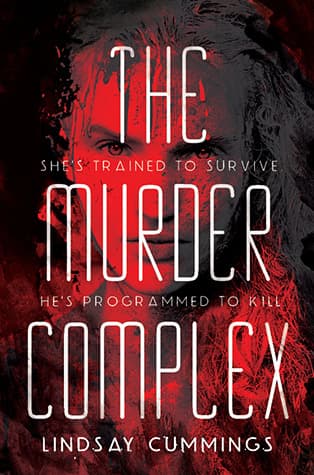
Lindsay Cummings (2014)
Genre
Thriller / Fantasy / Mystery / Science Fiction / Young Adult
Reading Time
450 min
Key Themes
See below
Sign in to track this book
In a brutal future where the Murder Complex controls life and death, a trained assassin falls for one of its programmed killers, forcing her to face a terrifying truth about her own family and destiny.
Fifteen-year-old Meadow Woodson lives with her father, mother, and younger sister, Lily, on a secluded houseboat in the Florida Everglades. Her father, a former assassin for The Murder Complex (MC), trains Meadow in combat, survival, and weapon use. He emphasizes never trusting anyone and always being ready to kill. Meadow's mother is often sick, and Lily is unaware of the dangers their family faces. This isolated life is her father's choice, to keep his family safe from the MC, an organization that controls society through violence and population management. Meadow's life is about constant watchfulness and training, different from other teenagers' 'normal' lives.
On a rare supply run into one of the controlled cities, Meadow, disguised and careful, meets Zephyr James. He is charismatic and seems to be looking for someone, though he acts casually. Despite her father's warnings against strangers, Meadow is drawn to Zephyr. Their first interaction is brief but leaves a lasting impression, sparking a curiosity she rarely allows. Unbeknownst to her, Zephyr is a skilled, programmed assassin for the MC, on a mission that will involve Meadow. This meeting is not accidental; it starts the main conflict of the story.
The Woodson family's hidden life ends when their houseboat is attacked by trained assassins, later revealed to be from the MC. Meadow's father is overwhelmed, and her mother is badly hurt. In the chaos, Meadow uses her training, fighting with her father to protect Lily and her mother. They escape the burning houseboat, but the incident leaves them exposed. This attack confirms Meadow's father's fears and forces the family to leave their safe place, pushing them deeper into a world they tried to avoid.
After the houseboat attack, Meadow is separated from her family. Believing them alive, she searches for them, navigating the dangerous, MC-controlled landscape. Her father had always stressed a backup plan, and Meadow uses her tracking and survival skills to follow clues, hoping to reunite with her parents and Lily. This period tests her independence and resilience, forcing hard decisions and showing her the harsh realities of a world where trust is rare. She faces various dangers and learns more about The Murder Complex's widespread control.
During her search, Meadow unexpectedly meets Zephyr James again. He appears to be looking for something specific, and their paths keep crossing. Despite initial suspicion, Meadow feels a strange connection to him and thinks he might be an ally in her search for her family. Zephyr is drawn to Meadow's strength and skills. They form an uneasy partnership, sharing information and protecting each other in the dangerous cities. This alliance is complicated by Zephyr's hidden agenda and Meadow's deep mistrust, but it helps them navigate the MC's world more effectively.
Following clues, Meadow and Zephyr decide to infiltrate a Murder Complex facility, believing it holds answers about her family's location and the MC's operations. Inside, they discover the truth about the MC's population control, including the programming of assassins like Zephyr and the manipulation of families to maintain order. They see horrific experiments and realize the MC's power and cruelty. This infiltration is dangerous, testing their combat skills and forcing them to face the organization that has shaped their lives.
Inside the MC facility, Meadow finds proof that Zephyr is one of the MC's programmed assassins, a 'collector' with specific kills. This discovery shatters her growing trust in him and leads to a confrontation. Zephyr, struggling with his fragmented memories and his programming, tries to reconcile his actions with his feelings for Meadow. He reveals that their meeting was part of his mission. Meadow feels betrayed, but also sees his internal conflict, making their future uncertain and dangerous.
Deep within the MC, Meadow uncovers the truth about her family: her father was a key figure in the MC, and their isolation was not just for protection, but also to hide something. She learns that her mother was also involved and that Lily's existence is linked to the MC's genetic experiments, making her a target. The 'attack' on their houseboat was planned, and her father had been preparing her for a role in the MC's plans. This revelation makes Meadow question everything about her family and her own identity.
Meadow, now knowing the full truth, confronts the leader of The Murder Complex, known as the Director. During this encounter, she discovers a personal connection to the Director, revealing a deeper, more manipulative layer to the MC's operations and her family's involvement. The Director reveals that Meadow's father had a long-term plan involving her and Zephyr, and that their paths were always meant to cross. Meadow realizes she is a pawn in a larger, generational game of control and rebellion, and that her unique skills were developed for this purpose.
In a key moment, a character, possibly her father or Zephyr, makes a sacrifice to protect Meadow or Lily, or to disrupt the MC's plans. This sacrifice has a great personal cost and deeply affects Meadow. At the same time, Meadow experiences a betrayal, realizing that someone she trusted has been manipulating her. This betrayal could be from a family member or Zephyr, forcing her to make a difficult choice. The stakes are very high, as her sister's fate and possibly the entire system depend on her actions.
Meadow, having survived the confrontation and betrayals, escapes The Murder Complex. She emerges changed, no longer an innocent girl but a hardened warrior who understands her past, her family's secrets, and her own abilities. She now knows her purpose is not just to survive, but to fight the MC and protect those she cares about, especially Lily. The ending leaves Meadow on a new path, with a renewed resolve to dismantle the oppressive system that has controlled her life, setting the stage for future conflicts.
The Protagonist
Meadow transforms from a sheltered, obedient daughter into an independent, determined warrior who challenges the system and defines her own path.
The Love Interest/Secondary Protagonist
Zephyr starts as a controlled asset of the MC and slowly awakens to his true identity, struggling to break free from his programming and choose his own path.
The Supporting/Mentor
His true motivations are gradually revealed, shifting him from a protector to a manipulative figure with his own agenda within the MC's power structure.
The Supporting
Lily remains largely static, serving as a symbol of innocence and a catalyst for Meadow's protective instincts.
The Supporting
Her character evolves from a seemingly passive, ill figure to a more complex individual with a secretive, active past within the MC.
The Antagonist
The Director is established as the primary antagonist, revealing their long-term, manipulative plan and personal connection to Meadow.
The Mentioned/Supporting Antagonists
As a collective, they represent the oppressive force of the MC, with individual members like Zephyr having the potential for an arc of breaking free.
The main conflict in 'The Murder Complex' is the struggle between the instinct to survive in a brutal world and keeping one's humanity. Meadow is trained to kill, but her interactions with Zephyr and her love for Lily challenge this training. Scenes where Meadow must choose between a ruthless act for survival and a compassionate one, or where Zephyr fights his programmed killer instincts, show this theme. The MC itself represents the extreme end of survival, sacrificing individual humanity for perceived societal control.
““Kill or be killed. That’s the first rule. The second is: trust no one.””
The novel explores what it means to have an identity when destinies are set and free will is suppressed. Both Meadow and Zephyr deal with who they are versus who they were trained or programmed to be. Meadow questions her father's motives and her own purpose, while Zephyr fights his genetic programming as an MC assassin. The revelation that their lives were planned by the MC highlights the struggle for self-determination against powerful external forces. Their journey is about finding their true selves amidst manipulation.
““What if everything you thought was real, wasn’t? What if your memories were lies?””
The theme of family secrets and betrayal is central to Meadow's story. Her family, especially her father, hides deep secrets about their past with The Murder Complex and why they were isolated. These secrets, when revealed, cause Meadow to feel deeply betrayed, forcing her to re-evaluate her upbringing and her understanding of her loved ones. The story's climax often involves a significant family revelation that shatters Meadow's perception and trust, leading her to make difficult choices about her future.
““My father had lied. Not just about the past, but about everything.””
The Murder Complex is a dystopian society under extreme oppression, where an organization controls the population through violence and fear. The story explores how this control works and the growing spirit of rebellion against it. Meadow, initially focused on personal survival, gradually becomes a symbol of resistance as she uncovers the MC's manipulative tactics. Her fight, and potentially Zephyr's, against the MC's system shows the struggle for freedom and justice against an all-powerful regime.
““They built this world on fear. It’s time someone tore it down.””
A futuristic world controlled by a murderous organization.
The novel is set in a near-future, post-apocalyptic Florida where the murder rate is higher than the birthrate, and society is governed by The Murder Complex. This setting establishes the high stakes and constant danger, justifying the characters' extreme survival skills and the pervasive atmosphere of mistrust. It creates a backdrop where violence is institutionalized and personal freedom is severely limited, directly influencing character motivations and plot developments. The dystopian elements highlight themes of control, survival, and rebellion.
Meadow's rigorous combat training and her family's mysterious history.
Meadow's entire upbringing is a secret training regimen designed by her father, a former assassin, to prepare her for a specific, undisclosed purpose. This device provides Meadow with extraordinary skills that are crucial for her survival and ability to fight against the MC. The hidden past of her family, especially her father's involvement with The Murder Complex, gradually unravels throughout the story, driving much of the mystery and plot reveals. It creates suspense and allows for shocking twists regarding character loyalties and motivations.
The MC's use of conditioned killers and altered memories.
The Murder Complex employs 'collectors' like Zephyr, who are programmed assassins, often with manipulated or suppressed memories. This device introduces a layer of psychological complexity and moral ambiguity. It raises questions about free will, identity, and the nature of evil when individuals are conditioned to kill. Zephyr's struggle to recall his past and break free from his programming is a major internal conflict, while the existence of these assassins underscores the MC's chilling power and its disregard for human autonomy.
Lily's genetic importance as a target for The Murder Complex.
While not a traditional MacGuffin, Lily's genetic significance serves a similar function. Her unique genetic makeup makes her a crucial target for The Murder Complex, driving much of Meadow's motivation to protect her and uncover the truth. The details of *why* she is genetically important are revealed later, but her status as a desired asset by the antagonist propels the plot forward and provides a clear objective for Meadow. This device elevates the stakes beyond personal survival to the protection of a vulnerable individual with systemic importance.
“The wind howled a mournful tune, carrying with it the scent of rain and something else… something metallic and acrid.”
— Early description of the unsettling atmosphere of the Complex.
“In the Complex, every shadow held a secret, every whisper a potential threat.”
— Reflecting on the constant danger and paranoia within the facility.
“Fear was a constant companion, a cold hand gripping her heart, but it wouldn't be her master.”
— Kaelen's determination to overcome her fear despite her circumstances.
“They trained us to kill, but they never taught us how to live with what we’d become.”
— A character's reflection on the psychological toll of their training.
“The truth was a knife, and sometimes it was better to leave it sheathed.”
— A character contemplating the difficult nature of revealing secrets.
“Love, in a place like this, was a dangerous luxury. A weakness waiting to be exploited.”
— Kaelen's internal struggle with developing feelings for another person in a deadly environment.
“Every lock had a key, and every system had a flaw. It was just a matter of finding them.”
— A character's analytical approach to escaping or subverting the Complex's control.
“The lines between right and wrong blurred when survival was the only goal.”
— Justifying difficult decisions made under extreme pressure.
“Memory was a fickle thing, easily manipulated, easily forgotten, especially when it hurt too much to remember.”
— Reflecting on the nature of memory and its role in the characters' pasts.
“He looked at me like I was a puzzle he was determined to solve, even if it broke him.”
— Kaelen's perception of another character's intense interest in her.
“The past wasn't just a story; it was a weapon, waiting to be unleashed.”
— Realization of how past events and secrets could be used against them.
“Sometimes the only way to find your own path was to burn the map they gave you.”
— A character's decision to defy expectations and forge their own destiny.
“We were all just pieces in someone else's game, but even pawns could turn into queens.”
— A powerful statement about agency and potential within a controlled environment.
“Hope was a dangerous flicker in the dark, but without it, there was only the void.”
— Contemplating the necessity of hope even in dire circumstances.
Ready to see how well you understood this book? Take our interactive quiz with 10 questions.







